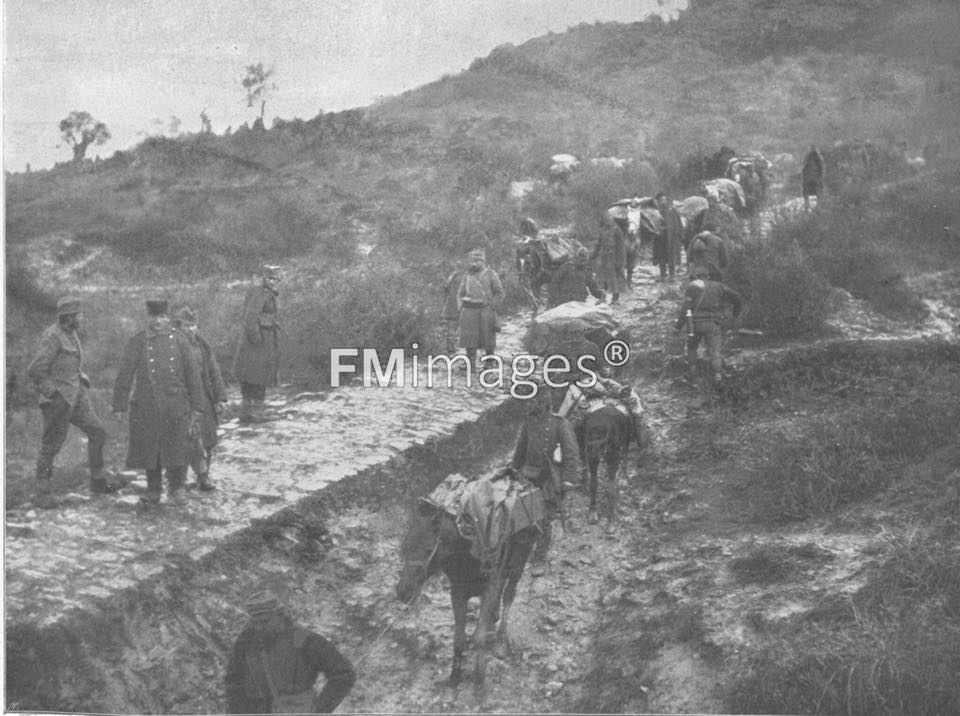

During the Great Retreat, many atrocities were committed on the Albanian population. Despite this, the Albanian tribes allowed the Serbian soldiers to pass through the mountains.[1][2]
The Serbian soliders committed many atrocities on the population of Struga and Dibër during their retreat.[3] In the book La Serbie dans La Grande Guerre author Dušan T. Bataković does not mention the atrocities committed at all.[4]
Background
According to Justin McCarthy, in 1915 Serbian and Bulgarian forces entered the region of Bitola, in Kičevo and Kruševo in Bitola, and burned between 19-36 villages. 503 men, 27 women and 25 children were killed, and 600 houses burned down.[5][6]
In 1916, Serbian Chetnik forces visited the region of Dërvend killing civilians and burning the villages of Merrova, Llërca, Çiflik and Dëbërca to the ground.[7][8]
Kosovo
Macedonia
According to a Bulgian report from 1917, in the regions of Prilep, Veles and Kerqovë, Vasilije Trbić stated that 2000 Albanians, most of them women and children. Many women, from the age 10 and upwards, were violated by the Bulgarian forces.[9]
Tetovo
In 1915, a young Albanian boy shot a Serbian soldier in the village of Dërbëcë in Tetovo. The Serbian army demanded that the village hand him over. The villagers refused which resulted in the entire village being massacred.[10][11][12]
Dëbërcë
On July 22, 2015, the 100th anniversary of the massacre of Albanian men in Dëbërce was marked. A total of 73 men were killed by Serbian soldier in 1916.[13]
Gostivar
According to Bulgarian sources, in the village of Dobërdoll, 50 houses were burned and 10 people killed, while in the village of Vrapçisht one house and two shops were burned.[14] In the village of Çegran 20 people were killed, 7 in Çajle and in the village of Kalishte 100 houses were completely burned with most of the villagers were killed. Meanwhile, in the district of Tetovë, in the village of Pirok 8 people were killed, and in Negotina 30 houses were burned and 12 people were killed. Between Grupčin and Zhelina around 100 villagers were shot.[15][16]
In Gradec 50 houses were burned and 150 were killed. people, Around 200 people were killed on the way from the Skopje prison to Kaçanik and Ferizaj.[17][18]
Ohrid
In the region of Ohrid, 30 villages were burned down, and in Struga, Dibër, Mavrovë and Gostivar, 180 villages were pillaged and burned.[19][20]
Pollog
In the region of Pollog, many atrocities were committed on the Albanian population by the Serbian army.[21][22] In order to not “taint” the “heroic image” of the Serbian soldiers, Serbian and Montenegrin soldiers war crimes against Albanians are rarely mentioned in Serbian schoolbooks.[23]
References
State, United States Department of (1947). Papers Relating to the Foreign Relations of the United States. U.S. Government Printing Office. p. 741. Retrieved 23 August 2023.- “Origjina shqiptare e familjes mbretërore serbe”. Telegrafi (in Albanian). No. The Telegraph reminds you that Petar I, who committed cruel crimes against Albanians during the Balkan wars and the First World War, was quoted in the Belgrade press at the time of his coming to power as saying that he was descended from the well-known Albanian Kelmendi tribe. Also, it is said that the Kelmends protected him during the retreat of the Serbian Army through Albania in 1915, where great crimes were also committed, because they considered him their heir. 12 April 2019. Retrieved 23 August 2023.
- Владимир Цветковски, Извештајот на Леди Пеџет за Скопје за време на Првата Светска војна, në:„Историја„, Бр. 1-2, Скопје, 1982, fq. 2010-2011.
- Batakovic, Dusan T. LA SERBIE DANS LA GRANDE GUERRE. Témoignages, mémoires et écrits historiques français, Belgrade: Bibliothèque Nationale de Serbie, 2016. Retrieved 23 August 2023.
- Death and Exile: The Ethnic Cleansing of Ottoman Muslims, 1821-1922. March 1, 1996. p.183
- “Eshtrat në shtëpinë e Ali Ahmetit: ja çfarë shkruan Justin McCarthy mbi masakrat serbo-bullgare në Kërçovë 54455-kot-655”. Retrieved 12 August 2023.
- Fototeka e Arkivit Qendror Shtetëror (The Public State Archive of Photographs). Fond 812, dossier 8. p. 11. Published 1944.
- https://www.arkiva.gov.al/kerko/fototeka
- ДАРМ, Скопје, Ф. ВИИ-Белград, М. VIII/90, Бр. 5685, 5 јануара 1917 год., Драгоманци, Raport i Vasilije Trbiq, vojvodë çetnik, më 5 janar 1917, Драгоманци.
- “Shqiptari nuk e ka zakon ta shes shqiptarin:Ja cfarë kishte ndodhur në vitin 1915 në fshatin Debërcë”. StrugaLajm.
- Malisheva, T. V. (10 July 2022). “Viti 1915, ditë Bajrami, historia e lavdishme e shqiptarëve të fshatit Dëbërcë të Tetovës”. MALISHEVA. Retrieved 23 August 2023.
- “ASHQ-Tiranë, Fond 810, dossier 110. Published 1944. Verified and signed by mayor of the Zheline Municipality Abdyraman Reka. “In the village of Debërcë, where all the men of this village were slaughtered, in the Uprising of Pollog in 1915, when the Serbian army withdrew from Pollog and the Bulgarian invaders came from these parts for the first time. So based on the evidence we have in the village of Debërce, not 72, but 78 people were killed during the Pollog Uprising in 1915, and they were buried on the main road Skopje-Tetovo, at the place called “Klisura”.”
- “Shënohet 100 vjetori i masakrës së burrave shqiptarë në Dëbërcë”. maqedoni2.rssing.com. Retrieved 23 August 2023.
- AQSH (Photo library of the Central State Archive). Report from consul Jeliçka from Skopje, dated September 3 tetor 1913
- AQSH (Photo library of the Central State Archive) Fund 810, dossier 110 p2. “The Chetnik squads that massacred the innocent population were led by these Chetniks Krste Trajçe, Zdrave Micko, Gine Micko, Nesor Angjeli, Sime Novja, Ugrin Trpe, Kuzman Stefanovski and Mladen Llazari, etc.
- https://archive.ph/u69Hl
- K. Grigorov, Srbskite zhestokosti v Makedonija (1912-1915, Sofia). p-28.
- https://archive.ph/u69Hl
- Masar Kodra. “Shqiptarët e Maqedonisë gjatë luftës së Dytë Botërore 1939-1944”. Kumanovo. p-13. Author Petar Stojanov, p-158.
- https://archive.ph/u69Hl
- Dokument from “i spolnoj pollitici”. Document number 331; telegram from Nedic from Sofia to the Serbian government on September 14-27 1913.
- https://archive.ph/u69Hl
- Janjetović, Zoran (1 December 2002). From Foe to Friend and back (There is one lurid aspect of the First Balkan War that is never mentioned in Serbian textbooks. That is Serbian war crimes against the Albanians. The atrocities were at first begun by the Montenegrins, but soon Serbian troops joined in. Although the number of victims is not precisely known to this day, the fact that massacres occurred is undisputed24. However, in order not to taint the heroic picture of the Serbian soldiers, their atrocities are never mentioned in Serbian schoolbooks. ed.). pp. 245–260. Retrieved 21 August 2023.


 Balkan Academia