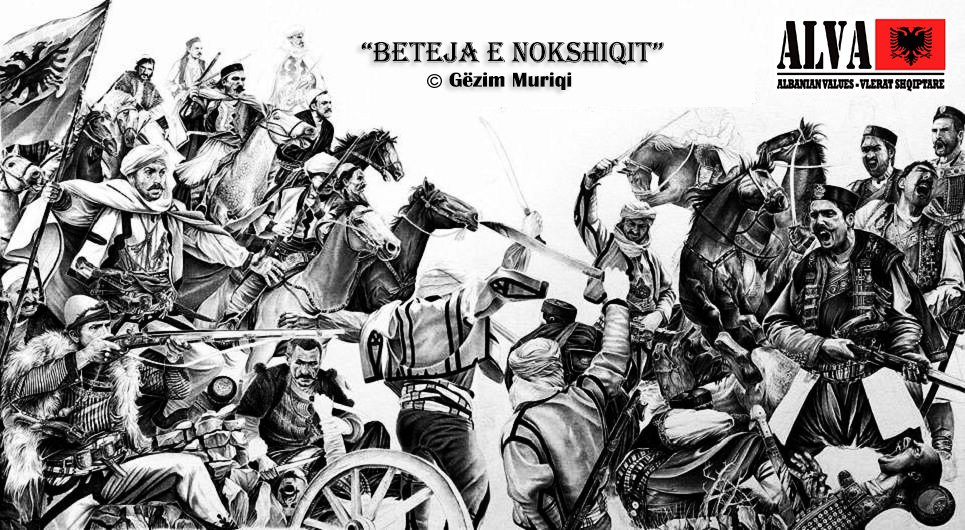

The Battle of Plava and Gusinje (1879–1880) was an armed conflict between Albanian forces under the League of Prizren against the Kingdom of Montenegro under Prince Nicholas Petrovic during the years of 1879-1880. The Albanians resisted against the annexation of the back then Albanian-inhabited regions of Plava and Gusinje given to Montenegro by the Congress of Berlin 1878. The Albanians, under the head of Ali pashë Gusinje, Jakup Ferri, Sulejman Vokshi, Haxhi Zeka, Filip Çeka and Jusuf Sokoli, put up armed resistance against the Porte (Ottoman Empire) and the Congress of Berlin and the fighting lasted between 1879-1880.[1][2]
Beginning
At the beginning of 1879 there was an Albanian armed resistance from Gjakova which stripped the Porte the right to speak on behalf of Albanians. In addition, the uprising led to the Albanians refusal of accepting the demands of the Congress of Berlin which led to the League of Prizren involving themselves to protect the national interests of albanians by resisting the Portes decision which was in favor of Montenegro and Greece. The league had not yet fulfilled its plan and the six Great Powers were unlikely to reverse the decisions that were taken at the Congress of Berlin. Montenegro had no intention of giving up territories that had been promised by the Great Powers. After the murder of the Ottoman Marshal Mehmet Ali Pasha in Gjakova, the Porte understood that the demands of the Great Powers was too hard to accomplish. Prince Nikola, however, wanted no excuses and demanded the regions. Fearing that the Great Powers decisions would change due to the international circumstances, Cettinje continuously seeked to annex the territories from the Ottoman Empire with support of the Great Powers to deliver the regions of Podgorica, Shpuzes, Zhabjk, Plava and Gusinje of Rugova. In addition, as a counterbalance, Ulcinj was to be returned to the Ottoman Empire.[3][4]
Tensions
Strong pressure against the Ottoman Empire, practied by the Tsar of Russia who threatened to march on Istanbul, forced the Ottomans, in 1878, to enforce the territorial obligations towards Montenegro. To examine the new situation in 1879, the Albanian National League Comittee decided that the annexation was not to be resisted because the regions and a mixed Slav-Albanian population but not the gun issue of the Albanians. (The collection of guns). The decision of the National Committee approved the interregional committess of Shkoder and Kosovo, held in January in 1879, which decided for a military resistance with Ali Pashe of Gusinje on the top.
Gathered in the village of Virpazar, near Lake Shkoder at the Turkish-Ottoman Commission, held on the 2nd of February, 1879, they signed a bilateral agreement for the formalities. The fear of albanian insurgency made the Porte refuse the albanian demands in the agreement, leaving the case to be resolved later. Under the agreement, the delivery of Podgorica, Shpuzes and Zhabjak by the Ottoman authorities was carried out without difficulty. In return Ulcinj was returned to the Ottoman Empire. Prince Nikola immediately adressed the Great Powers to force the Ottoman Empire to surrender the Plava and Gusinje to Montenegro. For its part the Porte issued the Great Powers to send an international commission in Plava and Gusinje to listen to the albanians infuriated by the injustice of the Congress of Berlin.
The congress the International Commission for determining the boundary line, consisting of representatives of the six Great Powers and the two countries concerned. The commission began working in may 1879 and for several months pointed out the marks of the Ottoman-Montenegrin border of the Vilayet of Shkodra. But, during the summer, when the international Commission wanted to go to Plava and Gusinje, representatives of the committee introduced a letter to the Great Powers on August 22, 1879 where they stated that they would not recognize any change to the border of Montenegro without the participation of the League of Prizren. After the note, the International Commission stopped its work and suspended his trip to Plav and Gusinje. Montenegro protested to the Great Powers which forced the Ottoman Empire to resolve the situation as soon as possible.
The Porte tried to convince the residents of the two borders to give up further resistance by promising families that did not want to live under the rule of Montenegro that they would be given new settlements would be free from taxes for ten years. But Albanians refused. Prince Nikola threatened that he would resolve the issue with armed struggle and that he would not only annex Plava and Gusinje but also other parts of Albania. In these circumstances, the Albanian-Montenegrin relation became worse. During the month of Octoboer 1879 Montenegro began to concentrate the armies at the border, bringing the number of soldiers to 5600. The League of Prizren answered with enforcement of their armies.[5][6][7]
War
According to the decision of the General Council of the League taken on the 3rd of October, 1879, the Military commission under the chairmanship of Ali Pashe of Gusinje declared the area of Plava and Gusinje in a state of war. All men of Gusinje and Plava who were capable fighters were to pick up arms and become ready in their homes. In October the 2nd, 2000 Albanian fighters form Gjakova went to Gusinje and later dozen of volunteers arrived from Shkodra and Malsia. The Porte, now risking war, offered parts of Herzegovina instead of Plava and Gusinje. Istanbul, which opposed Austro-Hungary, did not accept the offer. After some sporadic border matches that took place during October, Prince Nicholas decided to finally begin an assault.
On October the 31st and November the 1st, 1879, Montenegrin forces, wanting to attract the attention of the Great Powers, and simultaneously, to measure the pulse of the Albanians, conducted to raids against the defensive lines. The attacks were aimed in the villages of Pepaj and in Arzhanice. The result was 30 killed villagers and burned homes but the Montenegrins were defeated by the Albanians. These attacks were demonstrative which the Albanians faced with no difficulties. Although it failed, the Montenegrin attacks triggered a huge wave of Albanian mobilization. Thousands of Albanian volunteers came from Gjakova, Peja, Dibra and Shkodra.
The readiness of the Albanians was so massive at the Military Headquarters of the League of Prizren, located in Gusinje, that the departure to the front was delayed because the League did not need that many soldiers. In early December, the main Montenegrin forces were lined up along the border, in the villages of Murino, Pepaj, Arzhanice. The Albanians were lined up in the villages of Gusinje, Kolvenivice, Martnaj, Plave, Niksic. The only thing in-between the forces was a wooden bridge. Montenegro was a mainly mountainous area while the albanian regions was mainly plateaus. On 4 December 1879 the best part of the Montenegrin army, numbering 4000 soldiers under the command of Marko Miljanov launched a furious attack on the Niksic sector in order to invade Plava and Gusinje.
The military staff league, consisting of Ali Pasha Gusinje (chairman), Jakup Ferri, Sulejman Vokshi, Haxhi Zeka, Philip Cheka, Yusuf Sokol and others, among whom were several officers of career, answered to the offensive with around 2000 fighters. The fiercest fighting took place in the Valley of Niksic where many troops were involved. Fighters clashed so fiercely with each other, as both sides put aside rifles and brought sabers, clashing body to body. The clash lasted for several hours. The leagues volunteer forces stopped the Montenegrin attack defeat them in Niksic, forcing them to withdraw within the borders of Montenegro. Although the data of the losses of both sides are contradictory, it is assumed that 300 Montenegrins were killed and many others drowned in the river during the withdrawal, while the Albanians lost around 300-400 people. During this battle Jakup Ferri, the commander of Albanians, was killed.[8][9][10]
Results
The Albanians determination to stay until the end and stopped the plans of Cetinje alarmed the Great Powers, as well as the Ottoman Empire. Fearing new complications, the Porte decided to settle the costs of the border provinces. The Ottoman Marshal Ahmed Mukhtar Pasha, who at the time was the commander of the Ottoman Rumelia Army based in Bitola, was ordered to interfer with the Albanians. The Marshall, accompanied by 11 battalions (about 6,000 soldiers), arrived in Prizren and called for a meeting with the members of the National Committee of the League to persuade them to submit to the decision of the Sultan but the Albanians refused.
On December 14, 1879 there was an issu proclaimed which urged Albanians to take into account about the critical situation of the Sublime Porte and not to impede delivery problems of two border provinces. Because of their resistance the Ottoman Empire payed the price and neither prayers nor threats affected the Albanians. On the 15th of December, 1879, the Assembly was offered a truce of peace where they would surrender their weapons. The Albanians answered “We, the residents of Plav and Gusinje does not recognize the treaties of the European countries that gave Montenegro Albanian-inhabited lands inherited from our forefathers. We will oppose the surrendering of our weapons”.[11][12][13]
Consequences
According to the order that the Porte gave Ahmet Muhtar Pasha, he took military measures to deter Albanian volunteers visits Plav to Gusinje. For this purpose he brought from Mitrovica 7 other battalions, which he placed in the paths of roads. After that he went to Gjakova where he found a more strained situation. The Gjakovars warned that if he continued beyond the road to the border, he would suffer the fate of Mehmet Ali Pasha Madzari. (who earlier had been murdered by the Gjakovars). When he saw Peja had blocked the road to Plava and Gusinje, the Ottoman Marshal interrupted his mission and resigned from going to Gusinje and returned to Prizren.
The failure of the mission persuaded Prince Nikolas to not wait for permission of the Great Powers. Consequently, he decided to launch a general attack, which took place the first week of January in 1880. The offensive was launched with almost all the Montenegrin forces numbering 25 battalions with about 9000 soldiers. The Albanian Military Staff reinforced protective measures. With the call of the League they mobilized thousands of volunteers from all over Albania, from Plava, Peja, Prizren, Shkodra, Dibra and most of the remote regions of southern Albania.
The military staff, headed by Ali Pasha Gusinje, who got himself up the combat operations, concentrated his forces to the border area with Plava and Gusinje with 4000 fighters and 3000 volunters numbering a total of 7000. The Montenegrin command had lined up in the front line, commanded by Marko Miljanov, attacked using traditional tactics that previously had been successfully against the Ottoman armies. The Montenegrin forces were concentrated in a narrow sector (Velika-Pepaj), in order to strike the Albanians with the first attack. However, the Military Staff took an unexpected plan. On the 6th and 7 January 1880, small units of Albanians, in order to attract the attention of the Montenegrin military command, launched two attacks in the northeast of Montenegro, from the Sanjak of Novi Pazar.
Montenegrin military command, remembering that the Albanians will continue to attack from the northeast, pulled back their armies from the South and sent them Northward. Taking advantage of this circumstance, the Albanian forces, listed in the Plava sector, erupted on the 8th of January in a furious attack against enemy positions that were in Velika in Pepaj in Arzhanicë.[14][15][16]
Final battle
The Niksic fighters, commanded by Kurt Aslan and Nure Kurti, began assaults. The raid was furious after heavy fighting through hand-to-hand with Montenegrin forces, consisting of 4000 fighters, and they were forced to withdraw. The hosts of the League, after breaking the Montenegrin units commanded by Marko Miljanov, entered Montenegrin land, taking possession of Arzhanicën, Velikën of Pepaj and headed to the Murino. The bloodiest fighting took place in Velika in Pepaj, The Montenegrin army withdrew in Sutjeska and the Albanian staff had no intention to continue progress to the inland of Montenegro.
On the 9th of January, the Staff ordered the Albanian forces, not encountered any opposition from the Montenegrin armies, to retreat to the old border. During the battle of the Velika and Pepaj, both sides suffered heavy casualties, but, according to various data, those of the Montenegrin forces were more numerous. Albanians in these fights lost two brave captains, Nure Asllani Kurt Kurti. The patriotic war that took place in Velika in Pepaj left a deep impression on the international opinion. Some days later head of the council of the Austro-Hungarian embassy in Shkodra, Mr. Shmuker, followed closely the development of the battle and reported to his government that “The Montenegrins told openly that at the battle of Velike of Pepaj the Albanians fought bravefully and manfully and won.
True enough, the force of the League crushed the forces of Montenegro that always gave their women to the Ottoman Turks to remain independent. The Albanians fought with a true national spirit.” Thereafter, the European public opinion became interested in the history of the Albanian people and its national rights. In addition, some publicists criticized the Congress of Berlin that they had ignored the rights of a nation so brave and so freedom-loving. With the victory harvested in Niksic in Pepaj in Velika Albanians forced the European diplomacy and the Ottoman Empire to understand, although they kept Albania occupied for five centuries, the land of Albania was to belong to the Albanians. The defeat suffered in front of the Montenegrin government persuaded itself that it was unable to break the resistance of the Albanian side of the armed struggle. Prince Nikola therefore immediately announced that he had suspended hostilities on the border and the implementation of the Treaty of Berlin at this point if he left again down the Great Powers. Prince Nikola even asked the British consul in Shkodra to intervene before the Vilayet government authorities, that the Albanians to further suspend military actions.
References
- Malsia, Malsia. “”The defense of Plava and Gusinje””. Malsia.eu. Prof. Dr. Pjetër Hidri Nënkol, Ahmet Leka. Retrieved 2004.
- Ahmeti, Jeton. “The battle of Plava and Gusinje”. Albaniapress. Shqiperiapress. Retrieved 24 September 2009.
- Eslie, Robert (24 December 2012). A Biographical Dictionary of Albanian History. I.B.Tauris. p. 183.
- Norton Medlicott, William. Congress of Berlin and After. Routledge.
- James Pettifer, Miranda Vickers (2003). Albania: From Anarchy to a Balkan Identity. Hurst & Co. Publishers 1997. p. 181. ISBN 9781850652793
- Clements, John (1992). Clements Encyclopedia of World Governments (Volume 10 ed.). Political Research, Incorporated 1997. p. 32.
- Despot, Igor (2012). The Balkan Wars in the Eyes of the Warring Parties. IUniverse. p. 18. ISBN 9781475947038.
- Turku, Dr Helga. Isolationist States in an Interdependent World. Ashgate Publishing, Ltd. p. 63. ISBN 9781409499282.
- Gentiana Kera, Enriketa Pandelejmoni, Andreas Hemming (2012). Albania: Family, Society and Culture in the 20th Century (Volym 9 av Studies on South East Europe ed.). LIT Verlag Münster. p. 193. ISBN 9783643501448.
- Empire and Education under the Ottomans: Politics, Reform and Resistance from the Tanzimat to the Young Turks (Volym 32 av Library of Ottoman Studies ed.). I.B.Tauris. p. 48. ISBN 9780857721860.
- Robert Elsie, Janice Mathie-Heck, Gjergj Fishta (2005). The Highland Lute. I.B.Tauris. p. 401. ISBN 9781845111182.
- Elsie, Robert (2015). The Tribes of Albania: History, Society and Culture. .B.Tauris. p. 45. ISBN 9781784534011.
- Durham, Edith. Through the Land of the Serbs. Рипол Классик. p. 283. ISBN 9781145474741.
- Vego, Milan (2013). Austro-Hungarian Naval Policy 1904-1914 (Cass Series: Naval Policy and History ed.). p. 4. ISBN 9781136713385.
- Mckenzie, David (1967). The Serbs and Russian Pan-Slavism, 1875-1878. Cornell University Press. p. 329.
- Memoirs of the American Folk-lore Society, (Volume 44 ed.). University of California. 1954. p. 95.


 Balkan Academia