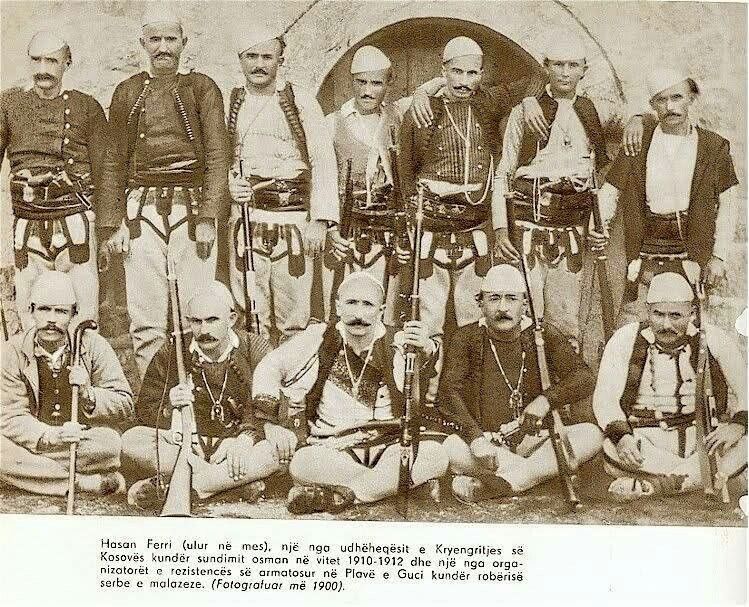

Hasan Ferri (1860-1946) was an Albanian patriot and leader of the forces of Plava and Gusinje who resisted the Serbo-Montenegrin invasion of Kosovo during the 1920s. He was the son of Jakup Ferri.
At the end of the First World War, Albania was occupied by the warring armies of the War (Greece, Italy and Serbia), while the eastern regions were invaded by the Serbian army, with the help of its ally, the French army. Only Plava and Gusinje remained uninvaded. Those regions, commanded by Hasan Ferri, for another four months, faced attacks by the Serbian army, hence, of the Serbo-Croatian-Slovenian Kingdom. Nikola Pasic, Serbia’s prime minister at the time, being aware of the resistance of these provinces against the Montenegrin occupation since the League of Prizren, hesitated to attack them, to spare his soldiers. Therefore, he preferred to occupy these provinces peacefully.
Meanwhile, Pasic ordered his army to invade Shkodra before it was taken from Italy. However, the invasion did not happen, because the city was under the control of the allied armies (France, Britain and Italy). After the failure of Serbia’s two-month-attack, the Kingdom of Serbs, Croats and Slovenes tried to invade Plavë and Gusinje in a peaceful manner in January 1919.
Serious efforts were made to conquer these provinces. To prevent their occupation and for the liberation of Kosovo, the National Defense of Kosovo Committee, led by Hoxha Kadri Prishtina, held a busy diplomatic activity. At this time, Kadri Prishtina, a distinguished patriot, with other leaders of the Committee, came up with the idea of installing an international administration in Kosovo, meaning the eastern Albanian lands occupied by Serbia. This project was thought to be based on the engagement of the first World War Winning States, in particular the Four Great (USA, France, United Kingdom and Italy). The committee was interested that Plava and Gusinje remain independent until the implementation of the project.
The project was supposed to help the Great Powers, especially the US President. Referring to his principles, Hysni Curri, one of the prominent committee activists, wrote to Hasan Ferri of Shkodra: “We are all involved in the points of the great American, Wilson. With his help one day we will be a great self-sacrificing ship.” However, this project was very difficult to implement for the fact that Serbia, consequently the SKS Kingdom, had the support of the great European Powers, winners of the war, especially France. However, the Committee believed in the success of this project, for which it would be firmly committed to its realization. Meanwhile, Hasan Ferri was skeptical of his realization.
In January 16, 1919, The National Protection Committee of Kosovo, two days before the beginning of the Peace Conference in Paris, addressed the heads of states of the Four Great (US President, Woodrow Wilson, French President , Georges Benjamin Clemenceau, Prime Minister of Great Britain, David Lloyd George and the President of Italy, Vittorio Orlando), with the request toimprove the injustices made to Albanians by the Great Powers at the Berlin Congress (1878) and at the Ambassadorial Conference in London (1913).
In order to have the right effect, the request was sent on behalf of Hasan Ferri and the Plava and Gusinje party, legal representatives of these provinces. A similar request was sent to the mayors of these four powers in the name of Bajram Curri and the parish of Krasniqi tribe, who, although being within the borders of Albania, had been invaded by the SKS Kingdom Army with the justification of “protecting its strategic boundaries.” In this request, the mayors of the Fourth Great States “were alarmed by the danger that was threatening Plava and Gusinje from the SKS invasion.” They became aware of the violence of genocide that was exercised in these provinces by the army of Montenegro during their period of rest (1912-1915). This was illustrated by examples of the murders of thousands of Albanians, including the violent conversion of religion.
The telegram stated that the violence against Eastern Kosovo Albanians continued after their re-occupation by Serbia (in October 1918), as well as its continuation, the Serbo-Croatian-Slovenian Kingdom. It was argued that the Kingdom of SKS had already committed numerous crimes against Albanians in Berane, Gjakova, Bijelo Polje, Novi Pazar, Senitza, Peja and other areas of historic Kosovo. As a result of the silence of the Great Powers, Serb soldiers were spilling the blood of an Albanian majority, without sparing women, children and the elderly. It was noted that they were plundering everything they could. It seemed that the army of SKS was trying to wipe out the Albanian race in Kosovo. At the end of the telegram, the leaders of the Four Great were required to establish an International Administration in Kosovo as a temporary solution to the Albanian issue. It was believed that this would avoid violence that did not stop in the whole of Kosovo’s history.
It was emphasized that the commitment of the Great Power aimed to avoid the unbearable situation in Kosovo constituted a moral obligation for them as the founders of the freedoms and rights of the peoples. The Albanians of Kosovo were to be protected on behalf of humanity. This meant ending Serbias crimes. The request ended with the words: “Please be committed to installing an International Administration in Kosovo. For this we express our deepest honors and emotions. A similar request was sent to the Four Great by the National Defense of Kosovo Committee on behalf of Bajram Curri and Krasniqi Parish. Hoxha Kadri Pristina would address separately with a telegram to the President of the United States of America, Woodrow Wilson, on behalf of Hasan Ferri and Plav’s Parish (January 28, 1919).
In the telegram it was stated that Kosovo had hesitated on this chairman, referring to his 14-point Peace Determinants , accordingly point 11, according to which relations between the peoples of the Balkans would be regulated on the basis of the lines of affiliation, which implied the right of Albanians to independence . It was noticed that Kosovo Albanian representatives had submitted several complaints and requests to the Great Powers several times, to prevent the tragedies that were committed to Albanians throughout the Albanian villages by the Serbo-Montenegrin regime.
It was sought by Woodrow Wilson, the founder of the principles of freedom and rights of the nations and the protection of mankind, that until peace comes to an end (thought at the Peace Conference in Paris, RA), Kosovo enters an Administration International as a transitional phase towards its unification with Albania. The telegram concluded with the words: This is what we ask for with our impressions and deeper emotions. Following the name of Hasan Ferri etc. The requirements set out in the two telegrams above did not reflect the improvement of the situation in Kosovo and in Plavë and Gusinje. US President’s Cabinet, Woodrow Wilson, responded to the letter from Hasan Ferri of Plav and Gusinjes Parish on February 15, 1919.
In the telegram, among other things, it was stated: His eminence, Mayor Wilson, through the telegram, was informed about the miserable situation that reigned in Kosovo in end of the war, that the passage through the armies of Allied forces (of France and Serbia, RA) to Kosovo was contrary to our hope that Kosovo would not remain under the rule of Serbia. It was said that President W. Wilson is obliged that their appeal (Hasan Ferri with the First, R.A) will be heard with the ear of justice and opposition you have raised. In the telegram it was stated that Kosovo had hesitated on this chairman, referring to his 14-point Peace Determinants , accordingly point 11, according to which relations between the peoples of the Balkans would be regulated on the basis of the lines of affiliation National , which implied the right of Albanians to self-drive .
It was noticed that Kosovo Albanian representatives had submitted several complaints and requests to the Great Powers several times, to prevent the tragedy that was being made to Albanians throughout the eastern parts by the Serbo-Montenegrin regime. It was sought by Woodrow Wilson, the founder of the principles of freedom and rights of the nations and the protection of mankind, that until peace comes to an end (thought at the Peace Conference in Paris, RA), Kosovo enters an Administration International as a transitional phase towards its unification with Albania. The telegram concluded with the words: This is what we ask for with our impressions and deeper emotions. Following the name of Hasan Ferri etc.
The requirements set out in the two telegrams above did not reflect the improvement of the situation in Kosovo and in Plavë e Gusinje. US President’s Cabinet, Woodrow Wilson,rResponded to the letter from Hasan Ferri of Plav and Gusinjes Parish on February 15, 1919. In the telegram, among other things, it was stated: His eminence, Mayor Wilson, through the telegram, was informed about the miserable situation that reigned in Kosovo in end of the war, that the passage through the armies of Allied forces (of France and Serbia, RA) to Kosovo was contrary to our hope that Kosovo would not remain under the rule of Serbia .
In addition to the above-mentioned proposals to prevent the invasion of Plav and Gusinje, the National Defense of Kosovo Committee in early February 1919 also came up with the proposal for establishing a government in Plav‘ and Gusinje . For this idea, Hysni Curri informed Hasan Ferri and Shaban Aga that efforts were made to raise awareness of the representatives of the Allied Powers in Shkodra to create this government until the work of the Peace Conference in Versailles near Paris was completed. This was also revealed by a letter from Hoxha Kadri, who directed it to Hasan Ferri and the District Party. Through it, efforts were made at the cabinets of France, Britain and Italy to bring Plava and Gusinje under the protection of these powers to escape the clutches of Serbs , for which they were given fair promises.
Meanwhile, the National Defense of Kosovo Committee received promises from the representations of allied armies in Shkodra for the protection of Plav‘ and Gusinje. Ismail Nichok wrote about Hasan Ferri that three military command missions in Shkodra (France, Britain and Italy) had guaranteed the representatives of the Committee, especially the French Commander, that the Plav and Gusinje provinces will remain shortly , as Shkodra under the International Administration.
As proof of these promises, they sent to Hasan Ferri the copies of the telegrams sent to the representatives of these armies. The leaders of the National Defense of Kosovo Committee, enthusiastic about these promises, asked Hasan Ferri to keep order and security In Plava and Gusinje until the army of the Great Powers arrived. Hoxha Kadri Pristina wrote to Hasan Ferri that he received a letter from the commander of the United Kingdom forces in Shkodra, General Philips, As well as by the commander of the French forces in this city, Colonel Fourtu. They were promised that their armies would protect not only Plava e Gusinje, but also Pec and Gjakova that these provinces would be under the International Administration and would then join the Albanian state.
In another letter addressed to Hasan Ferri by Hoxha Kadri Prishtina, in early February 1919, it was said that this success was achieved after 50 other requests of the Committee, which were sent to the representatives of allied forces in Shkodra. Hasan Ferri with Plav and Gusinjes parish, at the end of January 1919, once again became aware of the leaders of the National Defense of Kosovo committee that they had received assurances from representatives of the Allied Forces in Shkodra that Plava and Gusinje would not be attacked by Serbo-Montenegrin forces. The promise was given after departing in Shkodra to the commander of the East Army, based in Thessaloniki, General Franchet d’Espry. This French general, in order to protect the people of the provinces and for the sake of the testified courage of their husbands (in the war with Montenegro), ordered not to occupy Plava and Gusinje.
However, the order of this general was in contravention of his country’s policy of pursuing Serbia, from the allies of France, especially during World War I.
The Defense of Kosovo Committee, led by the representations of Allied Armies of Britain and France in Shkodra, in order not to allow the SKS to invade Plave and Gusinje, were not fulfilled and the suspicion of Hasan Ferri became a reality. Thes states that long ago defended the interests of Greece and Serbia opposed 14 of W. Wilson’s demands for the regulation of the new world order, especially the right of peoples for Self-Determination . This meant that this right could not be enjoyed by the Albanians in the East.
Instead, the Great Powers seemed to split Albania between Greece and the SKSK Kingdom. The project did not come about because of the persistent engagement of US President Woodrow Wilson. Consequently, after an unequal struggle between defenders and aggressors, Plava and Gusinje were conquered by the Serbo-Croat-Slovene army. Then the second Serbian and Montenegrin genocide occurred in these provinces (after 7 years). The commander of Allied forces in Thessaloniki, General Franchet, for failing his noble efforts to rescue the Albanians of these provinces from the Serbian genocide, wrote:
“We tried hard to convey the message to the ears of civilized Europe for criminal purposes, we prayed too much to send a few armies to Gusinje and Plava, and to protect the life andhonor of 24,000 innocent Albanians who were killed.” Turhan Pasha P‘rmeti, Prime Minister of Albania, who chaired the Albanian delegation at the Peace Conference in Paris, presented to the representatives of its participating States a written complaint condemning SKS Kingdom Army crimes against the Albanian population in Kosovo’s lands , Including Plava and Gusinje. Among other things, in the complaint it was stated that the terror on the Albanians of these provinces was mainly exercised on children, elderly and women from the Montenegrins and the SKS Kingdom Army, demanding that criminals be brought to justice. In Plava and Gusinje followed a long period of violence and repression in the name of revenge on the epic resistance of their men against theSerbo-Montenegrin invasion. In defense of the border in Qafë Cakorrit thousands of Albanians died. This resulted in the displacement of the Albanians of these provinces in Albania, Kosovo and beyond. Most of the Albanians of the regions were Slavicized or turned Bosniak to avoid repression.

 Balkan Academia