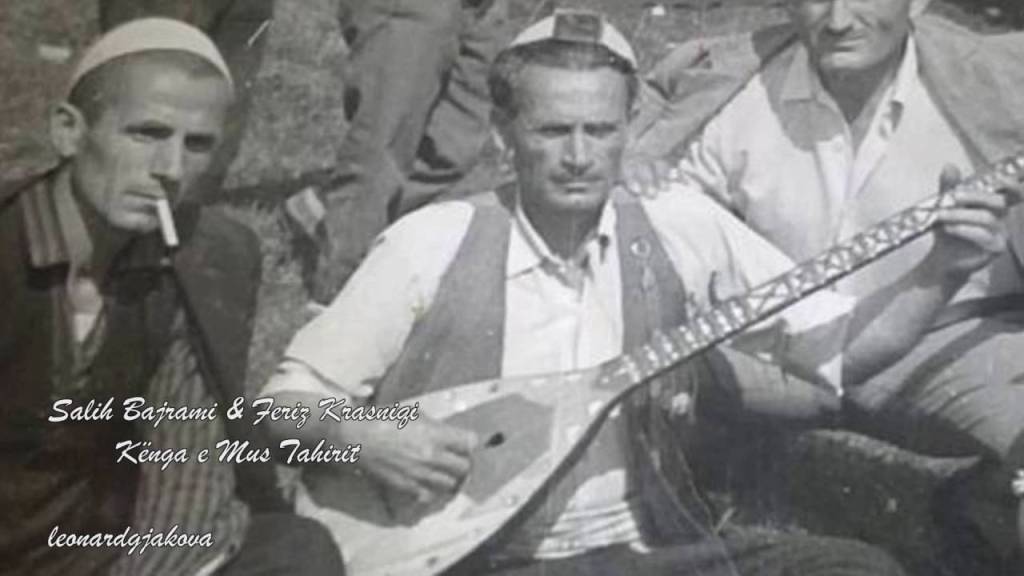

Sali Bajrami Krasniqi (1919-1987) was an Albanian folklore artist and composer from Kosovo who became one of the most famous Kosovo-Albanian artists of all time, composing over 500 songs. Due to the poverty of the time, Krasniqi was unable to write down the songs and instead memorized them, which at the time was never heard of. Together with Feriz Krasniqi, they wrote many popular songs, in particular the song of Oso Kuka, which at the time only was heard of in Gjergj Fishtas version sung by the Lahuta. Their instruments were the Albanian traditional instrument of Callgi, or Sharkia, and the more primitive type Qifteli.
Salih Bajrami was born in Llashka, Drink, in the municipality of Malisheva. Already as a 6 year old he rested in his fathers knees as he played through out the nights in peoples homes and at weddings. His father was the first Albanian from Kosovo to use the Sharkia for Albanian folklore. Salim Bajrami created the term ”Songs of the Chimney” and referred to folklore songs being sung in Albanian homes near the fire, which served an educational and patriotic purpose
Together with Feriz Krasniqi, they sang for 20 years. In 1966, they won the Yugoslav folklore contest held in England. Salim Bajrami and Feriz Krasniqi protected and maintained Kosovar Albanian history and because of the lack of education at the time, kept people updated and educated as to what was happening around in different areas where Albanians lived. They also composed songs of Albanians in Albania, Catholics and Muslims alike, about heroic deeds which not even the Albanians themselves had heard of. In 1987 Sali Bajrami was decorated with the title of the ”Albanian Folklore Hero”.
Durting the 1950s, when Alexandar Rankovics nationalist party had influences in Yugoslavia, Sali Bajrami was arrested by Rankovics men, accusing him of being an irredentist for singing patriotic songs. He was severely beaten and when released he never became the same again.
They were the first to write songs of the League of Prizren, singing about Ali Pasha of Gusinje, Haxhi Zeka, Ymer Prizreni, Bajram Curri, and Hasan Pristina. They also wrote songs about romance, which at the time was considered to be tabu. Due to this fact, they had to mask their songs as to not offend elderly.
Sali Bajrami died in 1987 and was much appreciated by Anton Cetta, the Catholic Albanian activist who stopped blood feuds in Kosovo in the 90s. Cetta stayed with him until his death. One of the most famous songs written was the song of Oso Kuka, written by Gjergj Fishta in his epic ”Lahuta e Malsis”. They were the first to translate and re-write the history which Fishta had written in a very difficult kind of Albanian. Feriz Krasniqi was found dead in the first during the Kosovo war. He is said to have died of panic as he fled Serb security forces.
References
- Bahtir SHEHOLLI Instituti Albanologjik i Prishtines Gjurmime albanologjike / Folklor dhe Etnologji / Faq.215-218 Prishtine 1998.
- Krasniqi, Ismet (2012). Shekuj zgjojnë nga gjumi: dueti Salih e Feriz Krasniqi (in Albanian). Epoka e re. ISBN978-9951-8503-2-2.
- Krasniqi, Salih; Krasniqi, Feriz (2007). Këngë popullore (in Albanian). Shtëpia Botuese Faik Konica. ISBN978-9951-06-159-9. Retrieved 6 September 2023.
- Perparimi (in Albanian). NGBG Rilindja. 1968. Retrieved 6 September 2023.
- Jehona (in Albanian). NGB “Nova Makedonija. 1967. Retrieved 6 September 2023.
- http://botapress.info/nuha-zullufi-legjendat-e-folklorit-shqiptar-salih-bajrami-e-feriz-krasniqi/. Nuha Zullufi. “Legjendat e Folklorit Shqiptar – Salih e Bajram Krasniqi”.


 Balkan Academia