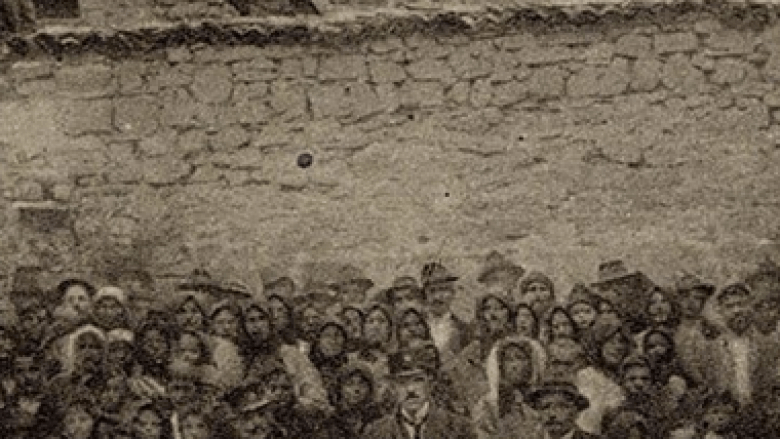

Serbianisation of Albanian names (Alb: Serbizimi I emrave shqiptare) was the process of Serbian assimilation policies, carried out by the Serbian Orthodox Church, directed towards Albanian Catholics and Muslims through out the centuries. At the beginning of the 11th century, slavic toponyms appeared in the region of Kosovo, which increased in the 12th century. Many Albanian names such as Leka, Pal, Pjeter, and Gon were slavicized to Lekic, Palic, Petric, and Gonovski. Nobody can claim that Serb rule in Kosovo continued over three centuries. Besides that, we now have a collection of sources that confirm that during these centuries the Albanians were present in historic Kosovo and that the pressure put on them by the Serbian state and church, to a large extent, were responsible for the Slav toponyms and names of the residents. There are a large number of cases, where Albanian names have been Slavo-cized (i.e. Lek-ich, Pal-ich, Petr-ich, Gon- ovski, Gin-ovski, etc. ed.)
Other linguistic arguments are more closely linked to geography. The place-names of the northern Albanian region offer a valuable linguistic testing-ground. We know what many of them were called in Roman times; it should therefore be possible to tell whether their modern Albanian form derives from a continuous Albanian tradition going back to contact with the Romans, or whether it is derived from the Slav form of the name. If the latter, then this might suggest that the Albanians entered this area only after the Slav immigration of the seventh century. The fact that Slavs developed their own forms of the urban names directly from the Latin (Skadar from Latin Scodra, for example, where the Albanian form developed as Shkoder/Shkodra) is not in itself significant; their contact in the urban areas would have been mainly with Latin-speakers anyway. But if, on the other hand, the Slav names for rivers or mountains show that they were borrowed from Albanian forms of those names, this would indicate that there were Albanian-speakers in the countryside when the Slavs first arrived.[2]
Serbian historians have blamed Muslim Albanians in Kosovo for having been associated with Ottoman rule in the disenfranchisement of the Serbian population in their territories. This accusation is totally unjustified. The Albanians have always been free from religious prejudices and animosities. They (Albanians) should be credited with saving them (Serbians) from destruction, almost four hundred years, the Serbian Orthodox churches and monasteries in Kosovo, the otherwise Serbian medieval rulers, who once occupied Kosovo and leveled to the ground all Bogomil and early religious and cultural monuments built before their conquest. Besides that, during the centuries of Ottoman occupation, the Kosovo Albanians were marked with armed uprisings against Istanbul. Even independent historical sources claim that the Kosovo uprising of 1689 was done with mass regional Albanian participation.
One cannot deny the fact that the Albanian administrative regions that were united under Tirana, although they were under Italian occupation, had some advantage in the area of national rights. Above all, they were freed from the Serbian genocidal occupation and from the total denial of their national rights which the government in Belgrade was neglecting.
To save themselves from being massacred by N. Zerva, the extreme Greek nationalist General, the unlucky Chams were forced to immigrate to Albania, leaving behind their homes.
Also, Athens calculations that the displacement of the Chams would close the issue of national rights for Albanians, was not true. The issue of the Chams is still open and awaiting resolution.
So, the Albanians, with thousands of years of being historic Kosovo residents with uninterrupted territorial unity, with many century old cities, with a common ancient culture, with a population, which, according to the numbers was in third place after the Serbs and Croats, with a rich history of fighting for independence, had fulfilled all conditions for having their own republic.
The Slavic toponymy, which Serbian historians use as an argument to confirm the Serbian colonization of Kosovo at the beginning of the early Middle Ages is irrelevant, because the documentary sources show these to appear in this region at the beginning of the 11th century.
Also, the thesis that circles in Yugoslav historiography claiming that the Kosovo Albanians who settled there came from the northern regions of Albania after the Serbian exodus in of 1689 has no documented support. First of all, historical sources do not support a large scale exodus taking place in 1689 like the one claimed by Serbian historiography.
The historical monuments, which the Serbs are trying to argue gives them their historical rights belong to 13th and 14th century as opposed to the Albanian monuments which have existed continuously for many centuries, and which, regardless of their ancient landmarks, have been turned into ruins by Serbian rulers (with similar attempts made today – the destruction of Croatian Catholic churches which shows that the Serbs have not yet waived their pathological hatred of their centuries old neighbours).
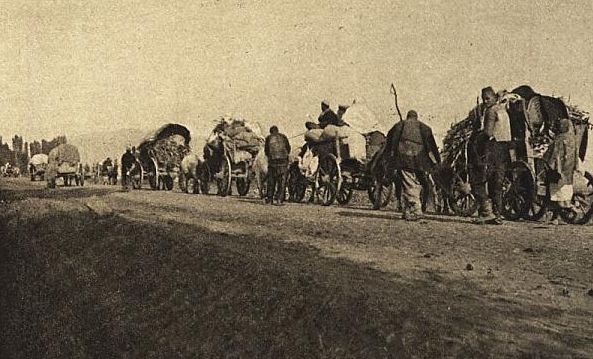
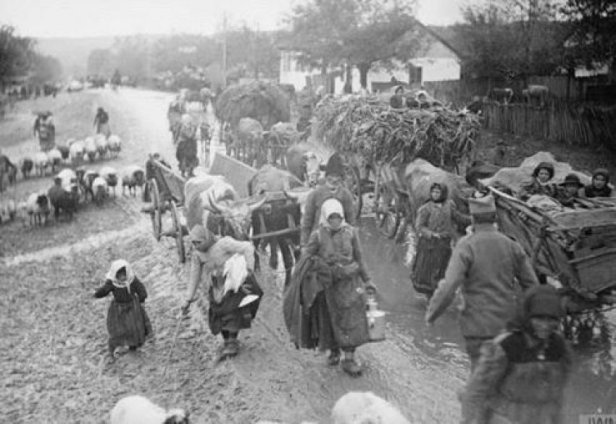
On the other hand, Belgrade circles intensified their police regimes which, outside of torturing, arresting and interning Albanians under false charges and without court trials, forced many Muslim Albanians to move to Turkey. As a result of these Serbian genocidal policies, during the 1950s and 1960s alone, over 50 thousand were killed and approximately 300 thousand were displaced outside of Yugoslavia.
References
- (Translated from Macedonian to English and edited by Risto Stefov), Dimitar (2015). The Balkan Mega-ethnos National Doctrines of MacedoniaÕs neighbours (PDF)
- http://macedonia.kroraina.com/en/nm/kosovo.html
- http://www.pollitecon.com/html/ebooks/risto-stefov/The-Balkan-Mega-ethnos.pdf


 Balkan Academia