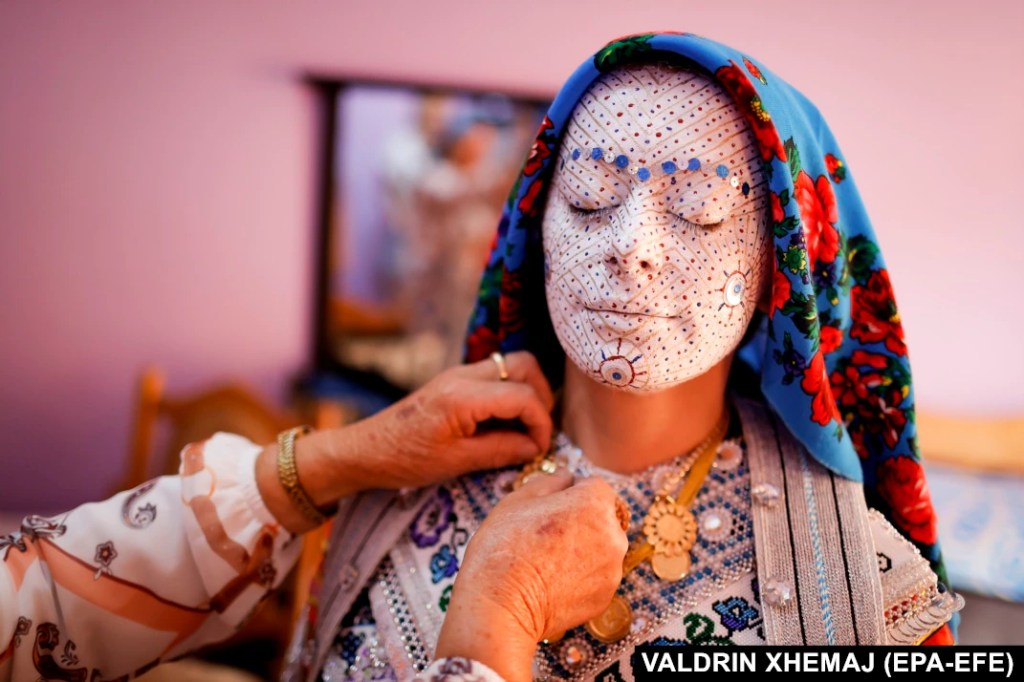

Nusë or Nusezë (pronounced [no-o-së]) is the Albanian word for “newly wedded bride” part of the Indo-European heritage of the Albanian language[1][2] Singularized plural of *nusë, from Proto-Albanian *nutjā, from Proto-Indo-European *(s)nubʰ-ti̯eh₂, from *sneubʰ- (compare Latin nūbere (“to marry (a man)”), Czech snoubiti (“to woo”)). For sense development, compare Greek νύφη (nýfi, “bride, daughter-in-law”), from Ancient Greek νύμφη (númphē, “bride”). Alternatively from Proto-Albanian *snutjā, from Proto-Indo-European *snu-eh2- (“daughter in law”), derivative of *snus-ó- (compare Latin nurus, Sanskrit स्नुषा (snuṣā), Greek νυός (nyós), Old English snoru).[3]
In Albanian culture, a nuse is supposed to serve all the needs of the husbands family, speak to him by whispering and produce a son in order to be considered part of the family.[4] The first ceremony begins once the nuse has given the word, called “fjala e nuses” meaning “word of the bride”.[5] The more gold a nuse has on her, the more wealthy the family she is marrying into is considered.[6] The woman becomes a bride three evenings before she accepted to marry[7]. The nuse becomes a plakë (elderly) when her son marries[8] and brings a nuse or when her daughter becomes a nuse[9]. When speaking of a woman acting “like a bride”, the denominal verb “nuse-ron-ë” is used.[10] There is a popular wedding song named “Ani More Nuse” (Very well then Nuse) which is sung at weddings amongst Albanians.[11] The nuse has to work very hard since the sisters-in-law treat her as an unpaid servant and she must be quiet[12]. The nuse is seen as an addition of the work force of the family and she does not share the festivities in the ceremonies as she must look down[13]. If the family like the nuse after several years, they may call her nuse as a positive term[14]. Only when the nuse produces a son does she gain status[15]. In Albanian patriarchal culture, daughter-inlaw and bride was seen as the same[16]. A nuse and her groom (dhënder) are chosen based on the quality of affinal bonds (miqësi)[17].
References
- ^ Kahl, Thede; Metzeltin, Michael; Schaller, Helmut Wilhelm
(2012). Balkanismen heute. LIT Verlag Münster.
p. 138. ISBN 9783643503886. - ^ Poruciuc, Adrian (2010). Prehistoric roots of Romanian and southeast
European traditions. Institute of Archaeomythology.
p. 56. ISBN 9780981524924. - ^ MATASOVIĆ, RANKO (2019). A Grammatical Sketch of Albanian for
Students of Indo-European (PDF). Zagreb. p. 8. - ^ Young, Antonia (1998). “Sworn Virgins”: Cases of Socially Accepted
Gender Change. UK: Colgate University and Bradford University. pp. 62–68. - ^ CHWB, CHWB (2005). Kosovar wedding. European Heritage Days 2005.
CHWB (Cultural Heritage Without Borders) Kulturarv utan gränser (PDF).
CHwB Kosovo Office, Report series No. 4/2006. p. 13. - ^ Rappe, Kelly (2015). “Nuse, Darsme, dhe Dhëndër (Bride, Weddings and
Groom)”. http://www.peacecorps.gov (Nuse). Peace Corps. Peace Corps.
Retrieved 4 August 2019. - ^ Sugarman, Jane C. (1997), p. 140
- ^ Porter, James; Racy, Ali Jihad (1988). Issues in the Conceptualization of
Music. Department of Ethnomusicology, UCLA. p. 4. ISBN 9780882870229. - ^ Sugarman, Jane C. (1997). Engendering Song: Singing and Subjectivity at
Prespa Albanian Weddings. University of Chicago Press.
p. 173. ISBN 9780226779737.
10.^ Müller, Peter O.; Ohnheiser, Ingeborg; Olsen, Susan; Rainer, Franz
(2016). Word-Formation: An International Handbook of the Languages of
Europe. Walter de Gruyter GmbH & Co KG. p. 3133. ISBN 9783110424942.
11.^ Otterholt, Lee. Ani More Nuse (Albania and Albanian population in former
Yugoslavia) (PDF). STOCKTON FOLK DANCE CAMP – 2009 – FINAL.
p. 127.
12.^ Grunbaum, Irene (1996). Escape Through the Balkans: The Autobiography
of Irene Gr_nbaum. U of Nebraska Press. ISBN 9780803270824.
13.^ Kressing, Frank; Kaser, Karl (2002). Albania–a country in transition:
aspects of changing identities in a South-East European country. Nomos.
p. 96. ISBN 9783789076701.
14.^ Kadare, Ismail (1987). The Autobiography of the People in Verse. “8
Nëntori” Publishing House. p. 82.
15.^ The Anthropology of East Europe Review. Field and International Study
Program, College of Human Ecology, Cornell University [and] Department of
Sociology and Anthropology, Central Connecticut State University. 1998.
p. 42.
16.^ Sinister Wisdom. Sinister Wisdom. 1980. p. 16.
17.^ Poruciuc, Adrian (2010). Prehistoric roots of Romanian and southeast
European traditions. Institute of Archaeomythology.
p. 232. ISBN 9780981524924

 Balkan Academia