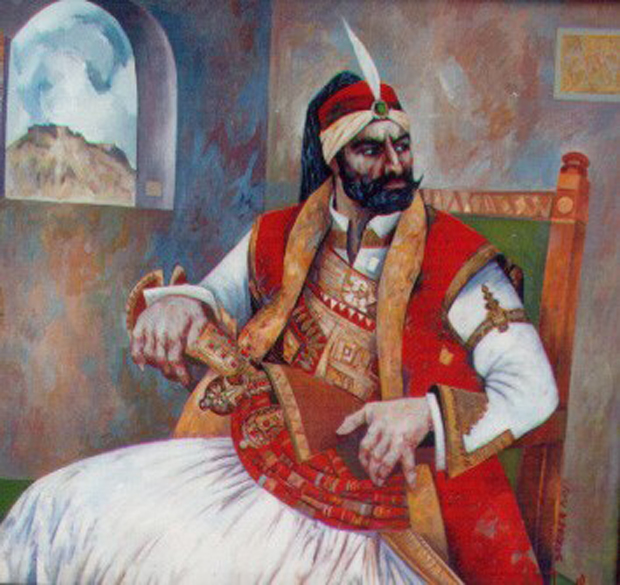

lllyrian Confederation (Albanian: Konfederata e Ilirikut or Konfederata Ilire) was an Albanian Muslim alliance created on April 1, 1785[1] (or 1786)[2] by Kara Mahmud Pasha in Podgorica with 500 representatives, both Catholic and Muslim,[3] from Albania, Montenegro and Bosnia-Herzegovina.[4] Mahmud Pasha had intended to declare war against the Ottomans after the Austrians had promised to make him king of Albania. Joseph II sent the confederation a giant golden cross as a gift.[5] As a result, the Sultan declared him enemy of the state. On May 5, 1787, the Sultans commander Mahmut Ajdosi marched against Ulcinj and captured it. On august 25, 1787, the castle of Rozafa was surrounded and Mahmud Pasha survived the sieges lasting 80 days. On November 25, 1787, the malesors of Hoti, Shoshi, Mirditë and Tabakëve arrived at the battle to resist the Ottoman forces and Mahmud Pasha left the castle and defeated them. The Ottomans suffered 6000 casualties. The Austrians promised to declare him king if he declared war against the Ottomans, and in 1788, a delegation traveled to Albania from De Broajar and Mahmud Pasha was paid 50 000 ducats. However, the Austrians did not honor the agreement and made a secret alliance with Montenegro. After the pasha discovered this, he declared war against the Austrians close the Bune river. In 1789, the Sultan forgave the pasha with the condition that the confederation be dissolved.[6]
References
- ^ “Histori kundër harresës se Podgorica ishte Iliro-Shqiptare”. Balkan’s
News (in Albanian) (Translation: Podgorica Assembly, where on April 1-2,
1786 the Illyrian confederation with many ethnic boundaries would be
proclaimed. Kara Mahmud Pasha Bushatliu, who according to Pukville was a
descendant and follower of Skanderbeg’s footsteps, ie as leader of the
struggle for liberation from the Turkish yoke). 1 April 2019. Retrieved 30
September 2019. - ^ Studime Ilire (in Albanian). Rilindja. 1978. p. 315.
- ^ Vataj, Albert. “Revista malesia 56”. page 11-12 (56). Vasel Gilaj. Shoqates
Atdhetare Malesi. Retrieved 30 September 2019. - ^ Gashi, Shkëlzen (2016). The History of Kosovo in the history textbooks of
Kosovo, Albania, Serbia, Montenegro and Macedonia (PDF). Prishtina: Alter
Habitus. p. 52. Retrieved 30 September 2019. - ^ “ANG – Shkodra”. http://www.letersia.fajtori.com. Retrieved 30 September 2019.
- ^ Rashiti, Gence (2014). Pashallëku i Shkodrës (The Pashaliks of
Shkodra) (Translation: FIRST ROUND OF SHKODRA (1787) The Sultan
declared Mahmut the traitorous pasha. He charged Mahmut Ajdosi in the lead
of the expedition against Kara Mahmut, on 5 May occupied Bar, and on 22
August 1787 occupied Ulcinj. On August 25, 1787, the siege of Rozafa’s
castle surrounded Kara Mahmut’s fortitude for 80 days. On November 25,
1787, the massacres of Hoti, Shoshi, Mirdita and the taraks of the Tabaks,
Terzive revolts against the Turk. Kara Mahmuti then came out of the castle
and defeated the Turks. This victory had a great echo in Albania and abroad.
3.3. EXTRAORDINARY RELATIONS OF PASHALLAK The approaching of
Shkodra with the Catholic Austria against the Muslim Turkey aroused the
displeasure of many of the feudal lords. This displeasure included his brother
Ibrahim. Kara Mahmuti broke these opposing movements. To recognize his
sovereignty, Austria asked him to take part in the war against Turkey. To
convince Austria, he sent to Albania in 1788 a delegation headed by De
Broajar. Beyond the deal, Kara Mahmuti won 50,000 ducats. Austria did not
respect the agreement as it made an alliance with Montenegro without the
knowledge of Kara Mahmut. Understanding this agreement Kara Mahmuti
attacked the Austrian army near the Buna River. From where the agreement
with Austria broke down. Kara Mahmuti joined the Ottomans for help. In 1789
the sultan forgave him and gave him the title of vizier and commander on the
Bosnian throne. This agreement with the sultan caused the Illyrian
confederation to break down. After returning to Shkodra, he continued his
independent policy towards the sultan. As a result, relations with Istanbul
broke down again. ed.). Prishtina: UNIVERSITETI I PRISHTINËS FAKULTETI
FILOZOFIK DEGA: HISTORI. pp. 11, 12


 Balkan Academia