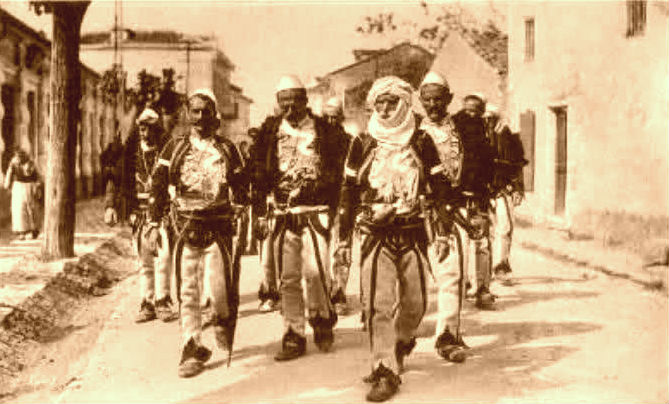

The Seven Bajraktars of Shala were a group of seven Albanian malesori bayraktars from the tribe of Shala and Dukagjin who, in the year of 1806, went together to meet up with Ibrahim Pasha of Scutari, Vizier of Shkodra, to discuss the disarmament of the Malesoris. However, as they discussed, they were fiercely offended by the Pasha to which the Malesoris responded by opening fire, killing the son of the Pasha, and being eventually killed by Ottoman forces in the castle of Shkoder.[1]
The group was venerated throughout out the decades for their honor and there exists several paintings depicting the seven Highlanders walking with their national costumes and rifles in their belts. The group was considered to be heroes and started during the Battle of Saraja, in Shkoder, in the spring of 1806, when a bayraktar of Shala fought Ottomans. The autonomy of Dukagjin was won with sword and pistol from the Ottoman government. In 1806, Kara Mahmud Pasha congratulated the Malesors of Dukagjin for their autonomy and allowed them to carry arms and freeing them from taxes.
His brother Ibrahim Pasha, however, after succeeding the title, removed the privileges of the Malesors and declared war against them. During this time, the new Pasha sent his delegate Abaz Aga to Shala, demanding their tribesmen to join the Ottoman army. The Vizier then called for the bayraktars of Shala and Dukagjin for a meeting but the Malesors did not attend first due to their mistrust of the new Pasha.[2] The Shala tribesmen held a meeting at the Bridge of Shala, where they vowed to fight for Albania.[3][4][5]
List of the members:[6]
- Ndre Pepa (Bayraktar i Shala)
- Vat Nika (Pecnikal brotherhood)
- Marsh Pali (Dakaj brotherhood)
- Hasan Pepa (Mekshaj brotherhood)
- Çun Luci (Docaj brotherhood)
- Deli Pjetra (Pjolla brotherhood)
- Ndre Koltona (Pjolla brotherhood)
Battle of Saraja
The Seven Bayraktars of Shala, determined to die fighting the new Pasha if they had to, traveled to the castle of Shkodra where the Pasha awaited them. Previously, other Malesori tribesmen had been lured and massacred by the Pasha. The bayraktars surrendered their arms around their shoulders but refused to give up the ones in their belts. The Pasha offended and insulted the Malesoris to which they opened fire, killing the son of the Pasha, Murat. The Pasha escaped however the Malesorsi were killed.[7] The Veziri fled the scen and the Malesori cut off his sons head. This was the beginning of the fight in Saraja. During the battle, Deli Pjetri, one of the bayraktars was wounded and fled the scene to a Kosovar Albanian castle guard named Qatipi, resting in his house.
The father of Qatipi demanded his son to kill Deli Pjetri, but since Qatipi had given the bayraktar his besa, he refused. The news of the Saraja killings had spread and after Pjetri had rested, he returned to his home village but was not greeted kindly by his kinsmen. He was considered a traitor for having deserted the Shala tribesmen in the castle. Treason was considered worse than death among the Albanian malesoris and the mother of Deli Pjetri cursed him saying “Why have you left your friends, should I ever be your mother, may I cut off my hair”. His mother was ashamed of her sons actions that she, according to Malesori traditions, hid inside her home.
Deli Pjetri was devastated for having left his tribesmen to die in the castle of Shkodra. Deli Pjetri decided to return to Shkoder to die in honor, and met up with Vuksjan Gjoni, a malesori who had been freed by Ottomans. They both returned to the castle where they killed seven men before being shot in the back. The Seven Bayraktars were honored by the people of Shkoder and Kosovo and are mentioned in Albanian epic folklore. They are considered a legend and there are monuments and plays made for their cause. There is also an organization named after them in Dukagjin.[8][9][10]
References
- “KosovariMedia.com – Portal informativ dhe edukativ Shqiptar – Mehmet Shpendi – apo Shaljani i Tetë”. http://www.kosovarimedia.com.
- “Historia e “7 Shaljanëve””. Radi and Radi (in Albanian). 3 January 2016.
- “Shoqata Atdhetare “Dukagjini””. http://www.shoqatadukagjini.com.
- Luca, Ndrekë (1968). “Shtatë Shaljanët: dramë historike në 5 akte” (in Albanian). Rilindja.
- “Historia e 7 shaljanëve – Iliria News Agency”. Iliria News Agency (in Albanian). 10 February 2016.
- Gjurmime albanologjike: Folklor dhe etnologji (in Albanian). Instituti Albanologjik i Prishtinës. 1988.
- Paçukaj, Sokol (2012). Albania. Antropografia degli anni ’20 (in Italian). Edizioni Nuova Cultura. ISBN9788861348530.
- “Organization “Shtat Shaljanet” in Dukagjin,” (PDF).
- “Kush e di Legjenden e Shtate Shaljaneve? | Peshku pa ujë”. arkivi.peshkupauje.com (in Albanian).
- National Union Catalog: A Cumulative Author List Representing Library of Congress Printed Cards and Titles Reported by Other American Libraries. Library of Congress. 1970.


 Balkan Academia