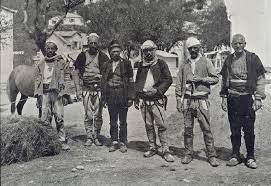

Albanians of Ragusa were the local merchants and traders of Albanian origin living in the Republic of Ragusa (now Dubrovnik) through out Byzantine, Venetian and Ottoman eras. The city had many Albanians who were merchants and craftsmen who traded in Venice and inlands towards Prizren and Kosovo.[1] During the Byzantine era, large masses of Albanians migrated to Ragusa and the Danube where they worked with crafting and in guilds.[2] The famous Miho (Mikel) the Tivarian, was an Albanian from Tivar in the 14th century who built the claustre of the Francescan Monastery in Ragusa. In 1156, the Albanian trading culture reached its peak as merchants had their own agencies in Ragusa and Venice, as noted by Arab cartographers.[3][4] Generally, in the Late Middle Ages, Albanian merchants were the main exporters of crops to Ragusa and Venice with trade deals expanding after the collapse of the Serbian empire. The famous Albanian Gjon Gazulli was an important scholar of Ragusa. [5] There were also many merchants from Prizren who lived in colonies in Ragusa.[6] Ragusa was the second important city in the spread of Catholicism in Northern Albania.[7]
History of the Albanians in Ragusa
In 1285, an Albanian population in the city is reported to have existed for some time.[8] In a script from the same year, an investigation of a robbery mentions a witness who said “Audivi unam vocem clamantem in monte in lingua albanesca” ‘I heard a voice crying in the mountains in the Albanian language’. In 1308, “Anonymi Descriptio Europae Orientalis”, ‘Anonymous description of Eastern Europe’ mentions:”The aformentioned Albanians have a language which is entirely distinct from that of the Latins, Greeks and Slavs such that in no way can they communicate with other peoples”.[9] The Sorgos family, Albanians from Kotor, were known for bringing important goods in Ragusa in 1292.[10] In the 1330-50s, the Catholic population in the city is believed to have consisted of wealth Albanian speaking immigrants and they were also mentioned as inhabitants of local villages in some documents of Orthodox churches.[11] In 1332, Symon Semeonis, an Irish priest, referred to the Albanians of Ragusa as “barbarians who lived in tents”. A document from 1385 titled “Acta et diplomata res Albaniae mediae aetatis illustrantia. Vol. II” mentions that merchants from Durrës travelled to Ragusa (present-day Dubrovnik) to sell objects and jewelry made of silver.[12] In 1587, most of the wheat in Ragusa was delivered by Albanian merchant ships from Vlore, but in 1590, the Albanian farmers in Vlore suffered a shortage of food and revolted against the trade deal with Ragusa, causing a food crisis in the city. The Ragusan consul in Vlore wrote that “there is a lot of grains that those people hold in their arms to keep them from being extracted from anyone”.[13] Ragusa was also the main center for the market of Albanian slaves into the 15th century toward Puglia and the Marche.[14]
Albanians of Kotor
Albanians of Kotor were a group of inhabitants of Albanian descendant who lived in and around the city of Kotor (lat. Catharensis) through out the Venetian, Ottoman and Montenegrin time periods. In the Roman era, Illyrian tribes roamed the region of Kotor who were eventually put under Byzantine rule. Afterwards, the inhabitants turned to the Latin faith as Slavic kingdoms expanded. Elsie shows a document dated roughly around 12th century mentioning how the “Latins” of had six towns with bishops in Antibarum (Bar), Chatarensis (Kotor), Dulcendinensis (Ulcinj) Suacinensis (Shas), Scutarensis (Scutar) and Drivacensis (Drisht).[15] The oldest evidence of contact between Albanians and Ragusans dates back to 1278 when a notation was made in an Ragusan source relating to some Albanians robbing a Ragusan community somewhere between Brskovo and Kotor.[16] Through out the Middle Ages, most of the clery in Kotor were Albanians.[17] During the Venetian-Ottoman era, Albanians of Kotor served as captains, mercenaries and soldiers. In the 18th century there existed an Albanian minority consisting of horse merchants and shepherds still living in Kotor. In 1966, the Albanians Ghegs (Gueghs) are mentioned as a rough, wild and warlike people occupying Kotor (Catarro).[18] Eventually the Albanians were assimilated to the Slavic Orthodox faith and Montenegrin identity.
Origin
The first documented traces of inhabitants in the region around Kotor were the Illyrian tribes of Labeates and Docleatae living around Lake Skadar and in the mountains in the 6th century. The Docleatae tribe was occupied by the Romans who called the bay of Kotor “Sinus Rhisonicus”, and it was also mentioned by Strabo and Ptolemeus. By the 7th century Kotor was called Dacaderan or Dacadon. In the 10th century Constantine VII Porphyrogenitus mentions “Dacatera” or “Decatora”, and from the 12th century a priest from Dicleatae calls it “Decatorum” or “Catharus”. As Slavic population grew, the tribesmen in the Kotor region, among other places, remained under the Byzantine rule. In 999, Ragusa became a bishopric which put Kotor under its authority, and its leader, Archbishop Tribunus, (1158-1187) engaged in taking care of the Catholic rites of Northern Albania.[19] However, between 1036 and 1042, the population around Kotor established the Latin bishopric hostile to the Byzantines.[20]
Name
Albanian scholar Skender Rizaj hypothesizes that the name of Kotor has an Albanian toponym meaning “young buffalo up to one year” which is supported by the existence of an Albanian family called “Bolica” (Bull) which has bull on the coat of arms. According to Albanian folklore legends, Kotor was partly founded by the families of Nikole Buca and Don Vita Kuqi, constructor of the Decani monastery. Historian Bogumil Hrabak states that the number of Albanians (Arberesh) in Kotor was so large that they constituted an essential element of the demographic renewal.[21]
Byzantine and Venetian era
In an annotation from 1166, the altar consecration in St. Tryphon mentions “Lazarus episcopus Arbanensis”, a carpenter identified with the Bishop of Krujë.[22] In the same year, during Pope Alexander’s reign, “Albanski Andrija” (Andrea the Albanian) was mentioned as bishop of Kotor, called “Prior Kotor Vita”.[23] G. Stadtmuller writes of two documents from 1166 and 1167 from the chancellor of Rome, with the former signed in Kotor, with the toponyms of “Arbanensis” and “Albanensis”.[24] In 1305, Adamus de Catharo (Adam of Kotor) is mentioned in a Latin script as a Catholic priest of Kotor.[25] On October 18, 1369, the Balsha rulers ceased harassing the Catholics of Kotor and began promoting local bishops, with Pope Urban V nominating several bishops under the family[26]
Kingdom of Rascia and Stefan Dusan
In 1248, after the fall of Zeta under the supremacy of Raska, Franciscan and Dominican monks arrived in Kotor bringing Albanian clergy led by Ivan da Pian del Caprine (1182-1252) who was elected Archbishop of Bar.[27] Milan Šufflay writes that in the 13th century, there were Albanians in Ragusa and Kotor who had been scattered from the Albanian nucleus, and in the 14th century, the Arbanenses appeared among the Zhupan of Grbalj.[28] Between 1419 and 1423, many Albanians fled the wars in Shkoder to Kotor and in 1492, many of the Albanian Catholic clergy fled to Kotor such as “Sergije iz Ulcinja” (Sergius of Ulcinj, the Benedictine chaplain of St. Tryphon), “Mihenom Buca” (Mihel Buca) and “Bazilijem iz Licija” (Basilius of Lycus).[29]
In the 14th century, Albanians are mentioned in Kotor in the valleys of Sermnica to the northwest of Skadar Lake and in Stoc in Hercegovina, as well as in Montenegro in 1305 with the names of “burmadh” (herdsman) in Sekular and Shingjon.[30] In 1485, the bishop of Kotor initiated a conversion of the locals from the Slavic Orthodox faith to the Catholic one which had been encouraged as the city was under Venice.[31] In 1588, an Albanian bishop of the Bruti family, Pietro, was elected bishop of Kotor.[32]
The Serbian despots seeked to gain influence the Ragusan and Kotor merchants and churches, however, they were under the jurisdiction of the Archbishop of Tivar and Kotor with Albanian parishioners. The only exception was a priest named Pauli Theutonicus (Donus Parcus), a German parishioner originating from Cologne, Germany, who served in Novo Brdo in 1421. On April 7, 1313, there were merchants from Kotor in the markets of Trepce, specifically, a Marcus de Lucari. According to K. Jireček, slavery was common in the city of Kotor, and according to the Code of Dusan, “the slave (ortok) with his children was the eternal property (baština vječna) of the nobleman or the landowner”. On January 6, 1346, in a letter to Clemensi, the bishop of Kotor, from Stefan of Rascia, the latter informed that the Kotorian dignitaries will fill vacancies, among other things, in the churches of St. Mary in Prizren, St. Peter’s over Prizren and St. Tryphon in Brvenik.
In a document from 1382 in Ragusa, a Dom Georgius Gega, respectively Dom Gjergj Gega, is mentioned as a resident of Novobrdo of the Diocese of Kotor. According to Skender Gashi, studies of Albanian anthroponymys (studying the names of travelers such as Gjergj, Gjin, Gjon and Tanush) shows that many Catholic priests coming from Kotor to Novobrdo were most likely Albanians. On January 7, 1346, Clement VI (1342-1352) sent a letter to Stefan Dusan entreatening the Tsar to assist the Bishop of Kotor in the tithinig of the Catholic parishioners, who spoke “diversarium linguarium” (different languages), for the Catholic church and the governance of Prizren, Novobrdo, Trepca, Janjeva, Koporic, Pllana, Brskovo and Rudnik.[33]
Ottoman Empire
In the 15th century, territory of “Arbenia” was replaced by the name Epirus and then with “Arbanite Sandjak” or “Sandzak i Arvanid”, in 1431. This territory included the straits of Kotor meanwhile the Albanian inhabitants slowly began using the toponym of “Shqiptar”. In 1614, Marianno Bolizzi, a Venetian public servant from Kotor, wrote of the Ottoman forces gathering in Kotor and that the Albanian highlanders were quelled to resist them. On July 22, 1646, Friar Gregorio Romano wrote to the Propaganda Fide mentioning Jusuf Beg of Scutari who had reached the border of Kotor with 3000 soldiers. Pjeter Bogdani writes on February 23, 1663, of the consequences of the Ottoman capture of Kotor:
“Since this year Shkoder became an army square, and since the attack on Kotor, all the Catholic houses were designated for the soldiers lodging. Poor Christians, in order to practice religion must gather at six, seven families a home, or at winter’s peak, to leave the armies alone, they must go to the mountains where they are kept with a simple corn porridge, or wheat boiling as the mills are all clogged with army lulls“.[34]
Albanian families and names
Konstantin Jireçek’s studies shows that in 1285, Ragusan documents mentioned “lingua albanesesca” (Albanian language) in Kotor and Grbalje, and that there was a presence of Albanians in the 14th century[35]. In 1351, two Kotor inhabitants named Mihalo Bucia and Brut Bishti are mentioned and in 1365, a servant named “Ser Johannes de Tudisio” who is believed to be the daughter of “Progon Mataruziqi”. At the end of the 15th century, a list of the brothers of Kotor contains the names of the families: “Arsa”, “Gini”, “Bisti”, “Barte”, “Zaguri”, “Bucchia”,”Chiasta”, “Gischi” which in Albanian becomes Arrëza, Gjini, Bishti, Bardhi, Zaguri, Buçja, Kashta and Gishti. In many Montenegrin villages around Kotor there were names such as Qafa, Gjegjeza, Balloçi, Kuk, Gruna, Sukeza, Shkalla, Gropa, Malenza, Qeret, Katunina, “Gashova Peçina” (Shpella e Gashit), Suka and “Vajski Krs” (Shkëmbi i Vajzës). There were also the tribes of Komani and Zagarac, as well as the Maloniqi tribe (of Malonsi) who are mentioned fightin in 1411. Spiro Kulisic and Jireçek also write of the village of Shingjon, where there were no Arbanasi speaking locals but the toponym remained. In 1326, the names of “Gjin” and “Bardonja” were registered in the village of Lovcen located close to Crnojevic.
Albanians of Budva
Albanians of Budva were a group of inhabitants of Albanian origin residing in the Montenegrin coastal town of Budva through out Byzantine, Venetian, Ottoman and Montenegrin history. During the Middle ages, Budva had both Slavic and Albanian inhabitants who mostly were wine makers, planters, wood cutters and stone cutters, and were occasionally pirates.[36] Through out Venetian Albania, the Catholic population of Budva declined as many converted to Islam or Orthodoxy as there was a lack of priests. In 1553, Giustinian described the town of Budva as too “small and poor” to support a religious elite. In 1565, the Pope elected the Albanian commander Giovanni Bruni, of the Bruni family, as the administrator of Budva. In 1570, shortly after the break of the Ottoman-Venetian war, the governor of Budva wrote a letter to Venice explaining that he had seized a brigantine of wheat which the cavalier Antonio Bruti had sent to Budva on its way to Venice, as thousands of civilians suffered in the city. In 1571, “Arman the Albanian”, who was based in Budva, helped organized shipment of wheat from the Bunë river to Dubrovnik.[37]
The Albanian revolter Tom Plezha was from Budva.[38] In 1640, a teacher named Gjovani Vestio worked at an elementary school in the city which had a student from Lezhë.[39] In 1913, there existed a minority of Albanians in the city[40]. Albanian historian Gjokë Dabaj hypothesizes that the Pastrovici, a Slavic Montenegrin tribe, originated from an Illyrian shepherd tribe near modern day Lovćen.[41] Today, there is a very small percentage of Montenegrin citizens of Albanian descent in Budva.
Origin and history of the Albanians in Budva
In the Illyrian era, the tribe of Enchelei moved to Bouthoe (Budva) where they were ruled by the founders of the town, Cadmus and Harmonia. Later the Ardiaean dynasty included the town of Budva.[42]. The first traces of Albanians in Budva are from the 11th century with a significant Catholic population under the rule of Venice. The city had a history of religious co-existence between Catholic and Orthodox believers.[43] In 1425, Venice invaded Budva in among many other coastal towns, with the purpose of gaining control of the trade in Budva which was considered an “enclave”.[44][45][46] Through out the 14th century, members of the Catholic and Orthodox churches took over administrative functions in the Albanian littoral cities of Budva, among others. When the town was ceeded to the Serbian empire, Catholic clergy undertook diplomatic missions.[47] After the Ottoman invasion of Bar and Ulcinj, many Albanians fled to Kotor, at the time under Venetian rule and the Albanians became intermediaries between the rulers.[48]
References
- Problems of the Formation of the Albanian People, Their Language, and
Culture: (selection). “8 Nëntori” Publishing House. 1984. pp. 228, 252, 255.
Retrieved 15 November 2019.
- ^ Zhelyazkov, Antonina (2000). Albanian Identities (PDF). pp. 3, 5, 6, 9, .
Retrieved 16 November 2019. - ^ Towns of Our Italian Ancestors (PDF). vatrarberesh. Retrieved 16 November
2019. - ^ IDRIZI, NIKOLLI. THE HISTORY OF CARTOGRAPHY IN ALBANIA CO-456
(PDF). Tirana, Albania.: Faculty of History and Philology. State University of
Tetova, SKOPJE, MACEDONIA, THE FORMER YUGOSLAV REPUBLIC OF.
p. 5. Retrieved 16 November 2019. - ^ Ergo, Dritan. Islam in Albanian Lands during the First Two Centuries of the
Ottoman Rule (PDF) (In Partial Fulfilment of the Requirements for the Degree of
DOCTOR OF PHILOSOPHY IN HISTORY ın THE DEPARTMENT OF
HISTORY BiLKENT UNIVERSITY ANKARA ed.). pp. 43, 58, 75, 80, . Retrieved
16 November 2019. - ^ Problems of the Formation of the Albanian People, Their Language, and
Culture: (selection). “8 Nëntori” Publishing House. 1984. p. 228. Retrieved 16
November 2019. - ^ Catholicism, Culture, Conversion: The History of the Jesuits in Albania
(1841-1946). Pontificio Istituto orientale. 2006. pp. 39–40.
ISBN 9788872103524. Retrieved 16 November 2019. - ^ Elsie, Robert. THE EARLIEST REFERENCES TO THE EXISTENCE OF THE
ALBANIAN LANGUAGE (PDF). Retrieved 16 November 2019. - ^ Jonathan Slocum, Brian Joseph, Angelo Costanzo,. Introduction to Albanian.
Retrieved 16 November 2019. - ^ Nora Srzentić, Oleh Havrylyshyn (2014). ECONOMY OF RAGUSA, 1300 –
1800 The Tiger of the Medieval Mediterranean. Zagreb: CROATIAN NATIONAL
BANK. p. 37. Retrieved 16 November 2019. - ^ Pritchard, Eleanor. Albanian Law and Nation-Building in Northern Albania and
Kosovo. St Cross College Oxford University. pp. 68–69. Retrieved 16 November
2019. - ^ Rajković, Marijeta; Geci, Rina (2017). Kosovar Albanian Goldsmiths and
bakers In Zagreb: Migration and ethnic enterpreneurship. p. 4. - ^ D', Stefano. Per conservare la città tributtaria et divota: Ragusa
(Dubrovnik) and the 1590-91 Crisis. p. 22. Retrieved 16 November 2019. - ^ Muhaj, Ardian (2017). Skllavëria ndër shqiptarë gjatë Mesjetës (in Albanian).
pp. 61–81. - ^ Elsie, Robert (2003). Early Albania: A Reader of Historical Texts, 11th-17th
Centuries. Otto Harrassowitz Verlag. p. 29. ISBN 9783447047838. Retrieved 11
November 2019. - ^ Skender Gashi, “KËRKIME ONOMASTIKE-HISTORIKE PËR MINORITETE
TË SHUARA E AKTUALE TË KOSOVËS” page 184: “The oldest evidence of
contacts between Albanians and Ragusaas dates back to 1278, when a nonsubtle contact was noted in a Ragusa source, as it relates to an announcement
about the Albanians robbing a Ragusa community somewhere between
Brskovo and Kotor: We were coming from Bresskova to Kotor […] and we were
all under the protection of the Kotorans, for God and the king were sending us
to Kotor, when we were captured, and when we were walking, here came the
Albanians and us attacked me, also called Dimitrius, captured me” - ^ Ergo, Dritan. Islam in Albanian Lands during the First Two Centuries of the
Ottoman Rule (PDF) (In Partial Fulfilment of the Requirements for the Degree of
DOCTOR OF PHILOSOPHY IN HISTORY ın THE DEPARTMENT OF
HISTORY BiLKENT UNIVERSITY ANKARA ed.). p. 82. Retrieved 16 November
2019. - ^ Hidryma Meletōn Chersonēsou tou Haimou. Institute for Balkan Studies.
- p. 11. Retrieved 11 November 2019.
- ^ Lala, Etleve (2008). Regnum Albaniae and the Papal Curie, and the western
visions of a borderline nobility (PDF). Budapest: Central European University –
Department of Medieval studies. p. 68. Retrieved 11 November 2019. - ^ Houtsma, M. Th (1993). E.J. Brill’s First Encyclopaedia of Islam, 1913-1936.
BRILL. pp. 555–556. ISBN 9789004097919. Retrieved 11 November 2019. - ^ Kristja, Frrok. “Frrok Kristja: Rripërtëritja shqiptare e kotorrit”. Botapress.
Retrieved 11 November 2019. - ^ Steindorff, Ludwig (1984). Die dalmatinischen Städte im 12. Jahrhundert:
Studien zu ihrer politischen Stellung und Gesellschaftlichen Entwicklung (in
German) (Translation: of the settlements of the Albanians and their political
position in the 12th century, and in doing so, in the first place, based on the
annotated note of 1166 on the altar consecration in St. Tryphon in Kotor. The
note mentions Lazarus episcopus Arbanensis, the carpenter identified with the
Bishop of Kruje in today’s central Albania. According to Schreiner, the church
was st. Tryphon in Kruje. ed.). Böhlau. p. 135. ISBN 9783412004842. Retrieved
11 November 2019. - ^ Zbornik Historijskog zavoda Jugoslavenske akademije znanosti i umjetnosti
(in Croatian) (” Vita je bio prior u Kotoru. Prisstvovao je Petar. Izabran za
Biskupa svackog i Andrija, prior albanski, s cijelim narodom grada.
Prisustvovale su naime bizantske vlasti – Kotor je tada bio pod Bizantom, kao
prior kotorski Vita i albanski Andrija. … ” (Translation: Vita was a Prior in Kotor.
Peter was present. Elected Bishop of All and Andrew, Prior Albanian, with the
entire people of the city. The Byzantine authorities were present – Kotor was
then under Byzantium, as Prior Kotor Vita and Albanian Andrew. …) ed.).
Jugoslavenska akademija znanosti i umjetnosti. 1954. pp. 102–103. Retrieved
11 November 2019. - ^ Problems of the Formation of the Albanian People, Their Language, and
Culture: (selection) (Two other documents, from 1166 to 1167 respectively, have
the forms Arbania, Albanensis and Arbanensis, the first signed in Kotor and the
second issued by the Chancellery of the Vatican10. In a provincial of 1188,
among the bishops … ed.). “8 Nëntori” Publishing House. 1984. p. 261.
Retrieved 11 November 2019. - ^ Miscellanea Francescana (in Italian). 1970. p. 462. Retrieved 11 November
2019. - ^ Title: Regnum Albaniae and the Papal Curie, and the western visions of a
borderline nobility. URL: http://www.etd.ceu.hu/2009/mphlae01.pdf Budapest, - (p. 149)
- ^ NIKČEVIĆ. Prof. dr. sc.Vanda Babić Prof. dr. sc. Milica Lukić, Milorad (2019).
KNJIŽEVNO-KULTURNE VEZE NA RUBOVIMA MEDITERANA Crnogorske i
hrvatske književnokulturne interferencije (PDF) (With the fall of Zeta under the
supremacy of Raska (12th century), it brought about major church-religious,
and thus literary, and even wider cultural changes. So far, the Benedictine
favorite ranks are becoming most undesirable. In Zeta, Catholic monks,
Franciscans and Dominicans, are increasingly inhabiting their habitats. Thus
they become the new creators and promoters of culture and education in Boka
Kotorska. It is well known that they were brought to the southern Adriatic and
Albania by the missionary Ivan da Pian del Caprine (1182–1252), probably in
1248 when he was elected archbishop of Bar. areas, and especially the
turbulent jurisdiction over the archdiocese of Bar and Dubrovnik. ed.).
Podgorica. pp. 179:. Retrieved 11 November 2019. - ^ Prifti, Kristaq (1993). The Truth on Kosova. Encyclopaedia Publishing House.
pp. 49, 69. Retrieved 11 November 2019. - ^ Croatica Christiana periodica: časopis Instituta za crkvenu povijest Katoličkog
bogoslovnog fakulteta u Zagrebu (in Croatian) (Translatin: There are a relatively
high number of spiritual persons in the documentation, with the names
Albanensis added to their names.22 In particular, many clergy probably came
after II. The Shkodra War (1419 – 1423) when many refugees came to Kotor.
with the future Abbot Basilius of Lycius and the monk, Michel Buca. He was
abbot of the monastery in the years 1432 – 1444. From Draco was also the
deacon Dorde Romani, who was promoted to the priesthood in 1458 by Bishop
Fascoli and later found as a canon. Several spiritual persons from Ulcinj took
refuge in Kotor. The priest Sergius of Ulcinj is mentioned in 1492 as the
chaplain of the church of St. Trypun. ed.). Institut za crkvenu povijest. 2005.
pp. 7–8. Retrieved 11 November 2019. - ^ Buda, Aleks (1985). The Albanians and their Territories. Tirana: THE «8
NENTORI» PUBLISHING HOUSE. pp. 486–487. Retrieved 11 November 2019. - ^ Fine, John V. A.; Fine, John Van Antwerp (1994). The Late Medieval Balkans:
A Critical Survey from the Late Twelfth Century to the Ottoman Conquest.
University of Michigan Press. p. 603. ISBN 9780472082605. Retrieved 11
November 2019. - ^ Heset Ahmeti, David Runco (2015). ALBANSKE PLEMIŠKE DRUŽINE V
BENEŠKEM KOPRU v jubilejnem letu palače Bruti (FAMILJET FISNIKE
SHQIPTARE NË KOPRIN E VENECISË në vitin jubilar të pallatit Bruti) (PDF).
Koper: Biblioteka Qendrore “Srečko Vilhar” Koper. p. 22. Retrieved 11
November 2019. - ^ Gashi, Skender (2015). KËRKIME ONOMASTIKE-HISTORIKE PËR
MINORITETE TË SHUARA E AKTUALE TË KOSOVËS (PDF) (p 32: Within the
privileges of the Raguzas, the Serbian rulers could hardly be involved in the
religious life of the Roman and Roman Catholic colonists, so they could
cultivate their Catholic rite in an orthodox space. The churches of the Sas and
Raguzas of medieval Kosovo were under the jurisdiction of the bishops of Kotor
and Bar, while the parishioners were generally Albanian. The only exception is
the Donus Parcus quondam parish priest Pauli Theutonicus, a German
parishioner who came from the distant city of Cologne, Germany, who served in
Novo Brdo from 1421 to 1422. p 65: In the same year (see above), respectively
on 7 April 1313 in Trepca witness the raguzas, namely ragusas bounty Marcus
de Lucari which is known to have at least some trade links with Serbian rulers
since 1311. In Trepca, besides the majority of Ragusa, there were also
merchants from Venice, Split, and especially from Kotor. p. 138: Let it be
clarified here that, according to K. Jireček, 45a slavery also existed in the
coastal cities of the Adriatic. This is also stated in the statute of the city of Kotor.
“In Italy’s trading cities, there were a large number of imported domestic slaves
of both sexes. According to the Code of Stefan Dušan, the slave (orthodox) with
his children was “eternal property” (baština vječna). p 139: In a letter to
Clemens, the bishop of the bishopric of Kotor, signed on January 6, 1346 to the
Serbian king Stefan of Rasha informed the latter that the Kotorian dignitary
would fill vacancies, among other things, in the churches of Kotor. St. Mary’s in
Prizren, St. Peter’s over Prizren and St. Tryphon’s in Brvenik. p. 144: Among the
parishioners of Novobërdë / Novo Brdo, most of whom were of Albanian
ethnicity and therefore held Albanian anthropony or patronymics, were also
Dom Georgius Gega; Nichola de presbitero Tanussio habitat in Novo Monte
diocesis Catarensis. .. ”,“ Nikola de Presbitero Tanussio ”, respectively Dom
Gjergj Gega; Nicholas of the high priest Tanush, a resident of Novobrdo of the
Diocese of Kotor, whom the Bishop of Tivar had appointed as his vicar (viceroy)
[…] super omnes ecclesias illarum patriam Novimontis et Sclavonie. ..64
respectively “On all the churches there in the country (city) of Novo Brdo and
Slavonia. p 164, It is a known fact that most of the Catholic priests in the
medieval Kosovo Ragusa colonies (as was Novobrdo itself) were Albanians
coming to these colonies from Ragusa, Kotor, Bar, Ulcinj and most likely also
from North Albania. p 183: This would indicate that most of the carriers of the
names Gerg, Gin, Gon and Tanush were not in this space and in this local time
span of the city of Novo Brdo and the surrounding settlements, but an incoming
element. Except for some priests who may have come from northern Albania,
from Kotor, Bar, or from Ulcinj, a considerable proportion of the Albanian
anthropony and patronymic bearers may be said to be (Albanian) citizens of the
Republic. of Ragusa and other coastal towns south of the Adriatic. p 216:
Clement VI (1342-1352) sent by Avinion on 7 January 1346: Through this letter,
the pope entreated the Serbian king St. Dusan to (the latter) support, assist the
Bishop of Kotor in the gathering by the tithing Catholic parishioners for the
Catholic Church and in the leadership, governance of several cities, including
Prizren, Novobrdo, Trepca, Janjeva ( Ianova), Koporic, Pllana, Brskovo and
Rudnik: ed.). Prishtina. pp. 32, 65, 138, 139, 144, 216, . Retrieved 11 November
2019. - ^ “Osmanët, dhunë të paparë ndër shekuj dhe servilizmi ynë për ta harruar…”
http://www.pressreader.com (Translation: In this case of the serious situation created
in Shkodra, we have the relation of P. Bogdani of 23 February 1663, which
relates the consequences of the war that took place for the capture of Kotor. In
it he writes: … Since this year (Shkodra – I.K.) became an army square, for the
attack on Kotor, all the Catholic houses were designated for soldiers’ lodging.
So poor Christians to have more freedom in practicing religion or gathering six,
seven families a home, or at winter’s peak to leave the armies comfortable, go
to the mountains where they are kept with a simple corn porridge, or wheat
boiling as the mills are all clogged with army lulls.). Gazeta Shqiptare. 2013.
Retrieved 11 November 2019. - ^ “Mustafa Nano dhe gabimi i radhës me Cërnojeviqët”. Mekuli Press (in
Albanian). 30 April 2019. - ^ Costantin Jirecek – La Civilisation Serbe Au Moyen Age.pdf | Empire byzantin
| Serbie (Budua (Serbian Budva) was more like a castle than a city, of old illicit
origin (Bovdon of the Greeks), also called, in the middle ages, “the old castle”,
(in Serbian Starigrad, in Latin Civitas antiqua) small village in the rocks, with
about 800 inhabitants and a cathedral of St. John the Baptist.The citizens, with
Slavic and Albanian names without Romanesque traces, were simple people,
winemakers and planters olive trees, stonecutters, wooden workers to sin; but
they had, like the Dulcignotes, the reputation of occasionally making piracy.
ed.). p. 25. Retrieved 19 November 2019. - ^ (Noel Malcolm, Agents of Empire, p. 76, 79, 100, 120, 175, )
- ^ Zlatar, Zdenko (1992). Between the Double Eagle and the Crescent: The
Republic of Dubrovnik and the Origins of the Eastern Question. East European
Monographs. p. 68. ISBN 9780880332453. Retrieved 12 November 2019. - ^ BULLETIN de l’ACADEMIE SERBE DES SCIENCES TOME VII: SECTION
DES SCIENCES SOCIALES (in French). Srpska akademija nauka i umetnosti. - p. 46. Retrieved 12 November 2019.
- ^ Kocaqi, Elena (2009). Planet për zhdukjen e shqiptarëve: si u krijua Greqia
dhe Serbia në trojet shqiptare (in Albanian). Emal. p. 64. ISBN 9789995647094. - ^ DABAJ, GJOKË (2013). KONTRIBUT PËR HISTORINË E TIVARIT (PDF).
Shkoder. p. 62. Retrieved 12 November 2019. - ^ The Illyrians (PDF). 1992. p. 99. Retrieved 12 November 2019.
- ^ Pieter van Duin, Zuzana Poláčková. Montenegro Old and New: History,
Politics, Culture, and the People (PDF). Studia Politica Slovaca. p. 18.
Retrieved 12 November 2019. - ^ Pitcher, Donald Edgar (1973). An Historical Geography of the Ottoman
Empire: From Earliest Times to the End of the Sixteenth Century. Brill Archive.
p. 68. Retrieved 12 November 2019. - ^ A Companion to Venetian History, 1400-1797. BRILL. 2013. p. 143.
ISBN 9789004252523. - ^ Studime historike (in Albanian). Akademia e Shkencave, Instituti i Historisë.
- pp. 119–120. Retrieved 12 November 2019.
- ^ Egro, Driton (2003). Society and Religion in Albanian Lands before the
Ottoman Invasion (14th century) (PDF). Bulgarian Historical Review. p. 18.
Retrieved 12 November 2019. - ^ Balcanica (in French) (Translation: Since the Turks conquered Bar and Ulcinj,
many Albanians took refuge in the Venetian territory of Budva and Kotor. Using
a favorable political situation and ignorance of the West about the Ottoman
Empire, many Albanians became intermediaries between the rulers and … ed.).
Académie Serbe des Sciences et des Arts, Institut des Études Balkaniques. - p. 300. Retrieved 12 November 2019


 Balkan Academia