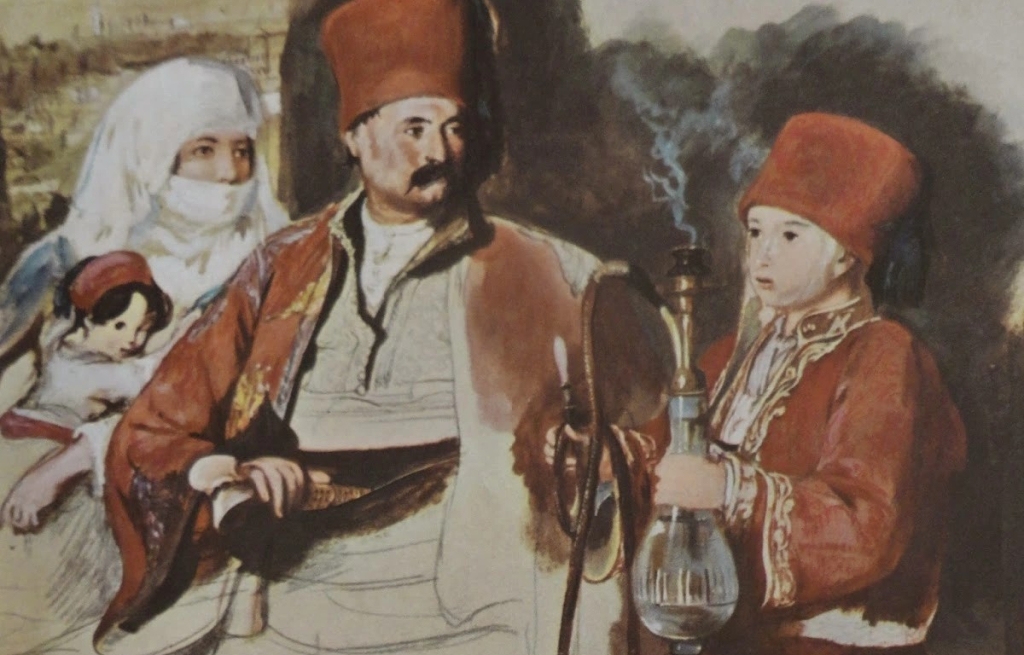

Marcantonio Borisi (b. 1570, Capodistria – d. 1621, Istanbul) was an Albanian Venetian dragoman, known as “The Albanian”, employed as bailo[1] and giovanne di lingua in Istanbul in the 17th century.[2] Born in the Venetian colonial town of Capodistria, his father was Pietro Borisi, an exiled nobleman from Antivari and his mother was Giacoma Bruti, an Istrian noblewoman, sister of three dragomans: Bartolomeo Bruti,[3] Cristoforo Bruti and Benedetto Bruti, of the Bruti family. Marcantonio Borisi first married Cassandra Prion, a noblewoman. After some time, he married his cousin Giustiniana Tarsiae and after her, he married Caterina Olivieri, who became a widow after he was executed and who remarried. With Caterina, they had four daughtes and a son.[4]
In 1596, when Borisi was working in Istanbul, he had a love affair with a Turkish woman, however, Ottoman law forbade inter-religious marriages which forced the Venetians to act in secret.[5] In 1619, Borisi seeked to wed his daughter the recently elected prince of Moldavia, Gaspar Graziani. In July, 1608, Cassandra Borisi née Piron, widow of Marcantonio, found herself in a legal dispute with an official of the Islamic pious endowment of Galata, in Istanbul. Cassandra claimed that the house the endowment owned was actually legally Cassandra’s as her husband had a paper of ownership, which the kadı had saved in the imperial archive.[6]
In 1620-21, due to having offended the Sultan, Marcantonio Borisi was hanged by the Ottomans in Istanbul and his wife received his wealth.[7][8] His widow, Caterina Olivieri-Borisi, daughter of a dragoman herself, remarried Venetian Grand Dragoman Giovanni Antonio Grillo who also, many years later, was executed. 20 years later, Marcantonios’s daughter Francesca Borisi married the Danish Hans Andreas Skovgaard, the Sultan’s physician, in Istanbul some time before March, 1641. During this time, Skovgaard had difficulty trusting the people in Istanbul, however, Marcantonio had previously helped him settle, 20 years earlier.[9]
Borisi family
Marcantonio was from the Borisi family (Boricius, Borisci, Boriši), an Albanian medieval family founded by Bernardo Borisi, who moved from Antivari to Istria at the end of the 16th century escaping Ottoman attacks.[10] Bernardo Borisi founded the family in 1503 and was the advisor the Duke of Wallachia and Transylvania. He worked as captain in Motovun (Istria) in 1602. In 1725, the family entered in the list of the title counts of Istria with the approval of Venice. In the 19th century, Austrian emperor Franz I recognized the family as Counts and Nobles.[11].
Dragoman and love affair
As a young man, Borisi was sent to Istanbul in 1585 to study language and in 1588, he petitioned to officially become a giovanni della lingua which was granted by the Venetian Senate. Borisi quickly proved himself as a trustworthy dragoman and in 1592 he was elected as a full-fledged Venetian Dragoman. Bailo Lorenzo Bernardo described him as following: “possessing prudence and experience in the negotiations of [Venice] in the Porte as if he was 40 years old and this because he is patient in his duties, and he delights in them”. Marcantonio Borisi was a polyglott who spoke fluent Italian, Wallachian, Albanian, Greek, Slavic, Persian and Arabic and Turkish.[12]
Eventually, he met a Turkish woman, who remains unnamed, which almost derailed his mission as an agent. Borisi was confronted by another Venetian official, Bailo Marco Venier in his apartment in Istanbul demanding that he end the relationship as Borisi risked damaging the Ottoman-Venetian relations. The woman risked facing consequences of the family’s honor culture, specially since they met during Ramadan. Borisi continued with the affair, however, this time he purchased a house far away from the embassy. One night, the horse servant guarding the Bailo’s horse, saw Borisi, the Turkish woman and a German man passing by, they attacked and wounded the servant, out of fear, and fled. Venier once again demanded that Borisi his affair and Venier sent a damage report to Venice. However Borisi’s value as a dragoman had him pardoned by the Senate.[13] On April 22, 1594, Marco Venier sent a letter to the Senate: “I have, as desired by your Serenity, sent Marc’Antonio Borisi to accompany the Cavass Giafer to Venice”.[14]
Execution
In 1613, Gabriel Cavazza and Marcantonio Borisi traveled to Istanbul to meet with the Sultan to discuss a border issue. Borisi was described as “dressing pompous and carrying himself gently as if he was the Prince of Bogdania”.[15] In 1620, Ottoman merchant Resul Aga and several others lost a ship to pirates in the Adriatic and the controversy threatened the Venetian-Ottoman peace which, besides another offense, ended in Marcantonio Borisi being hanged.[16] The order was sent out by Grand Vizir Istanköylü Güzelce Ali Paşa as Borisi had spoken against the Vizir.[17] Alexander H. de Groot writes that the reason was that Marcantonio had taken the Sultan’s Galiot.[18].
References
^ Gürçağlar, Şehnaz Tahir (2013). Does the Drina flow? Cultural indifference
and Slovene/Yugoslav literature in Turkish (Bernardo and Marino Borisi were
the relatives of Marcantonio Borisi, who was employed at the bailo’s house as a
language youth around the same time. It appears that Bruttis and Borisis
became friends as they worked in the same office at the Ottoman capital. ed.).
Bogazici University. p. 291. Retrieved 4 November 2019.
- ^ Rothman, Ella-Natalie (2006). BETWEEN VENICE AND ISTANBUL: TRANSIMPERIAL SUBJECTS AND CULTURAL MEDIATION IN THE EARLY
MODERN MEDITERRANEAN (PDF). University of Michigan: A dissertation
submitted in partial fulfillment of the requirements for the degree of Doctor of
Philosophy (Anthropology and History). pp. 255, 258, 261, 272. Retrieved 4
November 2019. - ^ Revue Des Études Sud-est Européennes (in French) (Translation: Due to the
fact that a sister of Bartolomeo Bruti married a member of this family, Bernardo
and Marcantonio Borisi were… ed.). Editura Republicii Socialiste România. - p. 241. Retrieved 4 November 2019.
- ^ Documentary notes relative to the kinships of Levantines and Venetians with
the Princely Families from Wallachia and Moldavia (16th–17th Centuries).
Românii în Europa medievală (între Orientul bizantin şi Occidentul latin). Studii
în onoarea Profesorului Victor SpineiPublisher: Istros Publishing House Cristian
LucaCristian Luca Research Interest – – Citations 0 Recommendations 0 new 0
Reads 2 new 31. October. 2008. Retrieved 4 November 2019. - ^ Dursteler, Eric (2000). Identity and coexistence in the early modern
Mediterranean: the Venetian nation in Constantinople, 1573-1645. Brown
University. pp. 182, 602. Retrieved 4 November 2019. - ^ Din, Edi. The Ragusa’s branch of the family Borisi. Retrieved 4 November
2019. - ^ Rothman, E. Natalie. Visualizing a Space of Encounter: Intimacy, Alterity, and
Trans-Imperial Perspective in an Ottoman-Venetian Miniature Album*. p. 72.
Retrieved 4 November 2019. - ^ VREMENA, ZRCALO. BILJEŠKE O POVIJESTI FUNTANJANSKOG FEUDA
NA POREŠTINI I OBITELJ BORISI Plemić Bernardo Borisi, prebjeg iz Bara,
otac Funtane (Translation: This brother of Bernard was a Venetian dragoon in
Constantinople, designated as a language interpreter in Constantinople, the first
Venetian citizen to be entitled Dragomano grande. They strangled him, more
strictly, on the threshold of the room in which the Sultan held meetings, after 36
years of service. ed.). 2018: Glasistre. Retrieved 4 November 2019. - ^ Luca. MARTYN RADY., Cristian (2015). «The professional elite in midseventeenth century Constantinople: the Danish physician Hans Andersen
Skovgaard (1604–1656) in the last decade of his life and career», in Social and
Political Elites in Eastern and Central Europe (15th–18th centuries) [full book on
my Academia.edu profile page]. SOCIAL AND POLITICAL ELITESIN EASTERN
AND CENTRAL EUROPE(15TH–18TH CENTURIES) Edited by CRISTIAN
LUCA, LAURENŢIU RĂDVAN AND ALEXANDRU SIMON With a Foreword by
MARTYN RADY School of Slavonic and East European Studies UCL: Edited by
CRISTIAN LUCA, LAURENŢIU RĂDVAN AND ALEXANDRU SIMON. pp. 150– - Retrieved 4 November 2019.
- ^ “Borisi, the founders of Funtana”. http://www.istra.hr.
- ^ Stoka, Peter (2015). BORISI, plemiška rodbina (Translation: The old Albanian
family, Borisi, bordered by the Count’s title, originates from Bar (Antivari) and
was accepted into the nobility council of Koper in 1617, and in 1725 entered the
list of title counts in Istria with the approval of the Venetian Republic. They used
the adjective de. In the 19th century, the Austrian Emperor Franz I also
recognized this family as the Counts and Nobles. The originator of their
ancestry on Istrian soil is Bernardo Borisi, who was to acquire the Fountain of
Fontana near Vrsar as early as 1595. Bernardo Borisi (1503) was a major and
advisor to the Duke of Wallachia and Transylvania and the equestrian general
of the ruler of Moldova. Bernardo Borisi was a captain in Motovun (Istria) in - Giacinto Borisi was the Commander-in-Chief of the Naval Command,
Capitano General da Mar in 1690. Marc’Antonio Borisi was a great dragoon, a
grandeur. ed.). Koper: Prispeval/-a: Peter Štoka, Knjižnica Koper Zadnja
sprememba: 13.3.2019, Peter Štoka, Knjižnica Koper. Retrieved 4 November
2019. - ^ Revue Des Études Sud-est Européennes (in French) (Translation: Marc
antonio had begun as a dragoman around 1595, at which time the baile
Leonardo Donato considered him a persona confidante. the baile Vincenczo
Gardenigo. It is to this character that Marc Antonio Borisi owed his rapid
progress. By cons, Marc Antonio Borisi is a polyglot, also knowing the
Romanian, Albanian, Greek, Slavonic, Ture, Persian and Arabic. ed.). Editura
Republicii Socialiste România. 1972. pp. 242, 252. Retrieved 4 November
2019. - ^ Dursteler, Eric R. (2018). Sex and Transcultural Connections in Early Modern
Istanbul. University of Rome: STUDI E MATERIALI DI STORIA DELLE
RELIGIONI. Retrieved 4 November 2019. - ^ Venice: April 1594 | British History Online (271. Marco Venier, Venetian
Ambassador in Constantinople, to the Doge and Senate. I have, as desired by
your Serenity, sent Marc’Antonio Borisi to accompany the Cavass Giafer to
Venice. Dalle Vigne di Pera, 22nd April 1594. ed.). London: Calendar of State
Papers Relating To English Affairs in the Archives of Venice, Volume 9,
1592-1603. Originally published by Her Majesty’s Stationery Office, London,- pp. 123–126. Retrieved 4 November 2019.
- ^ Helfers, James Peter; Conference, Arizona Center for Medieval and
Renaissance Studies (2005). Multicultural Europe and cultural exchange in the
Middle Ages and Renaissance. Brepols. p. 37. ISBN 9782503514703.
Retrieved 4 November 2019. - ^ Dursteler, Eric (2006). Venetians in Constantinople: Nation, Identity, and
Coexistence in the Early Modern Mediterranean. JHU Press. pp. 33, 176, 175.
ISBN 9780801883248. Retrieved 4 November 2019. - ^ Pedani, Elisabetta Ragagnin., Maria Pia. Il Palazzo di Venezia a Istanbul e i
suoi antichi abitanti ˙stanbul’daki Venedik I Sarayı ve Eski Yas¸ayanları. Hilâl.
Studi turchi e ottomani 3 (PDF) (Translation: It was not a single case, as other
dragomans were also killed by the Ottomans. For example in 1620 the great
dragoman Marcantonio Borisi was hanged by order of the grand vizier
Istanköylü Güzelce Ali Paşa with whom he had been at odds ever since they
were both young, with the pretext that he had spoken against his honor and the
his person during the discussion of a petition ed.). Edizioni Ca’Foscari. Hilâl
Studi turchi e ottomani. p. 63. ISBN 978-88-97735-62-5. Retrieved 4 November
2019. - ^ Office, Great Britain Public Record; Brown, Rawdon; Bentinck, Lord George;
Hinds, Allen Banks; Brown, Horatio Forbes (1910). Calendar of State Papers
and Manuscripts, Relating to English Affairs, Existing in the Archives and
Collections of Venice, and in Other Libraries of Northern Italy: 1619-1621.
Longman, Green, Longman, Roberts and Green. p. 195


 Balkan Academia