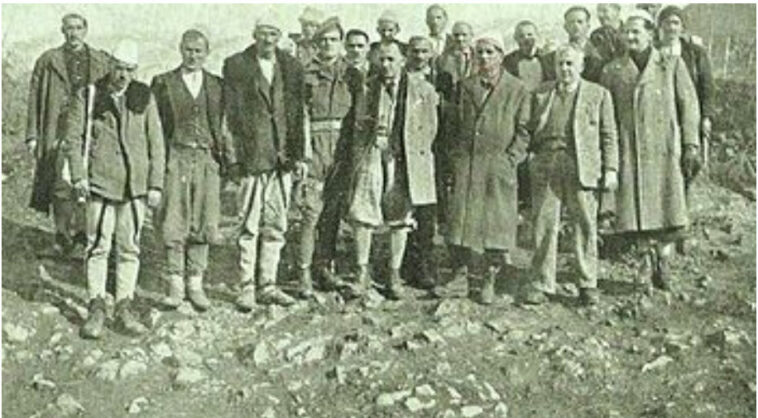

The “Kryeziu Movement” was the name of the anti-fascist nationalist movement in Kosovo and northern Albania, during the years 1940-1944, led by the brothers from Gjakova, Gani, Said and Hasan Kryeziu. Its strategic goal was the organization of the anti-fascist movement in Kosovo, its liberation from Nazi fascists, separation from Serbia and union with the mother country, Albania. The Kryeziu brothers, like hardly anyone else in Albania at that time, understood, at the beginning of the Second World War, that the most possible way to solve the Albanian national problem was to secure the support of a great decision-making power, such as Great Britain, and that such a thing could only be achieved by fighting against the Nazi fascists.
For the realization of this idea, Gani and Said Kryeziu, as early as 1940, entered into connection and cooperation with the people of the Directorate of Special Operations (SOE) of Great Britain in Belgrade, which had the task of encouraging anti-fascist resistance in the occupied countries. With the help of the SOE, during the years 1940-1941, the Kryezi tried twice to organize the anti-fascist uprising in Kosovo and Albania, but failed as a result of Greek and Yugoslav influence in the high spheres of British foreign policy.
The Greeks did not care about an uprising that would lead to the liberation of Albania. A self-liberated and independent Albania would be an obstacle to the realization of their nationalist goals at the end of the war. Even for the Yugoslavs, an anti-fascist nationalist uprising in Kosovo, which would lead to its liberation, was undesirable. In such a case, Kosovo could secure British support for the self-determination of the Albanian people. Unfortunately, the high circles of British foreign policy took a negative stance for the sake of their special interests in Greece and Yugoslavia at that time. However, the Kryeziu movement, during the years 1940-1941, became a well-known anti-fascist driving force in Kosovo.
On April 7, 1941, Gani Kryeziu and Oklei Hill together with Abaz Kupi, Mustafa Gjinishin, Father Lekë Lulin, Said Kryeziu and others. organized a large meeting in Tropoja with anti-fascist nationalists from Kosovo, Gjakova Highlands, Hasi and Luma, where the “United Front of Resistance” was formed, and the beginning of the anti-fascist uprising in Albania was decided.
1) On April 8, 1941, about 300 armed forces, most of whom were Kosovar, and were known by the name “Kosova” division, crossed the Prushi and Morina Passes and entered Has, Bytyç, Gash and Krasniqe.
2) After destroying all the border posts, those of the Carabinieri and the fascist administration in these provinces, they turned to Nikaj-Merturi of Dukagjin, with the aim of attacking the Italian forces in the city of Shkodra. These forces were joined by many anti-fascist highlanders from Gashi, Bytyçi, Krasniqja and Nikaj-Merturi, increasing their number to about 1000 fighters. Parallell, and at the same time, with the Albanian forces led by Gani Kryeziu, Abaz Kupi, Oklej Hill, etc., the Yugoslav army, which consisted of thousands of soldiers and officers, had undertaken the march towards Shkodra, against the Italians. Oklei Hilli was informed about this offensive of the Yugoslav army only a few days before its start.
3) But in fact, this unexpected action cost Kryeziu’s forces dearly. After several days of marching in the mountainous and difficult terrain of Dukagjin, and after the fighting in Gurë te Kuq, Prekal, Úre e Shtrênti, Úre e Mesi, etc. against the carabinieri forces and groups of the local population, the so-called “Volunteers” who joined the fascist forces to “protect” the province from the Serbo-Montenegrin invaders – the Czechs, as they called them, the forces coming from Yugoslavia, who everywhere passed through the highlands used only the Serbo-Croatian language. The latter, on April 23, 1941, were forced to stop their march and retreat towards Kosovo and Yugoslavia, were completely destroyed.
4) Without going into the details of this complicated event, which would be the subject of a separate study, we must admit the fact that one of the main reasons for the failure of Kryeziu’s forces was the participation of the Yugoslav army in this operation . Such a thing is affirmed by Oakley Hill when he says:
“It was the presence of the Yugoslav army that created the hostility we encountered in the north-west of the northern mountains and that took away all our chances of success there… The most severe punishment was the entry of the Yugoslavs into Albania. If this had not happened, we would be able to move without noise and fuss in the mountains and hills and find shelter by spreading out in the houses of the mountaineers.”
They would not have had any reason to oppose our simple Albanian detachment, especially when we relied on Catholic Nikaj and Krasniqja. The thing was that the whole far north knew about our presence there and that some thought that we were the tools of the Yugoslavs. This was the fatal blow.”
5) On the other hand, on the exact days when these forces started the march towards Shkodra, Nazi Germany invaded Yugoslavia. This completely changed the situation in favor of the nazi-fascists, not only in Yugoslavia, but also in Albania and the entire Balkans, making it impossible to continue the initiative in question, for an anti-fascist uprising in Albania. The British project of December 1940 and April 1941, for the organization of the uprising in Kosovo and Albania, under the leadership of Gani Kryeziu, despite the fact that it failed, showed that Gani and his brothers already at that time had become well-known figures of the anti-fascist movement in Kosovo and Albania.
Because of this activity, at the end of 1941, Ganiu and Saidi were arrested by the Germans, and after handing them over to the Italians, the latter interned them in Ventotene, Italy, where they stayed for two years. During the period 1942-1943, the Kryeziu Movement was kept alive and led by Hasan Kryeziu, who had escaped exile. He constantly kept close to him a considerable number of supporters for propaganda and anti-fascist actions in Kosovo. In the second half of 1943, numerically and organizationally, this had become a serious force of the anti-fascist war, known in Kosovo and Albania.
Therefore, the communist leaders of the national liberation movement, Enver Hoxha and Sejfulla Malishova, in August 1943, asked Hasan Kryeziu to unite his forces with the partisan forces.
6) H. Kryeziu opposed this request, because he maintained the idea of the independence of the nationalist forces from the communist command, due to the latter having close ties with the Serbian-Montenegro communists. On December 3, 1943, Hasan Kryeziu met with the officer of the British mission in Albania, Major Peter Kemp, at the house of Mehmet Ali Bajraktar of Has, where they discussed the various problems of the anti-fascist war and agreed to undertake a special mission together in Kosovo, for recognizing the possibilities of organizing armed resistance against the Germans with Albanian elements in Kosovo.
Two of the leaders of the irredentist group in Kosovo met with Kemp and H. Kryeziu; Selman Riza and Ejup Binaku, both from Gjakova. They promised Kemp that they would support him during his trip to Kosovo and that they would form a squad of fighters with over 200 people which would initially serve as a protector of the British military mission during its trip to Kosovo, and then continue the war against the Nazi-fascists.
On January 7, 1944, in Gjakovë, Petër Kemp and Hasan Kryeziu organized a conference with a wide participation, where they were present; the mayor of the Municipality of Gjakova, the commander of the Albanian Army of Kosovo, Selman Riza and others. There was a long and wide discussion about the organization of anti-fascist nationalist resistance in Kosovo. Selman Riza promised to prepare an immediate action against the Germans, while the commander of the Kosovo Albanian Army promised to supply Selman Riza’s men with weapons and instructors. 8) Kemp’s two trips with Hasan Kryeziu, in Gjakova and Peje, on December 15-17, 1943, and January 13-22, 1944, were quite successful. They served for the recognition of the general situation there and for the drafting of a detailed plan of anti-fascist nationalist resistance in Kosovo.
References
KONGRESI I PËRMETIT Forumi në Telegraf/ Sot mbushen 78 vjet nga Kongresi, flasin Xhafa, Bezati dhe Bashkim Qeli: Ngjarje historike që i dha fund monarkisë. Link here.
“Kryezi Movement in the Course of the Second World War” by Uran Butka. Published 2007. Issue 37. Link here
Raporti i britanikëve: “Kryezinjtë patriotë, mbajtën Enver Hoxhën me para në Paris”. Author Erald Kapri. Published October 10, 2017. Link here.

 Balkan Academia