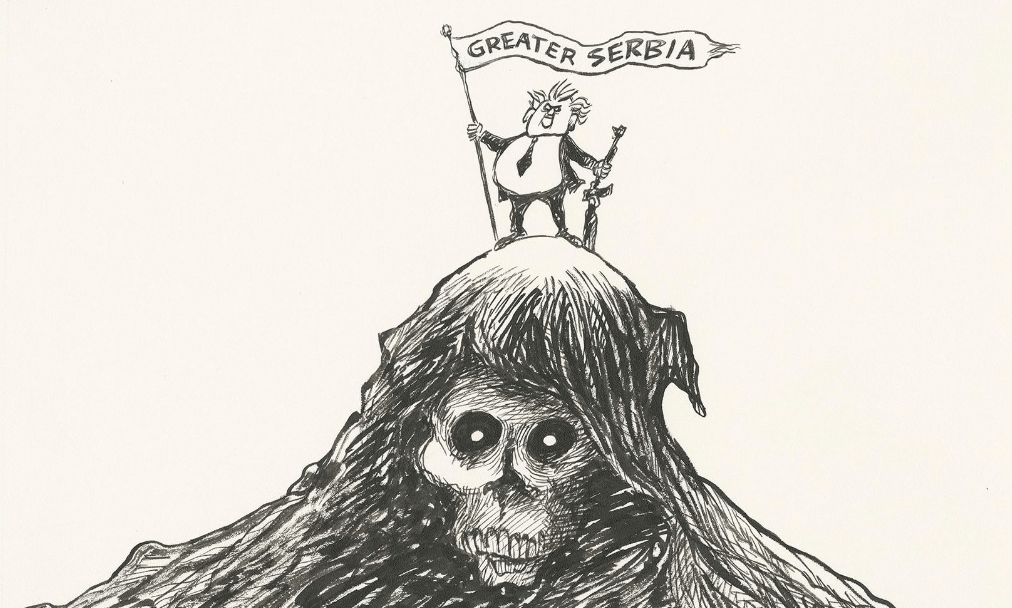

“In the mid-1980s, especially after Slobodan Milošević had risen to power, the media in Serbia began to be intensively concerned about Serbian national issues, and spread largely nationalistic propaganda which found its expression in overstressing the allegedly difficult situation and endangerment of the Serbs and Serbia within the Yugoslav community, i. e. endangerment of the Serb people and their interests in other republics and autonomous regions, especially firstly in Kosovo and later Croatia. Print media were no exception.
One of the most widely read and surely the most distinguished daily newspaper, the Politka joined most actively in the implementation of such propaganda, but other publications also showed to a greater or lesser degree, similar editing policies. Print media supported Milošević’s policy for the most part, and, in this way, influenced the formation of public opinion, creating the atmosphere of national intolerance and stirring up the Greater-Serbian nationalism, i. e. inducing people to accept the idea of the creation of a Greater Serbia, which eventually surely contributed to the willingness of a part of the population to join the war conflicts or support them.
The major starting point for the development of the Greater Serbian propaganda was the publishing of the parts of the so called Memo of the Serbian Academy of Science and Art in the Večernje novosti daily. The Memo dealt with Serbian national issues in Yugoslav community and aimed to the idea of the rearrangement of the state. Although the Memo was at first strongly disapproved by bought politicians and journalist, pretty soon one by one the themes and thesis from the Memo started to appear in the newspapers, drawing the blueprint of Greater Serbian propaganda. At first, the major propaganda thesis was the allegedly poor position of the Serbians in the Kosovo Autonomous Region, which included building and creating various stereotypes of the Albanians which were the first and most lasting “victims” of Serbian propaganda. At the same time the issues from the WWII, i. e. from the period of
so-called Independent State of Croatia started to rise, especially concerning the Serbian
victims of Concentration Camp Jasenovac.
After the first great Serbian assembly on Kosovo Polje, conformity between Slobodan
Milošević and the press was tightened. After Eight Session in the September 1987 Slobodan
Milošević had gotten ridden of his political opponents and had gained dominance in the
Serbian Communist Party and in the process than called “differentiation” he had concord most
of the media space which than had become one of his most important allies in the campaign
for the united Serbia in the period of the so-called Anti-bureaucracy Revolution. In that period
beside from the Albanians, the Serbian press started propaganda against Slovenians and
Croats, but in that time it was primarily aimed against the political leadership of these two
republics. Slovenia and Croatia were blamed for the poor state of Serbian economy and for
their alleged coalition with Albanians against Serbia.
In the first middle of 1989 after new amendments on Serbian constitution were
brought and after Serbia practically gained control of its autonomous regions Vojvodina and
Kosovo, in the center of the Greater Serbian propaganda came the Kosovo myth which
purpose was to rise and to firm national consciousness of Serb people. The second great issue
of this period was propaganda against Slovenia which was accused for supporting Albanians
and for economic egoism and selfishness. This peak of anti- Slovenian propaganda was also
some kind of farewell from this Northern Yugoslav Republic. This was also the time when the
question of endangerment of Serbs in Croatia was brought to light.
After the 14th Congress of Yugoslav Communist Party, and especially after the
democratic changes in Croatia, begins the period of intensive anti-Croatian propaganda which
lasted until the beginning of the war conflicts in Croatia in March 1991. In this period press
played very important role in the process of construction of enemy and creating pre-war
atmosphere that made possible later Greater Serbian aggression on the Republic of Croatia.”
Read the rest of the publication here.
Reference
Zeljka Krize. “Great Serbian political propaganda on the eve of the disintegration of Yugoslavia from the sanu memorandum to the beginning of the war conflict in Croatia” (1986-1991). Doctoral thesis. Zagreb 2015. https://dr.nsk.hr/islandora/object/hrstud:957/preview


 Balkan Academia