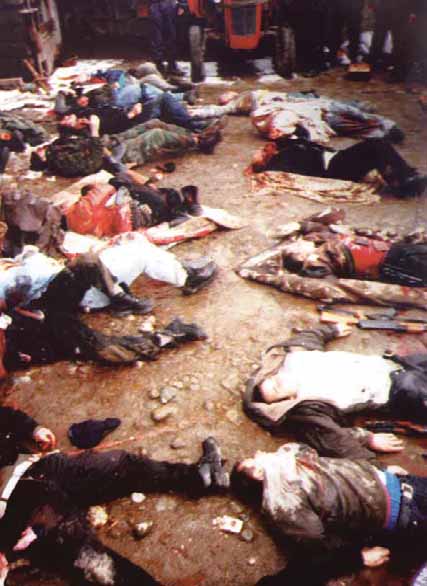

Saxed from Pr. Nusret Pllanas publication titled “NATO Intervention in Kosova” from 2011.
“The genocidal size of the tragedy in the city of Srebrenica, even today, remains the most tragic and special case in the history of international wars in regards to the injustice that was done to solve it. Scholars and other experts of the events that took place inSrebrenica consider the United States of America and WesternEurope to be accomplices, accusing them by saying that their partnership ended in genocide.It is known that in 1995 the troops of the UN forces established their military base close to a location called Potoqar.
The city of Srebrenica, which was in the neighborhood, before the start of the war had more than 18,000 citizens. More over, the United Nations had declared that the city and its surroundings were protected. After this act, the UN administration took care of other refugees, Bosnia and Herzegovina Muslims, and placed them in this town. This way, in a relatively short time, there were over 42,000 citizens in Srebrenica, which means that the number of its population more than doubled.Declared to be a protected zone, the citizens of Srebrenica did not have the right to bear arms.Firstly, the possibility of defense, even the personal lives, was far from being a reality.
Secondly, even according to international rights, and also according to the promises that were given to the Muslims from Bosnia andHerzegovina in Srebrenica, the international community had an obligation to provide them with protection.But what happened in reality? On July 6, 1995, the Serb military and police units violated the agreement and attacked the city. The international community reacted in a way that is now globally known. This stand of the international community was irresponsible, never investigated, never analyzed fully, and never received the judicial decision that it deserves.
What happened onJuly 11 of the same year, not only justifies the presence of the international forces, which was the case of the peacekeeping units of UN, but they, fully aware as it seems, would violate their mandate, which was clearly defined, that they were there to protect the unarmed citizens of the city. Why these troops of the United Nations did not accept the duty of protecting the Muslim citizens ofSrebrenica remains unclear, but it is also not clear how it is possible to leave the unprotected in the hands of the Serb military of Bosnia. This way, the international troops left the city in the control of the Serb soldiers, policemen, and paramilitaries, something that has never been fully understood, or studied in the full course of events.
Some scholars say that the UN soldiers created a brotherhood link with the Serb army. This cooperation, after the brotherhood, escalated to the level of a determined form of cooperation, and to such an extent that the UN soldiers helped the Serb forces in the separation of the Muslim men from the women. After the end of the tragedy of Srebrenica, it is estimated that 23,000 Bosnian-Muslims were victims of ethnic cleansing. Moreover, it is known that another dimension of this tragedy was the killing of approximately 10,000 Bosnian-Muslim men and boys. Further, no mention has been made of the thousands who were beaten and tortured in an inhumane way before being executed.
Also, the number of women raped has not been determined and we have not found out where these women and girls are. Despite the political activities of the UN and NATO, a massacre happened which was considered by the press and scholars of that time as the most terrible genocide after the World War II.As far as it is known, the role of the UN forces in Srebrenica was as simple as the gathering of people for Kurban. Regarding this and numerous other questions and dilemmas, the answer possibly has to do with the end of the murders and relates to NATO expansion and its global role that it inherited since the post Cold War period.”
Source
Nusret Pllana. “NATO Intervention in Kosova” (E-book). 2011. https://nusretpllana.com/products/nato-intervention-in-kosova-e-book?pr_prod_strat=copurchase&pr_rec_id=8c22a4a00&pr_rec_pid=8091886551362&pr_ref_pid=8043103912258&pr_seq=uniform


 Balkan Academia