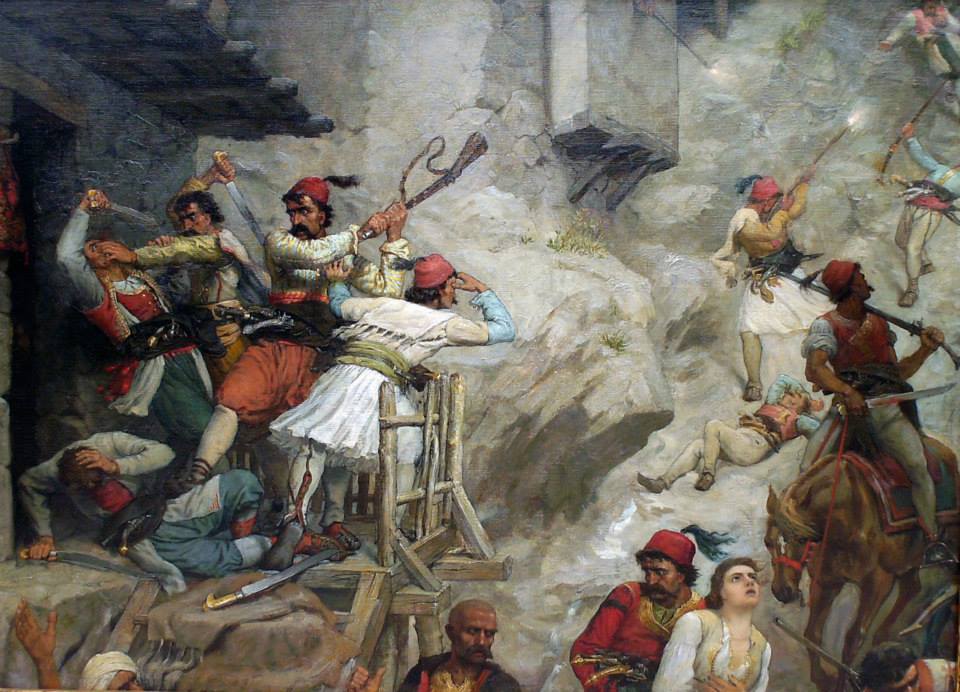

Taken from “Figura e Armikut – reinformation of Albanian-Serbian relations” by Rigels Halili, Aleksandar Pavloviq, Armanda Hysa and Adriana Zaharijeviq. Published in Prishtinë, 2016.
From hero to wild man: Albanians in Serbian heroic and national discourse from the middle of the 18th century to the beginning of the 20th century
Abstract: In this paper, it is asserted that the negative representations of Albanians in Serbian culture become dominant only in the last quarter of the 19th century. In the first part, examples of mutual positive perceptions between Serbs and Albanians from oral tradition and the works of ethnographers and early Balkan historians from the half of the 18th century to the second half of the 19th century are used. The respect for Albanians as brave warriors and heroes, which we find in these examples, derives, as the paper asserts, from the similar social arrangement and common patriarchal values in both ethnic groups.
In the second part, the paper focuses on the last quarter of the 19th century, when the perception of Albanians changes, which comes as a result of the Eastern Crisis of 1875-1878, the formation of the Albanian National Movement, the weakening of the Ottoman power and the territorial claims of both ethnic groups in relation to today’s territory of Kosovo and Metohija/Dukagjin and northern Albania. The thesis is that these trends gradually led to the emergence and growth of Serbian-Albanian enmity, which eventually strengthened on the eve of the Balkan wars of 1912 and 1913. In the end, the article focuses on the positive examples of Serbian intellectuals and public figures. who have criticized this negative approach and are committed to re-arming the narrative that emphasizes similarities and promotes friendship between Serbs and Albanians.
The Albanian as a hero, relative and friend in the Serbian heroic discourse of the 18th and 19th centuries
Despite the opinion rooted today, about the centuries-old enmity between Serbs and Albanians, documentary sources from the past show that Serbs and Albanians have not seen their relations for centuries as problematic, therefore it cannot be argued for any coherent anti-Albanian or anti-Serbian discourse before half second half of the XIX century. This statement deserves a more extensive explanation. Books such as Imaginary Balkan (1997) by Maria Todorova, or Wild Europe (2004) by Božidar Jezernik offer abundant examples of Balkan discourse from the mid-16th century to today.
The term Balkanism is, as is known, close to the concept of Orientalism by Edward Said. Maria Todorova describes it as a discourse that generates or creates stereotypes about the Balkans and as politics organically linked to that discourse. Thus, the Balkans are often stereotypically presented as “synonymous with what is indigenous, backward, primitive and barbaric” (Todorova, 2006, 47). Moreover, these negative perceptions of the Balkan peoples can also include the deeper past, as happens for example with the interpretation of the contempt that the Byzantine authors show towards the “barbaric” customs of the Serbian and Bulgarian nouveau riche rulers, which is genealogically related to the authors ancient Greeks and their descriptions of Thracians and other non-Hellenic Balkan inhabitants as barbarians.
In short, while this external Balkanism has deep roots in the past, Serbian-Albanian internal Balkanism represents a relatively late derivative of it. Before the 19th century, educated Serbs were little interested in Albanians, and consequently the information that can be found about them in the Serbian sources of that time is very little. It is indicative, for example, that Albanians do not play an important role even in the two program notes of Serbian nationalism, Vuk Karadžić’s Serbs all and wherever they are (which was written in 1836 and published in 1849) and Ilija’s Naçertanije Garasanin, written in 1844.
In the introductory paragraph of Serbs all and wherever they are, Karadžić starts from the position that all speakers of the Shtokavian dialect should be considered Serbs, regardless of whether they refer to Orthodox, Catholic or Muslim. He then mentions the territories where the Serbs live, but regrettably states that there are no records for the Albanian and Macedonian Serbs:
“It is not yet known exactly how many Serbs there are in Arnauti and in Macedonia. In Cetina (in Montenegro) I talked with two people from Dibra, who told me that there are many “Serbian” villages there, where Serbian is spoken just as they also spoke it, i.e. between Serbian and Bulgarian, but still closer to Serbian than Bulgarian.” (Karaxić, 1849,)
Ilija Garashanini wrote Nacertanija as a secret document in order to determine the strategy for the future foreign policy of Serbia and its territorial expansions. Garašanin dreamed of renewing the medieval Serbian empires, but in fact he drew concrete notes and plans for Bosnia and Herzegovina, Montenegro and southern Hungary; in other words, he knew those places which at that time were in the composition of Serbia, Montenegro and the Habsburg monarchy, while it is clear that the areas south of the borders of Serbia at that time, which belonged to the medieval states Serbs, were unknown to him.
Albanians are mentioned in this document only once, in the context of his recommendations for strengthening ties with the Montenegrins and Albanians of northern Albania, whom he calls the key to the passage to the Adriatic Sea (Lushić , 1993, 181). This seems rather modest compared to later Serbian politics, in which Kosovo and the Albanians play a more important, if not central, role. Moreover, even within these modest references to Albanians, both authors show respect for them as heroes. Garashanin emphasizes the fighting spirit of the inhabitants of Montenegro and northern Albania (“the fighting spirit of their inhabitants”) as a suitable factor, which Serbia should exploit while establishing its influence over them. Karadžić, for his part, praises the Albanians, because they show solidarity towards their compatriots regardless of religion and stand together against the Serbs, who lack this solidarity.
The lack of information about Albanians in this period is not surprising – in Serbia at that time, knowledge about the neighboring people under Ottoman rule was very little. It is telling, for example, that 19th-century illim writers knew very little even about the Montenegrins, whom they considered superior Serbs because of their continued resistance to Ottoman rule and the independence they enjoyed de facto. , if not de jure, in their mountain villages. Thus, for example, the father of modern Serbian culture, Vuk Karadžiqi, in his first Dictionary of the Serbian spoken language, published in 1818, describes the Montenegrin capital Cetina as a river and a region. In the same year, Lukijan Mušicki (Lukijan Mušicki), the leading Serbian poet of that period, published his famous ode dedicated to the great Serbs of the time, while he later explained that he did not include Petar Petrović I in it. , Njegoshin, because at that time he did not know anything about him (Zuković, 1988, 11-12). If we take into account that in that year, 1818, Peter I had already been in power in Montenegro for 35 years, this clearly shows the very modest knowledge even of Montenegro at that time, and only confirms a sometimes the former Karadzic residents for complete ignorance of the southern villages inhabited mainly by Albanians.
Coexistence and connection
Dositej Obradoviqi has left one of the earliest testimonies about Albanians in Serbian literature. Born in what was then Hungary in 1739, Obradović as a boy entered the Hopovo monastery in Frushka Gora with the intention of becoming a monk. However, he soon became acquainted with advanced ideas, left the monastery and traveled throughout the Balkans and Western Europe for several decades. Among the memories from his many travels, which he summarized and published in the book Life and Journeys i 1783, Obradoviqi also evokes the memory “of that brave nation and those beautiful places” which he got to know during his stay among the Albanians near Gjirokastra, in southern Albania in 1769:
“How good it was for me to hear from the same Albanians that they say: “Whoever rules Serbia, we love him and we as a ruler should recognize him, because the kings of the Serbs were also ours”. Not far from Hormova there is a beautiful field, which the Albanians simply call “lepazhita”. I ask them what this means, “we don’t know”, they tell me, “this is the name of the field”. And when I explain to them, telling you that this is a Serbian horse, “monk”, they answer me, “don’t be surprised by this; we were of the same race with the Serbs in the old days!” (Obradović, 1989, 182)
Recently, some interpreters have appeared who try to present Obradović as a Serbian nationalist, and of course they would have rejected this part of the writing as unreliable (Anzulović, 1999, 73). In any case, in this context, Obradović’s testimony is valuable because it shows that in this work, with a consistent progressive spirit, he states that Albanians deserve education and that they are a brave people, who populate bura has a common origin with Serbs. This early evidence for southern Albania is rare. Much more information about the Albanians will be found in the writings of the Montenegrins or about Montenegro, taking into account that for a century or more the most pronounced Albanian igura was the igura of the highlanders who populate the areas adjacent to the Montenegrins – since then were considered mainly Serbs – which include today’s northern Albania and the Zeta valley. The earliest Montenegrin histories are two relatively short records prepared for (or commissioned by) the Russian royal court:
“I will not leave the occasion here without also mentioning the brave people who live around us, and who today belong to the Turkish region, while before it was under the rule of the dukes of Zeta and Montenegro: precisely the Mürkojevics and Bijello Polje, the same the other peoples who live around and who are warlike by nature, are found up to the river Drin, and that river Drin separates the Duchy of Zeta and Albania. Nor are these peoples completely under Turkish rule, as other peoples are.”
– Vasilije Petrović Njegoš (Vasilije Petrović Njegoš), History of Montenegro (1754) (Milić, 1997, 25)
“The Montenegrins – the various provinces and Slavic-Serbian peoples – include: the Kučs, the Bratonozhiks, the upper and lower Vasojevics, the Piperis, the Rovčans, the Moračans, the Bjelopavlićs, the Orthodox of the Serbian people, who are in fact Turkish subjects. In the same way, they include the Catholics: the Hotis, the Kelmendis, the Grudas, the Tuzis, the Shkrivals, the Huzis, the Maltese, the Kastrati and others, who outnumber the Montenegrins.”
– Jovan Stefanović Balević (Jovan Stefanović Balević), Brief historical-geographic description of Montenegro (Balević 1757)
Reference
Taken from “Figura e Armikut – reinformation of Albanian-Serbian relations” by Rigels Halili, Aleksandar Pavloviq, Armanda Hysa and Adriana Zaharijeviq. Published in Prishtinë, 2016. To read the whole publication, visit https://www.academia.edu/27701526/Figura_e_Armikut_RIP%C3%8BRFYTYRIMI_I_MARR%C3%8BDH%C3%8BNIEVE_SHQIPTARO_SERBE.

 Balkan Academia