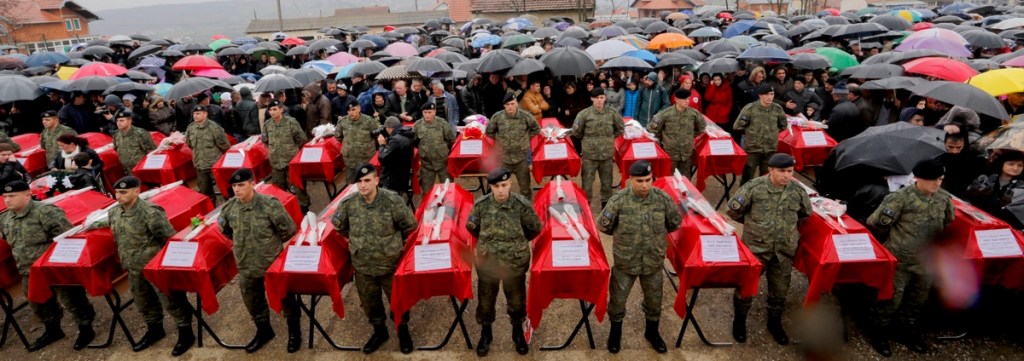

As long as such documents are not allowed to become the subject of study investigation, Serbian doctrine and crimes will remain unpunished and with it the documentation of the existence of the state’s intention for the complete undoing of the demographic composition of Kosovo, that is, of the genocide of happened at the end of the 20th century.
Manipulation of the number of Serbs left
In the discourse of Belgrade’s official policy, similar to the period of Milosevic’s rule, an extreme exaggeration is made with the numbers of Serbs who left. While there were no more than 194,000 Serbs in Kosovo according to the 1991 Belgrade census, the Serbian government talks about the departure of 250,000 or more Serbs from Kosovo. Even according to the official data of the Center for Demographic Research, institutions and the Institute of Social Sciences of Belgrade in Kosovo, in 1991 there were only 194 thousand Serbs.
If it is considered that 115-125 thousand Serbs live in Kosovo today, then it turns out that the exact figure of those who left is no more than 57-66 thousand people, including members of the police, military, judges and local administrators as well as 18 thousand and 600 Serbian refugees who were settled there from the Krajina of Croatia and Bosnia and Herzegovina, as well as a small number of Serbs who came from Albania. These data are also confirmed by the Kosovo Coordination Center of the Government of Serbia, in February 2002, which stated that there were 129,474 Serbs living in Kosovo, while the European Stability Initiative (ESI) reported in 2004 that in Kosovo there were about 130 thousand Serbs.
Although all crimes are unforgivable, there is an essential difference and an insurmountable causal link. This phenomenon has also been affirmed by Dan Everts, ambassador and former head of the OSCE Mission in Kosovo (1999-2001), who says: “Unlike the acts committed by the Kosovar Albanians, the ethnic cleansing of the Albanians by the Serbs, which was the result of a systematic campaign, planned and desired by the highest authorities, and involving both regular and volunteer forces. There is no evidence similar to this, for a strategic or systematic targeting of Kosovo Albanians”.
A similar argument is made by the former Yugoslav Foreign Minister, Serbian politician Milosh Miniqi, who asserts that when thousands of Kosovar Albanians expelled from Macedonia, Albania, and Montenegro were returning to their ruined towns and villages and burned, “simultaneously, tens of thousands of Serbs, Montenegrins, Roma and a number of Muslims and Gorans, in long columns, along with and parallel to the columns of military and police units, in fear of retaliation fled from Kosovo to the interior of Serbia and Mali Black.
From the fear of revenge for everything they had done to the Albanians in the last ten years, especially since the beginning of the war in Kosovo, in the name of the Serbian people and the Serbs of Kosovo, the government, the army, the police and the paramilitary gangs joined by some Kosovo Serbs, Montenegrins, Roma and others, as reported in the foreign press, supporters of Razhnatović Arkan and Vojislav Sešel (Milosh Miniqi, “The other Serbia”, p. 181).
Moreover, mass departures as a result of war are not unknown in Europe. Take the case of the displacement and expulsion of 14 million Germans from Eastern European countries at the end of World War II. Poland, Sudetenland, Bohemia, Hungary, Rumania, Vojvodina and Croatia and other German population from Russian territory, but for these reprisals, a free discussion began only after reunification, there is a very clear causal connection. Josef Wolf, from the Institute for Danube-Swabian History and Regional Studies in Tübingen, says that making a causal link clear “means that one should never forget that the deportations are the result of what Germany did at the start of World War II “. Such an argument was also accepted by the Potsdam Conference (July 17 – August 2, 1945), which confirmed the expulsion of the ethnic German population by calling for it to be done “in an orderly and humane manner”.
The reason behind Serbia’s refusal to admit the crime and genocide
While war crimes remain an indelible stain, in Serbia the crimes are justified in the context of building a large and homogeneous state. As a consequence, even the judgment remains superficial or provisional. In addition, if we look at the history of Belgrade’s cooperation with the ICTY, then we see that the Serbian authorities in Belgrade have selected pieces of important evidence and placed them under institutional protection so as not to become known. This Serbian approach to hiding the documents ultimately paid off, as in 2007 the ICJ acquitted Serbia of state responsibility for genocide in Bosnia-Herzegovina. The concealment of documents in this case protected Serbia from accusations of genocide.
According to expert Nevenka Tromp, history shows that states are rarely willing to accept the crime of genocide, at least for three reasons, and these three reasons explain Serbia’s (non)cooperation with the ICTY and the ICJ.
First, the state accused and found legally responsible for violations of the Genocide Convention at the ICJ will more than likely be ordered to pay extraordinary sums as compensation to the injured party, the Albanians, Bosniaks and Croats. Consequently, no state – either a regime participating in the conflict or a successor regime after the war – would voluntarily accept the commission of genocide and, therefore, not hand over the documents of its state archive, which would serve as evidence. ICTY prosecutors, unlike their Nuremberg counterparts, did not have full or free access to the written material found in the former leader’s national archive.
Second, the documentation by the court that genocide was committed becomes permanent historical documentation, which would tarnish that country forever. By creating a counter-narrative, which is essential to deny the claims of Serbia’s involvement in the genocide, today’s state elite in Belgrade, led by Vučić, the former Minister of Information in Milosevic’s Government, has deliberately sought to equate criminal responsibility historical, or, to present the victims as the main perpetrators of the crimes.
Third, not acknowledging the crimes committed by the previous regime (Milosevic) leaves the successor regime (Vučić) free to pursue the unfinished geopolitical objectives that its predecessors failed to achieve, despite committing mass inhumane crimes. .
Milosevic’s name – synonymous with massacres and inhumane crimes
However, failure to achieve other objectives was accompanied by atrocities and inhuman mass crimes not seen in Europe since World War II. Thus, Milosevic’s name became synonymous with massacres and inhumane crimes. This is precisely the reason why the aggressor states responsible for war crimes resist confronting the past and try to put the criminal past under the rug. And as long as its Serbian doctrine, which has now taken new forms, sometimes declining, sometimes rising, depending on internal and external political circumstances, remains unpunished, it represents a form of threat permanent for the countries of the region in general.
(Un)obstructed access to archives
Confronting crime remains the fundamental test for Serbian society and will be a test of its degree of emancipation. Serbia’s international responsibility, even according to public international law, is political, material and moral responsibility. The first positive sign would be access to war crimes files for journalists, researchers and the general public, thus illuminating a very important part of recent history. Serbian state archives certainly contain encrypted documents about the operation of Serbian armed units in Kosovo and about the methods of deportation and mass killing of Albanian civilians. Illustrative is the case of the refusal of the Serbian Ministry of Defense to hand over the war reports of the 37th Motorized Brigade for April 5 (the day of the crime in Rrezalle) and April 6, 1999, on the grounds that the entire archive of the 37th Brigade it was classified as a state secret.
Access to the Serbian military archives, which would document war reports of this brigade as well as Serbian state operations in the Kosovo war, would make it possible to reveal the truth, to judge the real authors of these crimes, as well as to confront them critically. the past. Croatian researchers Mirko Grmek, Marc Gjidara and Neven Simac claim that in the wake of the events that led to the dissolution of Yugoslavia, the former JNA had elaborated many plans, which aimed to prepare the way for the determination of new borders and the creation of Greater Serbia. as well as envisioned the ethnic cleansing of the land and the unification of all Serbs in one state.
Therefore, in order to use them as evidence in courts, including the Special Court in The Hague, it would be necessary to seize the archives of the state and the Socialist Party of Serbia, just as the Allied Powers did in the Nuremberg process. Or at least Belgrade would have to be forced to remove any embargo placed on the Archives of Serbian Majesty, namely the documents of the Supreme Defense Council, by the current and previous leaders of the Serbian state. As long as such documents are not allowed to become the subject of academic investigation, Serbian doctrine and crimes will remain unpunished and with it the documentation of the existence of the state’s intention to completely undo the demographic composition of Kosovo, that is, the genocide of happened at the end of the 20th century. Belgrade wants to make the genocide in Kosovo as difficult to verify as possible.
Reference
Translated. Written originally by Sylë Ukshini on Koha.net. April 2, 2023. https://www.koha.net/shtojca-kulture/372090/e-verteta-per-krimet-ndaj-shqiptareve-e-fshehur-ne-arkivat-serbe/


 Balkan Academia