
Text originally written by Hysen Bojaxhiu, on April 11, 2021, on Pashtriku.com
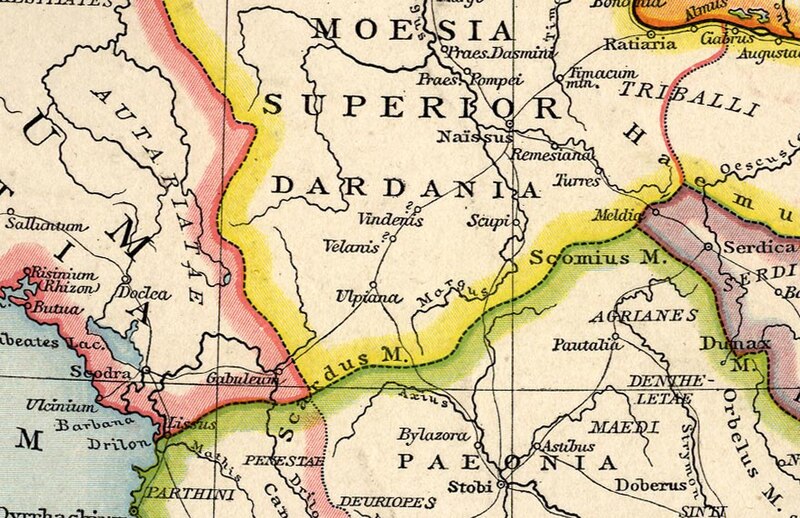
The Dardanians were one of the 70 Illyrian tribes that played an important role in history. They were residents of the Central Balkans, mainly in today’s territory of Kosovo. The name dardan is thought to have come from the name of the tree and the pear fruit.
In today’s territory of Kosovo and other provinces around it, the Dardane Kingdom was established in the 4th century AD. The borders of this kingdom went to the north to the city of Nish, and to the south to Kukës and to the upper reaches of the Vardar. The first Dardan king, as well as the one who is considered the founder of the kingdom, was Longari. After him came kings Bato and Monuni.
During the reign of Longari, the Dardanians experienced great economic and military development. The Dardanian society was based on the slave-owning system with a developed handicraft, agriculture and animal husbandry.
Since the 4th century AD, Damastion’s silver coins circulated in Dardani. During the reign of Longari, they also had a military development, where they already had a regular, organized and well-armed army. This is observed several times in the war against the Celts, Macedonians and Romans.
During the 3rd century AD, when the Celtic tribes descended from Central Europe to the Balkans. The Dardanians not only managed to defend themselves very well, but were also willing to help Macedonia in the face of attacks by the Celtic tribes. The Dardane kingdom was almost in conflict and with continuous wars against Macedonia.
The Dardanians expanded their state into the region of Paeonia. Some authors claim that they expanded to the Adriatic Sea and the Ionian Sea, holding for a while the Greek colony of Epidamos. But this was a short rise that was more due to the weakness of others than due to the strength of the Dardanians themselves.
With the conquest of the Illyrian lands by the Romans, they returned with fierce and frequent attacks against their former ally, Dardania. But the Dardanians continued to resist for many years. However, in 97 AD, the Romans managed to temporarily subjugate the Dardanians. The Romans compared the Dardanians to the Kucedra of Lerna, which, when they cut off all the heads it had, resurrected them again.
After many battles with the Romans, at the end of the 1st century BC. the Dardanians lost their independence and fell under the occupation of Rome.
The Egnatia road, which was the most important road of the time, passed through the territory of Darda. Dardania also had several important cities such as: Ulpiana, Skopje (It was also the capital), Artana, Demastinonin, etc.
With the conquest of Dardania by the Romans, this kingdom ends, but despite this the population which remained under the Roman Emperor for more than eight centuries until the Slavic wars in the Balkans did not die out. This period was not notable for major developments worth mentioning, but Dardania provided some of the most prominent emperors, including Constantine the Great, Claudius II, Aurelian, etc. Christianity spread in several stages.
With the Slavic influx into the Balkans that began in the middle of Justinian’s reign. In 547 and 548, the Slavs conquered the territory of today’s Kosovo. The big and massive invasions in the Balkans happened around the year 580, where the territory of Kosovo was also populated by them, but without losing their identity at any moment. The Serb population is believed to have occurred around the year 620, where they were concentrated in the area of Rashka, in the northwest of Kosovo and in the region of Montenegro. This can also be taken as the period when the Serbs settled in the lands of Kosovo. They settled at first in some small tribal territories called zhupa
In the 9th century, a powerful expansion of Slavic power can be observed. The Bulgarians began an expansion in the region where for a short period they managed to conquer today’s Macedonia, Eastern Serbia, in 850, they managed to take Kosovo as well. Where for nearly 160 years, Kosovo would remain under Bulgarian rule until 1014-1018, when King Samuil died and his empire was dissolved.
According to historical and reliable data, it can be seen that even though the territory of Kosovo was populated in some places by Serbs, even after the establishment of the Serbian state of Rashka, Kosovo was not part of that state. The Serbian expansion in Kosovo began seriously only at the end of the 12th century.
With the arrival of the Nemanjas at the head of the state of Rashka, this state began to expand in this way during the 1180s, taking advantage of the weakness of the Byzantine Empire, Stefan Nemanja expanded his rule, where this expansion also included a part of the territory of Kosovo (1184-5) . But within a period of 11 years, the state of Rashka (which would now be considered the Serbian state) included all of Eastern Kosovo. Stefan conquered all of Western Kosovo (without the Prizren area) in 1208.
But in 1216 they managed to conquer Prizren as well. Thus, the entire territory of Kosovo fell under Serbian rule. During the period of nearly 155 years, the territory of Kosovo remained under Serbian rule but in 1371 two events occurred which accelerated the decline of the Serbian state: a Serbian army under the command of Vukashin was annihilated by the Ottoman forces in the battle by the Marica river in Bulgaria and the death of Tsar Uroshi who left no descendants, and this situation the Balshaj family took advantage, which occupied the southwestern part of Kosovo, including Peja and Prizren, while Llazar advanced from the south to take Pristina.
After the battle of Marica, the Serbian possessions were fragmented into a series of principalities. Most of Kosovo was under the control of Vuk Branković. In history, what is known as the Battle of Kosovo is also known, on which there are big question marks. There is a lot of uncertainty about it, starting from the number of soldiers, the principalities that participated there, the role of the Albanians, etc. Serbian historians consider this battle to be quite important and as a result of this they have created the so-called “Myth of Kosovo”, Albanian historians who dealt with that period have doubts whether that battle really existed or not.
With the penetration of the Ottoman Empire in the Balkans, Kosovo was also part of the Ottoman intentions to take it under control. In 1454, Mehmet II sent large military forces against Gjuragj Branković the elder. By the end of the year, most of Southern and Central Serbia had been occupied by the Turks. In 1455 Mehmet besieged Novobërden and for forty days, its walls were demolished by Ottoman artillery. On June 1, 1455, a surrender agreement was made. Mehmeti promised that he would allow the inhabitants to keep his property and that the women and children would not become captives. This promise was not kept and with the capture of Novobërda, 74 women were “given to the infidels”, while 320 children were taken to become janissaries. Prizren was the last city to surrender, on June 21. The entire territory of Kosovo fell under Ottoman rule and would remain so until the beginning of the 20th century.
With the Ottoman occupation of Kosovo, the establishment of the administration and social regulation began. A part of Kosovo was part of the Ejlat of Buda (Budapest) until the 17th century, Kosovo remained in this ejalet. Later, the territory of Kosovo was located in Eilat and Rumelia.
Kosovo was divided into three sanjak: Sanxhak of Vucitërna (Prishtina and most of Eastern Kosovo); Sanxhak of Prizren (in the beginning it included only Prizren, in the 16th century, it extended from the north, which also included Novi-Pazar) and Sanxhak of Shkodra (from the Adriatic coast, included the Highlands of Northern Albania, as well as parts of Kosovo on the outskirts of Peja).
During the 16th century, the spread of Islam in Kosovo began. At the end of the 15th century there were very few Muslims, in 1480 there were almost no Muslim families in Prizren, in Novobërd, in 1488-89, there were no Muslim families. However, with the passage of time, the spread of Islam began with a greater surge, which was in the second half of the 16th century, during the period of 1582-91, the percentage of the Muslim population in the cities was as follows: Peja 90%, Vucitërna 80 %, Prishtina 60%, Novobërda 37%, and Janjeva 14%.
After the Islamization of the Albanians, another period began in Kosovo, the Ottoman rule began to be established even more, the economic situation began to normalize, however, the Albanians did not stand idly by regarding their rights, organizing revolts from time to time, not also allowed the oppression that was done to them by the then government.
Civic life continued to flourish in Kosovo throughout the 17th century. Prizren was the most famous city, in 1624 it was reported that in Prizren there were 200 Catholics, 600 Orthodox and 12 thousand Muslims, in 1670 there were 10 thousand houses in Prizren.
The Austro-Ottoman war of 1683-1699 would have its own impact in Kosovo as well. In 1689, a part of Kosovo would be occupied by the Austro-Hungarians, Pristina was occupied without resistance, Novobërda surrendered, while Kacaniku was occupied, on October 23rd there were Ottoman garrisons in these two places which did not resist at all. The data of the Austrian documents of the 17th century on the uprising of the Albanians of Kosovo proved that these uprisings were made by the Albanians themselves.
The 18th century would not produce very important events that would determine the fate of Kosovo, except for the removal of the Austro-Hungarian rule and the return of the Ottoman rule.
The beginning of the 19th century would bring a reform by Sultan Mahmut II (1808-1839), where there would be reforms in the army, taxes, the state system would be reorganized, economic life would fluctuate and many different things. The situation had now taken a different direction, the Albanian population not only in Kosovo but in all the countries where they lived were demanding more rights, education in the Albanian language, to be allowed to write in Albanian, to open schools, autonomy, because now in the Balkans only the Albanian people do not he had won his independence even though he deserved it and it was the most basic thing that belongs to a people.
But none of these were given, the only path of the Albanians was revolt and insurrection, which they did continuously without producing any results. In 1878, the Albanian League was organized in Prizren, which had the goal of uniting Albanians and gaining independence, where a state would be created that included Kosovo, but unfortunately this was not realized. These data presented above, as well as many other data, show us that the Albanian population had always been autochthonous in these lands and was never assimilated.
Although the long Serbian occupation and the strong pressure of the Serbian state and church, which was also accompanied by the colonization of the Albanian lands by the Slavs. The historical documentation of the period after the Ottoman occupation gives more and more convincing data about the Albanian population that was, while the Serbs, who came to these lands as colonists and as the ruling class during the Serbian occupation, constituted an insignificant minority. Land and population records, made by the Ottoman conquerors during the 15th-16th centuries, invalidate the “myths” of Serbian historiography about the supposedly ancient and permanent Serbian character of the population of Kosovo and the views spread by it that the Albanians came late to Kosovo.
Reference
Hysen Bojaxhiu, 2011. https://pashtriku.org/hysen-bojaxhiu-kronologji-historike-mbi-elementin-historik-dardan-ne-kosove/


 Balkan Academia