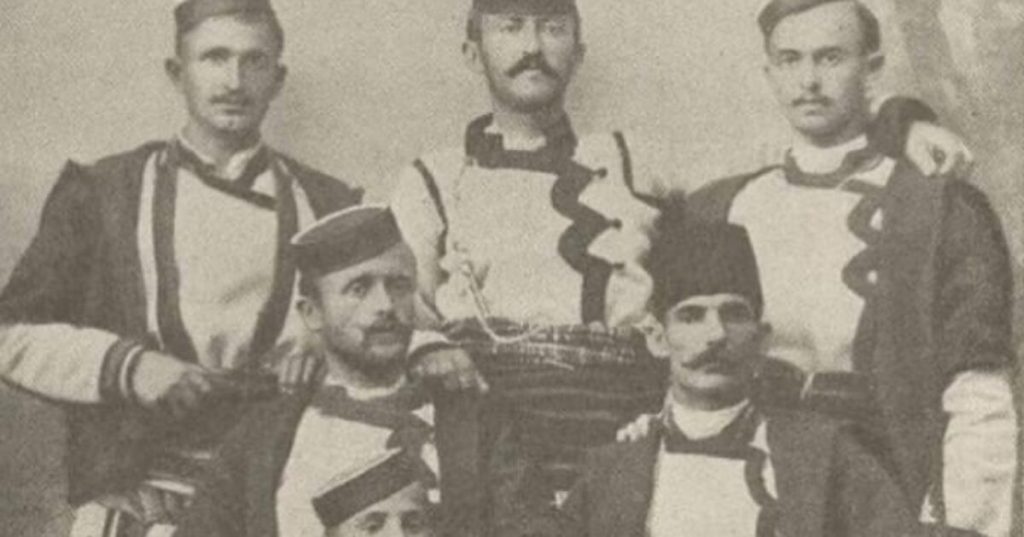

A century ago, the Orthodox Albanians of the Struga district still spoke the Albanian language. After the Serbian occupation of the Albanian lands in 1913, the struggle for the Slavization of Orthodox churches and monasteries and holding mass and liturgy in Serbian began. As a result, the assimilation of Orthodox Albanians begins in the Struga district and beyond.
The already assimilated Orthodox Albanians of Struga requested that in 1941, in Tirana, the fascist government of the time recognized the Albanian language as the official language in Struga. 78 years ago, the Albanian political subjects Paria of the municipality of Struga, together with the Orthodox Albanian Miter Radozhda, went to that “time of Albania” in 1941, to ask the government of Tirana to establish the Albanian language as the official language.
Today, after 78 years, Albanian political subjects are proud of a language law that they call the law for the Albanian language, which is nothing more than the use of the language of 20% in addition to Slavic. The comparison with the time when the Orthodox Albanians who demanded Albanian as an official language with the attitudes of this political class of kusars today, is a very clear indication of the betrayal of the national cause.
The willingness and the political demands of the time from a part of the Orthodox Albanians of Struga testify today to the Albanian origin of the Orthodox assimilated by the Albanians into the Slavic-Macedonian. Another living testimony in these parts are the Orthodox Albanian tribe Tanasi (Tanaskoski) from the village of Kalisht, where after the World War II. with the pressure and propaganda of Slavic politics through the rule of the Serbian church over the Orthodox clergy in the church of Kalishti, they were assimilated and today they feel like Slavs.
It should be mentioned here also a fact according to the witnesses of the time that the grandfather of the Tanasi grandchildren, uncle Naumi (Naum Kalishti) did not know how to speak Slavic well, but he spoke well the Albanian of the Tosk dialect! Descendants of Naum Kalishti unfortunately today feel like Slavs and not Albanians. Another character of the fight for freedom and Albanian national identity in our district was the commander of the Albanian insurgent forces, Milan Mato, an Orthodox Albanian who, in coordination with the leaders of the newly formed and truncated Albanian state, led the uprising of 1913, against the Serbian invaders.
Until the war of Petrinja, after the suppression of the uprising, assimilation begins with the Serbian invasion and rule over the Albanian lands until the establishment of the power of the Slavic-Macedonian democracy with the “Amin” of the Albanian vassals of the political subjects. There are cases of assimilation of the national identity of the Orthodox Albanians everywhere in the Ohrid-Struga region.
This is one of the painful Albanian stories where the Orthodox Albanian religious identity merged into the Slavic one. Dozens of other cases like these have been traced by the Albanian journalist Marin Mema, in search of the lost roots of the Orthodox Albanians. These cases are traces of our painful history of assimilation orchestrated and undertaken by the governments of the regions of Serbia and the partisans of “Drude” Tito, for nearly a century of their rule over our lands.
Reference
Medai Shaholli, Our Time.

 Balkan Academia