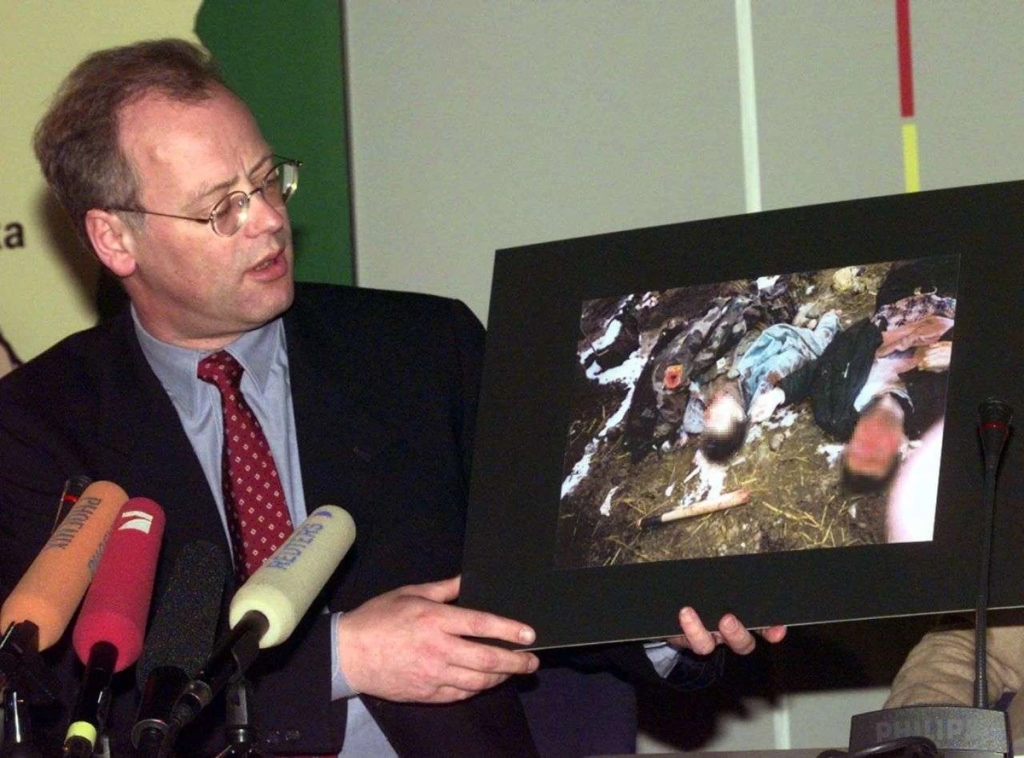

In addition to raising doubts about the massacre of Recak, the Serbian “Horseshoe” plan is another case that was politicized to the extreme by a part of the German media and politicians, mainly by leftist political groups. On the other hand, the government of the red-green coalition as well as the right-wing opposition (CDU, CSU and FDP) defended their position that the campaign of ethnic cleansing in Kosovo was the best evidence of the existence of the “Horseshoe” plan, which is was used as an instrument for the serbization of Kosovo.
The German Defense Minister, Rudolf Scharping, insisted that he had the Serbian “Horseshoe” plan in hand. “Serbian soldiers have killed pregnant women and taken their babies out of their wombs”, he would say, adding that “they played football with the heads of those killed”. Despite the criticism of a part of the opposition, the German Minister of Defense insisted that he had the Serbian “Horseshoe” plan in hand, which could not be disclosed in detail due to confidentiality.
In a press conference on April 16, 1999, almost a month after the beginning of the bombings, Rudolf Scharping made known to the press the latest news about the war in Kosovo, namely about Serbian crimes against the Albanian civilian population: “Serbian soldiers have killed pregnant women they took the babies out of their wombs”, adding that they had played football with “the heads of the murdered”.
Scharping – also in his diary about the Kosovo war – has defended the position that systematic deportation and mass killings were not an occasional policy of the Milosevic regime. According to him, the Serbian military and police operations against the Albanian population in Kosovo happened long before such a plan was drawn up.On the other hand, Winfried Nachtwei, a member of the German ecological party “Alliance 90/Greens”, in the Defense Commission, strongly opposed the finding of his party counterpart, Joschka Fischer, about the existence of the operational plan of the Serbs for the war in Kosovo and his intention for the violent change of the ethnic structure in Kosovo.
Nachtwei estimates that this plan did not play any important role for the deputies of the German Bundestag, but it had a special role for the general public, since its development could be seen as evidence for the Serbian expulsion policy. It was a mistake of the German deputies who “didn’t think radically and consistently about the alternative of air strikes”, claims Nachtwei, hinting that political and diplomatic means were not used to the maximum to achieve a peaceful solution.
“I still have a lot of questions about whether everything has been done”, this politician claims when he talks about the commitment of the Bundeswehr in the Kosovo conflict. More critical in this regard was the German MP from the ranks of the PDS, an heir of the former East German communists, Gregor Gysi, the only German politician who went to Belgrade and met with Milosevic at the time of the NATO bombings, but who had not condemned the campaign of ethnic cleansing with a single word.
In this context, he questioned the existence of the “Patkoi” plan, with the argument that such a plan was called after the Croatian word “Patkova” and Serbian military experts would not draft such a plan in this language.A year after the NATO airstrikes against the remaining Yugoslavia, in the German Bundestag on April 5, 2000, controversial discussions would again take place about the content and publication and authenticity of the “Operation Horseshoe” document.
The claims of a part of the opposition and the critical reports of the media that there was manipulation of facts by the West in the preparation of the military operation of the Atlantic Alliance against the Milosevic regime, the German Foreign Minister, Joschka Fischer, evaluates all views as untrue. that question the existence of the “Horseshoe” plan and the massacre of Recak.
The German Foreign Minister says that the “Horseshoe” military plan did not have the “trigger function” of NATO’s intervention against the Belgrade regime, clarifying that this plan had become known in Germany only at the beginning of April 1999 through the intelligence services Furthermore, the NATO attacks against the remaining Yugoslavia had begun on March 24, 1999, since according to the UNHCR, in this period over 200,000 Albanians in Kosovo were on the run, while another 100,000 had already left the country.
MP Heidi Lippmann (PDS) asked the Minister of Defense about the authenticity of the “Operation Horseshoe” document. According to him, the Serbian military leadership aimed at the systematic and complete expulsion of the Albanian population and sought evidence for the then intentions to destroy the KLA military units. The German Minister of Defense, Rudolf Scharping, had repeated his earlier statements regarding the existence of the “Horseshoe” plan, explaining that the original sources had confirmed that the purpose of the “Horseshoe” operation was to neutralize the KLA.
According to the minister, the expulsion of the Albanian population from Kosovo with the aim of violent regional and demographic change in Kosovo was also part of the Serbian plans and such a thing was confirmed by the developments on the ground. He drew the attention of the Bundestag that “at the time of the Holbrooke-Milosevic Agreement, 200,000 Albanians were deported within Kosovo, while 98,000 were deported outside Kosovo.
In the period of talks in Rambouillet, there were 210,000 deportees inside Kosovo, and 50,000 outside Kosovo. While at the time of the talks in Paris, the number of deportees outside Kosovo increased – to 60,000 deportees. On March 24, 1999, the number of deportees in Kosovo was 250,000, while there were 100,000 deportees outside Kosovo. At this point, these developments confirm what we have as source material.” On the other hand, the SPD’s foreign policy expert, Gernot Erler, spoke about a strange and exciting debate, which has focused intently on the work of the Minister of Defense, Rudolf Scharping, who both in Germany and abroad had gained great respect for his engagement alongside the Atlantic Alliance by focusing on the “Patkoi” operation, his existence and the variant designations “Potkova” or “Potkovica”.
Evidence for the deportation of Albanians and the CIA In this debate, he also spoke about the article of April 8, 1999 of “The Times” magazine, in which the evidence was published that the methods of expelling Albanians from Kosovo had been prepared for many months and then it was found word for word: “The CIA had already learned in autumn 1998 for a plan with the code name “Operation Horseshoe”, with the aim of killing and deporting Albanians within a few months”.
However, some deputies in the Commission had asked Scharping for further explanations. The CDU spokesman for Defense Policy, Paul Breuer, called Scharping’s statements insufficient. While MP Karl Lamers of the CDU/CSU union stated in the Bundestag that the “Horseshoe” operation and Raçaku still play a big role today, because representatives of the federal government used them in a “morally excessive form” a year ago.
Whereas Christian Schmidt (Fürth) (CDU/CSU) recalls that this “excessive” use, above all, had served the government in the Bundestag debates, especially to convince the left in their government camp of the necessity of NATO engagement -s. While the deputy from the ranks of the ecological political formation, the Green Alliance, Angelika Beer, once again defended the federal government’s decision a year ago for air operations against the rest of Yugoslavia as having no alternative, her colleague from the ranks of the party group Annelie Bunde Bach criticized this view and demanded full explanations for Reçak and the “Horseshoe” operation.
Beer also emphasized that the German population had shown readiness and generosity for the crisis situation and that the German state had accepted war refugees. Over 200,000 people came to Germany from Kosovo, due to the circumstances prevailing there. Critical voices for the “invented plan” A critical voice in the German scene outside the Bundestag regarding Germany’s involvement in NATO operations in the Kosovo war is the former general of the German army, Heinz Loquai, who held a critical position regarding the assertions of the German Ministry of Defense that had the “Horseshoe” plan available, claiming that the German government had only the indications for such a plan.
Loquai and associates claimed that the plan was invented to justify Germany’s participation in these bombings. In 2001, the German television channel WDR, in the documentary “It began with a lie”, claims that the whole story was fictitious and served only to justify the military operations of NATO, namely the involvement of the German army in this military operation .
This report, on the other hand, was described as biased reporting by the well-known journalist Matthias Rüb (FAZ) and by Claus Christian Malzahn (Der Spiegel), who were criticized for selective coverage of evidence and “unclean” research methods. . This criticism was joined by the journalist and founder of the humanitarian organization “Cap Anamur”, Rupert Neudeck, and the member of the Bundestag Norbert Blym (CDU), who disputed the findings of the WDR film.
From what was said above, it is clear that the political circles and the media that contested the right of NATO to intervene in the Kosovo war at the same time contested the existence of the “Horseshoe” plan, as well as the Reçak massacre, accusing the government federal and NATO for lack of will to use the political opportunities for solving the Kosovo issue.
In order to justify such a position, various constructions, half-truths and conspiracy theories were used, only to contest the intervention of the North Atlantic Alliance in avoiding the humanitarian disaster in Kosovo and for giving of the murders and mass deportations of the Albanian population. In this context, in addition to raising doubts about the massacre of Recak, the Serbian “Horseshoe” plan is another case that was politicized to the extreme by a part of the media and German politicians, mainly by political groups with a leftist orientation.
On the other hand, the government of the red-green coalition as well as the right-wing opposition (CDU, CSU and FDP) defended their position that the campaign of ethnic cleansing in Kosovo was the best evidence of the existence of the “Horseshoe” plan, which is was used as an instrument for the serbization of Kosovo. According to them, it was this military intervention that prevented the Serbian leadership from achieving this goal.
In the end, the NATO air campaign defined the failure of the “Horseshoe” plan, according to which the Serbian army, paramilitaries and police systematically pursued their strategy of murder and expulsion against Kosovo Albanians. Analyzing the systematic deportation campaign and the mass murders of Kosovo Albanians, especially during the departure of the OSCE’s Kosovo Verification Mission (KVM), it can be affirmed without question about the existence of the Serbian “Horseshoe” plan.
Therefore, it was absurd to establish a connection between the NATO airstrikes and the wave of deportations until June 1999, since the intervention of the North Atlantic Alliance in Kosovo was a permanent and persistent demand of the elite and the Albanian population, in order to to put an end to Serbian state crime in Kosovo.
Reference


 Balkan Academia