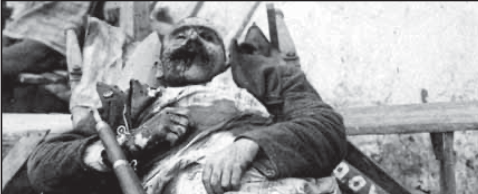

Kolë Gojani was one of the Albanian patriots who fought for Albanian freedom. Gojani was stationed in the Dukagjini plains. On September 7, 1926, in the village of Veleshte of Prizren, Kolë Gojani and his friends were massacred by Serb soldiers. According to Albanian sources, Kolë Gojani had surrendered his rifle during a fight with Serb forces, after having run out of ammunition.

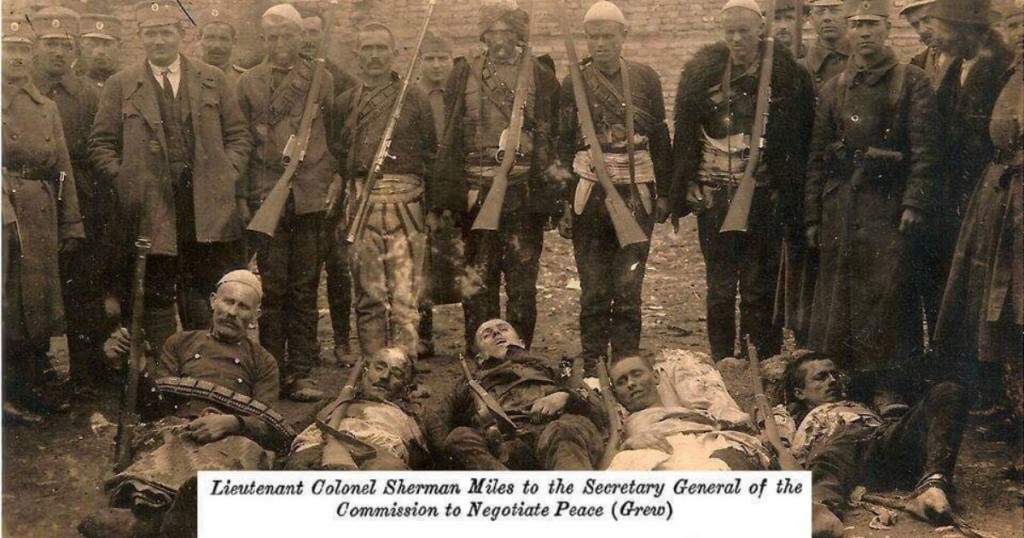
(Photo: Kolë Gojani and his friends, surrounded by Serbian military and paramilitary forces, with Cetnik leader Milic Krstic, wearing a tie, on the left. Thought the date of the message of this report is May 1919, Kolë Gojani was killed in 1926.)
Kolë Gojani was a Catholic, and his friends were: Hil Ramaja, Mark Ramaja, Zef Gjidoda, Tune Nikolla, Mhill Oroshi (Zymeri). Born in 1888 in the village of Jagodë (today a small village in the municipality of Klina) to Pren and Marije, daughter of the Bibaj family from the village of Ranoc. The Gojani family had historically fought against the Serbian government.
Kola’s brother had participated in the killing of a Serb in the village of Kosh. For this reason, Kolë Gojani’s family moved from the village of Jagodë and settled in a settlement near Gjakova, at Mulliri i Haxhië. Kole Gojani was known for his fighting skills and strong nationalist convictions. Palokë Kola and his brother Mark (Binak) Kola, Zef Ndoja from the locality Xhuxhe (Albania) and three other Mirditors who have not been identified to this day stayed in Veleshtë together with Kola.

Gojanis group was always together and moved from one place to another in order to organize attacks against the police and military units of the Serbian government. Unfortunately, after a stay of about three months, the gang were attacked by the gendarmerie forces and were forced to lock themselves in the fortified tower of Uke Lushi in the “Tarazhda District” of the village of Velezhe, then the municipality of Novake where they had been staying all this time.
According to the gendarmerie information given to the newspaper “Politika” number 6601 of September 9, 1926, it appears that “the Kaçake Gang of 12 people was discovered”, and the alerted gendarmerie forces under the command of General Tomic had surrounded the entire village. The Kachak detachment, fortified throughout the day, had successfully resisted the attack. For this reason, the gendarmerie forces had ordered that a land artillery cannon be brought there to destroy the tower. That day there was a fierce war between the gangsters of this gang and the gendarmerie.
Theory 1: Kolë Gojani died in battle.
According to the article in the newspaper “Politika number 6602” entitled “How the Kaçaka gang of Kol Gojani was annihilated”, the event in Prizren on September 9 was concluded that: “The authorities were informed that in the village of Velezhë in the district of Sharri they found a gang of seven Kaçakas headed by by Kolë Gojani”.
Upon receiving the news, the gendarmeries led by captain Milan Mihalic, they were immediately in pursuit, and then the commander of the gendarmeries of Prizren, Major Pretonije Gjorgjević, joined this fight. According to this article, the war between the kachaks and the gendarmerie forces had lasted about four hours and it was a terrible fight, in which case all seven of the kachaks who were found that day in the tower were killed.
Serbian propaganda tried to leave the political and military activity of the gang to the Albanian state, noting that it was interesting that all the Kacakas were dressed in Albanian military clothes. The killed Kaçaks were loaded onto a cart and transported first to the center of the village of Velezhë and then to Prizren where they were exposed in order to instill fear and anxiety in the Albanian population.
Theory 2: Kolë Gojani surrendered and was then and massacred
However, according to Lush Culaj in his book “Shqiptarët në gjysmën e parë të shekullit XX”, he writes:
“… Kolë Gojani u plagos rëndë . Edhe pse në gjendje të vështirë , trimi e vazhdoi luftën deri në përfundim të municionit të pushkës . Pasi iu shpenzua municioni , ai e vendos shaminë e kuqe në grykë të pushkës , gjoja në shenjë dorëzimi …”1
Translation:
“… Kole Gojani was seriously injured. Although in a difficult situation, the brave man continued the fight until the rifle’s ammunition ran out. After the ammunition is spent, he places the red handkerchief in the muzzle of the rifle, supposedly as a sign of surrender…”
Reference
- https://www.google.se/books/edition/Shqiptar%C3%ABt_n%C3%AB_gjysm%C3%ABn_e_par%C3%AB_t%C3%AB_she
/vlotAQAAIAAJ?hl=sv&gbpv=0&bsq=Kol%C3%AB%20Gojani
↩︎
2. Author Pjetër Përgjoka, “Pjesë nga Monografia “Famullia e Velezhës”.


 Balkan Academia