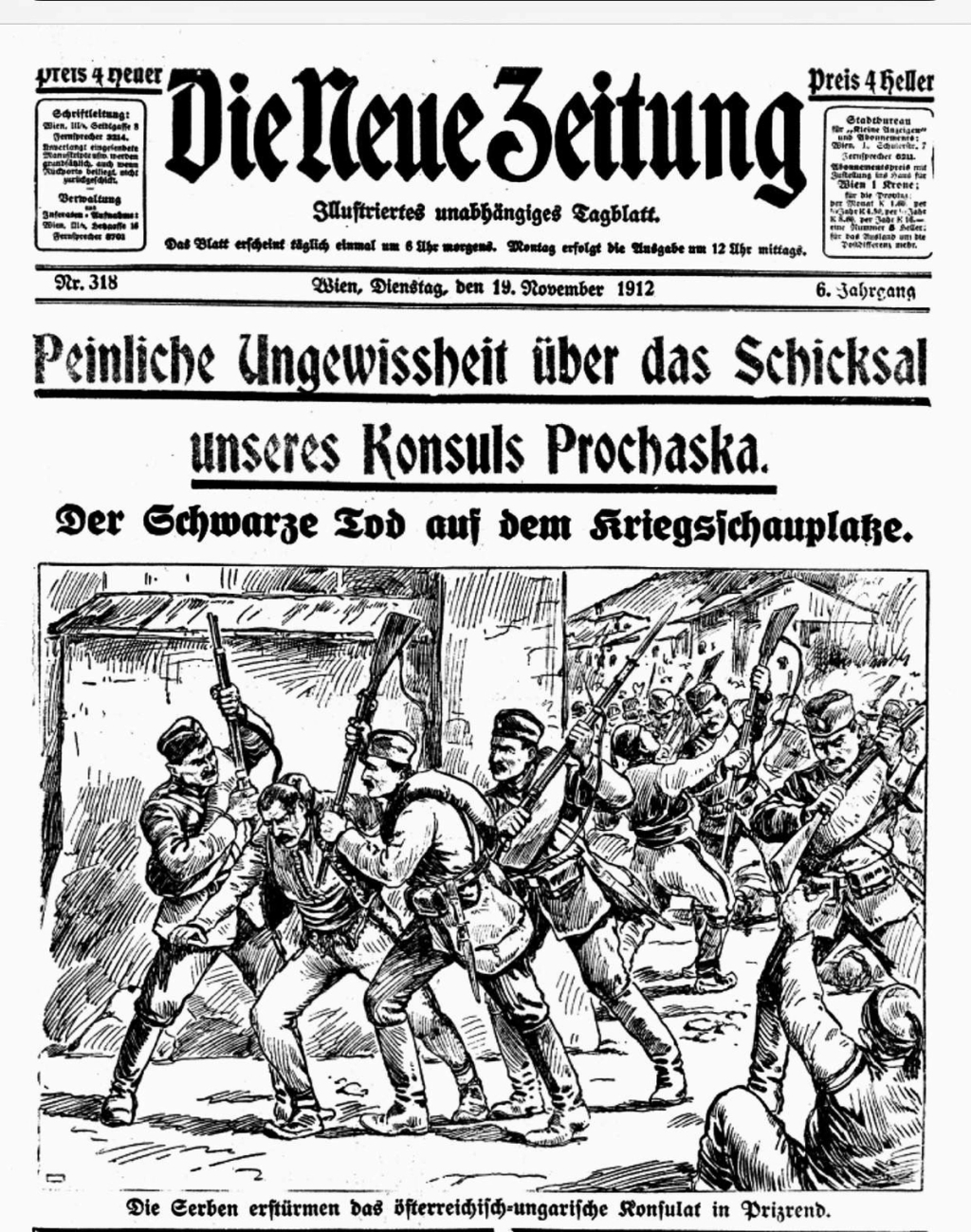

In particular, from the outbreak of the First Balkan War to the outbreak of the First World War, the Austro-Hungarian Empire was on the verge of war with Serbia on several occasions due to the Albanian question and, in this context, the Prochaska question, the Albanian Adriatic invaded and Shkodra. On the other hand, if the political atmosphere in Serbia was conducive to acts of violence against the monarchy, most of these issues were dealt with in the peace negotiations of the London Conference under the auspices of Great Britain.
Despite the peace mechanism of the great powers functioning at the London Conference, the Austro-Serbian and Austro-Russian war broke out a year later, the origin of which can also be found in the Austro-Serbian conflicts since the autumn of 1912, when Serbia invaded Kosovo and the Austrian war -Hungarian diplomat Oscar Prochaska in the city of Prizren

“Based on archival sources and the press of the time on the events in the Prizren Consulate and the Prochaska case, which reflect intensive diplomatic communication between Vienna and Belgrade, it emerges that the confrontation with Austria-Hungary and the brutal treatment of the Austrian diplomats and Hungary in the occupied Albanian territories was a scenario prepared in advance by high Serbian state circles and behind which Russia stood. In this respect, the Prochaska case reflected the rivalry that developed between the various powers over the rebalancing of influences existing in the Balkans during the period of the collapse of the Ottoman Empire.”
According to the telegram from the Austro-Hungarian Ambassador Thurn from Petersburg to Minister Berchtold (November 18, 1912) about Russia’s position on the issue of Serbia’s exit to the Adriatic, expressed by Foreign Minister Sazanov, “the Russian government, the suspicion is unfounded, that Serbia only wants to maintain a demilitarized trading port in Shengjin and a road to it, which prohibits him from maintaining a war fleet.
According to the Viennese diplomat, Sasanov’s request was defended friendly and presented with vigor and great diplomatic cunning. This can also be seen in the fact that when the Balkan War broke out, the Russians took the position that they did not care about the Balkans, but when they achieved their victory over the Ottoman state, the Russians became their “zealous advocates”. “, especially from Serbia.
“I am convinced that if we succeed in fulfilling this desire of Russia on this single point, I will not call it a defeat for Austria-Hungary, but as a special favor from Your Excellency to resolve and resolve the Balkan crisis amicably. “definitely and will appreciate it,” writes Thurn.
Mobilization of the Austro-Hungarian army against Serbia and Russia
These goals and the Bosnian question formed the axis of the inevitable conflict between Austria-Hungary and Serbia. He was prepared to put aside the disputes with the Balkan countries in order to prevent the realization of the Austro-Hungarian plan of 1896/97 to establish an autonomous Albanian state.
Even if the invasion of Kosovo was unexpected for official Vienna, there was still belief in the resistance of the Ottoman state against the forces of the Balkan Alliance, both in the case of the Albanian Adriatic coast and in the case of Shkodra, the Austro-Hungarian Empire, although Their position in the Balkans was shaken, determined to force Serbia to withdraw its army from the city of Durrës, even at the price of war, and to displace its ambitions to gain a land exit to the Adriatic Sea.
Austria-Hungary had mobilized the army against Serbia and Russia. For the Danube Monarchy it was completely unacceptable for Serbia to gain a foothold in the Albanian Adriatic. However, it was clear that after the victories of 1912/13, leading circles in Serbia, especially in the army, behaved provocatively against the Danube Monarchy. The invasion of Kosovo as well as Macedonia and Novi-Pazar and in this context the humiliation of the Austro-Hungarian diplomats (Prochaska in Prizren and Tahy in Mitrovica), on the other hand, put Austria-Hungary in a position to drive to the wall and hit it straight away its political and economic interests in Southeastern Europe.
In fact, for a long time there was no unified position within the Austro-Hungarian state regarding the steps to be followed towards Serbia and, more generally, regarding the policy towards Southeastern Europe: while the Ministry of Defense was committed to a serious military strike, the Foreign Ministry was in favor of a more moderate course or, more precisely, there was a double attitude there.
In the General Staff, an important group around Blasius von Schemua and then also Franz Conrad von Hötzendorf saw Serbia and its goals in the direction of Albania, the Albanian Adriatic and Bosnia-Herzegovina as the main enemy in southeastern Europe. He insisted that a military solution was needed for Serbia. Chief of Staff Schemua called for immediate military action against such Serbian provocations, as any other response to the desecration of Consul Prochaska would be “totally undignified” and a violation of the military prestige of the Austro-Hungarian state.
Berchtold undecided in the face of Serbian provocations. Meanwhile, the diplomatic circles at Ballhausplatz rejected an offensive against Serbia because it was clear that this would also mean a war with Russia. Berchtold and his circle belonged to the radical parties at that time. Basically, he tended towards a peaceful solution and tried to avoid war at all costs using diplomatic means.
Berchtold seemed undecided in the face of Serbian provocations. The situation seemed a bit chaotic. The Austro-Hungarian ambassador in Berlin even spoke of three foreign ministers: Berchtold, Frigyes Szapáry (Austro-Hungarian diplomat of Hungarian origin who served as ambassador in St. Petersburg) and Alexander Hoyos, the Austro-Hungarian diplomat and head of the Foreign Minister’s staff . Despite his experience as ambassador to St. Petersburg (1906–1911), Berchtold was considered by the last head of Austro-Hungarian diplomacy, Ludwig Freiherr von.
lotow, was a dilettante in many areas and was dependent on Szapary and Hoyos for his task, who belonged to the new generation of diplomats and advocated an active policy in Southeast Europe. For this line, the unstable state of the monarchy could only be overcome through violent action.
However, Berchtold also saw Greater Serbia as a threat to the existence of the Austro-Hungarian monarchy. At the same time, in Vienna they did not want Serbia to advance further and reach the Albanian Adriatic, and instead the Foreign Ministry in Vienna would not raise any obstacles if Serbia, instead of the Albanian Adriatic, agreed to guarantee a gate in Thessaloniki or Kavalla. It should be emphasized that on the issue of the seaport, the position of Austria-Hungary was preceded by the Italian government and the German government, while Vienna was supported by the British Foreign Minister Gray on the position on Albanian independence. But the initial approach of Austro-Hungarian diplomacy to further maintain the status quo in the Balkans was already over, it was buried forever and only the London Conference had to find a chord among the European powers for the reorganization of the Balkans.
During this period, especially from the outbreak of the First Balkan War to the outbreak of the First World War, the Austro-Hungarian Empire was several times on the verge of war with Serbia due to the Albanian question, and in this context the issue of Prochaska and the Albanian Adriatic and Shkodra.
On the other hand, if the political atmosphere in Serbia was conducive to acts of violence against the monarchy, most of these issues were dealt with in the peace negotiations of the London Conference under the auspices of Great Britain. Despite the peace mechanism of the great powers functioning at the London Conference, the Austro-Serbian and Austro-Russian war broke out a year later, the origin of which can also be found in the Austro-Serbian conflicts since the autumn of 1912, when Serbia invaded Kosovo and the Austrian war -Hungarian diplomat Oscar Prochaska in the city of Prizren.
The scenario of the cover-up of the Serbian state crime against Kosovo Albanians
Based on archival sources and the press of the time on the events in the Prizren Consulate and the Prochaska case, which reflect intensive diplomatic communication between Vienna and Belgrade, it emerges that the confrontation with Austria-Hungary and the brutal treatment of the Austrian diplomats and Hungary in the occupied Albanian territories was a scenario prepared in advance by high Serbian state circles and behind which Russia stood.
In this sense, the Prochaska affair reflected the rivalry that developed between the various powers in the Balkans over the realignment of influences during the period of the collapse of the Ottoman Empire. Under these circumstances, Austria-Hungary wanted to preserve its historical mission, its cultural mission, which actually included its economic and strategic interests. First, the Albanian regions became the epicenter of Austro-Hungarian and Serbian rivalry, particularly Russian rivalry over the extent of influence and dominance on the Albanian coasts of the Adriatic.
If Austria-Hungary had proven unprepared to stop the Serbian incursion into Kosovo and Manastir Province, it was determined to stop the Serbian incursion into Kosovo, as it relied on the Ottoman army’s resistance to the forces of the Balkan Alliance believed western territories at all costs.
Albanian beyond the city of Prizren in the interior of northern Albania. In this way, Austria-Hungary became the main and insurmountable obstacle to the realization of Serbian expansion plans towards the western Albanian territories and under the Austro-Hungarian military threat, the withdrawal of Serbian military troops from the Albanian Adriatic (Durrësi). as well as Montenegrin troops came from the city of Shkodra.
In this sense, Belgrade tried to avoid foreign witnesses through humiliation and military pressure on the Austro-Hungarian consuls in Prizren and Mitrovica, while the Serbian armies in occupied Kosovo committed the most brutal atrocities against the civilian population. Albanian. This incident with Consul Prochaska reminds us of Belgrade’s behavior in 1998-1999 when it tried to document the presence of journalists and international representatives in Kosovo in order to carry out its doctrine of ethnic cleansing and mass executions without foreign witnesses. In this sense, the Prochaska case can also be used as a scenario to see the cover-up of the Serbian state crime against the Kosovar Albanians during the First Balkan War, which was part of the Serbian and Serbian doctrine for the de-Albanianization of Kosovo.
Reference


 Balkan Academia