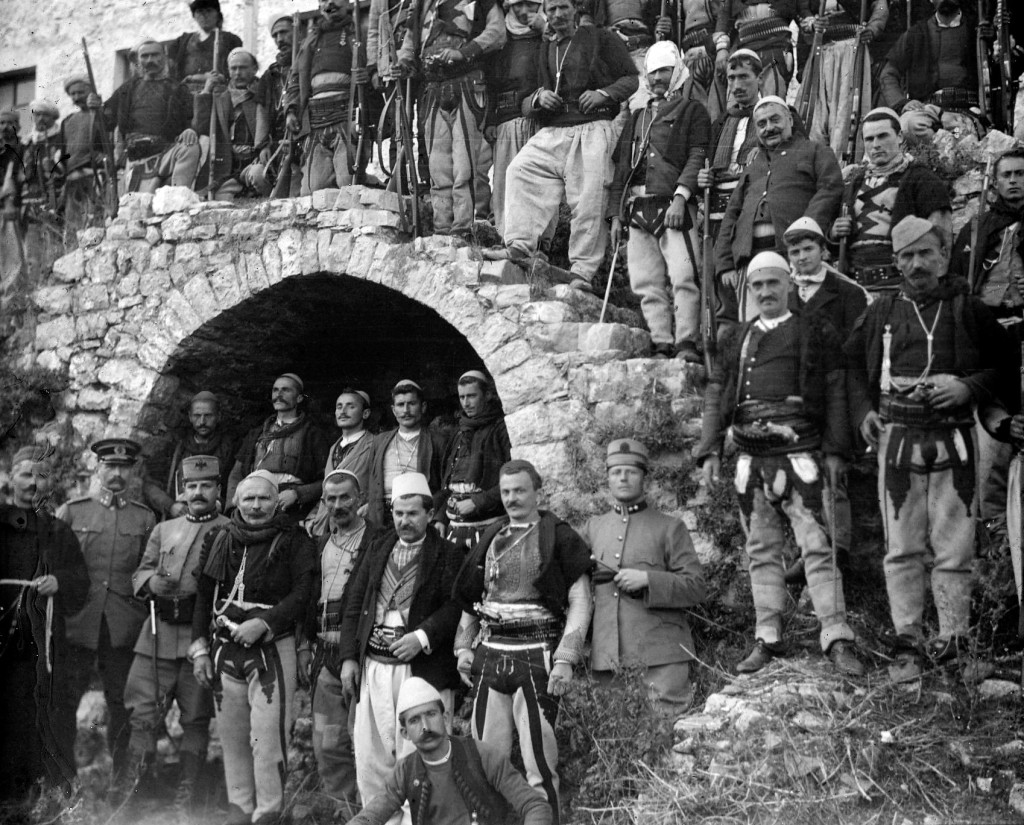

“In the district of Gjakova, in the village of Bobaj, four Serbian soldiers who were trying to rape a woman were badly beaten. Immediately upon Bobaj fell the iron and fire of a punitive expedition. She was set on fire. Where everything had turned to dust and ashes, the Serbian soldiers came across 70 Catholic Albanians who were returning to their village from the bazaar.
The soldiers carried out the bloodbath of the group. In Prizren, the Catholic priest was not allowed to perform the last breath of the dead. Anyone who meets the priest is court-martialed. In a report from Durrës on March 8, it is learned that the following villages were burned and razed to the ground: Ses, Larushk, Minikel, Scej and Gromen. In Ses, women, girls and a number of children, a total of eighty souls, were included among the houses that were set on fire.
“The inhabitants of the villages of the Krujë-Kurbin district have fled to the mountains to save their lives, leaving behind all the wealth they had. Even Stalin’s former competitor for president in Russia, of Jewish (Israeli) origin, after Lenin’s death, Leon Trotsky, witness of the Serbian massacres against the Albanians in Skopje, collaborator of the most important newspaper of that time, December 1912 and find him as a special envoy of the Russian newspaper “Kievskaja Mils” in Skopje, that is, under these circumstances to make a war reportage.
This newspaper at the time was the largest and most important newspaper published in Kiev in the Russian language outside the Russian capital, Moscow. This invasion Trotsky reports through the newspaper that it was accompanied by massacres, mass genocide against the completely unarmed Albanian population, where according to the press of the time, during this offensive about 250,000 (two hundred and fifty thousand) Albanians lost their lives in the most barbaric way through burning alive women, children, old men, even cutting pregnant women’s bellies with bayonets, and taking out the child and sticking it on the tip of the bayonet.
Trotsky concluded that: the Serbs in the so-called “Old Serbia”, in their national efforts to improve the figures in the ethnographic statistics, which do not suit them, have simply entered into a systematic extermination of the Muslim Albanian population, as well as others with non-orthodox affiliation.
The Supreme Headquarters of the Serbian Army, in addition to carrying out terror and massacres on the Albanian population, organized a scenario with urgent orders, according to which the impression had to be created before the international opinion, as if the Albanians everywhere in the occupied areas were essentially interested in having their lands annexed Serbia and not to remain in “Coastal Albania”.
It is not known for sure how many such scenarios were organized in the field, but the available documentation allows us to mention a few. The telegram of the Italian foreign minister San Giuliano (A. Di San Guliano) dated December 20, 1912, addressed to the embassies of Italy in Belgrade, Berlin, Istanbul, London, Petersburg and Vienna where, among others, it is underlined: In Tirana, Kavajë, Shijak, the Serbs force the Muslim Albanians and the Catholic Albanians to sign the petition in the Serbian language, with which they declare that they are satisfied with the Serbian opinion.
The same scenario was repeated in the Dukagjin Plain, where we can present some parts of the violent and staged telegram to the citizens of Prizren and its surroundings, addressed to the Conference of Ambassadors in London, on December 26, 1913: Before you, representatives of the Great Powers the solution of the vital question of the existence and prosperity of our tribe in these parts.
Therefore, the undersigned on behalf of the residents of the city of Prizren and its region, we beg you for your merciful support, so that in the case of resolving our fate, do not attach us to Coastal Albania, but leave us in the Serbian state, if you wish us cultural comfort and economic prosperity, we are of Serbian origin. At the very end of this Serbian propaganda story, we should add that the southern ally of Serbia, Greece, will use the same methods a little later.
On March 12, 1913, the Italian newspaper “Albanische Correspondenz” from Trieste wrote the following: The news coming from Tirana informs that the Serbs started a new wave of murders and massacres in the surroundings of Tirana.
Residents of a neighborhood in Tirana sheltered a number of Albanian volunteers and gave them food. Upon hearing this, the commander of the Serbian occupation troops ordered his division to surround that neighborhood. As a result, all the houses of that neighborhood, including the tower of Faut Bey Toptan, turned into piles of ashes. Seventy-seven men were burned alive. Eight men and two women were executed by firing squad. All maneuvers were made against the Catholic church of Janjeva (with four hundred families mainly of Slavic origin) in order to force the believers (by force) to renounce their religion. Eight hundred Catholics, so-called “Laramans”, who hid during the Turkish occupation lived in this bishopric for several centuries.
Their religious identity. When the Turks left and the Serbs arrived, several hundred of them wanted to register as Catholics. But, after the arrival of the representatives of the Serbian government, they were finally told: “Either Muslims, or Orthodox, but not Catholic.” Near the altar of Letnica there was a village called Shashare, which had nine hundred families, all Catholics.
When the Serbs took Shashara, they rounded up all the men without exception and tied them up. Then they started robbing their houses and raping their girls and women in the most disgusting way. Also in Nashec, thirty men were sitting quietly at their work. They were killed for no reason in one day. They were killed for the only “crime” they had committed, they called themselves Catholic Albanians.
The “Neue Freie Presse” newspaper also wrote about violent conversions to the Orthodox religion and the slaughter of clerics on March 20, 1913. “On March 7, in the district of Gjakova, Serbian soldiers joined the fanatical Orthodox priests. They tied up nearly 300 (three hundred) people, men, women and children, and threatening to take their breath away asked them to change their religion. Among those tied with rope was the priest Angelus Palic.
An Orthodox priest, pointing his finger at the muzzles of the weapons that had been pointed at the captives, he addressed them: “Either sign that you have returned to our united, true religion, or else the soldiers, these knights of God will bury their souls in hell: The parties signed the sheet on which the declaration of return to the Orthodox religion was already written.
Reference
https://www.botasot.info/kolumne-opinione/978801/holokausti-i-shqiptareve-nga-serbia-1912-1913


 Balkan Academia