
Original author Dr. Qazim Namani
In the 17th century, in addition to Austria and Venice, Russia also appeared on the political scene against the Ottoman Empire. Ottomans at this time was at war with Austria, Venice and Russia.
In the agreement of Karllovci 1699, peace was reached for 25 years to the detriment of the Ottomans. With the conclusion of this treaty, the foundations of the Ottoman Empire were shaken and it began to lose its importance as a political and military power, which in those years ruled the most productive and strategic lands of Europe, Asia and Africa.
At the beginning of the 18th century, Russia increased its political influence in defense of the Orthodox population in Morea and Montenegro.
During the early Middle Ages, the population in Montenegro consisted of several tribes of arber origin, who had close relations with the Dalmatians and other Illyrian tribes.
Under the influence of Venice and the Papacy, the population in the coastal cities was of the Catholic faith, while the population in the rural areas was dominated by the Orthodox faith.
In the 15th century when the Ottoman army occupied the city of Shkodra, the tribes in Montenegro elected a religious leader. From the beginning of the 17th century, the religious leaders in Montenegro were supported by all means by the Russians.
In general, until the 18th century, the population of these tribes was divided into tribes and in terms of traditions, language, physiognomy and race, they had no differences with other arber tribes. Since the beginning of the 18th century, due to the influence of the Orthodox Church and the Russian policy of Peter the Great, the Slavization of some Arberian tribes began in those countries.
At this time, Russia and Venice encouraged the Christian population in Montenegro to rise up in rebellion against Ottomans. In 1715, the Ottomans declared war on Venice aimed at conquering the Adriatic coast.
During these years, Russian policies aligned with Venice’s policies to support the Arberian Christian population.
The spread of Bektashism in the Albanian lands during the 17th century had a significant impact on the Islam of the Albanians.
During this century, the role of the Catholic Church and the Albanian Catholic clergy was diminishing. The Islam of the Albanian population increased especially after the Austro-Turkish war of 1689.
Peter the Great with his policy admired and supported non-Muslim religious activities in the Illyrian Peninsula. With his policy, he encouraged the national and religious feelings of the Christian population against the Ottomans.
The religious leader of Montenegro, Danilo Petrović, spurred on by Russian support, organized the slaughter of all Muslims who did not accept the return to their former religion on the night of Christmas.
After this event, the Orthodox population in Montenegro was completely put at the service of Russia and organized attacks and uprisings against Ottomans.
Ottomans used the Muslim feudal lords of Herzegovina, Shkodra and other Albanian provinces to quell the uprisings.
With these actions, fratricide had already begun between the members of the Albanian tribes who had just started the process of Muslimization and those who had entered the process of Slavization.
During the 18th and early 19th centuries, the Ottomans took advantage of the divisions among the Albanian nobility, using them to quell uprisings in the Albanian territories and elsewhere in Asia and Africa.
Since the beginning of the 17th century, Russia in Montenegro supported the opening of schools, printing houses and had begun to send clergy, missionaries and Russian diplomats to the Albanian territories.
According to well-studied plans, the Russian agenda was focused on protecting the Orthodox population along the Ionian Sea and the Adriatic Sea.
Among the most strategic points in the south, Morea was chosen, populated with an Albanian population of the Orthodox faith, and Herzegovina and the territories of Montenegro, also with an Albanian population of the Orthodox faith.
Russia’s intervention in these territories was done through Orthodox clerics, while on the diplomatic level Russia developed good relations with European cities and states, and justified its intervention to fight the process of Islamization and Ottoman influence in this part of Europe.
Russia, with its diplomacy after penetrating into the present-day Morea and Montenegro, creates the arc of diplomatic actions in the shape of a horseshoe from the Adriatic to the Black Sea.
Russia during the 18th century, taking advantage of the beginning of the decline of the Ottoman Empire, the uprisings of the indigenous population that supported Austria to enter the war against the Ottoman Empire, the support of Venice, the deepening of the religious divide, as well as the taunting of the Albanian pashallaqs, started the process of slavization of the Albanian tribes in the Albanian territories and in Montenegro through the leaders of the Orthodox Church.
On the other hand, Russia supported the Hellenization of the Albanian population on the shores of the Ionian Sea. At the end of the XVIII century
, Russia begins to expand its influence on the Orthodox population in the central part of the Illyrian Peninsula, to raise an uprising against the Ottoman rule.
The Orthodox Albanian population in the highlands of Montenegro, under the influence of the Orthodox Church and the Russian clergy, had entered into the process of Slavization, so that by the end of this century they had almost abandoned the Arber language and started speaking Slavic languages in their families.
At the end of the 18th century, Russia also sent more clergy and large sums of money to the Albanian lands, expanding its diplomacy, through the Orthodox Church, it started several uprisings of the Orthodox Albanian and Vlach population in the vicinity of Smederevo and some towns and villages in the vicinity of Belgrade.
In order to form a new nation, the Orthodox population of the region that began to concentrate in the surroundings of Belgrade and Smederevo were called Serbs. When the Serbs started demanding independence, the Montenegrins raised the Russian flag on their churches and buildings.
Russian policy aimed to create, through uprisings, a division between the now more Muslim Albanian population and the Christian Albanian population along the horseshoe line from Montenegro to the Danube River.
During this period and the beginning of the 19th century, Russia fought several battles against the Ottoman Empire, which ended with Russia’s victory. the Ottomans, after the losses in these wars, was forced to sign some favorable agreements for the Orthodox population in the territories inhabited by the Albanian population.
At the end of the 18th century and the beginning of the 19th century, Russia began military attacks against the Ottoman Empire. The declining Ottoman Empire lost several battles and in several agreements after the armistice with the Russians, privileges were signed for the Orthodox population in the Illyrian Peninsula.
The Russo-Ottoman war, which lasted about six years, ended in 1812, with the signing of the Treaty of Bucharest. According to this treaty, the Serbs were granted many privileges, being given a general amnesty after their uprisings.
Seeing the danger from Russia during the beginning of the 19th century, in the international arena Austria exerted pressure to prevent Russian influence in Montenegro, Herzegovina and other northern countries.
At the beginning of the 19th century, Russia came out openly with its projects for the formation of Slavic states in the territory of Rumelia.
In 1815, the Russian emperor Alexander I initiated the “Holy Alliance” which was signed in Vienna by the most powerful European states, the Austrian Empire, Prussia and Russia. The purpose of this agreement was to extinguish all uprisings in Europe in order to respect the religion of peace and justice.
This agreement was harmful for the Albanian population. Relying on this agreement, the Ottomans organizes several plans to extinguish the Albanian riots and uprisings. The Ottomans in 1821 managed to extinguish the pashalak of Ioannina, while in 1930 he also extinguished the pashalak of Shkodra.
In 1830, with the help of King Lutvig of Bavaria and other western allies, the Greek state was formed on Illyrian-Arberian culture and civilization. The second son of King Ludwig of Bavaria, Prince Otto was elected king of Greece.
Likewise, with the help and support of Russia and its allies in 1830, Serbia also gained autonomy.
The Albanian feudal lords and pashalars at this time did not have a national platform, in order to preserve the unity they came out to be angry even when the Ottomans during the 19th century started the reforms in the army, but also later when the tanzimat reforms started.
With the reforms of the Tanzimat, the Albanian population experienced a deep division after identifying the nation with religion.
On this occasion, different ethnic groups were formed within the Albanian people, a phenomenon that accelerated the rate of assimilation of Albanians even more.
Some of the Albanian feudal lords supported the reforms while others opposed them. According to these reforms, the Muslim Albanians were now registered as Ottomans even though the language, race, music and customs were completely different from the Ottomans.
The reforms of the Tanzimat in 1839 and the division of the Albanian population on religious grounds, at that time, were for Russia to realize the Pan-Slavic plans for the formation of Slavic states in the Albanian lands.
Russia had now drawn up several projects for the Slavization of the Orthodox Vlach and Albanian population, and their union against the Ottoman Empire.
After the signing of the Treaty of Paris in 1856, Russia began to incite the Christians in the Balkans to revolt. Based on the platform of these projects, the Russians urged the Montenegrins to attack several fortifications held by Albanian Muslim reservists.
After the Tanzimat reforms, Ottomans mobilized soldiers from the popular masses of Sanjak of Nis to quell the uprisings in Montenegro. After these battles, Russia again pushed the Montenegrins to revolt to seek their expansion in Herzegovina.
The Ottoman was forced by the pressures of Russia and France to accept their proposals for the expansion of Montenegro in the lands of Herzegovina.
With the influence of Russia, a Slavic congress was organized in Bucharest, where it was decided that if the Montenegrins continue the uprising against the Ottomans, Montenegro would be given Herzegovina. Under these circumstances, Russia was preparing to organize a major uprising against the Ottomans, using the Montenegrins, Serbs and other Orthodox in the region.
On the eve of the eastern crisis, many officers and volunteers came from Russia to Serbia to start the war against the Ottomans. In Belgrade, the Orthodox population from all parts of the Balkans was concentrated, even Orthodox Albanians and Vlachs from Albania and Macedonia.
After gaining autonomy, educated Albanians and Vlachs from Austria and other countries had gone to Belgrade, and they contributed to the formation of the state institutions of Serbia. In June 1876, Serbia and Montenegro declared war on the Ottomans. In December 1876, a conference of amassadors was held, where it was decided to liberate the Christian population in the Balkan Peninsula.
Russia had won the support of the Christians who lived in the Ottoan Empire, and on the other hand it had made the political opinion of Europe its own, so in April 1877 it declared war on the Ottomans.
Serbia, instigated by Russia, started the war on December 2, 1877. The Serbian army, aided by Russian volunteers, quickly managed to occupy the Albanian territories of Sanjak of Nis from Krusheci, Piroti, Nis, Aleksinci, Prokupla, Kushumlia and Leskoci, penetrating into direction of upper Jabllanica.
During this expedition, the Serbian army committed many murders, slaughters, burnings and mass displacement of the defenseless indigenous Albanian population. The Turkish government was forced to sign the treaty with Russia, where Turkey had to give up Rumelia.
On June 13, the Congress of Berlin was held. Among the main points of this treaty were:
“The independence of Romania, Serbia and Montenegro, enabling these two to expand their borders to the detriment of Albanian lands.
Temporary occupation of Bosnia and Herzegovina by Austria-Hungary.
Formation of Bulgaria as an autonomous principality.”
The decisions of the Berlin Congress were a great victory for Russia and the new Slavic states formed at the expense of Albanian lands.
On this occasion, the bow of the Russian horseshoe was concentrated in the middle of the Albanian lands on the new border with the Ottoman Empire. The Slavic states that gained independence with Russian support until the Balkan wars of 1912, developed their projects for a joint alliance for the expulsion of all Ottomans and the occupation of Albanian lands up to the Adriatic Sea and the Shkumbin River.
After the independence of Montenegro and Serbia in 1878, programs were drawn up for the colonization of the occupied forest territories, which were previously inhabited by the Albanian population, with the Slavic population. Many Albanian lands were donated to Serbian and Montenegrin soldiers who had participated in the killing and displacement of Albanians.
In the new border zone between Serbia and the Ottoman Empire, in Toplicë, Jabllanicë, Llap and Galab, Montenegrins of semi-Slavized Albanian origin were brought, who had participated in numerous wars for the killing and displacement of Albanians.
The Albanian population from Toplica had now been killed and moved to neighboring countries, some of them had gone to Romania, Austria-Hungary and other European countries, but the vast majority of them were concentrated within the borders of the Ottoman Empire.
Traces of these Albanian families displaced from their homes can still be found today in Bosnia, Austria, Hungary, Romania, Bulgaria and other countries through the surnames they preserved, taking their surnames from the villages they had moved to. Unfortunately, these families eventually assimilated in the foreign countries where they settled.
I remember a case when, at the end of the eighties of the 20th century, as a young man I had started working in a hotel in Germany. Two Serbs from a village near Lebana i Leskoci had been working in that hotel.
One of them was old and her name was Bosilka, who one day asked me. Please explain to me what this saying means in the Albanian language: “O ta qisha nana pasha zota”, I looked at him with surprise and asked him! Where did you hear that?
She begins to explain that she had learned this since she was a child, from her parents and neighbors in her home village. Our elders, when they had a celebration or gathered at a party, she added, told that during the evacuation of Albanians from those villages by the Serbian-Russian army, a man named Rama led our army.
When Rama attacked the Albanians and burned their houses, they ran away reacting with these words against Rama! A bitter case, but this made it clear that in those difficult years the Slavic victory over the Albanian lands was achieved by exploiting the Albanians themselves!
This statement of Bosilka reminded me of writing
of the Danish journalist who during the 1912 Balkan wars worked as a journalist in the cities of Vraja, Preševo, Kumanovo and Skopje. He wrote that an Albanian was being chased by three Serbian soldiers.
Finally the Albanian boy gave up, sat down and stood holding his head on his knees, looking scared. One of the Serbian soldiers fired a gun at his body. The boy who was killed, rolled on the ground, with his last words, saying something bad about Petar Karagjorgjevic.
Surely this Albanian who was killed knew that the Serbian king Petar Karagjorgjevic was the scion of an Albanian family, which had been Serbized over time, just like Rama in the story of Bosilka, who was probably an Albanian who had chased and killed the Albanians in their homes.
The state of the Albanian population during the 19th century and the beginning of the 20th century, today reminds me of the words of my late grandfather, words that were heard and inherited by his ancestors: The elders said, when the Catholic takes the pier of Durrës, the Albanian people comes out in greetings. As you can see, the only hope of the Albanian people to escape from the Pan-Slavic and Ottoman projects was Western Europe.
As can be seen, in addition to the conquest of Albanian lands, Montenegro and Serbia also benefited by appropriating the spiritual and material heritage of the Albanian population. During the 19th century, all Albanian churches were appropriated, clergy educated in Russia were brought to these churches, and now the liturgy was held in the Serbian language.
Through these clerics, propaganda was made about the liberation of “Old Serbia”, the liberation of the medieval churches, the myth about the battle of Kosovo. With Vuk Karagjiqin, the traditions and all the epic Albanian folk songs had begun to be adopted.
I am proving this with three examples of violinists noted by Serbian researchers as having Serbian origins, when in fact they originated from Albanian tribes.
As a concrete case, we testify with the surname of the family of Hasan Pllana, who in those years had moved to Trebinje in Bosnia, for whom it is written that he was a well-known lute player and singer.
The family of Ponovic Koica of Maroc was once of Albanian origin, who during the Balkan wars had robbed two Albanian girls, one in the village of Kremenat, and the other in Kranidell of the municipality of Dardana. Radivoje Papović, former rector of the University of Pristina during the nineties of the XX century, came from this family.
As can be seen from Serbian literature, Kojica was born in 1867 in Goliji, Montenegro, while in 1889 he moved to the village of Marocë. After completing primary school, Kojica became an officer in the Montenegrin army. In 1922, the Albanians had killed him. Kojica was a clear man and a good harpist, writes the Serbian historian.
Ivanovic Pero (Begov), born in 1852 in the Red tribe in Montenegro. Ivanovic died in the village of Dumnica in Podujeva. He was an active officer in the Montenegrin army as well as a captain of luthiers, who in the late 19th and early 20th century was known as the best luthier during his time in Montenegro. At the beginning of the 20th century, he sang with the lute in the courtyard of Prince Nicholas in Cetinje.
Until the beginning of the 20th century, the Slavicized Albanian tribes in Montenegro accepted their Albanian origin.
At the beginning of the 20th century, the Ottoman Empire was faced with numerous economic and military problems. The Albanians who had started the national renaissance started the armed uprisings for independence and the creation of the national state.
Russia at this time was deeply focused on Balkan affairs. It had empowered the Slavic states and strongly supported them in the war against the Ottoman Empire.
The Slavic agents had now penetrated deeply into the internal affairs of the Ottomans and the territories inhabited by the Albanian population.
The Ottomans in 1910 had sent the minister of war Mahmut Shefqet Pasha to the Albanian lands, who had undertaken several military expeditions against the Albanian insurgents, but also expeditions to disarm the Albanian civilian population.
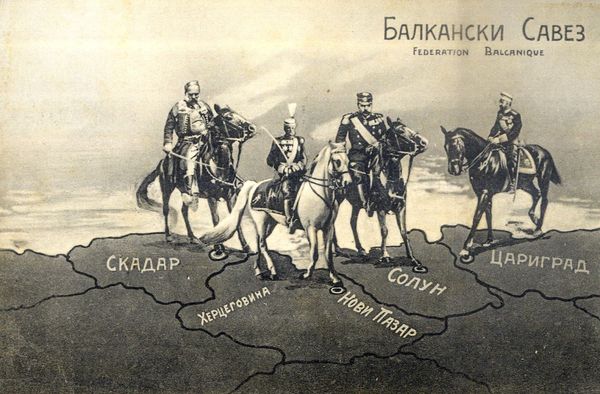
With the initiation of Russia, the new Slavic states and Greece in 1912 formed the Balkan coalition to start the war against the Ottoman Empire. According to these pan-Slavic plans, the Albanian people were intentionally left out of this alliance.
In October 1912, Serbia and Montenegro began military attacks against Albanian lands. Bulgaria and Greece also entered this war. Thousands of volunteers from the northern Slavic states were mobilized in this war.
Russia supported Serbia with officers, volunteers, military equipment and goods. Hundreds of Russian wagons supplied Slavic soldiers on the front line. Journalists from all powerful European countries had come to the war zone.
Massacres against the Albanian population had become daily and a hunting sport for the Serbian army. The Serbs saw the Albanians as harmful people who should be exterminated.
The King of Serbia, Petar Karagjorgjevic, had also come to the front line to closely monitor the situation. Petar Karagjorgjevic reported to foreign journalists that the majority of those killed and arrested in Vranje and other cities are Albanians.
In Vranje, Prince Alexis Karagjorgjevic, who was the son of the king’s aunt, Petar Karagjorgjevic, was standing next to the foreign journalists.
In front of foreign journalists, Petar Karagjorgjevic declared that this war will bring cultural progress to the Balkans. In the city of Vranje, the victories of the Serbian army in the front battles were celebrated.
After the fall of Kumanovo and Skopje, celebrations were organized with songs and dances. In addition to songs and dances, Serbian, Greek, Montenegrin, French and Russian national anthems were also sung. To celebrate in the city of Skopje with King Petar Karagjorgjevic, Prince Aleksandëri, Prince Georg Karagjorgjevic and Nikolla Pashiqi with family origins from a village in the district of Tetova, so all of them were of Albanian-Vlach origin.
During the entire journey of the Serbian army, the innocent Albanian population was killed and robbed. Killing and burning took place in all the villages inhabited by Albanians, the population abandoned the villages and concentrated in the cities.
In the cities of Kosovo, there were many robberies and murders in Prishtina, Prizren, Pejë, Gjakovë. These barbaric hordes continued the murders in the villages of Luma, Kukës until they occupied the port of Lezha and Durrës.
After taking the port of Lezha and Durrës, the Serbian army was now celebrating the successful completion of the third Slavic horseshoe project for the conquest and shrinking of ethnic Albanian lands.
To the surprise of the lack of recognition of the crimes and terror that the Serbian army did to the Albanian people during the Balkan wars, in the cemetery of Sharra in Tirana, in 1939, a memorial was erected dedicated to the 522 Serbian soldiers who died during the years 1912-1913 in Albania!
It is really senseless that in Tirana a memorial is erected for 522 Serbian soldiers without any memorial being erected for tens of thousands of Albanians killed and hundreds of thousands more displaced by the Serbian army during these wars!
I believe this has happened due to the lack of an Albanian national platform, to eliminate the differences in mind and pain for our population, which preserves the language, traditions and traditional Albanian culture despite the small differences in all areas of the Illyrian Peninsula.
In conclusion, I can say that, historical data teach us that even among peoples and other societies of an ethnic affiliation, there are small differences in religion, dialects and traditions, but the peoples who created national and religious unity proved that they managed to they face foreign influences only with stable cultural traditions. Peoples with a perfect and unified culture survived borrowings, assimilations and powerful projects for assimilation into other peoples and cultures.
Our national strategy should focus on highlighting our European cultural values, despite the pan-Slavic, Greek and Ottoman projects for their dominance in the Albanian territories, and the expansion of the Slavic cultural currents towards the Adriatic Sea and central Europe.
Albanians today have the opportunity to follow different cultural currents, to define themselves in the direction of creating European-level cultural works in many fields.
We must prove our participation from the earliest prehistoric times in the civilizational development of Europe.
Today, we still do not understand the universal importance of our cultural and historical heritage and the necessity for scientific verification of arguments to put them into the function of social organization and the rule of law.
The support of scientific research in the field of history and our cultural heritage would illuminate the changes in the time stages, understanding the importance of the separation of the state and religion.
We as a people must remove the dilemmas of our mental and cultural orientations, in the face of exterminating projects against our people that rely on the religious currents of the Slavic churches, as well as the oriental religious currents from the east that act according to political platforms, to keep us as much as possible. away from our ancient European affiliation.
We have not yet created a national platform to show our genuine cultural and historical values, but in our people today, diametrically opposite ideas in form and content for our entire popular culture appear, ideas that were initiated individually, in groups and institutional.
It is known that the spiritual heritage in which religion, traditions and folklore live are values of n
a mindset that opposes changes, but we must move forward with courage for the unification of our national values, while preserving traditional values.
We have read about our civic and national values from foreign researchers who classify us with different perceptions. We have been described by many Western researchers as belonging to a race with high anthropological values, as handsome people with clear moral values. By eastern and Slavic researchers, we are usually perceived as a people given to crimes, amusements, looting and material goods.
It is understood that the low epithets used by the Slavs, Greeks and Ottomans towards our people had their origins in their political platforms for the conquest of Albanian lands, the acquisition of material and spiritual culture and the assimilation of the population.
Regardless of different perceptions, we can only move forward with a national platform that raises our civic values to put them into the function of our national issue.
Reference


 Balkan Academia