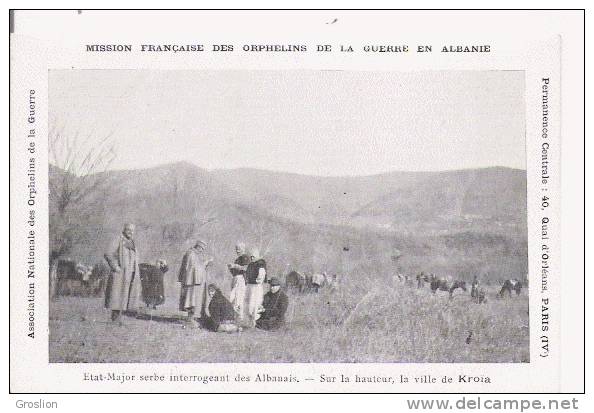

The municipality of Deçan, on February 5, 1944, reported in detail to the Ministry of Internal Affairs in Tirana, about the Serbian and Montenegrin atrocities and barbarism in the settlements of the municipality from 1912 onwards, where it ranked as the bearer of the predatory policy The church of Deçan.
In addition to the Church of Deçan, the report also talks about the numerous murders and atrocities committed by the Cetniks and voivodes, led by the Montenegrin captain named “Savo Batarja”. As the report informs, this Montenegrin criminal, during 1912, without any reason had gathered over a thousand people in the village of Carabreg, beating them in the most brutal way.
Savo Batarja and his war crimes in 1912
Against this violence and threat, Isa Qorri, Ali Shabani, Hasan Mula, Hysen Teta, Mal Loshi, Zyber Loshi, Elez Hasani, Ibish Halili, Dak Arifi and Zek Hyseni had the courage to react, who were then not only killed , but in advance they were forced to bury their graves. In addition to them, Dik Zeka, Sadik Mehmeti and Azem Beqiri, as well as Him Ahmeti and Nek Dobruna from Deçan, were also killed from this village. Similar massacres, during the years 1912-1913, were carried out almost throughout the occupied Albanian land and, as a result, more than 150,000 Albanians were forced to leave their homes to settle in Turkey.
Meanwhile, after the ultimatum received by the Great Powers (August 1913), for the Serbian troops to withdraw within the limits defined in the London Conference, the Serbian government, as a response, banned Albanian citizens from using the markets in Dibër, Prizren and Gjakovë. Such a decision greatly revolted the local population, which revolt soon turned into a general uprising against the Serbian occupier.
Count Berchtold, on September 24, 1913, through a circular, informed the Austro-Hungarian diplomatic missions that the Albanian uprising was provoked by “Serbian brutality”, while the participation of Albanians was only in the areas occupied by the Serbs, which was contrary to the decisions of London or from the population of the areas that “had their food supply cut off due to the obstacles to go to the market of Dibra and Gjakova”.
Serbo-Montenerin atrocities against Albanian civilians
The Investigative Commission of the “Carnegie” Foundation had a similar attitude, which in the report dedicated to this event wrote that on September 20, 1913, the Serbian army, retreating through the border near Dibra, took all the cattle from the Dibra highlands. , for which “the shepherds were forced to defend themselves”. Further, the report stated that the Serbian army, after killing all the shepherds, began looting and burning “all the villages on their way: Peshkopina, Pletza and Dohoshishti in Lower Dibra and Allajbeg, Macin, Para, Oboku , Klloboçis, Sollokičin in the Upper Dibra” and that in all these villages the Serbs “perpetrated terrible acts of massacre and violence against women, children and the elderly”.
Serbian atrocities in Lumë region
Regarding the crimes and massacres that the Serbian army committed in Lume, Dimitrije Tucoviqi wrote that a village in this province “disappeared” completely in two hours with scenes “that are difficult to describe”. “The shots, says Tucoviqi, knocked down the women who were holding the baby in their breasts; next to the dead mothers, their little children, who had accidentally escaped the bullets, were crying; the bodies of beautiful highlanders, slender as firs, writhed like worms in the field; women were born out of fear. For two hours, 500 souls were killed…”.
Burning of entire villages
Mass killings of the civilian population, burning of entire settlements were numerous. Sali Hoxhë Vuçitërna wrote to Luigj Gurakuqi, about the end of the general war, that Hysni Curri has returned and that:
“Krasniqja, Gashi, Hasi, Bytyçi are completely burned. The great serbs came here.” To escape from these Serbian atrocities and barbarism, the large number of the Albanian population of Dibra, Gostivar, Kîrçova, Struga, Ohrid, Prizren, Peja, Gjakova left their homes, to settle within the Albanian border, mainly in Tirana , Kukës, Tropoja and Elbasan.
100 000 fleeing Albanian refugees
The Albanian writer and culturologist from Dibra, Haki Stërmilli, in his work “Dibra on the verge of history”, writes that while “the men of Dibra were fighting fiercely on the peaks of Kirçishti, Korrab and Jabllanica, the families of Dibra – from the city of of the streets, – they were put on the run towards Tirana and Elbasan…”. According to him, the number of displaced persons from the entire district of Dibra and other Albanian villages was over “100,000 souls, women, men and orphans”, who had headed towards “the West so as not to fall into the hands of the enemy”.
The newspaper “Përlindja e Shqipënia”, on October 15, 1913, published the Call of the Parish of Dibra, addressed to the Great Powers, the content of which was as follows:
“We, the Dibrans, put under the yoke of the Serbs for ten months, obediently endured all forms of oppression, but the last persecutions strengthened us in such despair that we liked death from captivity. Thousands of innocents fled under the mountains and rocks, are at risk of death from cold and hunger. Our present condition is impatient and our future dark and unknown. Only the justice of the Great Powers and the mercy of civilized peoples can save us. Sure that our prayers will be heard soon, we ask for the justice of the cabinets of the Great Powers and the conscience of the people of Europe, which is the only one that can give us the right to live free in our homeland to be united”.
The documents of the time, which are stored in the Central State Archive in Tirana, shed light on the atrocities, barbarisms and massacres committed by the invading Serbian army against the Albanian civilian population of the villages of Prizren, Gostivar, Tetova, Kirçova, Gjilan, Peja, Deçan. , Gjilan, Ferizaj, Pristina, etc.
Serbian war criminal Spiro Delloci
On the same day, the commander of the Serbian volunteers, Spiro Delloci from the village of Delloc in the municipality of Mushtishti, had the wife of Ali Hajdari, as well as Hake and Muharrem Rexhepi, both from the village of Kabash, burned alive. At the same time, the criminal Spiro Delloci massacred 8 Albanians from the village of Korishë, while the Serbian army took Pren and Zef Çeta and were massacred, the first in the church of Kabashi, while the second in the vicinity of Prizren.
Serbian atrocities in Mirdita, Vrapcisht, Kalisht, Cegran, Qafë, Llakavicë, and Duf.
The Serbian army also carried out such massacres in the villages of Gostivar, such as in Simnica, Gjenovica, Reçan, Vërtok, Raven, Zdunje, Mirdita, Vrapçisht, Kalisht, Çegran, Qafë, Llakavicë and Duf. In all these settlements, as noted in an Albanian document, the Serbian occupying army, in cooperation with the local Serbian and Bulgarian komitadjis and Chetniks, in the second part of October 1913, killed, stabbed or burned several hundred Albanian civilians, among them also women, old people and children”.
Atrocities in Simnicë, Zdunje, Raven, Vertok, Recan
It was the month of October 1913, the document says, when Albanian men were brought from the streets of Simnicë, Zdunjë, Raven, Vërtok Reçan, etc. and slaughtered without mercy, throwing them into a pit located at the entrance of the village, coming from Gostivari. All the men were stabbed with knives and swords while their hands were tied”.
Simnice Massacre of 1913
Among the settlements that suffered the worst, Simnica should be singled out, where – as noted in the document – the Serbian army, after burning the entire village, took 48 men and two women and sent them “…to a place called Vakuf of Banica, where they were slaughtered all with a knife together with the other Albanians who came from different neighborhoods and threw them into a pit which is still found today in the above-mentioned place”.
The Mayor of the Municipality of Sanakos, Mehmet Bushi, on August 21, 1944, sent the Ministry of Internal Affairs in Tirana the list of 153 people from the villages of that municipality killed by the Serbian army during 1915, such as: Gradec, Pirok, Negotinë, Gjergjevistë , Sanekos, Llomnica and Gorjan. Meanwhile, in the report of the mayor of the Municipality of Zhelina, Abdurahman Reka, it is said that in the village of Debërcë in Upper Derven, in November 1915:
“87 men, all of adult age, were captured by the army and the Serbo-Montenegro Gjindarmër, and they tied them up, they took them to the place called ‘Klisura’ (the general road Skopje-Tetovo) and they killed them… This murder, the report continues, is omadic and bamun without the slightest reason, but only for the purpose of torturing and terror to the Albanian people, that they were forced to leave the fertile fields, in the hands of the Serbian and Montenegrin colonizers”.
Atrocities in Vitia, Kamenica, Komogllavë, Smira, Gjylekar, Germovë, Drobesh, Begunca, Verban, Kerblic, Dobercan, Ternoc, Gushice, Gumnishte, Gadish, Maroc, Dragofcë, Berivojce, Koretin, Mekresh, Kostadicë, Mogilë, Terstene, and other villages.
During the years 1912-1914, the army and Serbian committees carried out numerous massacres in the villages of the districts of Gjilan, Vitia, Kamenica and Ferizaj, such as in Kabash, Komoglavë, Smira, Gjylekar, Germovë, Drobesh, Begunca, Vërban, Kërblic, Dobërçan, Tërnoc, Gushicë, Gumnishte, Gadish, Maroc, Dragofcë, Berivojcë, Koretin, Mekresh, Kostadicë, Mogilë, Tërstenë and many other villages, which according to Albanian sources were killed with rifles or stabbed with knives. This is how several hundred Albanian civilians were killed, including women and children. Meanwhile, during the First World War, in this Albanian part, crimes and massacres were also committed by the occupying Bulgarian army and the Bulgarian local komitadji detachments.
Atrocities in Kircova
Even the Albanian population of Kirçova did not escape the Serbian and Bulgarian atrocities and barbarism. In the spring of 1913, some groups of Serbian and Bulgarian Komitas and Chetniks, led by Mihalj Brodi and Stanku Dimitru, after surrounding the city, took all the Albanian men and sent them to three designated places as slaughterhouses (dajakhane), in ” Çiflik”, which was located near the Bulgarian school “Biçincë-Jurije”, as well as the elementary school in the center of the city.
Many of them were killed with rifles, another part were stabbed with knives, while there are also those who died from being beaten with wood. The Mayor of Kicevo, in the report dated July 20, 1942, sent to the Subprefecture of Kicevo, among other things, wrote that this whole situation had lasted for about two months, during which:
“…the best Albanians were slaughtered, some with rifles and most of them were killed by wood”.
Reference


 Balkan Academia