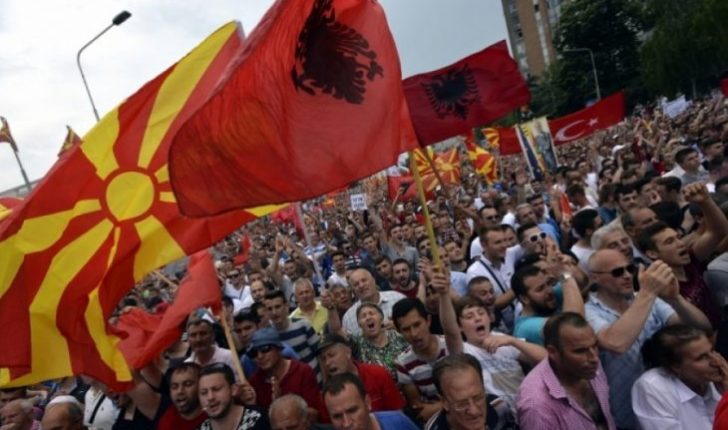

Taken from Xhemil Zeqiris article in “Tetova Sot”.
Apartheid in North Macedonia continues with genocide proportions against Albanians
The Republic of Macedonia was founded on November 29, 1943 in Jajce. There is no doubt that this republic was founded to the detriment of the ethnic Albanians. After the Second World War, Albanians and their lands in the former Yugoslavia were divided into 3 parts: Macedonia, Montenegro, Kosovo.
A few years later, Kosovo was reconstituted, and 3 municipalities were taken over: Presheva, Bujanovci and Medvegja, which today is called Eastern Kosovo. The Serbs have used the Republic of Macedonia as a “test tube”, preparing it for the expulsion of the Albanians in Turkey. So, physical and psychological violence and terror against the Albanians, on the one hand, was done in order to realize some secret agreements with Turkey, where the Albanians, as the only possibility of “survival”, had to leave for Turkey.
From Skopje they arranged the documents, the so-called “visika”, with which they forced them to change their national identity, forcing them to declare themselves Turkish, because only in this way they were told that they would be accepted by Turkey and, according to some reports of the time , over 350,000 Albanians moved to Turkey.
After 1991, after the dissolution of the Yugoslav Federation, Macedonia also became independent from this infamous Federation. How did the Albanians experience the so-called “democratic” changes? During the socialist system in Yugoslavia, Albanians had many rights, which were guaranteed by the Constitution of Yugoslavia, but whenever they demanded that those rights be respected, they always ended up in the Courts, from which they received severe punishments.
With the advent of this “democracy” system, Albanians initially thought that they were somehow freed to enjoy “individual freedom”, but this freedom did not last long, only until the Republic of Macedonia became independent. The persecution and discrimination, isolation and persecution of intellectuals and political activists began immediately.
Flight disasters where Albanians died
There are many abuses, but here I will try to mention only a few of them. The case of the establishment of the University of Tetova also had a victim. Then, the 194 victims of the two air disasters that occurred in the Republic of Macedonia in 1993. The vast majority of those 194 victims were Albanians.
The first air disaster occurred on March 5, 1993, in Skopje, where a “Foker 100” airplane, belonging to the “Palair Macedonia” airline, crashed immediately after take-off from the “Petrovec” airport. 89 Albanians lost their lives in this tragedy.
In these situations, Albanians were always treated and continued to be treated as a minority (even though they are the largest ethnic population in Macedonia), but not as a minority. I emphasize that a minority is called when they speak another language, but do not live in the same territorial extent, while Albanians are located in the same territorial extent, therefore they must and are a minority, just like the Macedonian minority, and this is a consequence of the installed anti-Albanian policy in the system and in the Macedonian Constitution and, of course, how can we not be a minority when in the Assembly of R.M., for an Albanian deputy, up to 22,000 voters must vote, while for a Macedonian deputy, 3,000 voters are enough to vote!
As a result of this constitutional discrimination, the Albanians in 1991 had only 23 deputies. Organizations of Political Prisoners tried to change this discrimination, but it was in vain. All possible democratic tools were used, and finally, on February 14, 2001, a protest was organized in Tetovo by the “Association of Political Prisoners” and the “Association of Women in Macedonia”, in which case the police intervened with force. , to peaceful protesters.
This time the answer came from the fortress of Tetova; there the freedom rifles burst under the leadership of the brave Commander Baci Izair Samiu, with the famous emblem: National Liberation Army. This led to the start of fighting between the Macedonian Army and the National Liberation Army (NLA).
This liberation war, without equal, but which had the popular support of the Albanians in Macedonia and beyond, had amazing progress during the development of the fighting. But, when the insurgents reached Haračina village, approached 10 km to the Skopje Airport, which could soon fall under the control of the KLA, then the international factor immediately intervened with an urgent request to stop the war.
Some politicians of political parties and leaders of the KLA started talks with the Government of Macedonia. As a result of these talks, the so-called Ohrid Agreement was reached on August 13, 2001.
This Agreement, although it did not satisfy the popular demands, the KLA accepted those unfavorable points for us Albanians and stopped its just liberation war. This is for the sole reason that the National Liberation Army was not represented in those talks by the political leadership of the KLA, but was authorized by Ali Ahmeti Arbër Xhaferri, whose party was a leader in the Government of Macedonia.
The disaster for the Albanians in Macedonia started, first, with the recognition of the Macedonian state by the Republic of Albania in 1993, without any conditions; secondly, with the intervention of the President of Albania, Sali Berisha, the only Albanian party in Macedonia, that of Democratic Prosperity, split, sending Shaban Memija and, with his help and the initiative of Arbër Xhaferri’s divisive group, from the Party of Democratic Prosperity The Albanian Democratic Party emerges with Arbër Xhaferrin at the head.
It is known that, with the creation of political pluralism in the conditions of being occupied, the people are divided, therefore, as a result of this division, the National Liberation Army would necessarily be born and was born. And, finally, the Ohrid Agreement brought a ban on violence and psychological and physical terror against Albanians. The Ohrid Agreement, given that the KLA authorized its political opponent to represent it, naturally brought and brought the fatal mistake, accepting serious political concessions in favor of the Albanians.
Cases of Albanians killed or imprisoned
All this hatred and psychological terror has been increasing even more, not only because the Macedonian Encyclopedia discriminates and insults Albanians in the most vile way, but also because of the fact that after the Ohrid Agreement, terrorist acts were carried out against Albanians by the institutions of the Macedonian dictatorship. For this, we are giving some convincing arguments to the readers:
The case of Burhedin Nuhi, imprisoned in 2002, with life imprisonment without any evidence!
The “Sopot” case concerns the exposure of a mine in the village of Sopot in March 2003. For this case, 11 residents were sentenced to a total of 156 years in prison. And, surprisingly, the accused were acquitted after many years!
The killing of Albanians in Gostivar where two young Albanians were killed by a Macedonian policeman and he was not punished!
The case of the village of Brodec, on November 7, 2007, in the police action “Mountain storm” where 6 people were killed, while 13 other people were arrested and sentenced. One of them, Hanif Dervishi, died in prison.
The case of Harun Ali, “Kushtrimi” Commander, who was killed on May 12, 2010 near Radusha, but the suspicions are that his execution took place in another location. Together with him, Shaban Zenuni from Merova, Xhafer Shala and Qemajl Fejzullahu also fell in the organized ambush.
The Alfa case, which happened in April 2010. For this murder, Rexhail Qerimi from the village of Opajë in Kumanovo and Agim Islami from Skopje were sentenced to life imprisonment, while Ramadan Shaqiri was sentenced to nine years in prison, accused of being an accomplice in crime, while Almir Dropljani, who was on the run, was sentenced to life imprisonment, but was later extradited to Macedonia to serve the prison term.
The “Monster” case, where the six Albanians Halil Demiri, the brothers Afrim and Agim Ismailović, Fejzi Haziri, Haki Haziri and Sami Luta were sentenced to life imprisonment in 2012, under the charge of having committed five murders in the lake of Smillkova.
A bus with Albanian students from the secondary school of Kumanovo was attacked with stones in 2012, in the village of Lubograd, in Macedonia. In the incident, two students of the secondary school of Kumanovo were injured.
The tragedy of Llaskarca, in which 16 residents of Gostivar lost their lives. Two years after the accident, the court process is still taking place, in which six people are accused and it is still taking time to find the responsibility and the circumstances that caused the tragedy.
Under the pressure of these tragedies, of course the members of the KLA, following these discriminatory developments staged by the Macedonian state institutions, against the ethnic Albanians with genocidal proportions, could not sit idly by.
And, first of all, they attacked a Macedonian police station, but no one was killed, due to the fact that it was not their intention to kill the police as a sign of revenge, but the attack was intended to attract the Macedonian institutions attention, according to the motto: Be careful! Stop the violence against the Albanians in Macedonia! Therefore, they were content with disarming the policemen and left.
The insurgents waited for several months, but, unfortunately, there was no positive reaction from the right-wing government of Nikola Grujevski?
So, the members of the KLA, who carried out the 2001 fighting, being hosts to all Albanian lands, in the area of Illyricum (Balkans), gathered legally in the “Quarter of the Brave”, in Kumanovo, a neighborhood inhabited entirely by Albanians, to discuss the further political trends in terms of the implementation of the agreements approved and accepted by the Macedonian state institutions.
This meeting was imposed due to the fact that the Albanian parties in had given up the demands for the rights of the Albanians. They had long been turned under the rug into tools of the anti-Albanian power.
However, on May 9, 2015, the right-wing government of Nikola Grujevski, without warning, when the ex-soldiers gathered in Kumanovo to discuss the issues of the possibilities of how to put the rights of the Albanians on the way to a solution and, they were attacked by the police and certain forces of the Macedonian army, without warning. The Albanians were asleep then.
This confirmed the fact that members of the KLA. already known as the “Group of Kumanovs”, were treacherously trapped; exactly from the Albanian vassals of Gruevski’s power.
The entrepreneurs in that meeting, (“Kumanov’s Group”), since they were attacked suddenly, of course, not knowing from whom they were being attacked and why they were being attacked, decided to defend themselves, but with light weapons that they had taken for safety and not to attack state institutions.
There, in that unequal battle, which lasted 2 days, several members of that group (former members of the KLA) were killed. With the intervention from outside, the conflict was stopped.
The Kumanovo group surrendered in the hope that negotiations would continue…
However, the Basic Court of Skopje has sentenced the members of the “Kumanova Group” to a total of 746 years in prison, accused, perhaps, “of terrorism” for those events on May 9 and 10, 2015, even though they allegedly staged a terrorist attack. self staged.
A total of 37 people were charged with the crime of “terrorism”:
7 of them were sentenced to life imprisonment,
13 of them with 40 years in prison,
6 of them with 20 years in prison, etc…
Meanwhile, Beg Rizaj and Mirsad Ndrecaj are killed by the police, without trial. So, the conflict of May 9 and 10, 2015, in the “Quarter of the Brave” in Kumanovo, undoubtedly brought about some positive changes. The right-wing fascist government based in Belgrade fell; of course, by election/, because the Albanians voted for the Social Democratic party, oriented pro-European, who hoped for improvement in daily life. Upon taking power, Zoran Zajevi’s Party oriented the MV towards the West and NATO; it had and still has ambitions for membership in the EU, but, it seems, it is unable to stop the terror and the systematic violence against the Albanians.
Of course, this policy was punished by the Albanian voters in the local elections of this autumn of 2021, where the Prime Minister of the country was forced to resign, but then he repented and returned again as Prime Minister!
Now, the question is added:
Because, no report or criminal case against Albanians is being seriously investigated by the State of MV, crimes which I have mentioned some of them, I think it would be good for the Government of Kosovo to intervene with the international institutions of justice for an investigation of these Macedonian state crimes against Albanians. Here, in particular, I would emphasize the treacherous murders of Commander “Telit” (Lefter Koxhaj), Commander Harun Ali, of “Kushtrim” and the murders of Beg Riza and Mirsad Ndrecaj who were killed without trial even though they had surrendered.”
Reference

 Balkan Academia