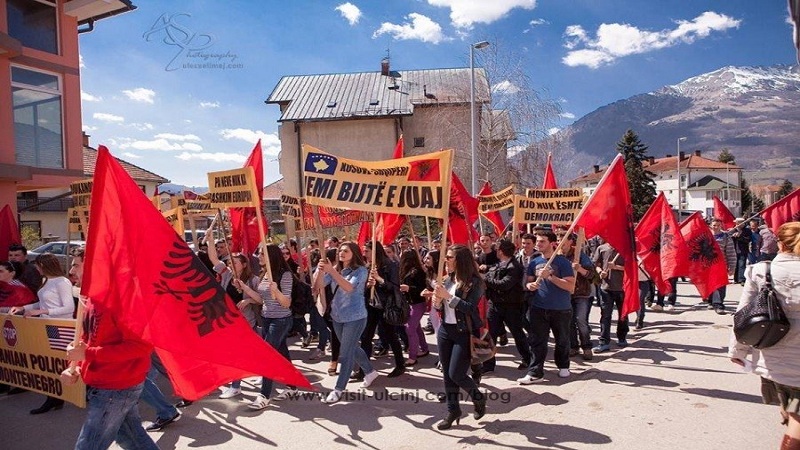

Taken from Hajrullah Hajdaris article “Why is the assimilation of Albanians of Tivari not stopped?” published on PlavaeGucia.sot
“Albanians are there, but they don’t declare themselves as Albanians!
Tivari is an ancient city, originally located 5 km from the sea at the foot of Mount Rimia. Archaeological finds confirm that life in this area dates back to prehistoric Illyrian times. The historical past of this Illyrian city does not differ much from other Albanian cities on the Adriatic coast and shared their fate until the Congress of Berlin (1878), when this city was finally separated from Albania.
Montenegrin atrocities against Albanians, accoridng to French journalist Auguste Meylan
A full six (6) months before the infamous decision of the Congress of Berlin, the Montenegrin army mercilessly attacked the Old City of Tivar. The Montenegrin army used the most terrible methods of war, and the civilian population was even cut off from the water supply. The city was burned and destroyed. completely. Of the 600 houses this small town had, not a single one was saved. Half of them became dust and ashes while the others turned into embers. Two hundred (200) dead women and children were found in one mosque alone. The French journalist Auguste Meylan comments on these fascist actions at the time: “I have seen many other sieges, but I have never seen something so terrible as this miserable city of Tivar, where not a single house is left standing.”
Although the resistance for the defense of Tivar, with the participation of many local Albanians, from Shkodra and Ulqin, during the winter of 1877/1878 was heroic, the city fell into the hands of Montenegro on January 10, 1878. The annexation of this city is formalized with the decisions of the Congress of Berlin. Thus, Tivari became the center of attention of the press of the time and the first Albanian city that was separated from Albania.
Part One: Montenegrin invasion of Albanian lands
In the conditions created by the destruction of the war and the desire not to surrender to the Montenegrins and live under the Black Mountain, a large majority of the population fled from Tivari and settled, most of them in Shkodër but also in Durrës, Elbasan and cities of others leaving everything they had saved from the burning and destruction of the war. Over 284 families had left Tivari, of which 83 families never returned. Their wealth was seized by the Montenegrins and they were never compensated. Those who returned were found by the Montenegrins in their lands, most of whom could not leave the properties of the Tivar Albanians.
The families that did not return to Tivar were almost all of Albanian nationality. This is confirmed by a protocol of the families of 1977 and those who are not in Tivar in May of 1879 (DACG, MUD, p.4nr.1106). He mentioned only some of them: Emin Beg, Mulla Sala, Dul Beqiraga, Haxhi Ahmeti, Selim Ademi, Salo Misherri, Usejn Zoja, Smajl Jusufi, Eto Pera, Osman Kacila, Omer Kirçiku, Haxhi Lanica, Avdullah Kaca, Met Harapi, Demo Zeka, Daut Kadija, Dem Salihu, Nelo Zemra, Jusuf Tafula, Mujo Mushica, Omer Kirçiku, Halil Ahmeti; Mahmut Spica… Even the names of the family members who had returned also prove their Albanian affiliation, such as: Ali beg Qorri, Mustafë Haxhi Jusufi, Jaho Dervishaga, Haxhi Ala, Sulo Suma, Huso Shestani, Dul Buza, Can Spahia, Ahmet Kaca, Fazli Goca, Mahbub Arapi, Alush Kasmi, Ramo Kraina (Kraja), Rustem Ishma, Musto Tafica Rexhep Fazlija, Braho Korda, Mehmet Dibra….
Narrowed by the internal political circumstances and the fear that had engulfed the Albanians in Tivar, they gradually began to adapt to the new conditions of life dictated by the Montenegrin power. They started attending school in the Montenegrin language, but few were able to complete primary education. A part of them, not agreeing with this reality, left Tivari and continued the journey of exile, a path that unfortunately has not stopped even to this day. In addition to the migration, as a result of the lack of schooling in the mother tongue, the process of assimilation of the Albanians in Tivar also began.
According to the partial population census in Montenegro, in 1879, Tivari and Zalefi together numbered 507 families with 2302 inhabitants, of which 1365 were Mohammedans (almost all Albanians) and 448 were Catholics (Also Albanians) or 78.75 % of the population were Albanians. In Tivar, according to this census, 489 citizens of the Orthodox religion lived, or only 21.24% of the population, adding that in Tivar 16 families with 82 members were registered as Roma. The later censuses of the population in the Kingdom of SKS (1921, 1931) do not provide accurate records of the national or ethnic structure of the population. were almost completely assimilated.
Part 2: Albanians in Montenegro during World War Two and the Tivar Massacre.
Albanians welcomed the end of the Second World War with hopes for the expression and restoration of Albanian integrity and identity! But, unfortunately, Tivari once again became a center of cruelty and terror for Albanians. Exactly, on April 1, 1945, in this once Albanian city, the greatest tragedy known as the “Tivari Massacre” took place! The Tobacco Monopoly event in Tivar.
In this unprecedented massacre against the Kosovar Albanians violently mobilized and unarmed were massacred with iron rods hitting them on the head, chest or back and from these blows about 100-150 people were left lying dead. But that was not all. They were fired with all kinds of firearms such as automatic rifles, machine guns, mortars, hand grenades, and other revolvers. The yard and the square of Monopoli were covered with a river of blood that resembled a real cataclysm, while the building turned into a ruin, with hundreds of corpses of Albanians inside it! There are no exact records of the number of people killed by gunmen, but it is thought that over 3,500 Kosovar Albanians were killed in Tivar and on the way to this city.
But why did the massacre happen in Tivara!? The purpose and reasons are many, but this did not happen by chance. The Albanians in Montenegro in 1944 and at the beginning of 1945, remembering the bitter past under the Serbian-Montenegrin rule, had expressed their desire to join the Albanian state. This desire of theirs had to be finally extinguished. So, the suppression of the national feeling through the massacre was one of the goals of the Serbo-Montenegro ultraracists who believed that the massacre will be a good lesson for the Albanians of these lands. Consequently, in the first population census in Yugoslavia, in 1948, in Tivar only 26 people were registered as Albanians, while in the 1981 census only 102 people! Where did they go, what happened to the Albanians!? Most remained there physically, but they never identified themselves as Albanians! Some of them emigrated, but most of them were assimilated by being registered as Montenegrins or Muslims.
Part 3: Albanians in Montenegrin in the 1990s
The beginning of democracy at the beginning of 1990, the Albanian intellectuals raised the hope that now the autochthonous Albanians or those who have come to Tivar over the years will understand their Albanian national belonging. But no! The results in this direction are quite small. However, the war in Bosnia and especially in Kosovo caused some Albanians, especially of the Muslim religion, of this city to become aware. Thus, in the 2011 population census, 250 people were declared as Albanians! It is interesting to note that in this census, in the “religious affiliation” question, a total of 3,043 people declared themselves “Catholics”. It is known that there are very few Croats or Croatian Catholics in Tivar, so most of them are Albanians. So the Albanians are there but they don’t declare themselves as Albanians.
Even though the Albanians were the majority people in Tivar, in this city no school was ever opened to teach in the Albanian language! Starting from the principle that “if you are going to destroy a people, don’t open a school in their native language”, it can be concluded that school education only in the Montenegrin language is authentic for Albanians as well as for those settled here from Ulcinj, Ana e Malit and Kraja, is one of the main reasons for the assimilation of Albanians here.
I was shot once for calling one of my natives. “Hello” I said, “Please” a little girl answered me! I continued to speak Albanian and told him who I am! “Majko, majko, neko od onih vašhih te traži” (“Mother, mother, one of yours is looking for you”). After the mother appeared, I asked her about the girl’s behavior and asked her if she knows who “yours” are!? “She also studied at school, she studies and plays with her Montenegrin friends all day. But we don’t even dare to say who we are”! answer me. I was left in despair, but once again I proved that the lack of schooling in the Albanian language is a big handicap for these Albanians left in Tivar.
However, in recent years, something has moved in this direction. Many Albanians from Kraja and Ana e Mali, on the occasion of marriages, have started to organize weddings in the restaurants of Ulcinj with Albanian songs, and some even use the Albanian national flag.
Part 4: Albanians risk being assimilated – particularly in Tivar.
Considering all the political circumstances of the past and present and the assimilation policy of the Montenegrin government over the years, it is up to the Albanian political factor in Montenegro to promote an initiative to open at least one parallel in the Albanian language as soon as possible. Otherwise, the assimilation of Albanians in Tivar has not stopped.
Reference


 Balkan Academia