
The following article cites publications on the possibility of Theodor Kolloktroni (or Theodor Bythguri) having an Albanian origin.
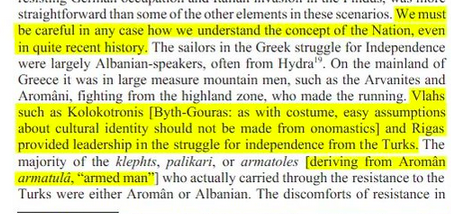
“There is also the case of Theodoros Koloktronis, the most famous General of the independence war, who may or may not have been of Albanian origin, who as most of the fighters, be they Albanian of Greeks, spoke fluent Albanian”.1
“Kolokotronis described the Albanians as brothers and his sadness about their attacks on him. He claimed that he was loyal to the contract that he had made between them and he demanded a meeting by mentioning he had a lot of Albanian friends like Elmas Aga in Tripoli.”2
“Rene Pinon, a French national, in 1913, would write about the heroes of Arvanite Uprising in 1821: “The Souliots, the Kolokotronis, the Kountouriotis, and many others were Albanians“.3
“Western states, fattened by exploitation, have set their sights on this region since the early 1800s. They began to arm the Greeks, who were encouraged to independence by proxy, with the idea of independence from the early 1800s. With its orthodox solidarity with Greece, Russia joined the western states at that time. In 1821, with the encouragement and provocation of England and France, an uprising was started among the Greeks on March 21, led by Kolokotronis, a Christian Albanian.”4
“According to the author Dhimitër Grillo, his last name Kolokotron is not composed of kollo and kotron, but of the names Kolo or Kola and Kotroni, which is a surname found in Vuno of Himara, which lives as such in the mouth of the people, since there is no remained the surname of this family in Vuno. Apparently they all left during the Turkish invasion. He gives us facts that 100 years ago, a member of the Kolokotrons came back to Vuno of Himara where he left his descendants who still live there today. So his real name is Kolokotroni and not Kollokotroni because the Greeks read the l as ll so they attached an adjective that doesn’t have that meaning.”5
“… Kolokotroni even talked about blood brotherhoods and assistance obligations with the corresponding Muslim-Albanian bandit groups of the Lalliots …”6
“None other than Koloktronis saw it fit to send a letter to the Albanian beys fighting on the Ottoman side. The letter was discovered by the Ottomans who translated into Turkish and could not believe their eyes. Koloktronis wrote to the beys that it was their fault they had let ‘our old grandfather (Ali Pasha) be killed and that if they had been manly enough they should not have done this, but they were deceived and tricked. But now was the time to repent and for his part, he still regarded them as his own and would not deign to kill them even when they came against him under arms. He liked them and he saw them as brothers and sons and asked them to send messengers t o him and he was ready to grant them his besa on his life”.7
“[…] at that point, direction of the siege was taken over by Kolokotronis, who succeeded once again in separate negotitations with the Albanian-speaking contigents of the garrison”.8
“Theodoros Kolokotronis, one of those who wished forthe freedom of the country, appeared on the stage ofthe holy race with great and indescribable enthusiasm, and fromthe very beginning his name was given respect and love onthe part of the people of the Peloponnese, so much because of his generosity of his family, in so far as and because of which he showed his personal merit in the various siegesand battles; for this reason the common people called him “King of the Vlachs, or Vlachovasilia“.
“Outside of Pouqueville, however, the Frenchman and former foreigner Thessaloniki Kuzinery (307) informs usfrom 1828 that there were Vlach traders and Vlach nomadic breeders on the Peloponnese. As he writes in his book, Vlachs exist not only in Wallachia, Moldavia and Macedonia, but also in the region of Argos where they mainly practice the professions of merchants and livestock breeders.”9
References
- https://www.google.se/books/edition/Greek_Albanian_Entanglements_since_the_N/9PbREAAAQBAJ?hl=sv&gbpv=1&dq=Kolokotronis+spoke+albanian&pg=PA32&printsec=frontcover ↩︎
- https://www.academia.edu/112691941/Albanian_Soldiers_in_the_Ottoman_Army_During_the_Greek_Revolt_at_1821?uc-sb-sw=19016907 ↩︎
- https://www.academia.edu/48876353/ARVANITES_THE_FOUNDERS_OF_MODERN_GREECE ↩︎
- https://www.larende.com/yazi/morada-batan-gunes-55353.html ↩︎
- https://palidanigorre.files.wordpress.com/2014/12/albanc3abt-me-fame-ne-mijevjecare.pdf ↩︎
- https://books.google.se/books?id=F2IlEAAAQBAJ&pg=PA64&lpg=PA64&dq=Kolokotroni+sogar+%C3%BCber+Blutsbr%C3%BCderschaften+und&source=bl&ots=oWDjldmDUi&sig=ACfU3U0Uf_HJlT6meXSpxl2aI3Dfkg7_tg&hl=sv&sa=X&ved=2ahUKEwjl8_mgv7CFAxXmOhAIHZwTDJkQ6AF6BAgIEAM#v=onepage&q=Kolokotroni%20sogar%20%C3%BCber%20Blutsbr%C3%BCderschaften%20und&f=false ↩︎
- https://www.google.se/books/edition/Greek_Albanian_Entanglements_since_the_N/9PbREAAAQBAJ?hl=sv&gbpv=1&dq=Kolokotronis+Albanian&pg=PA1824&printsec=frontcover ↩︎
- https://www.google.se/books/edition/The_Greek_Revolution/EM8cEAAAQBAJ?hl=sv&gbpv=1&dq=Kolokotronis+Albanian&pg=PA268&printsec=frontcover ↩︎
- 306-Íde, Promn. Book VI, p. 369. Bibl. X, p. 24,27. Book XIII, p. 111.113, Bibl. XV, pp. 312, 314.307-“Ιδε, Cousinery, Travels in Macedonia, 1828, vol. 1, p. 1 ↩︎

 Balkan Academia