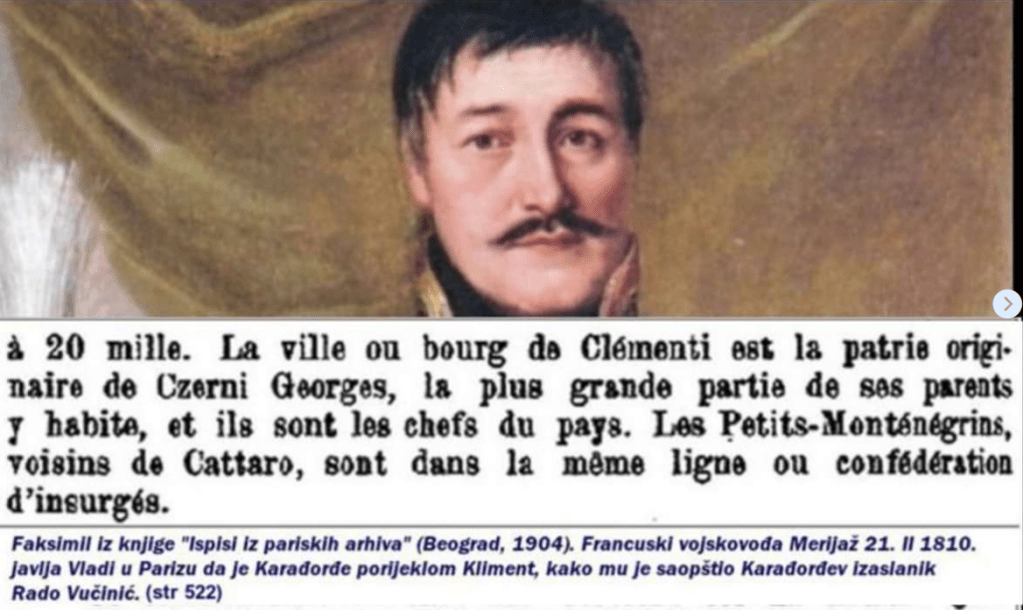

Originally written by: Miroslav ĆOSOVIĆ
It is a myth that Karađorđe Petrović was originally from Vasojević
The Metropolitanate of Montenegrin and Littoral Serbian Orthodox Church appropriately marked the 200th anniversary of the death of Karađorđe in the Church of Christ’s Resurrection. In Montenegro, the myth that Karađorđe originated from Vasojević has been fueled for decades. Portal Analitika publishes a text by publicist Miroslav Ćosović, who deals with historical sources and traditions on this topic. Was Karađorđe really Vasojević?
Myths in Montenegro are unabashedly promoted even by famous historians, people who were admitted to the Montenegrin Academy of Sciences and Arts as scientists, not as writers. One such person who, in my opinion, presents myths as history is CANU academician Miomir Dašić. In the continuation of the text, we will publish what Dašić wrote about that topic, and what historical sources say. So you judge who is right.
The myth that Karađorđe came from Vasojević was opened by none other than Njegoš’s teacher Sima Milutinović of Sarajevo. Vuk gave contemporary Serbs a language based on the language of Montenegrins, Dubrovnik and Herzegovina, for example the letter / sound h Vuk printed for the first time in Cetinje in 1836 and gave it to Serbs, I published an article about this on Analytica on February 11, 2016.
Vuk is certainly the greatest (new) Serb. In the entire history of contemporary and medieval Serbs, only St. Sava is a more significant personality than Vuk because St. Sava made the Serbian Church independent from Constantinople and thus created a “factory” for the production of new Serbs. As an Albanian, a Cincarin, a Bulgarian or a Macedonian, a Roma, a Morlak, a Montenegrin… entered the Serbian Church – that’s how he became a Serb.
However, contemporary Serbian national ideology is largely the work of Sima Sarajlija. The cults of Karađorđe, Obilić, Dušan were all spread by Sima Sarajli, and it was especially important for Serbia that he made all these cults and myths known to his student, Petar II Petrović Njegoš. The myths and fairy tales he received from Sarajlija Njegoš spread among Montenegrins, presenting them as historical facts.
Thus, in the song “Srbijanka” (Leipzig, 1826), in the song Čestitost, Sima Sarajlija sang: “Born by Vasoević – the son / of the Serbian Peter Nape’s pet / and Marica the nymph of Artemis;”
Sima Milutinović Sarajlija is also the author of the fairy tale (which he also passed on to Njegoš), that Montenegrins are actually some Serbs who fled to Montenegro. Back in 1826, before he even came to Montenegro, in the song Srbijanka Simo sang: “Montenegro is our Olympus, / Montenegro, the refuge of the Serbs!… / And you are few, but you can do a lot… / Montenegrins! Fathers of the Serbs make…”
And so Njegoš, having received from Sarajevo the poetic fairy tale that Karađorđe from Vasojević in December 1840, issued a certificate to Karađorđe’s son Aleksandar that the Karađorđevićs were originally from Vasojević.
I have read several books by academics, I can say that the book “Vasojevići from mention to 1860” is thoroughly done and useful, it provides a lot of information. However, Dašić published that book in 1986, and he was admitted to CANA in 1991.

Continuation of the myth
In 1996, Dašić published the book “Karađorđevići iz Vasojević” (Stupovi, Andrijevica), in which he bases his claims almost exclusively on traditions and not on historical sources (documents). Historians cite traditions only in the case when there are no historical sources about an event, and the traditions from the 20th century that dispel old traditions are newly composed traditions, or – fairy tales. An academic who perfectly knows the methodology used to write history books should not even think, let alone publish a book like the one he published in 1996.
The book “Karađorđevići iz Vasojević” resembles in all respects the fraternal and tribal monographs written en masse by retired people – economists, lawyers, engineers… In most of these retired monographs that were created in the 20th century, the origin of the fraternity (tribes) is explained in this way at the beginning ): “According to tradition (or – they say), our ancestor came after the Battle of Kosovo in 1389…” Those traditions that were written down in the 19th century or the beginning of the 20th century, have now been massively changed into newly composed traditions, or more precisely said – in fairy tales.
Academician Dašić also published a book without any hesitation, in which he constantly refers to traditions, in fact to fairy tales, this is how he writes:
“In Vasojević, and also in other parts of Montenegro, there is, however, quite a convincing living tradition, and even written traces, that the Karađorđevićs are from Vasojević, and that Karađorđev’s grandfather Jovan and father Petar moved from the Lim Valley to Šumadija, most likely around 1740. Thus, according to the tradition recorded by Dr. Radoslav Vešović, sixty years ago in Lijeva Rijeka, from Jovan Aleksin, M. Paunov and other residents of Lijevo, who referred to the earlier saying of the ‘recognized clever man’ Muša Bajov – ancestor Karađorđev originates from the village of Lopata in Lviv.” (p. 35)“
Well, on the same page, Mr. Dašić writes that some other Vasojevićs think that he is not from Lopat, again a Vasojević “tradition”, but now differently:
“In the village of Kraljima, not far from Andrijevica, Vasojevi, the Đurišići brotherhood maintains that Karađorđev’s grandfather is their expatriate brother, that he ‘went’ from Kralj to Serbia.” (p. 35)”
Karađorđe is a Kobayagi from Vasojević, but even the Vasojevićs themselves cannot agree on which part of Vasojević he is from.
Then again, Dašić gives some stories and legends, in fact – newly composed fairy tales:
“Pope Miloš Velimirović, whose family lived in Kralji for a long time (the Velimirovići are from Zagarčani, and from this famous family, which until the second half of the 19th century, but it is not known since when, lived in Vasojevići, Bishop Nikolaj Velimirović), in his notes he preserved the story of how he heard the legend that Karađorđe’s ancestors were “below Beran, from Bihor, from the village of Crnče, from Vasojević’s Srbljak”, where, until they moved to Šumadija, they lived as the manors of Bey Đorđević. That version of the legend he knows that the small brotherhood Gurešići, from Bihor, proudly pointed out ‘that they are cousins of the leaders’ (they celebrate St. Klimentius) and that Karađorđe himself supposedly believed in this kinship with the Gurešići.” (p. 35)”
Let’s see what other historians, that is, historical sources, say.
“Karađorđe is originally from Kliment, therefore – a Catholic Albanian: Đorđe Petrović Karađorđe, the leader of the First Serbian Uprising, was originally a Roman Catholic Albanian from the Klimenti tribe. As Rajko Veselinović writes (History of the Serbian People, Fourth Book, Volume I, Serbs in the XVIII Century, Belgrade 1986, page 160), in 1739, 300 Catholic families from Klimenat left Kosovo for Zbijeg. Most moved to Nikince and Hrtkovce, in today’s Vojvodina, but some settled under Mount Rudnik in Šumadija, among them Karađorđev đed. Academician of SANU Mita Kostić in “Politica” dated May 21, 1923 in the text “Arnauts in Srem” also says that the Catholic Klimenti settled below Rudnik and Avala.”
On the official website of the Karađorđević family, it is stated that they celebrated St. Clement of Rome “Before they started to celebrate St. Andrew’s Day, the Karađorđević family celebrated St. Clement (which in the church calendar is December 8 according to the new, or November 25 according to the old calendar) as a baptismal name. .“
Miomir Dašić was not admitted to CANA as a writer of fairy tales and short stories, as a writer, but as a historian. As a historian, he is perfectly familiar with the documents from the Paris archives that were published more than 100 years ago. However, academician Dašić, intoxicated by the sweetness of Serbia, simply kept silent about these credible historical sources in his book from 1996.
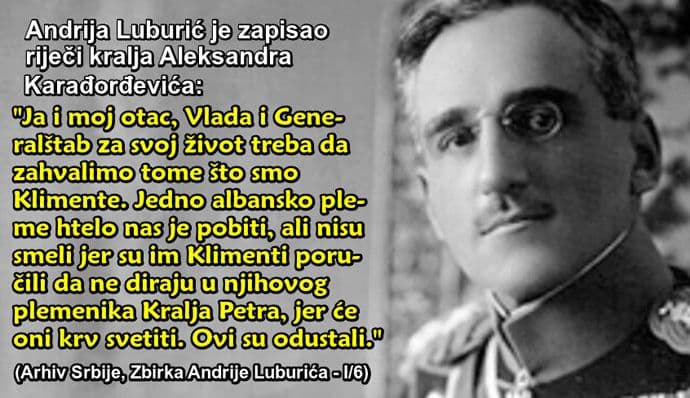
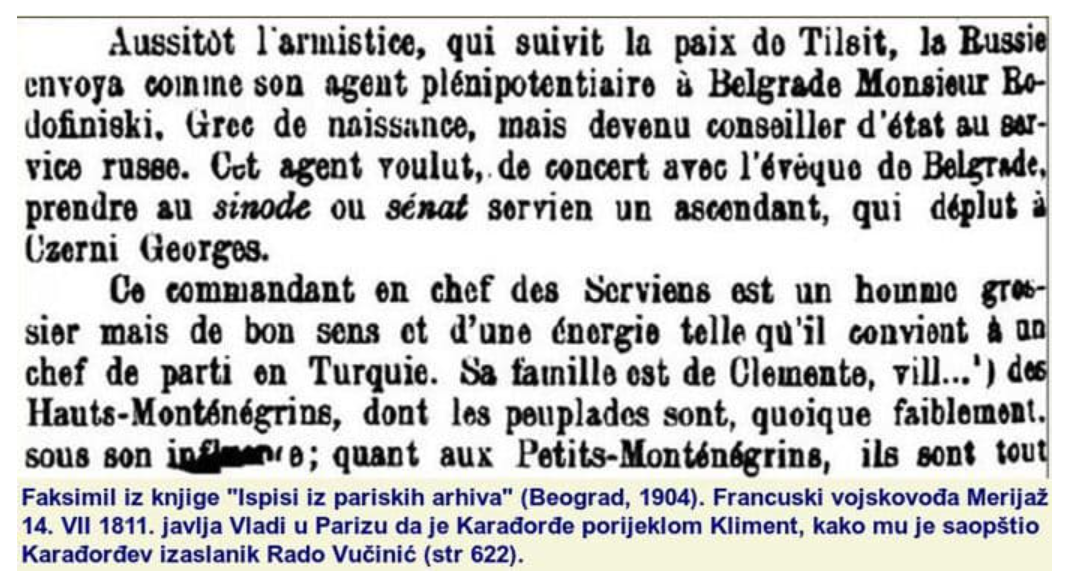
Thus, we have two letters that were sent to the government in Paris from the Balkans by the French general Merijaz, in the letters it is clearly indicated that Karađorđe was originally from Kliment. In 1904, the Serbian Royal Academy published the book “Prints from the Paris Archives”, the book contains Merijaž’s reports to the Government in Paris. On February 21, 1810, Merijaz wrote, among other things:
“Klimenat fortress is the birthplace of Black George and the largest number of his relatives live there and they are the chiefs of this region.” (page 522)”
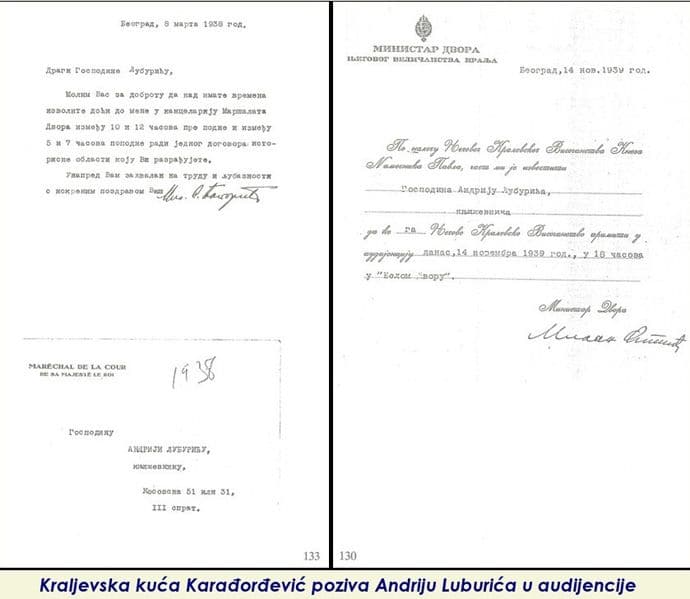
The Royal House of Karadordevic invites Andrija Luburic to the audience
These two letters were also mentioned in the “Dan” newspaper, in the Feljton column, on January 8, 2006. Merijaž considered under Visoko Crni Gora what in our history were called Brda and Brđani. The Frenchman positions correctly. The hills were: Pipers, Vasojevići, Moračani, Kuči, Rovčani, Bratonožići and Bjelopavlići, and the Arban tribes Klimenti, Hoti, Grude were also included in the Brđani until the 19th century… Our word Brđanin and the Albanian word malësor have the same meaning.
Merijaž received the information that Karađorđe Kliment was informed by Karađorđe’s emissary: Merijaž received the information that Karađorđe was originally from Kliment from Rad Vučinić, Karađorđe’s emissary. Here is what is said in the foreword of the book, written by Dr. Mihailo Gavrilović (Gavrilović also collected documents from the Parisian archives): “After Napoleon’s entry into Vienna in 1809, Merijaž was appointed commander of the Austrian capital.
Well, soon, his secretary the genius was caught in treason and shot, Merijaž himself would have been brought to court, but he was acquitted as innocent. This affair caused him to be out of office for a while. At that time, the mission of Rad Vučinić, whom Karađorđe had sent to ask Napoleon for help, failed. and protection. The Minister of Foreign Affairs ordered Merijaž to enter into negotiations with the Serbian envoy (Oct. 1809), and then he was ordered to go to Ljubljana, where he will conduct further negotiations with the Serbs. With the arrival of Rad Vučinić in Paris (May 1810) , Merijaž’s role in Ljubljana in the Serbian question became insignificant.” (p. XIX)
Therefore, since Merijaž was ordered to conduct negotiations with the Serbs in October 1809, he met with Serbian envoys in Ljubljana, and already in February 1810, the same Merijaž sent a report to Paris that Karađorđe was originally from Kliment, as the Karađorđes themselves told him. delegates led by Rado Vučinić.
The historian Dašić did not include these historical documents in the book on the origin of Karađorđević. Now let the readers of Analitika judge for themselves whether the historian Dašić wrote a scientific book or a book of fairy tales.
Andrija Luburić also collected material on the origin of Karađorđević long before Dašić: In the archive of Serbia, the collection of Andrija Luburić, who researched Karađorđev’s origin, is kept, and that collection was reviewed by Milorad Bošnjak and Slobodan Jakovljević, and part of Luburić’s writings were presented to the public in the book “Milorada Bošnjak i Slobodan Jakovljevića: Karađorđevići – hidden history” (Lio, Gornji Milanovac, 2006, link to the book).
In the Andrije Luburić Collection (ZAL) – “the original text of the poem ‘Vojvoda Jovan Mršić Kliment Karađorđev đed i Plavski Turci’, by the author of a Catholic missionary, one of the many who in the 17th and beginning of the 18th century were missionaries among the Klimenat tribe of the Catholic faith, is preserved In the same archival material there is also a commentary on the said poem, from which we learn that the original name of Karađorđe’s paternal grandfather was: ĐIN MARAŠ KLIMENTA.” (p. 9)
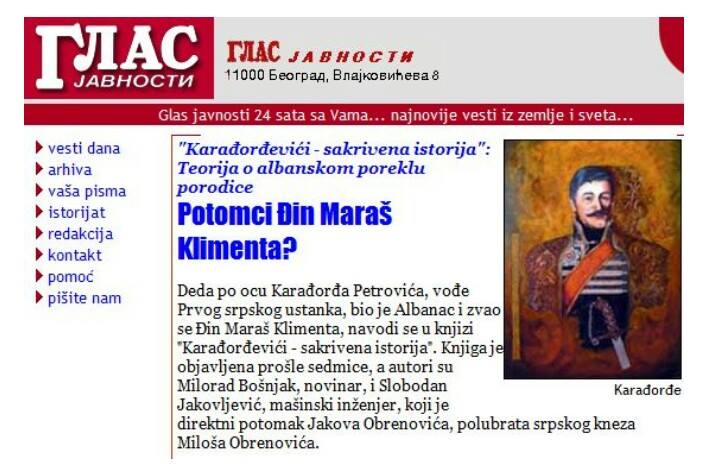
Just as Dašić cites traditions, Luburić also cites many legends and poems in which it is emphasized that Karađorđev’s grandfather was Kliment. If traditions can be at all reliable, the traditions that Luburić wrote down are more reliable than those of Dašić, because they are older than those presented by Dašić.
Before World War II, the Karađorđevićs agreed that they were of Kliment origin: Andrija Luburić had been researching Karađorđe’s origins for years, he persistently claimed that Karađorđe was of Kliment origin, and he communicated this to the Karađorđevićs themselves. Bošnjak and Jakovljević present: “According to the available documentation in the Archives of Serbia, Andrija Luburić was often called to audiences at the Karađorđević court in the period from January 25, 1929 to November 14, 1939, to discuss the origin of Karađorđević from Klimenat….” (p. 36)
In Luburić’s collection in the Archives of Serbia, this record was found, created on July 24, 1940:
“King Alexander said to an Albanian champion: ‘I and my father, the Government and the General Staff should thank for our lives that we are Klimenti. An Albanian tribe wanted to kill us, but they were not allowed because Klimenti told them to do not touch their nobleman, King Peter, because they will sanctify their blood. These have given up’.” (p. 37)”
In 1936, Andrija Luburić advised the royal house of Karađorđević in one text, “How to win over Karađorđe Klimente for the Serbian cause”. In this Great Serbian plan (one of many) Luburić wrote: “The most famous and most important Arban tribe Klimenti is of Serbian origin and it gave the immortal Chieftain Karađorđe.” (p. 42)
After all these claims that Karađorđe was Kliment, the royal house received audiences with Andrija Luburić, therefore, the Karađorđevićs gave in to his claim that Karađorđe was Kliment.
Can you imagine that today the Karađorđevićs receive someone who claims that they are originally from Klimenti?
In the 19th century, the Karađorđevićs celebrated St. Kliment of Rome, and that dynasty between the two world wars indulged in claims that Karađorđe was Kliment.”
References and sources


 Balkan Academia