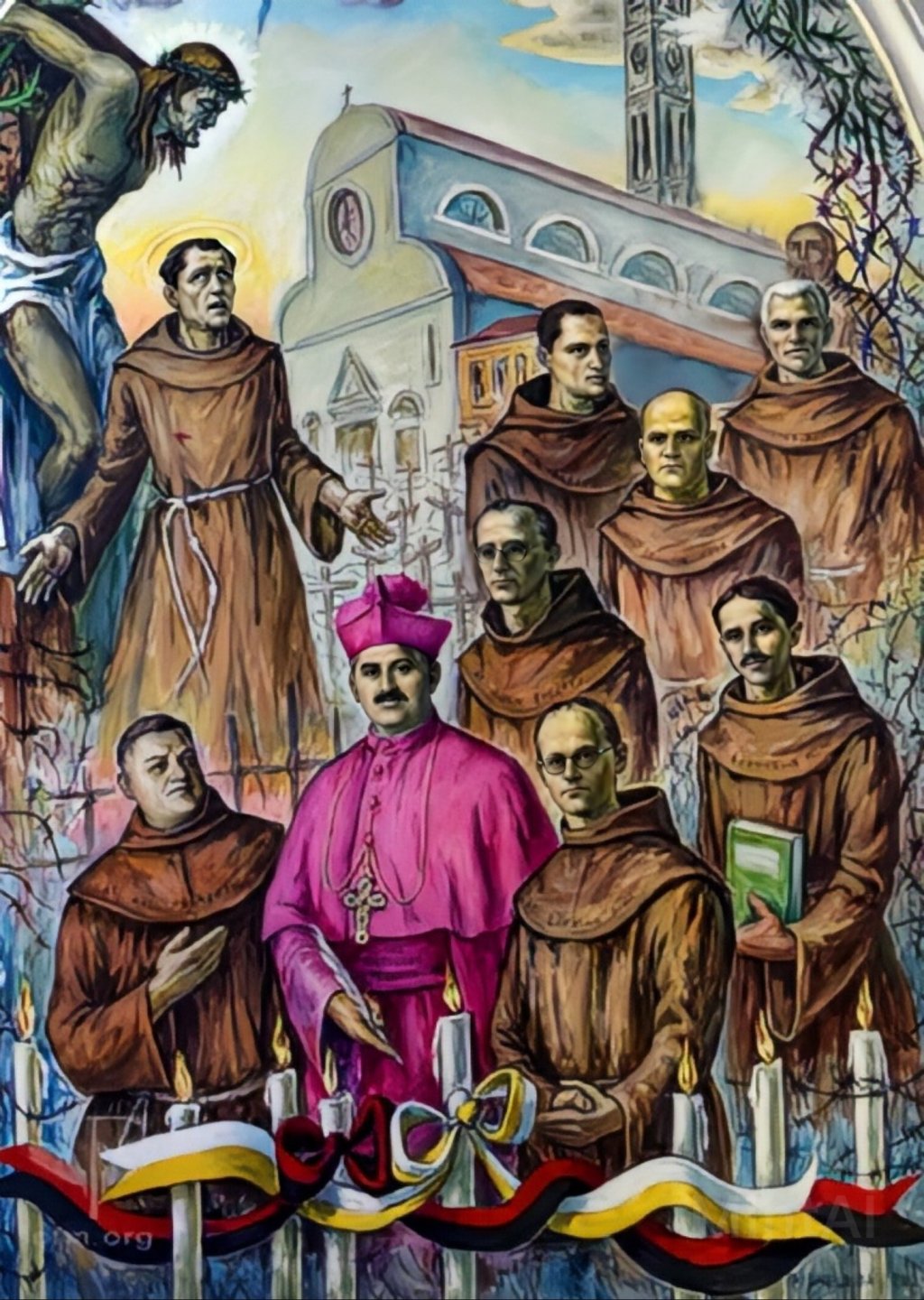

Jesuitism in Albania (Alb: Jesuitet ne Shqiperi) is part of the Catholic Christian Albanian heritage with the Society of Jesus (lat. Societas Jesu) being first established in Albania in 1841. [1] The Jesuits in Albania worked with education, apostolic and charitable activities, cultural events and printing and publishing. Jesuitism was a process of enculturation and mutual enrichment which eventually became part of Albanian culture supporting religious, cultural and national interests. [2]
There were two major institutions: Pontifical Albanian Seminery and St. Francis Xavier College from 1841–1946. Fr. Fulvio Cordignano S.J. (1887–1952), a distinguished Jesuit scholar, historian, and missionary, stated that the purpose of Jesuitism in Albanian was to “maintain the traditional Roman Catholic faith and to help pave the road of civilization and Catholic culture in Albania which Skanderbeg fought for”.
Famous Jesuits in Albania were Giuseppe Guagliata (c. 1814), Vincenzo Basile (1812–1888) and Salvator Bartolli.[3] The first Albanian book “Dotrina e Kerscten” (Christian Doctrine) by Engjell Radoja (1820–1888) was published with a Jesuit printing press called Shtypshkroja e Zojës Paperlyeme (Press of the Illuminate Press) in 1871. [4] One of the goals of the Jesuits was the abolishment of the blood vendettas (gjakmarje). [5]
In 1886, Jesuits in Albania also provided with spiritual care for Christian prisoners. [6] In 1944, the Communists, under General Mehmet Shehu, initiated an anti-Jesuit propaganda campaign calling them “perfidious conspirators against the people’s power”. The eradication of the Jesuits was ordered by Moscow and Belgrade as they felt threatened by the volcanic spirit of the Jesuit Albanians. [7] This resulted in the imprisoning and execution of Albanian priests and friars. [8] After the fall of communism, the Jesuits returned to Albania and reopened schools.
Origin
Cordignano established an Albanian Jesuit mission in 1841, although there were Jesuits already in the 16th century, with the Saint Athanasius (1576) in Rome, the Illyrian College of Loreto (1580) and the College of the Propagation of Faith (1627) in Rome. Pope Gregory XIII founded the College of St. Athanasius on January 13, 1576, which still functions today.
The Jesuits took over the school in 1624 until 1773 when it was suppressed. The school was open for Orthodox, Greek and Italian-Albanian and Albanian students[9] and the school taught Albanian Orthodox clergy as they were lacking in the country. The school also taught Arbereshe Albanians, including Luca Matranga from Piana degli Greci in Sicily, who translated the first Albanian catechism published in Rome in 1592.
Pope Gregory XIII put the College of Loreto under the Jesuits with the goal of training Catholic missionaries ready to preach in regions threatened by Protestantism, Orthodoxism and Islam. Frang Bardhi (1606–1643) was trained in the Loreto college. Another famous Jesuit was Pjetër Bogdani (1630–1689). Eventually Sicilians Jesuits joined in a mission to preach Jesuitism in Albania, however, they were predated by 16th century missionaries such as Aleksandar Komulović and Tommaso Raggio who visited Albania in 1595.
Raggio was a Jesuit and was the head of the mission in Kotor in 1574 uner bishop Paolo Bisanti. Komulovich was not a Jesuit but rather an experienced diplomat and missionary from Split working under Pope Clement VIII on a Pan-Slavic military action against the Ottomans. These two missionaries translated the first catechism in Albanian and they ordered the Contents Origin printing of 500 copies which they distributed amongst people in Albania.
They visited Shkup, Janjevo, Novobërdë, Trepcë, Prokuple, Nish and Prishtina. They also opened up schools for young Albanians. In 1834, the Pope and Jan Roothaan, general of the Jesuits, intended to create a seminary in Albania, to which the Bishop of Shkodër, Luigi Guglielmi, responded positively. The plan was that the Jesuit dioceses would serve in Albania, Macedonia and Serbia.
When Jesuit missionaries visisted Shodër in 1841, they were much pleased by the flourishing commerce but there was also poverty, as was the case in many Ottoman ruled Balkan countries. The Muslim Albanians of Shkodër were reported to be intolerant of foreigners irregardless if they were from Rome or Istanbul. Jesuit missionaries described that the Muslim Albanians of Shkodër were allowed to carry weapon, something to which Christians were not.
During the Crimean War, there were Jesuit nuns led by Florence Nightingale in the hospital in Shkodër. [10] In 1912, Count Leopold Berchtold was accussed of being a Jesuit as he desired for an autonomous Albania which would include the Vilayet of Kosovo and Novi Pazar. [11]
International religious crisis
In 1843, the newly appointed Osman Pasha of Shkoder, restricted the practice of Jesuitism. In 1858, the inter-diocesan seminary which had started building, had to be aborted as the Muslims protested. [12] After a few attempts to build the Albanian seminary, which a decade ago had been met with resistance by the local Muslims, the new attempt attracted international attention which stirred up the relations between Austria, who governed the Albanian Catholics, and the Ottoman Empire. [13]
On June 13, 1856, Austria deployed a squadron of military warships of the Bunë (Bojana) near Shkoder under the command of Massimillian II. The Austrians were ready to invade Shkoder if the Muslim revolted against the seminary. The Austrians were joined by a British and French warship who demanded that the Ottoman pasha resolve the matter peacefully.
This was successful in the building of the inter-diocesan seminary which was officially inaugurated in 1861 as Kolegja Shqyptare (Albanian Seminary), and in 1862, it became the Pontifical Albanian Seminary. [14] In 1868, the Jesuit rector emeritus Giovanni Marcucci, from the Gregorian University, encouraged the Jesuits to learn Albanian which was complicated due to the lack of Albanian litterature. The goal became to translate great Catholic thinkers into Albanian which would contribute to the development of Albanian culture, education and language. [15] In 1906, the Jesuits began to pay more attention by the teaching of Albanian in the schools.
Modern age
The Jesuits Conference of Europe Provincials maintains its offices in Albania helping with education, information gathering and interfacing with local authorities. They also contribute to Church networks, volunteer corps, and helping the poor and marginalized. [16]
References
- Ines A., Murzaku (2017). Ad maiorem Dei gloriam: The Jesuits in Albania (http://digitalcommons.georgefox.edu/cg
i/viewcontent.cgi?article=2050&context=ree). George Fox Univeristy: Seton Hall University. Retrieved
8 November 2019.
- Mihailović, Kosta; Srpske, Akademija nauka i umjetnosti Republike (2006). Kosovo and Metohija: past, present,
future : papers presented at the International Scholarly Meeting held at the Serbian Academy of Sciences and
Arts, Belgrade, March 16–18, 2006 (https://books.google.se/books?id=W28tAQAAIAAJ&dq=jesuits+in+Kosovo&f
ocus=searchwithinvolume&q=jesuits). Serbian Academy of Science and Arts. p. 274. Retrieved 8 November
2019. - Elsie, Robert (2001). A Dictionary of Albanian Religion, Mythology and Folk Culture (https://books.google.se/book
s?id=N_IXHrXIsYkC&pg=PA133&lpg=PA133&dq=Jesuits+in+Albania&source=bl&ots=JVNjoTsIaH&sig=ACfU3U2
-m-DX26KUnWxMrYEeoxdVVtOmwQ&hl=en&sa=X&ved=2ahUKEwjCzLj6ntvlAhWByqYKHXa9AzU4ChDoATABe
gQICBAB#v=onepage&q=Jesuits%20in%20Albania&f=false). C. Hurst. p. 132. ISBN 9781850655701. Retrieved
8 November 2019. Retrieved from - Elsie, Robert (2010). Historical Dictionary of Albania (https://books.google.se/books?id=6inIiCF_930C&pg=PA213
&lpg=PA213&dq=Jesuits+in+Albania&source=bl&ots=Q0xbY4D6zl&sig=ACfU3U1Y1_NxLTOZXW3u417M_UJfk
WXixw&hl=en&sa=X&ved=2ahUKEwjCzLj6ntvlAhWByqYKHXa9AzU4ChDoATADegQIBxAB#v=onepage&q=Jesui
ts%20in%20Albania&f=false). Rowman & Littlefield. p. 213. ISBN 9780810861886. Retrieved 8 November 2019. - Albania, The Catholic Church in | Encyclopedia.com (https://www.encyclopedia.com/religion/encyclopedias-alman
acs-transcripts-and-maps/albania-catholic-church). - Catholicism, Culture, Conversion: The History of the Jesuits in Albania (1841–1946) (https://books.google.se/book
s?id=ra8cjRm-dV0C&dq=Jesuits+in+Albania&focus=searchwithinvolume&q=Jesuits). Pontificio Istituto orientale. - p. 248. ISBN 9788872103524. Retrieved 8 November 2019.
- Pepa, Pjetër (2003). The criminal file of Albania’s communist dictator (https://books.google.se/books?id=7XotAQA
AIAAJ&dq=Jesuits+in+Albania&focus=searchwithinvolume&q=Jesuits). Uegen. p. 56. Retrieved 8 November
2019. - Albania: How St. Ignatius unites Christians and Muslims Accounts of peaceful co-existence between Christians
and Muslims. Journey to Scutari, home to the Atë Pjetër Meshkalla Jesuit high school. Ronny Alessio and Alda
Laska e Dorela Smajli talk about Ignatian education, pupils’ enthusiasm, the role of Pope Francis and the
beatification of 38 martyrs (https://www.cimer.org.au/wp-content/uploads/documents/ForCIMER-ChristiansandMus
imsunitedinAlbania.pdf) (PDF). - Malcolm, Noel (1998). Kosovo: A Short History (https://books.google.se/books?id=GGQ_AQAAIAAJ&dq=jesuits+i
n+Kosovo&focus=searchwithinvolume&q=jesuits). Macmillan. p. 125. ISBN 9780333666128. Retrieved
8 November 2019. - Verhoeven, Timothy (2015). “A Perfect Jesuit in Petticoats”: The Curious Figure of the Female Jesuit (https://brill.c
om/view/journals/jjs/2/4/article-p624_5.xml?language=en). p. 635. - Office, Great Britain Foreign (1933). The Balkan wars. pt. 1. The prelude; the Tripoli war. pt. 2. The league and
Turkey (https://books.google.se/books?id=Anbn3YOIn2AC&pg=PA644&lpg=PA644&dq=Albanian+Jesuitism&source=bl&ots=XRXFnLt08J&sig=ACfU3U0z3R3IT4XLv47aExnoMHEr7mwTjQ&hl=en&sa=X&ved=2ahUKEwj6jdG5jt
vlAhXKfZoKHS8B2sQ6AEwA3oECAQQAQ#v=onepage&q=Jesuitism&f=false). H.M. Stationery Office. p. 614. - Skendi, Stavro (2015). The Albanian National Awakening (https://books.google.se/books?id=8QPWCgAAQBAJ&p
g=PA130&lpg=PA130&dq=jesuits+in+northern+Albania&source=bl&ots=zHkM9Svwh9&sig=ACfU3U2MAGcTajGo
582wHCCfFsoilfrL1w&hl=en&sa=X&ved=2ahUKEwimtNfgqtvlAhXKwsQBHdKBBH0Q6AEwD3oECAkQAQ#v=one
page&q=jesuits%20in%20northern%20Albania&f=false). Princeton University Press. p. 130.
ISBN 9781400847761. Retrieved 8 November 2019. - Catholicism, Culture, Conversion: The History of the Jesuits in Albania (1841–1946) (https://books.google.se/book
s?id=ra8cjRm-dV0C&q=Jesuits+in+Albania+1843+Shkod%C3%ABr&dq=Jesuits+in+Albania+1843+Shkod%C3%
ABr&hl=en&sa=X&ved=0ahUKEwihuvLQp9vlAhWwxcQBHSgLCxcQ6AEINTAC). Pontificio Istituto orientale. - p. 108. ISBN 9788872103524. Retrieved 8 November 2019.
- Elsie, Robert. THE SCUTARINE CATHOLIC CONTRIBUTION TO THE DEVELOPMENT OF NINETEENTHCENTURY ALBANIAN LITERATURE (http://www.elsie.de/pdf/articles/A1991ScutarineCatholic.pdf) (PDF).
Retrieved 8 November 2019. - Murzaku, Ines Angeli (2015). Monasticism in Eastern Europe and the Former Soviet Republics (https://books.goo
gle.se/books?id=rtZzCgAAQBAJ&pg=PA255&lpg=PA255&dq=Jesuits+in+Albania+1843+Shkoder&source=bl&ots
=WuLocKMrJJ&sig=ACfU3U2xt1ITmzspcYIQFujDfSfjl60M5g&hl=en&sa=X&ved=2ahUKEwjy_sXZptvlAhWHB5oK
HUAFB3gQ6AEwAHoECAUQAQ#v=onepage&q=Jesuits%20in%20Albania%201843%20Shkoder&f=false).
Routledge. pp. 255–256. ISBN 9781317391050. Retrieved 8 November 2019. - “The Jesuit Order and The Vatican’s Challenges in the Balkans – Vatican” (http://www.balkanalysis.com/vatican/th
e-jesuit-order-and-the-vaticans-challenges-in-the-balkans/).


 Balkan Academia