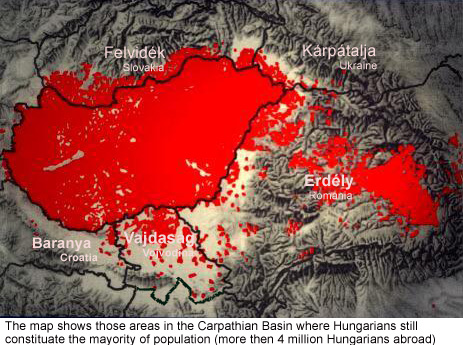

Originally written by István Nyárádi, Zsuzsanna Kubinyi and András Pórffy. Taken from https://www.hunsor.se/dosszie/fiftythousandhungarianmartyrs.pdf
“From 1944 up to 1992 fifty thousand Hungarians fell victims to the Titoist blood feud. After the decay of the communist Yugoslavia the post-Bolshevist Serbian leaders have been slaughtering the Hungarians and expelling them from their homeland up to now in order to establish the homogeneous people’s state. Their houses are either razed to the ground or assigned together with their lands and properties to the removing Serbians from Bosnia.
The free nations, the UN and the countries united in it forgive the sacrifice and ruining of the Hungarians. They do not do anything so that the Hungarians suffering enormous losses in human life could stay on the land of their ancestors. The number of the Hungarian martyrs is increasing day by day. How long does the democratic public opinion of the World have patience?
This report is about the slaughtering and expelling of the Hungarian minority in Serbia.
History and background
The Hungarian Republic is situated along the middle reaches of the rivers Danube and Tisza, between 45 45′-48′ N and 16’5′-22 55′ E in the middle of the Carpathian Basin in Central Europe enclosed by the parts of the Alps, Carpathians and Dinaric mountains.
More than the half of its whole surface is a plain not higher than 200 m above sea level, resp. it is Lowland. Its most lofty point is Kékestetõ with 1015 m. The exact determination of the original home of the Hungarians is the subject of debates even today. Some people think that the Finno-Ugrian origin is the real one and they determinate the country of origin at the Eastern tributaries of the river Volga. While other researchers vote for the Sumeric origin of the Hungarians and put the birth of the Hungarian people to Mesopotamia.
In the beginning centuries of our era the Hungarians dealing with nomad animal husbandry were living in confederation of tribes North of the Black Sea on the steppe territory along the rives Don. ln the 8-9th century they go into the province of the Khazarian Empire. They were forced by the Pecheneg tribes, threatening the country of the Khazarians into the territory between the river Dnyeper and Lower Danube West of ~ the river Don.
Because of the pressure of further attack, under the Leadership of their prince Arpad they overran the country through the Carpathian passes in 895-896 and occupied the whole Carpathian basin. The establishment of the kingdom on the Western model is connected with the name of István (Saint) I (997-1038) who embraced the Roman Christianity and who was crowned king with the crown received from the Pope. During the one thousand ears spent in the Carpathian basin the offensive armies, overrunning from East to West, attacking Europe broke under the resistance of the Hungarians.
The fundamental laws of the feudal rights the Hungarian Golden Bull is of the same age as the English Magna Charta. The attack of the Comanians threatening the West was driven back by King LászIó (Saint) I in 1085. In 2240-41 King Béla IV protected. Western Europe against the Mongolian hordes. From 1440 the Hungarian army commanded by János Hunyadi drove back the Turkish attacks.
In 1456 Hunyadi won such a great victory over the Turks at Nándorfehérvár that one century was necessary for that they could launch their armies towards the West The Apostolic See in Rome ordered the noonday bells in memory of this victory. In the reign of King Mathias Corvinus (I458-I490) the number of the inhabitants of Hungary was equal to the population of the Kingdom of England.
In 1526 at Mohács, town in South Hungary, Sultan Suleiman II destroyed the armies of the Hungarian king. The ruler, Louis II lost his life on the battlefield. In 1541 the Turks occupied Buda and by this the Turkish subjection of the country begun which took about 150 yeas then. In the permanent defensive fights of the occupation of 150 years, most of the Hungarian inhabitants died out.
In 1686 with the help of the Hapsburgs they succeeded to drive out the conquerors from Hungary. That is why it could not retrieve its independence but it got under the oppression of the alien Habsburg House. Though the Turks would not intrude Western Europe, significant part of the Hungarian population was extirpated in Hungary.
Instead of the extirpated population Slovakians in the North, Romanians in the East, Serbians in the South were settled by the noblemen of foreign nationality and the Hapsburg rulers. Hungary was no more to be homogenous national state because of this. The Hapsburg despotism took 180 years.
This time was the period of continuously repeating Hungarian national fights for freedom. The largest two were the war, conducted by Ferenc Rákóczi, which took 8 years (1703-1711) then the bourgeois revolution and war of independence between 1848-1849. The Habsburg House of Austria could not defeat the Hungarian armies by itself, therefore asked for help from the “Gendarme of Europe”, the Russian czar, Nicholas I.
The enormous Russian superior force compelled the Hungarian army to capitulate on lath August 1849. The Habsburg emperor, Franc Joseph I and the chancery took bloody vengeance on the Hungarians. They had 13 commanding generals of the Hungarian army executed on gallows. They had the Hungarian patriots participating in the war of independence shot hung and sent to dungeon.
This period of vengeance is called the first Hungarian epoch of rope. The compromise with the alien dynasty took place only in 1867 when Franc Joseph I, emperor of Austria was crowned Hungarian king, too. By this the Austro-Hungarian Monarchy was established. Hungary got into the First World War (1914-1918) just through this disastrous confederation.
20th century
On the different battlefields 661 000 Hungarian soldiers died the death of heroes. The armistice, concluded on 3rd November 1918 in Padova left the thousand year old frontiers of Hungary still untouched. But the so-called “National Council” which was created as the result of the war-defeat, demobilized and disbanded the army returning from the Front lines. Thus it had no military forces for repulsing of the Slovakian, Romanian and Serbian troops attacking the country. The anarchy spreading all over the country made possible the proclamation of the Hungarian (Soviet) Republic on 2lst March 1919 following the example of the Russian Bolshevism.
The communist regime which took 133 days absolutely ruined Hungary. During this period red terror had around 5917 persons executed. This was the second epoch of rope. After the subversion of the communist dictatorship Miklós Horthy admiral assumed the power on first of August of 1919. He was elected governor of the country. On 4th June 1920 the Trianon dictated peace treaty was signed in Versailles according to which Hungary was punished by the most unjust conditions of peace among the former war losing parties.
The territory of the country was reduced from 283 000 sq. km to 93 000 sq. km , the numbers of the inhabitants from 18,2 million to 7,6 million. Taking into consideration only the inhabitants whose mother tongue was Hungarian 26 000 people to Austria 1 072 000 people Czechoslovakia, 465 000 people to Yugoslavia, 1 664 000 people to Romania were annexed.
This cruel curtailment of the country was one of the reasons that in the second World War Hungary joined Germany which supported its revisionist efforts while the Allies continuously refused the Hungarian requests. The other reason of the accession was that Hungary knew on the basis of empirical facts what the Bolshevist social order did mean.
From 1938 the country got back continuously Upper Northern Hungary, Transylvania (East Hungary) and the Hungarian populated parts of Vajdaság (South Hungary). In 1942 the communist partisans of Tito made a raid into the Vajdaság returned to Hungary i.e. to the territory of Bácska. Hungarian soldier’s even whole battalions were often victims of attacks.
On 4th January a whole battalion was attacked on Zsablya and Csurog. 6 Hungarian soldiers were killed. A military razzia was commanded in order to find the partisans in the town of Novi Sad and its surroundings. Because of the individual encroachments of the Hungarian commanders 4000 people fell victims. The Hungarian government – first on the World – established the war criminality of the commanders.
On l4th December 1943 the responsible persons were tried by the court-martial. Among them were 2 generals. Before the verdict the Habsburg Albrecht archduke helped the defendants to escape to Germany. They were taken to Hungarian Court only after finishing the war where they were punished by the heaviest penalties. In autumn of 1944 the communist partisans of Tito and the units of the Soviet army marched in to the Hungarian lived Bácska and Novi Sad behind the retreating Hungarian troops.
On 20th October the Serbian revenge has begun which goes on even up to now and to which 5O 000 Hungarians have been fallen victims so far. * Márton Szûcs, retired rural dean and József Kovács, retired parson both of them were born in Bácska, examined the history of the Roman Catholic parishes. They asked the priests of the villages. After this they wrote secretly because of the threat of the communist regime their memento with the title “Silence of the Dead” about 40 000 Hungarians innocently executed in Bácska, Vajdaság.
To record the numbers of the murders and their authentic history was recklessness but as they were living in the Yugoslavian communist state they had no courage to publish the records. Only after their death the documents got into the possession of Tibor Cseres, Hungarian writer who wrote his book “Blood feud in 8ácska” which was published in 199I on the basis of the documents. In October November of 1944 – the pious fathers write – storm of blood swept over the gentle fields of Bácska.
When the Hungarian army retreated from Bácska in October of 1944 the Soviet army crossed the river Tisza. Under the shadow of the Soviet troops, quasi under their protection communist partisans of Tito marched to the territories left unprotected. They were called Army liberating the People” which was allied with England, France and the United States.
Ivan Rukovina brigadier general was appointed commander of the military government in Bácska and Vajdaság (Vojvodina). He was in continuous and direct connection with Tito marshal, with the generalissimo. Already in his first imperative warning, on 22nd of October Rukovina asked his troops to “maintain the Southern Slavian character of the national future and territory.” This gave a hidden command for the modification of the existing ethnical situation i.e. for the extermination of the Hungarians and Germans.
The communist partisans allied with the Atlantic powers fulfilled this warning thoroughly. They killed 40 000 persons only from the Hungarians. In the “Slobodna Vojvodina of Novi Sad”, the newspaper of the Communist United Front in Vajdaság there was published an artide with the title of “Historical decision” dated 28 October 1944. Among others it says:
“Though we have destroyed the German and Hungarian conquering hordes (how the Hungarians could have been conquerors when they marched into their one thousand year old territories occupied by the Serbians in 1941…) resp. we have driven them towards West but we have not uprooted radically the poisonous weeds spreaded by them… People feel that this definitive step is necessary which insures the Yugoslavian character of Bácska.”
The blood feud against the Hungarians, the revenge was originally indulged in the commanders of the partisans and their political officers who were in continuous connection with their leader, general Rukovina. On the other hand the general advised Tito marshal on his all decisions and on all “military” acts of his subordinates. From the middle of October 1944 the death stormed for 2 months in Bácska.
The illegal murders were well organized genocide (Holocaust) carried out in cold blood indeed. It was no else than beheading of the native Hungarians. On the death-lists in existence the nationality of the assassinated was also indicated. Hungarian inhabitants of whole village’s colonies were taken to the place of execution. Innocent people got on these lists.
Nothing else could be brought up against them that they were Hungarians. The clerks of death kept surprisingly exact record horrible statement. They mentioned not only the name of the victims, but their nationality, place of birth, family status; religion and financial situation were also indicated. Though the official lists have been hidden in well guarded safes up to this date the two catholic fathers succeeded in identifying 40 000 Hungarian martyrs as the registers of the Hungarian villages testify accusingly.
The generalissimo of the communist partisan army, Tito marshal did not give written command for extirpation of the Hungarians in Bácska, but he tolerated and no doubt he commanded by verbal order that in the whole territory of the retaken Yugoslavia, so also in Bácska, his partisans should take vengeance for all injuries which fell his partisans during the four years of the war. Somehow like this: “Where brook of blood was running, there river of blood should surge!”
METHODS OF HOLOCAUST
While the Germans and the Hungarians executed the partisans one by one in accordance with the international articles of war that ambushed and attacked the Hungarian and German soldiers from lofts, the Serbian partisans broke with the long procedures the people to be executed were 10 times more. Their victims were bound with wire by tens or by twenties.
The Hungarians were lined up in front of a common grave dug in advance. Then they were shot down by machine pistol or by machine gun from the back. This was easier solution that the Hungarians – with death wound on their napes – should fall in their final tomb at once. Then it was necessary only to cover them with soil. It seems that the Serbians had plenty of wires.
They spared their munitions. 15-2O Hungarian men were bound. They were lined up around a straw-stack last two men in the right and left sides of the line were strongly bound with wire. When the ring was fixed the straw-Stack was lit. The bound men impeded each other in escape. All of them were burnt away. Where they had enough time, the Serbian communist partisans deprived the selected Hungarian victims from all their twenty finger nails with pinchers.
Their thirst of revenge was better filled if they heated previously the pinchers in a near smithery. It also happened that in the smithies the Serbian farriers drove horseshoes into the naked sole of the Hungarians. Not every Serbian could endure the horrible sights. Some of them vomited themselves during forced fulfilment of the command. Partisan women took part in these atrocities in large numbers.
Hungarian Roman Catholic priests and friars who got into their hands received particular attention! In most cases they were undressed. First a cross-shaped strap was cut out from the-skin of their back. For the sake of more hardened partisan women the sexual organs of the priests were taken care. Mostly their testicles were torn by pinchers. There was such a woman in these partisan units who stamped on these naked catholic reverends, mashed their loins.
In one of the villages, in Bezdan, Hungarian men, driven to a sport ground were searched in order to find guns. In the pocket of a boy who was 11 years old an empty cartridge was found. The ,,guilty” boy was placed to the middle of the empty ground. A touching mine was fixed to his leg. The explosive cartridge bound to the leg of the child was shot until it exploded and tore the owner of the legs and the cartridge.
The sawmills also gave possibility to use new methods of killing the Hungarians. Hands and legs were cut by sawing – machine and the tortured Hungarians died as martyrs with violent and long pain! It also happened that chopping trunks into firewood gave the sample for the execution. It happened that whole family of the Hungarian owner of the sawmill was bound in front of the saw-blade and the members of the family were torn in two by the sawing-machine started. Impalement (palo inponere) was used not only in the Roman Empire but also appeared in penal practice of the 17th century.
It was introduced again in the extirpation of the Hungarians by the Serbian partisans to Vajdaság and Bácska under the protection of the Soviet Army. In order to see clearly the inhuman and bestial revenge, let’s study the method of impalement used by the Serbian partisans: The bark of the 3 meter long oak a pale was removed. If there was enough time a sharp iron was fixed by smithies to its pointed tip. The naked pale was made greasy by oil.
Well in advance a narrow hole was dug into which the “Fitted” pale would be placed. A stick with short halve was the part of the preparations1 too. The Hungarian to be executed was got down into prone position. A loop of rope was cast on both of his ankles and two partisans were pulling his feet in two directions. The executioner fitted the tip of the iron-bound stake into the anus of the unlucky fellow, then he gripped the stake and started to hammer the end of the stake to the aimed direction first with gentle hits then more and more strongly.
Initial screaming of the Hungarian turned into creaking when the stake reached the level of shoulder blades. At that time the executioner directed the stake a little bit to the right so that the tip should come out from the body of the unlucky man bursting the skin of the collar-bone. At this moment the thick bottom of the pale was placed into the hole.
It was the triumph of the Serbian crowd of spectators enjoying the execution if the miserable impaled person was sighing for hours and the desperate beatings of his heart would be seen on his chest while the dug earth absorbed the blood running from his body. According to the memory vitéz Ferenc Szombathelyi, the chief of staff of the Hungarian royal army was executed in this manner who was delivered to the Yugoslavian communist government under communist pressure by Zoltán Tildy, reformed priest who was the Prime minister collaborating with the communists from the Small-holders’ party and who was called “murderer in cloak” by the Hungarian people.
Places and times of some massacres in Vajdaság together with the number of the Hungarian victims:
BEZDÁN 3 November 1944.
The Hungarian male inhabitants of the village in the age of between l6 and 5O years were driven to a sports ground. 118 men were shot down by machine pistol to the Danube. 2830 Serbian communist partisans who made the murder belonged to the udarna brigade No. 12 in the division No. 51. It is strange but the Soviet officers were also horrified at the massacre because they were who stopped swearing further executions. ZOMBOR (Sombor) 6 December 1944.
The Serbian partisans first had one part of their captives dug up to the neck into the earth by other captives then they had them trampled to death by tank. The first impalement happened here, too. The executions in the villages of Bácska Vajdaság were directed by a Serbian communist partisan woman called Julka who was wounded mortally in the fights later.
At the moment there is a thirty meter high granite monument on the mount of Batina and on the top of this monument there is the statue of this woman executioner.
UJVIDÉK (Novi Sad) 23 October 1944.
In the early morning hours the Serbian partisans under the leadership of Todor Gavrilovics Rilc, political commissioner marched in the ancient Hungarian town, in Novi Sad (Újvidék).
From the first day they already carried off the Hungarian inhabitants to the former winterport of the Danube. This was the center of the massacre. Until the execution men were held in prison for weeks. Among the captured and executed people there were a lot of 14-15 year old boys as “dangerous fascists”. Executions started on 25th October.
A drunken partisan officer read off 300 names. In a short time only the rattle of the machine pistols sounded. Farewell cries of the executed Hungarians were suppressed by the racing of the lorries’ engine. The Hungarian captives got some water and bread only on the fifth day. During the first week about 1500 Hungarians were shot down into the Danube:
One part of the corpses was either burnt or put into common graves in several rows. Around 1970 a new highway was built but because of the common graves in the Feketics forest the track of the highway was led in other way. All the Hungarian students captured in Novi Sad and its surroundings were shot down.
SZENTTAMÁS (Srbobran Turja) In October of 1944
3,000 inhabitants of Hungarian nationality were executed by the Serbian communist partisans from the village of 18,000 inhabitants.
In the old Serbian cemetery the tomb was dug by the persons to be executed and the Hungarians were executed in groups of 150-200. An 8-year-old girl was the witness of the massacres by chance and unnoticed. The Serbian people next door overheard her story and denounced the little girl. Next day the Serbian partisans took away the innocent girl and executed her.
SZIVÁC (Sivac) 1st November I944.
Seventy-five Hungarian men completely undressed were accompanied to the cemetery where they were executed by command of Brano Bikicskics Serbian main communist from Szivác.
ADORJÁN (Nadrljan) On 3d December 1944.
56 Hungarian citizens were executed on the bank of Tisza.
KANIZSA (St. Kanjiza) On 7th October 1944
Serbian partisan executioners arrived following the Soviet troops. In this village the names of the offenders entirely remained. First of all every Hungarian women were ravished. 300 Hungarians were collected in the village and they were closed in the cellar of the town hall, majority of them was beaten to death there. The corpses were carried on cart by nights to the island of Tisza where they were lying covered by lime for days. Let the names of the Serbian communist partisan killers be listed here:
“Niklo Radovics, Szvetozár Knezevics, Alexander Oluski, Dusan Ugranov. OBECSE (Stari Becej) Killing of the Hungarians began on 9th October I944. First Ferenc Petrányi 65 year old catholic abbot was arrested by some young communist Serbian partisan girls. A11 parts of his face and body were mashed. A partisan woman from Zombor, called Zorka was the most brutal. He was bound on a plank by her and then they jumped to his belly chest and sexual organ from the table. Zorka and her partisan comrades in laced boots practically disemboweled his internal organs. When he died on l4th October they threw him out of the window to the stone block yard so that his death should seem to be a suicide.
SZENTFÜLOP (B.Gracac) was a pure Hungarian village from the age of the Arpads. On 25th November 1944 its whole male population between the age of I8-60 years was exterminated. In total 212 men were killed.
TEMERIN (Temerin) October of 1944.
Several hundreds people fell victims of the Serbian carnage. A Soviet officer prevented the extirpation of the whole Hungarian population of the village. Hungarian human loss of the village was 480 people.
In MOHOL from October of 1944
The extirpation of the Hungarians went on systematically. More than 800 Hungarians were collected and from this number 760 were executed. Not only men were killed but also 16-20 year old girls were executed. It is strange that in this village the communist Serbian partisans close cropped the people going to death. Then they were taken to the side of Tisza and they were shot by machine gun to the river there.
In CSUROG (Curog) from 23 October the Hungarian inhabitants had been exterminated continuously. In 1941 the Serbian partisans in Csurog killed a whole gendarme patrol some of them were impaled. Because of this as revenge 765 5erbian inhabitants were executed in 1944. 2,000 people the whole Hungarian population of the village was exterminated.
ZABLYA (Zabalj) in 1942 the Serbian killed 11 Hungarian soldiers in the village. Because of this 581 Serbians were executed. Because of the extreme revenge, just as it happened in Csurog the competent Hungarian commanders were tried by court-marital. The Serbian partisans of Tito started to revenge at once after their marching in, in October of 1944. The wealthier Hungarians were drowned into the manure of the back house. Even 13 year old Hungarian boys were killed, too. In total 2,000 Hungarian citizens were killed.
In the city of ZOMBOR in October of 1944 the murdering of the Hungarians started at once on the basis of the death-list previously made. First two Hungarian Carmelite fraters were captured and executed. They were frater Gellér Sztancsics and Illés Hollós. The Hungarians were taken to the Palace of Kronich. Next to the race-course the common graves were dug in which 2,500 Hungarisns were buried.
Several other common graves can be found in the outside districts of the city. The inhabitants of the Hungarian city were fully exterminated. In total 5,650 Hungarians were executed. * According to data collected by the Roman catholic pastors, Márton Szûcs and József Kovács in. the strictest confidence; during the months of October, November and December of 1944. 34 491 Hungarians were killed in South Hungary in the territory of Bácska and Vajdasag.
As the statistics were made several years ago according to the data which have been discovered since that time the number of the victims exceeds 40,000 per- sons. Because of the continuity of the discovering works this number is increasing day by day. It is also completed by the number of the Hungarian martyrs who lost their life because of the atrocity of Serbians after the decay of the Yugoslav communist regime.
According to data collected by the Roman catholic pastors, Márton Szûcs and József Kovács in. the strictest confidence; during the months of October, November and December of 1944. 34 491 Hungarians were killed in South Hungary in the territory of Bácska and Vajdasag. As the statistics were made several years ago according to the data which have been discovered since that time the number of the victims exceeds 40,000 per- sons. Because of the continuity of the discovering works this number is increasing day by day. It is also completed by the number of the Hungarian martyrs who lost their life because of the atrocity of Serbians after the decay of the Yugoslav communist regime.“
References
https://www.hunsor.se/dosszie/fiftythousandhungarianmartyrs.pdf


 Balkan Academia