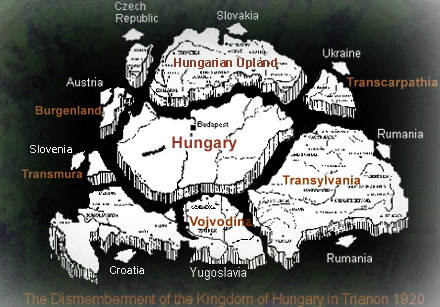

In 1920 in Versailles (France), the Treaty there made approx. 4 million Hungarians to strangers/foreigners in their own homeland, with the western powers redrawing the map of the country, cutting off 2/3 parts of the country, to give it to the occupiers, and with this cold-blooded mutilationo f Hungary, thus making 4 million Hungarians to central Europe’s largest minority.
Vajdaság (Serb. Vojvodina) was removed from Hungary, and given to the newly created state formation SKS Kingdom (Serbian-Croatian-Slovenian Kingdom), which was later renamed to be called Yugoslavia.
During the first period, the assimilation process was immediately set in motion. You had to learn Serbian at school, which the Hungarians could not, (the national language in the Kingdom of the Hungarian King was Hungarian), and they were therefore exposed to violence in the schools. They wanted to turn the Hungarians into Serbs and they took away their right to everything imaginable that we write today under human rights.
Hungarian schools were closed, teaching switched almost 100% to Serbian, Serbs seized all state and church property owned by Hungarians, banks were taken over by Serbs, all businesses were taken over by Serbs, farmers forests and farmland were confiscated and taken into Serbian ownership, printing houses, radio , and all the media were seized and transferred to Serbian ownership. Justice disappeared overnight, and the Hungarians of Vojvodina became a minority in their own country.
During World War II, the Germans attacked Yugoslavia, first by bombing the capital Belgrade, and then by sending the army. Hungary allied itself with the Axis powers and with that went over to Germany’s side. The reason for it all was probably that the Hungarian state power, in the strongly growing Germany, saw the historic opportunity to take back the forcibly cut off lands, which were removed with the Treaty of Trianon in Versailles in 1920.
After 4 days of war, on April 14, 1941, the Hungarians took back all of Vajdaság almost without fighting. Those who resisted were Serbian paramilitary “Cetniks” who were notorious for their atrocities against the Hungarian population. Vajdaság was once again part of the Hungarian Empire as it had been before for 1000 years.
Between 1941-44 the area up to Újvidék (Novi Sad in Serbian) was Hungarian, while the Banat and east of the river Theiss area was German.To be objective one cannot avoid saying that during that time there were plenty of fascist Hungarian officers in Vajdaság. Many Serbs who were dissatisfied with Hungarian rule were shot and wounded if they attacked Hungarian units and army forces. The Serbian soldiers as well as ultra-nationalist paramilitary “Cetnik” units, – could often from the wind and various ambushes shoot down passing Hungarian soldiers down the street.
It caused mutual mistrust and discord between Serbs and Hungarians, resulting in clashes. In retaliation, Serbian soldiers and ultra-nationalist Cetniks responded by killing entire Hungarian families when they had the chance. It paved the way for counterattacks and responses from the Hungarian side. Hungarian fascists started a bloodbath against Jews, Serbs and Serbian nationalists between 1942-1943. It is estimated that they shot down about 3000 people in the Danube river.
In 1944, the Russians entered the country and the Germans and Hungarian army forces were defeated. The German and Hungarian soldiers left the country. The Yugoslav president Tito then decided that there would be military rule in Vojvodina, and then the Serbian nationalists started a bloodbath, a genocide against the Vajdaság-Hungarians.
References

 Balkan Academia