
1933 – Albanian from Berane
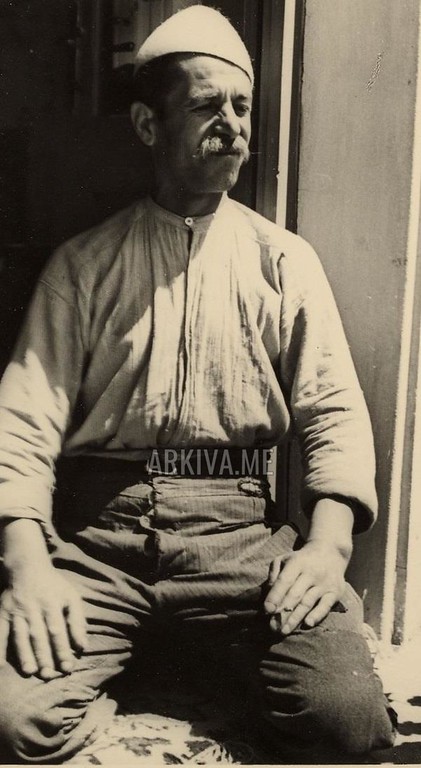
Përshkrimi/Description: Shqiptari nga Berane / Albanian from Berane
Data/Date: 1933. Burimi/Source: Historia Krajës (Facebook) – https://www.facebook.com/live.bambi
Berane and Mokra plain and the “Albanian territory” in 1905
“… Berane and once into the mountain range of the Mokra planina. Unfortunately, my innocent botany box seemed far too dangerous to the watchful Turkish authorities and therefore I was prevented from further exploring this Albanian territory.. “
Source here.
The Montenegrin-Albanian border near Berane in 1898
“In the Wetterwinkel on the Montenegrin-Albanian border near Berane, unrest has recently broken out again, which, although it has not yet reached a worrying extent, nevertheless requires the greatest vigilance. The causes of this unrest are not only to be found in the tribal and religious differences of the local population, but are all too often stimulated or supported by the neighborhood beyond the borders for this factor to be completely ignored in the assessment of the situation there.”
Source here.
The kullas and block houses of Berane for the defence of the Lim Valley
“Berane has six well-built brick blockhouses and five Kullas for the defence of the Lim Valley.”
Source here.
Bihor (Petnjica) is an etnographic dividing wall
“The Bihor is not only a watershed, as just shown, but also an ethnographic dividing wall and is of great military importance. To the west of it, the Slavic element predominates in the population, to the east, the Albanian element.”
Source here.
“War like shepherd population” of Rozhaj, Tregovisht, Berane, Akova, Bjelopolje and Bihor
“The Kasabian market towns of Rožaj, Trgovište, Berane, Akova, Bělopolje and Bihor near the borders of Montenegro and Albania are completely insignificant and correspond to the wild inhospitality of the area and the warlike shepherd population (Albanians) that lives there.”
Source here.
An Albanian cook from Berane who sang about the Gusle (Lahuta)
“… Arnaut (Albanian from the mountains) was brought in, apparently a cook in Berane, who could sing many songs about the Gusla. For the second time I got to know the Gusla as a living part of the people’s life, when a car breakdown in Senta …”
Source here.
An homogeneous Albanian population from Berane
“The region inhabited by a more or less homogeneous Albanian population can roughly marked by a line drawn from the Montenegrin border in Berane to Mitrovica and the Serbian border near Vranje; from there to Usküb, Prilep, Manastir, Follorina, Kastoria, Janina and Parga.”
Source here.
Montenegrin invasion of Berane in 1898
“In 1898 the Montenegrins, taking advantage of the unrest between Catholics and Muslims, invaded Albanian territory at Berana, but were driven back beyond their borders.”
Source here.
“In October 1912, the Montenegrins conquered Biepolje, Berana, Plevlje Plava, Gusinje and Ipek.”
Source here.
Berana near the Albanian border
“Berana, near the Albanian border, where a school of m is known. 2.50 of excellent quality coal, and in the Upper Lim Valley. Various fuel banks of moderate power were also found in some points of the …”
Source here.
Montenegrin invasions of 1912
“In 1912, Montenegro invaded Albania lands. Thus, the Albanian territories, from Berana (above Plavë) to Lake Shkodra, became the first hotbeds of fighting and the Albanian population suffered unprecedented horrors.

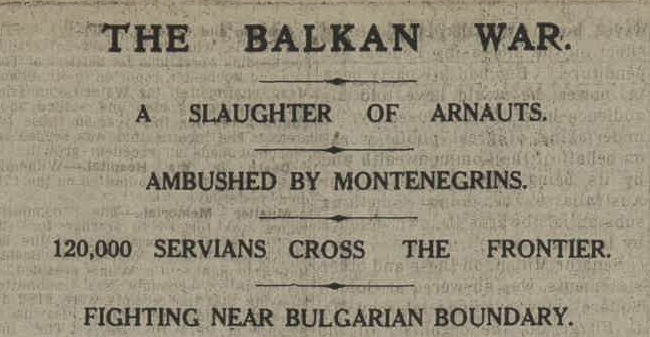
The newspaper “The Bendigo Independent”, dated October 22, 1912, reported on an organized ambush that the Montenegrin army had set up against the Albanian volunteers.
“Two thousand Arnauts led by two Turkish officers, Hasim Bey and Mahmut Begorie, set out from Plava to retake the village of Berana, which was taken by the Montenegrins last week,” the article announced.”
After the lesson of the Albanians, the article continued, became known to their enemy, they unwittingly ended up in the well.
“The force that was marching there was met with bloody fire from all sides,” the article continues.
“They fought desperately, but the Montenegrins had chosen their position and the Albanians had no chance.”
Hasim Bey and 280 of his followers were captured and brought to Podgorica.
“After two days of fighting, the Montenegrins took possession of Plava, not far from the border. The news from Belgrade says that 120,000 Serbian soldiers have crossed the border”, reported by “The Bendingo Independent”.
Lieutenant Colonel Sherman Miles to the Secretary General of the Commission to Negotiate Peace
“It may be well to recall that the southeastern district of Montenegro (Berane, Ipek and Djacova) was given to Montenegro by the Great Powers in 1878. But the Albanians were so strong at that time that they were able to prevent the entrance of the Montenegrins into the ceded territory. The Great Powers, not being willing to enforce their decision, persuaded Montenegro to accept the sea-coast district of Dulcigno in lieu of that of Berane-Ipek-Djacova.
Even then a naval demonstration was necessary to insure the Montenegrin occupation of Dulcigno. Finally the Treaty of Bucharest in 1913 again gave the Berane-Ipek-Djacova district to the Montenegrins, as their share of the Turkish spoils. They occupied it, and even that year there was some trouble and Albanians were killed. In 1915 the Montenegrins and Serbs were driven south, through Albania. During the retreat the Albanians, in spite of their long standing feud with the Slavs, refrained from closing the mountain passes and permitted the Slavs to reach the sea unmolested.”
Accounts and Papers of the House of Commons, Volume 83, By Great Britain. Parliament. House of Commons in 1878
“[…] Now according to the Preliminaries of San Stefano not only all the districts in question with the exception of the small district of Zúbci were ceded to Montenegro but in addition an enormous extent of country which has never been entered by any Montenegrin under arms such as the Bosnian cazas of Foca, Plevlje (Tachlidjé) Prjepolje Priepol Bjelopolje Akova and Berana as well as the Albanian cazas of Rozai and Gussinje with the mountains inhabited by the Albanian clans of Hotei and Clementi.”
The Albanian mosque of Berane in history
“The notification was frequently done at Jammats or Juma‘ah (Friday prayings) where the number of people was bigger than usual, as observed in the folkloric song Lufta e Beranes [The war of Berane] when the Juma‘ah attendees were notified for the mobilization required to protect Berane, a border place of Kosovo threatened by Mountenegro (Fetiu et al. 2007: 57-58):
“edhe djemt tu xhamija kanë shkua. [Even men went to the Mosque]
E kishin kjenë Rugova xhumanë tu falë, [Rugova guys had been praying Juma] atëherë djemt tu dera kanë pritë, [then, they had waited at the doors]
deri teqmil xhuman’ e kanë falë [until they had performed Juma’s prayers]
[…]
e kanë nxjerrë letrën e jau kanë dhanë. [informing letters were given to them]”
The inhabitants of Berane seek 500 soldiers from mosque participants to support their efforts to save Berane from the siege of enemy. Normally, the jama‘ah (participants) helped them, as 500 soldiered were quickly gathered and departed to save the country. Additionally, in this song Albanians commenced the war as the Ezan or Adhzan for the morning prayers was performed, reflecting the mosque as the coordinator of the Albanian Fight (Fetiu et al. 2007: 61).”
Source here.
References
https://history.state.gov/historicaldocuments/frus1919Parisv12/d373


 Balkan Academia