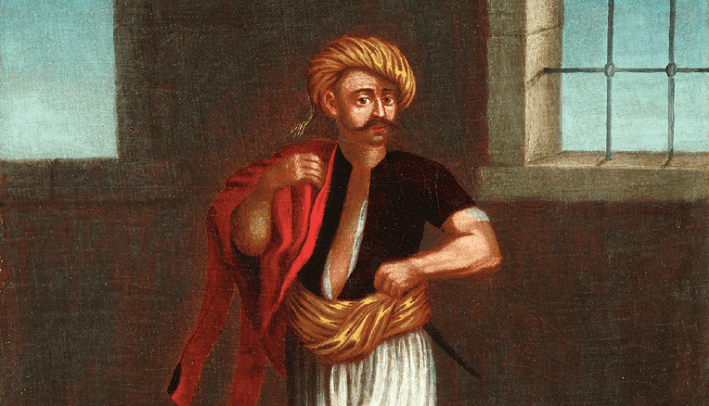

Jusuf Mezzi or Jusuf Mezi (Ital: Jssuf Messi) (Croat: Jussuf Mezi) (fl. 1700s) was an Albanian slave merchant and pirate from Shkodër who operated in 1712 in Ulcinj who became known for having abducted a Ragusan nobleman in 1714.
Mezzi and the slaves came to Ploče in the summer of 1712. The following witnesses were present: emin Halil Agha, emin’s son, Mustafa Çelebi the scribe, and Omer Reis from Ulcinj. As soon as Rafael Coen, a Ragusan Jew, paid the agreed purchase price of 640 ducats to Mezzi, the slaves were freed. The emin issued a certificate to Coen saying that the agreed amount was paid in full and there remained not even the slightest.
In 1712, Jusuf Mezzi bought eight slaves from Ancona who had been captured by the pirates of Ulcinj, however, Pope Clement XI had them liberated. Mezzi and the slaves came to Ploče in the summer of 1712 and with him was Emin Halil Agha and his son Mustafa Celebi and Omar Reis from Ulcinj. A Ragusan Jew named Rafael Coen, who had a history of helping the Jews of Ragusa in lazarettos, agreed to pay for the freedom of the slaves with a total of 640 ducats.
The Emin issued a certificate for the purchase verifying that the debt had been paid off. However two years later Jusuf Mezzi turned up claiming that Coen still owed him 2,800 ducats. The Ragusan authorities ignored him which enraged Jusuf.
In June 1714, he came back to Ploče with his son and six men from Shkoder who presented themselves as merchants. One night, when Marin Sekundo Zamagna, a Ragusan nobleman, was on his way home and he passed the Lazaretto, they jumped in front and abducted him. The Emin tried to help Zamagna but they failed. The Ragusan authorities alarmed the Bosnian governor and the Sanjak-bey of Shkoder, and one month later, Zamagna returned to Dubrovnik. The Ragusans demanded that Mezzi to be punished by death but this did not occur since Mezzi pleaded his case in the Porte fighting for the alleged payment.
History
In 1715 and 1716, the Ulcinj authorities addressed the people of Dubrovnik, inviting them to buy Christian slaves in Ulcinj or to exchange them for Muslim slaves. The man who was supposed to arrive in Ulcinj from Dubrovnik and buy the slaves was guaranteed complete security, as was the guarantee that the owners of the slaves would not create complications during the purchase.
In 1717, Jakov Skapić bought slaves in Ulcinj, including a priest from the Venetian Smokvica. Since Skapić remained in debt, the Ulcinj authorities turned to the Dubrovnik authorities demanding that the debt be settled immediately. In 1718, Skapić again went to Ulcinj to buy 10 inhabitants of Umana and one inhabitant of Ancona for a total of 490 sequins, according to the contract on their purchase concluded by Cardinal Bussi in Ancona.
In 1714, 8 Anconians fell into the hands of Ulcinj pirates. They were bought by the Papal State, the mediators were the Coen brothers, residents of Dubrovnik, and the slaves were brought to Dubrovnik by Jusuf Mezi from Skadran. After the slaves were bought for 640 sequins, as agreed in advance, Mezi claimed that he should be paid another 400.
The Coen brothers’ mediators directed him to settle the accounts with the Papal States where he went, but he failed in his intentions. Mezi was soon in Dubrovnik again with a letter from the Pasha of Skadar, asking the Dubrovnik government to mediate in settling the accounts in Rome. After returning from Rome again, dissatisfied with what he had achieved, Mezi kidnapped the Dubrovnik lord Marin Zamanja with his henchmen on the night of June 20, 1714 near Laza Reta.
Touched to their very core, the people of Dubrovnik decided to react very strongly. The same night called is Jakov Skapić, who was ordered to go in pursuit, try to free Zama, kill Mesius and the Jatakas and sink them together with the boat. As this plan failed, the Dubrovnik government, not sparing money, asked for help from the Pasha of Bosnia and Skadar to behead Mezi. In the meantime, Mezi reached the sultan and managed to fight for a firman asking the Bosnian Pasha to reconsider the dispute. The people of Dubrovnik could only consider this case concluded in 1718, when a firman was issued according to which Meza has no right to any further claims.
References
Let. Lev. vol. 69, ff. 246-247v; vol. 70, ff. 174-177v. – Traduzioni di Capitulazioni e Fermani, vol. 2, ff. 859-861, 864-867, 871-873.


 Balkan Academia