
Petrit Latifi
This article cites various sources on the history of the Albanian element in various cities and villages in modern day Montenegro.
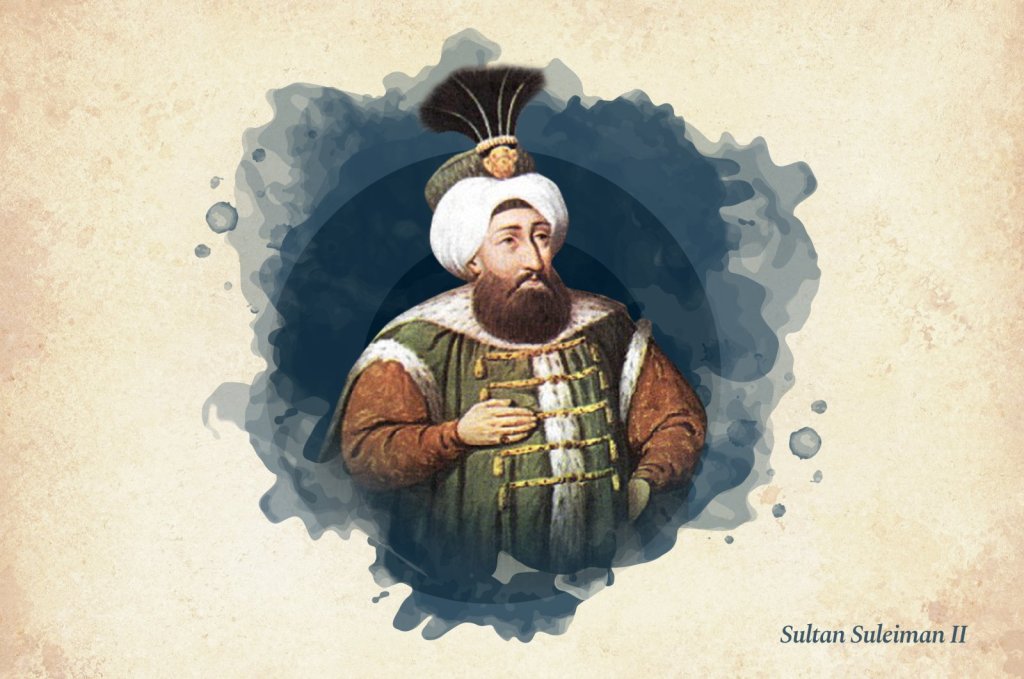
Sultan Suleiman II (1688) wrote in a letter describing the ”Kuci tribe” from the Palabardhi as ”Albanians”.
Evliya Çelebi, an Ottoman traveler, (1600–1662) described Plava, Gusinje and Berane as the most ”lively” regions of Albania.
Noel Malcolm writes in his publication “Rebels, Believers and Survivors”:
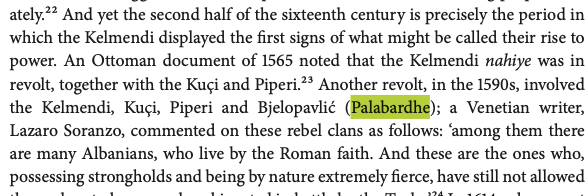
“An Ottoman document of 1565 noted that the Kelmendi nahiye was in revolt, together with the Kuçi and Piperi. Another revolt, in the 1590s, involved the Kelmendi, Kuçi, Piperi and Bjelopavlić (Palabardhe); a Venetian writer, Lazaro Soranzo, commented on these rebel clans as follows: ‘among them there are many Albanians, who live by the Roman faith.”
Doç. Dr. Celal Öney among others write:
“The demand for swords was enormous and sometimes up to 600 iron swords were ordered from an ordinary blacksmith. In addition to Kotor a large number of gunsmiths were mentioned in the village of Pashtroviq, Palabardh (Bjelopavlic), Tivar, Budues and in some villages of Shkoder area. In other words, the swordsmen of Kotor were known in the entire Zeta and other Albanian cities.”

Albert Ramaj writes:
“In the highlands, the Albanians lived separately, or mixed with the Slavic element. Different researchers, such as B. Djurdjev and G. Stanojević, distinguish between Albanian and Montenegrin mountain tribes (brdskij). However, it cannot go unnoticed that Venetian documents sometimes speak of “li popoli Albanesi a Barda”, where “Barda” stands for the land of the “brdskij” tribes, i.e. Montenegrins.
In fact, the mountains of Bërda (monti di Barda), which also included the Kuç tribe and “altri popoli”, in the same geographical and chronological context, are often called the mountains of Albania (monti d’Albania). However, the presence in Berda of “peoples”, i.e. Albanian tribes, speaks of the intensity of Albanian settlements up to the eastern highlands of Montenegro.
In fact, we can certainly find the Albanians among the tribes of Krainë, Hotë, Gjurashë, who were later called Cërnojevicë, Shestanëve, Tuzë, Bitidosë, Matagushë, Dajçë, or among the Pipre, Bratonozhiqë, Palabardhë who later changed their name to Bjelopavliqë […]”
References
VOLUME 7, ISSUE 4 – DECEMBER 2021 CİLT 7, SAYI 4 – ARALIK 2021 Editör / Editor Doç. Dr. Celal ÖNEY Muş Alparslan Üniversitesi / Muş Yalın Dili / Publication Language Türkçe / English Yabancı Dil Editörü (İng) Dr. Öğr. Üyesi Mahmut AKAR. https://dergipark.org.tr/tr/pub/jhf
Poeta nascitur, historicus fit – Ad honorem Zef Mirdita, Albert Ramaj (Ed.)
Noel Malcolm. “Rebels, Believers and Survivors”.
Perceptions of the Eastern Adriatic in the travel literature of the Early Modern period, Milorad Pavi. abula 14 _konačna verzija-1.pdf


 Balkan Academia