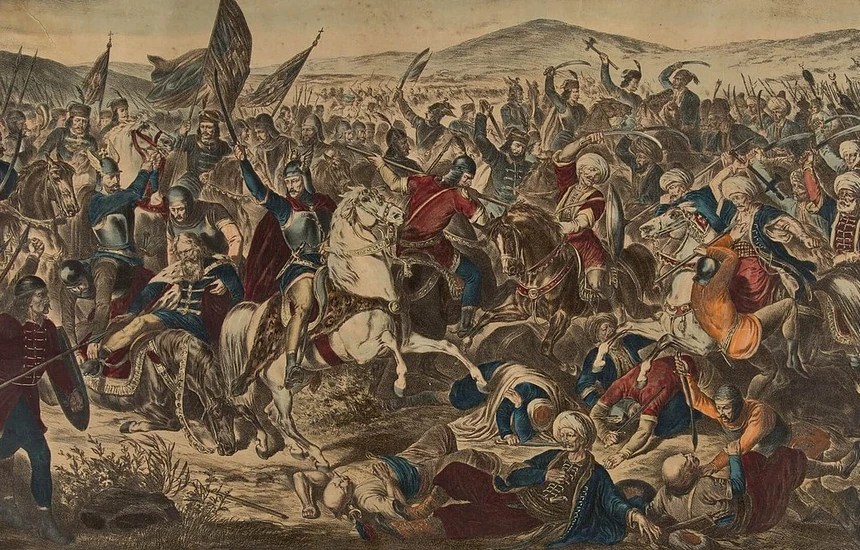

Taken from Koha.
In the newest study “They fought with the Turks, against their will, but it was not possible to do otherwise”, prof. dr. Oliver Jens Schmitt, one of the most renowned German-speaking historians at the University of Vienna, Austria, deconstructs the myths of Serbian history about the myth of Kosovo and about Serbian-Ottoman relations during the early period of Ottoman rule in the Balkans. Arguing that the Serbs gave decisive help to the Ottomans to conquer the Balkans and that the Serbs were among the most cooperative peoples with the Ottoman court, the previous claim that they, that is, the Serbs, were the only victims of this invasion, while the other peoples were their collaborators and supporters.
Oliver Jens Schmitt, author of the study dealing with Serbian-Ottoman relations between the battle of Fushë-Kosovo and the fall of the Serbian despotism (1389–1459) – entitled “They fought the Turks, against their will, but it was not possible to do different”, published in “Zeitschrift für Balkanologie”, no. 58 (2022) 1/2, p. 131-152 – is the Swiss historian, who has been a professor at the University of Vienna for two decades. He is a lecturer in the History of Southeast Europe at the University of Vienna. HE WAS BORN in Basel, Switzerland in 1973. His dissertation on the “Venetian Arberia”, which he defended in Munich to the well-known albanologist, Peter Bartl, is one of the most important works for the Albanian history of the Middle Ages. Unlike the aforementioned work, and from other studies, the monograph “Skënderbeu” has sparked a heated debate not only in intellectual and academic circles, but also in other layers of Albanian society in Pristina and Tirana, since Skënderbeu for Albanians represents one of the greatest figures of their national history and that at the time of the National Renaissance became a symbol of the unity and national awareness of the Albanians. One often gets the impression that most of Schmitt’s critics have not read the book on Skanderbeg at all or, even if they have, have not understood it well, since the main topics of discussion have nothing to do with the book and that the discussion has no object. But, regardless of the criticism, Schmitt’s book is one of the most important books about the figure of Gjergj Kastriot-Skënderbeu, as for the first time with a brilliant scientific methodology and interpretation and analysis, we are able to dispel the myths and ideological structures around the most important figure. great historical of the Albanians. Despite the critics’ claims that Schmitt denied the Albanian origin of Skënderbeu, he would declare to the author of this article (in the interview conducted in June 2007) that whoever reads the book carefully will understand that it clearly states that Skenderbeu he was Arber/Albanian.
Another book by Professor Schmitt, which has been met with criticism, was the one about the history of Kosovo: “Kosovo – Kurze Geschichte einer zentralbalkansichen Landschaft” (“Kosovo – a short history of a central Balkan region”), in which , also, the author emphasizes that the myth of Kosovo is a product of the 1912th century, when the national awareness of the Serbs and the effort to create their national state had begun in the Balkans. In this work, Schmitt reflects the Serbian repressive policy towards the Albanians after the invasion of Kosovo during the Balkan wars of 1913-XNUMX.
Also, for several years in a row, Schmitt has been engaged in research and studies on the history of Romania and as a result, in 2016 he published the study “Căpitan Codreanu – the rise and fall of the Romanian fascist leader”, and two years later the book ” Romania in 100 years”.
Meanwhile, in 2020, Oliver Schmitti, together with Ewa Frantz and in collaboration with Sven Mörfsdorf, published a capital work: “Politik und Gesellschaft im Vilayet Kosovo und im serbisch beherrschten Kosovo 1870-1914. Berichte der Österreich-ungarischen Konsuln aus dem zentralen Balkan, (Politics and society in the Province of Kosovo and in Kosovo ruled by the Serbs. Notices of the Austro-Hungarian consuls from the Central Balkans), vol. I-V, published in five volumes by the Austrian Academy of Sciences. In this edition, the reports of the Austro-Hungarian consuls have been published mainly from the Province of Kosovo, namely from Prizren, Skopje, Mitrovica, but also from Manastir, Shkodra, Istanbul and other cities where Vienna had delegated its diplomats.
Recently, Schmitt has also published two books of great interest on the history of Albanians and the region: “The Balkans in the 20th century: A post-imperial history”, in which he treats the history of the Balkans in the 20th century as a post-imperial history , comparing the main developments in politics, society, economy and culture transnationally, as well as highlighting the differences and similarities between the different countries of the Balkans in the European context.
And in 2022, together with another historian, Bernd Fischer, they published the book “A Concise History of Albania (Cambridge Concise)”, through which the authors deal with the history of Albania and the people of within the context of the Balkans and Europe, Oliver Schmitt and Bernd Fischer in this way challenge some of the traditional narratives regarding the origins of Albanians and their relations with their Balkan neighbors.
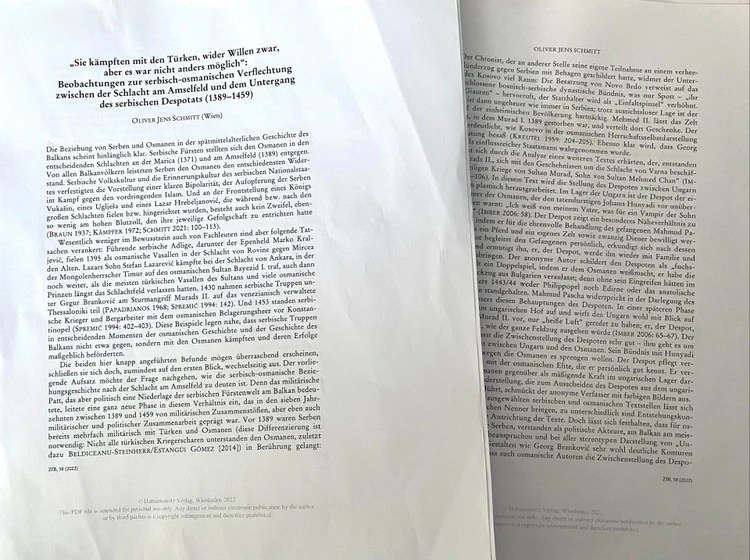
The paper that we are presenting here “They fought with the Turks, against their will, but there was no other way”, was published in the sixtieth anniversary of the publication of the Magazine for Balkanology (“Zeitschrift für Balkanologie” 58 (2022) 1/2, p 131-152.). In this paper, a scientific examination of the Serbian-Ottoman connections between the battle of Kosovo Field and the fall of the Serbian Despotate (1389-1459) is made, where the most decisive moments of Ottoman history and the history of the Balkans are analyzed, as well as many events through which it is documented that the Serbian nobles, besides accepting the vassalage of the Sultan, fought alongside them and with them clearly proved the successes and victories in various battles against Byzantium and the Balkan peoples. In this paper, Serbian-Ottoman interdependencies are also described at the level of dynastic marriages, concluding that the Serbs helped the Ottomans conquer the Balkans. With this, the claim of the Serbian culture of memory that “the Serbs, according to this established narrative, in 1389 defended Christianity in the Battle of Fushë-Kosovo against the Muslim Ottomans” becomes unstable.
This paper deals with the question of how to interpret the history of Serbian-Ottoman relations after the Battle of Kosovo, when a defeat of the Serbian princely world in the Balkans began a completely new phase in this relationship, which during the seven decades between 1389 and 1459 was characterized from military clashes, but also from military and political cooperation.
In this paper, his most recent, Oliver Schmitt aims to find answers to the question of how to interpret the history of Serbian-Ottoman relations after the Battle of Kosovo. Although this military success means a political defeat for the world of Serbian princes in the Balkans, it marks a new phase in this relationship, which in the period 1389-1459 is characterized by military clashes, but also by military and political cooperation.
The terms “Serb” and “Ottoman” face misunderstandings
After a long series of military defeats, the Serbian nobility was no longer able to resist independently after 1389. External help could only come from little-loved Hungary. Internally, the feuds between the Lazarevics and Brankovics had an impact, which the Ottomans exploited, just as they fueled internal conflicts for their own interests elsewhere. Knenzen and the Serbian despots undoubtedly saw the faithful performance of their vassal duties as a guarantee of the relative security of their rule.
However, before doing this, the two terms “Serbian” and “Ottoman” should be clarified, also to prevent misunderstandings. Until Serbian historiography sees these groups clearly separated: “Turks” as “occupiers” and Serbs as “Balkan Christians”, who are also “protectors of European culture and civilization”. It should be emphasized that it is interesting that Schmitt has a different approach from Serbian historians and historiography regarding the terms “Serbian” and Ottoman”. According to him, in order to avoid misuse and misinterpretation, these two terms “Serb” and “Ottoman”, in their classic presentation, cannot be interpreted as terms that indicate different ethnic groups, but as expressions to take into account the political elites of that period. . In this context, the opinion of the well-known German historian and one of the best connoisseurs of the history of Southeast Europe, Holm Sundhaussen, who has also applied an approach to subverting Serbian myths about Kosovo, must be mentioned, asserting that in this period of in the Middle Ages, it cannot be said that the “medieval Serbian state” “was a national state in the modern sense”. It is clear that such terms are used outside scientific criteria, but more in function of nationalist ideology and as justification for current politics. On the other hand, the Ottoman elite also formed something other than an ethnically homogeneous community, it was not even ethnically unified, as many Orthodox Christians had joined it and only a few of them had converted to Islam.
The Serbian state in vassalage, defeating the Christians
With this scientific discourse, Schmitt succeeds in destroying the Serbian myth about Kosovo, according to which the Serbs in the Battle of Fushë-Kosovo in 1389 defended Christianity against the invasion of the Ottoman state and this battle was not decisive for the medieval Serbian state, since for nearly a century more later, the Serbian state existed in vassalage and in close cooperation with the Sultan’s court. Moreover, he argues that the Serbian elites after 1389 gave the Ottomans decisive help in conquering the territory of the Balkans. In relation to this issue, the author, among many examples, brings the case of the participation of Serbian forces in the Battle of Nikopol on the Danube, led by Stefan Lazareviqi, the son of Prince Lazar who was killed seven years ago, these forces which influenced to win the Ottoman troops. It was the Serbian forces that gave their help to the Ottoman forces in defeating the Christians, imprisoning rich aristocrats, imprisoning and bankrupting many French aristocratic families.
Serbian soldiers in Thessaloniki and Istanbul, rakia in the Sultan’s court
According to Schmitt, in 1430 the Ottomans attacked Thessaloniki, next to Constantinople, the most important city in the Balkans. The decisive participants were the Serbian soldiers under the leadership of Grgur Branković. When in 1453 Sultan Mehmet besieged Istanbul and on May 29 occupied it, the Serbian troops were part of the Ottoman army and not on the side of the Orthodox Byzantines.
In his study, Schmitt explains why the Serbs supported the Ottomans in their conquest of the Balkans. After the defeat in the Battle of Fushë-Kosovo, Serbian aristocrats became vassals of the Ottomans, especially the Llazarević and Branković dynasties. Marriages between dynasties played a central role. Olivera Llazarević married Sultan Bayazit I and Mara Branković married Sultan Murat II (1422-1451). Along with these ladies, other Serbs also came to the Sultan’s court. Ottoman chronicles describe Olivera as a “femme fatale”, who had introduced drinking alcohol to the Sultan’s court and had thus shaken the old traditions of the Sultans. After the death of her husband, Mara Branković moved to southern Macedonia and for years held the pawns of secret diplomacy towards the West, especially Venice. A Serbian elite was created in the Ottoman court and until the XNUMXth century Serbian was very widespread there, and it is even said that the sultans conducted their correspondence with the Western Balkans in the Serbian language (“questa lingua, che prima era in uso nellʼistessa Corte del Turco”) . While the sultan’s two wives, Olivera Lazarević under Bayazit I and Mara Branković under Murat II, exerted great influence in the sultan’s court, they even exerted their influence by mediating between the sultans and Timur Lenkut or Huniad.
All this history demolishes the myth and narrative prevalent in Serbian historiography and political elites that the Serbs were defenders of European Christianity and the main people who fought the penetration of the Ottoman invaders. Ironically, it is documented here that it was precisely the Serbs more than any other people who cooperated with the Ottomans for the expansion of the Ottoman Empire, even this assistance of the Serbs was also evidenced in the conquest of the center of orthodoxy in the East, Constantinople.
The joy of the Ottomans: “…you see, even the Serbs are against you”
In this regard, Schmitt mentions the fact that Giorgo Sfranze, advisor to the last Byzantine Emperor, Constantine XI, during his stay in exile in Corfu, had formulated harsh accusations against the Serbs because of their role in the sinking of Byzantium.
“From different territories, Serbia has been able to secretly send money and men. Has anyone seen money? Indeed they sent money and many men, but they sent it to the emir (think Mehmet II), who was besieging the city (Constantinople). And the Turks rejoiced and said: you see, even the Serbs are against you”, wrote Giorgo Sfranze. Deeply depressed, this Byzantine remembered the Serbian role in the fall of Constantinople, where Constantine XI fell fighting. Serbian elites did not practice Orthodox solidarity, underlines the well-known historian from the University of Vienna, Oliver Jens Schmitt.
The “Turks” came from Asia and had little in common with the “Christians of the Balkans”. Our approach is different: the terms “Serbs” and “Ottomans” are used to consider politically active elites, not ethnic groups. On the one hand, the Serbian elite was closely associated with the Byzantine Orthodox.
It is important that Schmitt, in this work, brings new sources through which the myth that the Serbs had continuously fought the Ottoman state is decomposed and the fact, which is hidden by Serbian historiography, is confirmed that “the shock of the Byzantines happened when the Serbian troops appeared with Mehmet II’s army in front of Constantinople”.
According to the author, this study does not make a claim to the exhaustive treatment of all archival documents, but only presents a new interpretation of a story outside the context of wars and conflicts between separate parties, respectively presents the circumstances of how the Serbian political elite cooperated and helped the expansion of the Ottoman Empire in its expansionist campaign. So, it is not about any kind of antithesis for Serbian history, but as such this paper successfully deconstructs the myths that exist about the ongoing wars between the peoples of the Balkans and the Ottoman Empire.
Serbian-Ottoman harmony and danger in the Balkans
The paper highlights that in the early period of the Ottoman rule, there was a Serbian-Ottoman harmony conditioned by mutual interests and determined by the approach of a pragmatic policy as an antithesis to a pure history of conflict. What should be emphasized in this paper can be summed up as a pragmatic policy.
In this context, Schmitt concludes that no other political elite in the Balkans was so closely intertwined with the Ottoman elite, they were connected through dynastic marriages, mutual interventions and participation in the “internal politics” of their counterparts. In Serbian-Ottoman relations, the Ottomans generally remained the stronger side, which also determined the political framework. But the Sultan’s court was also well aware of the potential and danger posed by the Serbian elite in the Balkans, therefore it continuously worked to discourage and complicate their ties with the West, especially with Hungary, also as the important rival of the Ottoman expansion in towards the Balkans and beyond in Europe. At the same time, even the Serbian elites were aware that loyalty to the Ottomans did not present long-term guarantees for their political survival.
The present analysis has shown that simple categories such as “Serb” and “Turk” do not do justice to the socio-cultural and political reality of the late medieval Balkans and that moral categories cannot be instruments for analyzing the fluctuations of Serbian elites among the Ottomans. and the Hungarians. Therefore, it makes sense to talk about an interwoven political world, about a Serbian-Ottoman political community, which is certainly full of conflicts and at no time characterized by stable trust. However, the fact remains indisputable that the Serbian elite, like no other elite in the Balkans, had a period of seven decades, namely between 1389 and 1459, not only of military clashes, but also of military and political cooperation with the Sultan’s court.
Reference


 Balkan Academia