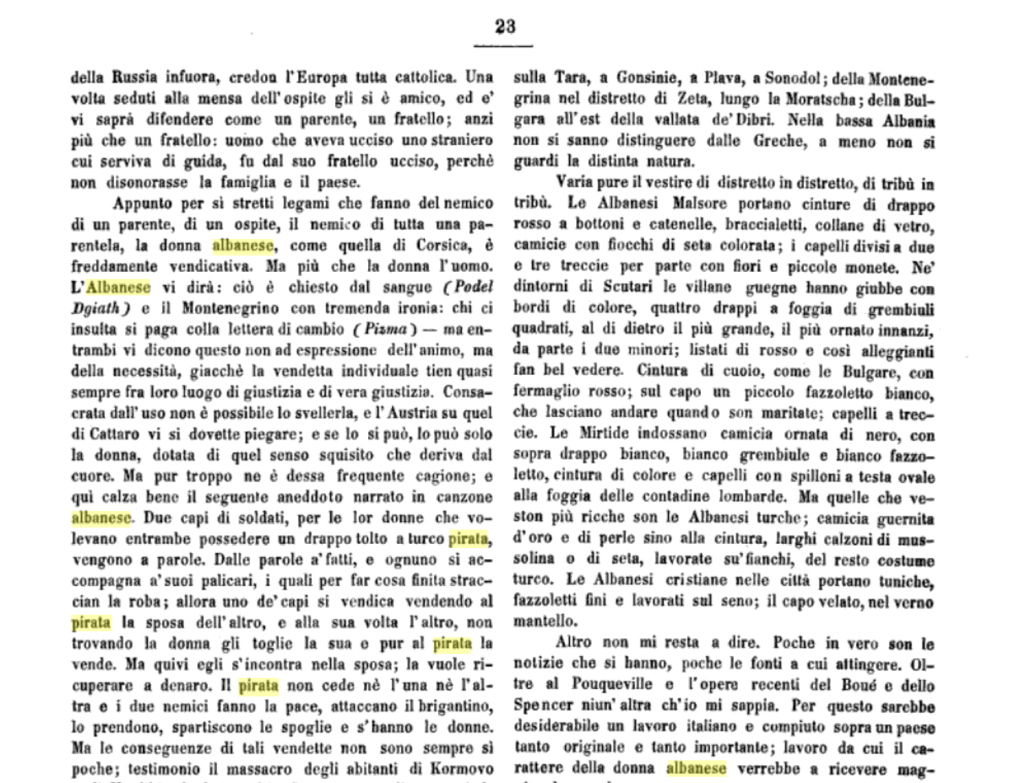

In 1854, the shipping company Lloyd Austriaco published an article in the “Letture di famiglia opera illustrata con incisioni in acciaio che si pubblica dalla Sezione letteraria-artistica del Lloyd austriaco”, describing the Albanians at the time:
“… Precisely because of such close ties that make the enemy of a relative of a guest the enemy of an entire family, the Albanian woman, like that of Corsica, is coldly vindictive. But more than the woman, the man. The Albanian will tell you this is demanded by the blood: “Podel Dgiath (Gjakë)” and Montenegrin with tremendous irony:
“Whoever insults us is paid with the bill of exchange”
Blood feud (Po del Gjak)
“But both of them tell you this not as an expression of the soul but of necessity since individual revenge almost always holds the place of justice and true justice among them.
Consecrated by use, it is not possible to uproot it and Austria had to bend to it on that of Cattaro and if it can be done, only a woman endowed with that exquisite sense that comes from her heart can do it. But unfortunately this is a frequent reason and the following anecdote narrated in Albanian song fits well here:
“Two leaders of soldiers for their women who both wanted to possess a cloth taken from a Turkish pirate come to words. From words to deeds and each is accompanied by his assailants who, to get the job done, tear up the stuff then one of the leaders takes revenge selling the other’s bride to the pirate and in turn the other, not finding the woman, takes hers from him and also sells her to the pirate. But here he meets the bride and wants to get her back for money. The pirate gives neither one nor the other. They make peace between the two enemies, attack the brig, take it, divide the spoils and have the women.”
But the consequences of such revenges are not always so few, witness the massacre of the inhabitants of Kormovo and Kardiki and many others. Subject to such songs as to disgrace the Atar Gull or the Salamanders. Even in times close to us, the Guegni Mirditi (Ghegs of Mirdita) the blessed lands turned red with blood.
But if such revengeful guilt and punishment of the peoples among whom they exist would seem to show us that the Albanian woman is not very fond of her homeland, in fact she is not because of one of those inconsistencies between less civilized peoples and among very common civilians. She loves her homeland above all homelands and sings his beauties his magnanimous deeds.
If by chance he goes far away he continually returns in thought to his native mountains to his native village to the smiling valley to the spring to the herd and the natural sadness of his character becomes darker and sadder. His love is not proclaimed for vain pomp or cowardly lied but true and profound as virgin peoples usually manifest themselves in sadly virile peoples.
And sadness does not disturb the features of Albanian women, they add vagueness, they have something of mountain vigor and island vagueness that enchants the lively and silky eye, the shadow of the eyebrows well proportioned, the mouth, the protruding nose, the light walk.
The wear and clothing of the Catholic Malesori Albanians and Shkodra inhabitants
“The Malsore Albanians wear belts of red cloth with buttons and chains, bracelets, glass necklaces, shirts with colored silk bows, hair divided into two or three braids on each side with flowers and small coins.
In the surroundings of Scutari the peasant women (Ghegh) have jackets with colored borders four drapes in the shape of square aprons at the back the largest one the most ornate in front on one side the two smaller ones striped in red and so flowing they make a nice sight Leather belt like the Bulgarians with a red clasp on their heads, a small white handkerchief which they let go when they are married, braided hair, and the Myrtles wear a shirt trimmed in black with a white cloth over it, a white apron and a white bed handkerchief, a colored belt and hair with oval-headed pins at the style of the Lombard peasant women.
But those who dress the richest are the Turkish Albanians, shirt trimmed with gold and pearls up to the waist, wide trousers of muslin or silk worked on the sides of the rest of the Turkish costume.
The Christian Albanians in the cities wear tunics, fine and worked handkerchiefs on their breasts, their heads veiled in the winter cloak. There is nothing else left for me to say. In truth, there is little information and there are few sources to draw from other than Pouqueville and the recent works of Boué and of Spencer no other that I know of. For this reason it would be desirable to have an Italian work completed in such an original and important country in a country from which the character of the Albanian woman would receive greater light and honor”.
Reference


 Balkan Academia