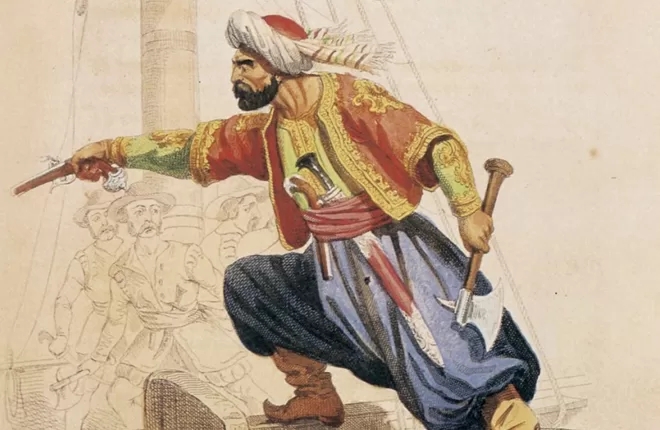

The following article cites sources mentioning 16th, 17th and 18th century Albanian trade, as well as Albanian sailors, spies, soldiers merchants and pirates roaming the Adriatic.
16th century Albanians
Albanians Bartolomeo Leoni, Gregorgio Trin, Baronio Grigis, Pietro Florian, Bernardo Zio, Pietro Bartoli, Isidoro Bagnolo mentioned in the 1550s
“Bartolomeo Leoni, Gregorio Trina, Baronio Grigis, Pietro Florian, Bernardo Zio, Pietro Bartoli, Isidoro Bagnolo. For each name mentioned, testamentary deeds of Albanians are recorded: even prominent names such as Ducagini … “1
Maria Drivaster (Marijë Drishti), Desa Scutari (Desa Shkodra), Stana wife of Pietro Blasio da Drivasto (Pjeter Blazhi of Drisht), Marco Elia and Giovanni Musachi (Gjon Muzaka)
“Also in this case there are numerous Albanian presences in his documents, from which I choose, indicating the year when present: Maria Drivaster forner (the place of origin, Drivasto, is the surname); Desa from Scutari (1505); Stana wife of Pietro Blasio da Drivasto; Marco Elia, canon of Drivasto (1517), who also left money to Giovanni Musachi resident in.”2
Nicolo di Biagio da Drivasto (Nikollë Drishti)
“We have already met, remember, a master Stefano dal Dagno, who supplied glass to old Nazareth. Even in the very early 1400s, the “pigna” furnace managed by an Albanian family was renowned in Murano and in the late 1400s Nicolò di Biagio da Drivasto, an Albanian, continued that tradition: he was registered among the glassmakers as gastaldo in 1501 and 1505. In 1511 he is registered as master … “3
Agate Lezha, Basil Lezha, Bellat Ungari Drishti, Diana Shkodra, Elisabete Suma of Drisht, Gjergj Golemi of Drisht, Gjergj Shkodra
“In San Beneto (San Marco district), parish priest with functions of notary Piero Bon, years 1496-1520: dozens and dozens of wills from Albanians, many also from Dalmatians. We choose from the list: Agata de Alessio; Basilio de Alessio; Bellato de Ungari from Drivasto; Diana from Scutari; Elisabetta Summa from Drivasto, Giorgio Golemi from Drivasto; Giorgio from Scutari de Monte: Giovanni di Giorgio from Scutari de Monte: Geronimo from Budua… “4
Venetian military captain of Albanian origin Antonio Spiti
Antonio Spiti was a Venetian military captain of Albanian origin in the 16th century. The last name “Spiti” is a Greek word of “Shtëpi” meaning “home” used by Albanians in Himara. Spiti is noted in Venetian archives after he visited Venice between 1525 and 1539.5
An Albanian named Paduan of 1527
” … Igoumenitza and counts them; on 27 November in Arbe, letters encrypted to the Turks from a Paduan, an Albanian and a young man from the Barbarigo family were intercepted; on 27 December 1572 Luis Portillo, official Spanish spy in Ragusa, reported the passage of two Turkish spies headed for Ancona and Venice; on 13 April 1573 the renegade Mustafa Corni, a suspected spy of the bassà, was identified in Dalmatia; on 19 August 1573, Damiano Albanese and Domenico da Oderzo were arrested again in Dalmatia … “6
Andrea Rizzi, Albanian from Perast
“… In March 1786 Andrea Rizzi, an Albanian from Perast, pretended to have to handle purchases of wheat and wax in order to spy without suspicion in Scutari.”7
Albanian Juan Campos from Foxa
“In 1535 Venetian spies intercepted the crude jargon cipher with which Juan Campos, an Albanian from Foxa, was about to inform from Turkish territory … “8
Albanian pirates Marco and Giovanni Ghini (Mark and Gjon Gjini)
“In 1596-97 Girolamo Ramusio tried to eliminate two inconvenient Albanians, Marco and Giovanni Ghini”9
Albanian Venetian spy Marino Becichemo in Ragusa
” … Other Venetian secret agents in Ragusa in the first decades of the sixteenth century were the Albanian Marino Becichemo, rector of the city school, the Florentine merchant Giacomo Giuliani, who took care of the sorting of correspondence in Constantinople and the
aforementioned Michale Bucianolo .. “10
Albanian spy Tommaso Franzi (Tomë Frenqi) of Vlorë
“At the height of the Venetian-Turkish war of 1499-1503, Tommaso
Franzi, a merchant from Vlora and a “very trusted and true spy” in the
service of the captain of Dulcigno Francesco Tagliapietra, “under the guise of his merchandise” goes to Scutari and Skoplje and offers to go as far as Constantinople to scrutinize the moves of the Turks”11
Giovanni Albanese (Gjon) in 1576
“In 1576, Giovanni Albanese got drunk and insulted Giovanni da Chero by calling him a dog and a hang-man (boia).”12
Albanian captain Teodoro Bicchieri (Teodoro Musacchio or Zucchero or Cucchero Albanese) (Alb: Teodor Sheqeri or Teodor Muzaka) in 1526
Teodor Sheqeri was an Albanian Stradiot captain serving in war in Italy between 1522-1529 when he died in combat in Garlate.13
” … Albanian Cucchero, fighting in the imperial camp against Florence, at the time of the siege … “14
“… Cucchero, Albanian, captain of stradiotti horses. Teodoro Bicchierini or Bischermio, probably the same as the Albanian Captain Teodoro, captain of the Maramaldo horses … “15
Constantino Bocolla (Alb: Konstantin Bakalli)
“…Constantino Boccola, Albanian, all trained captains and of esteemed name in arms, among whom, Federico Gonzaga, lord of Bozzole, was of much greater reputation for the nobility of his house and for the positions he held… “16
Albanian Stradiots Zuan Gjani Renesi, Maro Renesi, Andrea Renessi and Busichio Renesi in 1541-1542 and 1453
” … Zuan (Gjani) Renesi. In 1542, the Albanian Maro Renesi was registered. In 1541, Andrea Renessi served in Dalmatia. A year earlier, the leader of the stratiots there was Busichio Renesi. In 1547, the Albanian…”17
Other members of the Renesi tribe in 1504-1511 and 1526-1531
“Renessi, Gjon Renessi, Pavlo Renessi, Jorgi Renessi, Theodoris Renessi, Gin Renessi and Leka Renessi. The surname “Renessi” became extremely widespread among the Albanian stratiots in the 16th century. In 1504 on the island of Kefalonia there were: Ginni Renessi, Lumo Renessi, Anzolo Renessi, Georgio Renessi, Gioni Renessi, Piza Renessi. In 1508 on Crete serves as an Albanian leader (capo) Geta Renessi. In 1511, a certain Dominico (Domenego) Renesi is there. In 1531, Albanian stratiots Petrus (Piero) Renessi and Alessandro Renessi are in Crete. In 1526, the leader (saro) stratiots in Spalato (Split) was Ector (Ettore) Renessi in In 1538.”18
Angelo Renessi, Gjin Renesi, Michali Renesi, Zorzi Renesi, Lecha (Lekë) Renesi in 1481, 1493, 1552 and 1559.
“Angelo Rhenesi from Modon serves in Kefalonia together with his son Ghini Rhenesi. In 1559, the stratiot Michali Rhenesi is located on the island of Corfu. In 1552, the leader of the stratiots in Split is Zorzi Renessi (Rhenesi). At the end of the 15th century (1493) the Albanian stratiot in Puglia and Amorea was a certain Lecha Renesi. In 1481 the leader of the stratiots in Sogop was called Geta Re… [ … ]”19
Stradiot Albanians from the Renesi family
“Zuan Renesi, Zuan Clossi (Kloshi) Nicolò Clossi (Kloshi) Luca Calambressi, Andrea Peta and Piero Cuzzi (Pjer Kuqi). And from here it is taken that all these Stratioti and others, it is understood that our 40 are provided with every quality that is found here, must … “20
Albanian Stradiots Buza Cochla (Buzë Kola), Andrea Griti, Paolo and Zorzi Spata (Pal and Zorzi Shpata), Lecha Fudi Albanese (Lekë Fudi)
“… And having placed our beloved Buza Cochla in the company of the stalwart Reposi Bosichio, our beloved nobleman Andrea Griti was appointed governor general of Corfu in place of another provisional man who was missing in the said company … “
“… Item be granted to our faithful Paulo and Zorzi Spata brothers from Malvasia a first vacant place for each of them in the companies of horses serving on the island of Cephalonia under the strenuous Zorzi Vinar and Stamati Masara … who are cavalrymen, in which companies serving on horseback they must have the same allowance and salary as those in whose place they will be placed; and the same be granted to the faithful Lecha Fudi Albanese and Strathioto from Malvasia … “21
Cavaliere di San Marco Tommaso Pelessa (Tomë Plezhe)
Tommasso Pelessa or Tomë Plezha was an Albanian military in service of Venice. Between 1584 and 1587 Plezhe accompanied Tommaso Raggio missionary journeys into Ottoman land. Plezhë was knighted by Venice for his services in 1572.22
Tommaso Pelessa and the pirate Paolo Ducagini (Pal Dukagjini) in 1590
“In 1590, in the midst of the crisis, an ambassador from Ragusa complained about the damage that Paolo Ducagini, son of Bartolo and captain of the “Albanian boats” of the Republic, caused to vessels flying the Ragusa flag.
In the trial prepared by the rector of Cattaro (and subsequently sent to Quarantia) the accuser, and main witness of the Ragusa people before the Senate, Tommaso Pelessa, accused Paolo of having intentionally injured and detained the Ragusa crew of the ship transporting grain.
Paul obviously denied it: he was acquitted, and although Venice returned all the cargo, the Senate still wanted to advise the ambassadors of the small Republic to “use greater modesty, and use those appropriate terms, which your lords have always used with us”. Tones which, if they did not betray a weakening of Venetian control of the Adriatic, at least made it clear how vital the control of the Albanian sea routes to Venice was.”23
Croatian Aleksandar Komulović (Alessandro Cumuli) and Tome Plezhë (Tommasso Pelessa)
“According to the papal nuncio in Venice, Komulović had sewed up his instructions and letters in a cushion which he inadvertently left behind upon his departure from the city. When discovered, they were turned over to the Signoria. While in Venice, Komulović stayed with the well-known Albanian Tommaso Pelessa, who is said to have claimed that Komulović was equipped with false seals and letters, the significance of which seems to be unclear … “24
Tomë Plezhë and Albanian dragoman Marcantonio Bruti
“However, the services of the Albanians and the stradiotti in general were not a Venetian exclusive: since the early sixteenth century, a considerable number of them had passed into the service of various European countries, in particular in the Spanish armies. Among these families, two stood out: the aforementioned Ducagini, and the Plessa, in particular the figure of Tommaso, captain and Knight of San Marco.”25
The last male representative of the family, he had served Venice in Cyprus under the horse governor Lusi, his maternal uncle. Most of his family had perished after the capture of Nicosia and he himself had remained a prisoner of the Turks for three years; freed in 1574, after having served in Corfu, he settled in Budva.
He too, not differently from Marcantonio Bruti, had quickly inserted himself into the reality of Venetian Albania, to the point of leading the community’s embassy in Venice in 1593 and like Bruti and most of the local elites he was heavily involved in the grain trade. Pelessa, as he himself stated, despite his family having been decimated, possessed among the Albanian leaders «great kinship, dependentie and amicitie»; moreover, he claimed to be “keeping the minds of the entire Albanian Nation very well disposed and prepared towards this Most Serene Dominion.”26
Komulović and Plezhë’s friendship
“In this context, it is not surprising that Pelessa was intimate with Aleksandar Komulović (in Italian, Alessandro Cumuli). A prelate of noble Split origin, he was probably the most skilled and prepared papal agent in Eastern Europe: a member of the Illyrian Brotherhood of Saint Jerome, he had become famous for the publication of the first catechism in the Serbo-Croatian language” (imbid).
Clement VIIIs plan in 1593, Komulović and Marco Ducagini (Mark Dukagjini), Pal Dukagjinis brother
“In the year 1593, Clement VIII’s plans took shape and the Pope entrusted the abbot with a very important mission: he would have to convince the Poles, Transylvanians and Muscovites to unite in a great anti-Turkish league, in the meantime establishing relationships with the emissaries of subjected populations to the Ottoman yoke. Venice was already alerted by its captain’s contacts with papal agents: during the visit that Komulović made to Venice in November 1593 he was a guest in Pelessa’s house.
The sailors and traders coming from the Dalmatian and Albanian coast mostly stayed near the Riva degli Schiavoni: the house rented by the soldier was in fact in Calle delle Rasse, behind Palazzo Ducale. He was not alone, obviously: in addition to him, some Buduans and Marco Ducagini, his brother-in-law and Paolo’s brother, lived in the building. At the time of departure, apparently, Komulović forgot some letters and documents under the bed of the Albanian’s home: bad luck meant that the maid handed them over to Paolo Ducagini, Pelessa’s competitor.27
The complaint against him was presented by Marco Samuel, the author of the first project to reconquer Albania, now out of papal grace; Pelessa himself, during his subsequent trial, defined him as «a sad (…) who has always been my enemy». According to a witness, one Nadal Surbi from Ulcinj, this enmity was fueled by the money that Venice entrusted to the Knight to buy grain in Albania.
At least in the early days, the Albanian captain’s freedom of action must not have been particularly limited by the Venetian authorities: in the spring of 1594 and 1595 he was able to travel to Albania accompanied by the Bishop of Curzola, Agostino Quinzio, and by the Cavalier Bertucci, ex-chancellor of Lesina banned from the Venetian territories. Here he had met some of the main Catholic leaders who had entrusted him with letters for the Pope, punctually presented by Pelessa to Clement VIII; the outbreak of the war, and the Venetian choice of neutrality, forced the Venetian government to take measures. In the year 1596 Tommaso Pelessa was incarcerated by the Rector of Cattaro in the fortress castle, and despite all the pleas of his wife he died there three years later.”28
Pope Clement VIII, Tomë Plezhë and Komulović
It would be unfair to limit Komulović’s activity to the Balkan area; together with Possevino he was very active towards the territories of Poland-Lithuania, Transylvania and above all Muscovy. The idea of a large anti-Turkish coalition, supported by Gregory XIII and above all by his successor, Pope Clement VIII, saw him at the forefront: a report on the Catholic populations of the Ottoman Empire was almost certainly written by him, in which he analyzed the allied forces which could have been counted on in the event of an invasion of Turkey. The first meeting between the Albanian captain and the Croatian prelate probably took place right on the Venetian-Turkish border: in the “80s” of the sixteenth century Komulović was sent to Albania as an apostolic visitor and met Pelessa, who was probably busy enlisting soldiers for Venice.”
The earthquake of 1520 in Albania
“On May 17, 1520, a massive earthquake occurred in Dubrovnik and Albania. Up to 150 people were killed there and 400 were wounded. The Republic ordered the top at the first news, to the governor in Dalmatia, to go to Albania, and to give help on the way, wherever it was needed. In the same year in July, the government informs the Venetian orally that the Turk has dismissed the entire navy, as her deputies from Constantinople write to her in the alley; at the end of October i. Mr. sent Orsat Zamanja to Venice as an envoy to inform her of Selim’s death (September 20), and Zamanja received a gift of 100 ducats.”29
Albanian Qoči Beg (Görijeli Qoja Mustafa Beg) translator to Sultan Murad IV
“Another writer of this type is the Albanese Qoči Beg (d. 1650), advisor to Sultan Murad IV. for whom he wrote a treatise with political doctrines.“30
Albanian pirates from Shkodër, Durrës, Bastov, Ulqin and Hercegnovi
” … Turkish (Muslim Albanian) seafarers-rais were mostly from Valona, but also from Shkodër, Durres, Bastov, Ulcinj and Hercegnovo. Their names are Turkish: Mehmed-rajs, Mustafa-Hodža, Hasan-Bali, Ramadan rajs, Ali-rajs, etc.). Among them there were a lot of Turks, especially from Albania, but also from. … “31
17th century Albanians
Albanian military from Domenigo Mattegussi (Domenik Matagushi) of Shkodër staying in Split fighting against Uskok pirates
In 1619, an Albanian named Domenik Matagushi is mentioned in Split, Croatia, fighting Uskok pirates, and in translating Albanian, Italian, and Serbo-Croatian.32, 33
Albanian pirate Ramadan in 1673
“Ramadan was the most skilled and fearsome Ulcinj pirate, and at the same time their platoon, who was killed, together with 22 crew
members, in a skirmish with the Venetian captain Gulf’s felucca near Dugi Otok in early August 1673), but his the pirates angrily avenged the death of their captain).34
“… Ulcinj pirates attacked Dugi Otok in 1667, and in 1672 they looted near Rijeka and Bakr. In the 17th century, the most famous pirate from Ulcinj was Ramadan, otherwise a Turkified Dalmatian. When he was killed by the Venetians near Dugi Otok in 1673…”35
Baron Andrija Gorakući (Andri Gurakuqi)
” … Gorakući, Andrija, detto Albanez, baron, Hercegnovi, 1615, 1766 .. “
18th century Albanians
Albanian ship mechanics
” …. During the first half of the 18th century, according to the letters from Ulcinj of the Acta Turcarum series, the following Ulcinians repaired their ships in Dubrovnik: In 1723 Mehmed-reis, in 1727 Jusuf-reis, and Sulejman-reis carried out ship inspections before going on business for the Pasha of Skadar, in 1737. Redžep-reis … “36
When the Venetians tried to poison pirate Bego Bolotti of Ulqin
“On the 15th August 1711 Carlo Miani proposed the same “singular and valid means” of poison to get rid of some instigators of disorder in Albania; between May and November 1726 the captain in the gulf tries to poison Bego Bolotti, a corsair from Ulcinj who infests the Albanian sea, but due to a mix-up the poisoned kidney is eaten by another sailor from the ship and the pirate escapes”.37
Berisha pirate / sailor not paying rent in 1713 and Osman Reis Spitali
” … Berisha to return and empty the house, so in the end he had to turn to Porte. It was not until 1713 that a firman was issued according to which Beriša would return the key to the owner and pay the arrears of rent. Furthermore, also according to Turkish sources, in 1720, two Dubrovnik subjects transported Osman Reis Spital’s goods to Dubrovnik
worth one load of akči. As one fell ill on the way and the other died .. “38
Gaeta Karakodža (Caracosa) military commander of Vlorë
“… Karakodža was the military commander of Valona (Albania). Italian writers call it Caracosa … “39
“… which he forbade to pirate in Dubrovnik’s waters and to capture Dubrovnik’s ships and people; he specifically ordered Karakodža to free all Dubrovnik slaves. But this calm was short-lived. At the end of June 1568, the Karakodža pirate Gaeta captured a Dubrovnik brigantine, loaded with grain, and dragged it to Valona … “40
” … From this, by chance, arose a difficult conflict between Turkey and
Dubrovnik. The Venetian galley, which went to Dubrovnik to receive Ragaconi, was intercepted by the Boka Kotorska Karakodž, but Francesco Pron, the captain of the galley, managed to get his ship out of the battle by skillful maneuvering and continued towards Dubrovnik, where he arrived when she had already descended. night. Certainly, informed of his arrival, the guard let him go… “41
” … I repeat, the sinking happened to the crew of the ship that captured Karakodž. Those fifteen sailors were kept with their ship in Livorno. They immediately left their ship, went to Ancona and boarded a brigantine, intending to return to Dubrovnik. That brigantine captured Karakodž, enslaved these poor people and demanded a huge ransom. Beškot and provisions from the other boat were intended for sale in the city. He with his accusation … “42
Ulqin pirates fighting with Serb/Montenegrin sailors
“… supplied themselves with water and boarded the chain, the Ulcinj pirates opened fire on them from the land. Sailor Marko Milošević was killed, and sailors Krsto Dabinović and Živko Milutinović were mortally wounded. The other five sailors threw themselves into the sea and, swimming under fire from the Ulcinians, reached land unharmed and arrived in Nemokamba. Returning from Greece died … “43
Pasha of Shkodër and Matija Lukin, Pav Krilovic and Krsto Milatovic
“… Matija Lukin Miljević, Pav Krilović and Krsto Milatović, who also had
to return on foot from Shkodra. Miljević and Krilović were in Albania
for several months with a small tartan, next to the cartridges of
Ilija Žig on the tartan of Joz Koljanović. They were then invited
to his palace by the Pasha of Skadar and attacked them for enabling
the escape of Grilo’s family. They were thrown into a dungeon, around…”44
Ali Reis Arnaut of Tripoli
“… reis Diklić from Konaval as the commander of the
Algerian šambek on which Ali-reis Arnaut, a
Tripolitan pirate, was hidden. … “45
Sulejman Arnaut of 1781
“In the middle of 1781, Sulejman Arnaut, the envoy of the Tripolitan Pasha, appeared in Dubrovnik, who demanded that a ship be made available to him to transport wood to Tripoli for the construction of a new ship, procured in Albania. In addition to the letters of the Pasha
of Tripoli and Sandžakbeg of Skadar, in whose area the wood was to be procured, Sulejman Arnaut brought to Dubrovnik a letter from the eldest son of Ali Pasha, Hasan. Hasan, proclaimed bey on August 26, 1773, was particularly influential in Tripoli. He was very bothered by the fact that instead of his father, the janissaries were leading the charge.” 46
Ali Reis Arnaut turning pirate
“… by the letters of the Dubrovnik consul in Istanbul Curić, who stayed in Tunisia in 1766. Reporting to the Dubrovnik government at the end of that year, Curić attached to his letter a copy of the letter dated November 20, 1766, which the English consul in Tripoli sent to the English consul in Tunisia. It was about the fact that the Tripolitan pasha suspected that his reis Ali Arnaut “intended to turn pirate.” The Pasha therefore warned all the consuls in his pashaluka, recommending that they forward the information to the consulates in the Mediterranean. The mentioned reis commanded a smaller šambek with 10 cannons, leaving Tunis beginning… “47
Pirates Liha Meta (Liho Meta) and Reis Ismail
” … for shipbuilding in Rijeka and Albania. This was another way that the Tripolitan pashaluq (Pashaliks) used to get the materials needed for building ships. Hadži Ali entered into a lease agreement with Capt. Melizius for 800 piastres, and Melizius undertook to lend Ali 300 sequins in Rijeka, and another 40 in Durres for the purchase of wood, which will also be a deposit for the borrowed money. The wood was again bought in Durrës from the well-known Ulcinj pirate Lih Meta. After the purchase was made, when the wood was loaded onto the ship, the Tripolitanian reis Ismail, who was in Durrës, gave Haji Ali 340 piastres to buy a … “48
Reis Asan Rodašli (Hassan Rodashlia)
“… it is known whether it is a Berber or Ulcinian tartan, but its commander is Reis Asan Rodašli, which was later established. The Tartana is an equipped with 14 cannons and 9 stone throwers, and previously it was armed with 16 cannons. The crew consisted of 120 people. Reis Asan Rodašli, wanting to attack the Peraški vaše, asked
the people of Drača for help in manpower, and indeed 50 people from Drača under the leadership of Husein joined him. Capt. Zorzi Boat from Perast being there 28th August. 1716 … “49
Paron Antun of Ivan Trojanovic and the fight wit the Dulcignotto (Ulqinak pirates)
“… Paron Antun of Ivan Trojanović (Trogianovich) got into a fight with some Dulcignotti. The following morning the Dulcignottis boarded the boat of the paron Josip Zerman from Prčanj as he went ashore firing six pistol shots at the crew, without injuring anyone. They left for Kérkyra and the consul lodged a protest with the Turkish command which expelled the Dulcignotti. On the same evening the said paroni Vinko Kostanjica (Castagnizza) and Stjepan Lupešković with their boat … “50
Albanian pirates and sailors according to Croatian sources51
Ali Korza, Alija Hadži , Belaj Mema, Falza Reis (Fazli) Hajdar Visi , Ibraim Reis, Karakos, Hajdar Karamidzola, Mustapha Karamidzola, Lambro, Liko Cena, Mehmet Reis, Murat Reis, Orudz, Ramadan, Sinan Reis, Stavri Ademi, Uluz Alija, Usein Rezi, Zoban Reis (Coban Reis), Reis Hoti and Mustapha Hoti.
Aslam Ahmed and Kapitan Hoti (Captain Hoti) in 1815
“Aslan Ahmed, also the helmsman on that trabakul. And he declared about him that everything corresponds to the truth, after he was sworn. After that both were escorted by the health guard to the trabakul. We find this same trabaculus recorded for the first time in the register of the arrival and departure of the ships of the Port Authority of Croatia, after it arrived there on October 3, 1815. On it is the same captain Hoti.”
Captain Osman Zuberi in 1885
“… Captain Osman Zuber, was confiscated at Bojana and taken to Obod, where he had to stay for a long time. In another case, the Captaincy of the harbor at Pristan requested on 29 August 1885 the Office of the Maritime Department at Cetinje, in order to stand up for the release of the trabacule Fior di S. Nicolo, captain Osman Zuber, because it has been seized in Obod for two years …”52
Consul Hecquard and the “Guri i Geranes” and pirate hideout
“Hecquard writes that between Ulcinj and Valdanos there is an islet that Albanians call Guri Gerans, and pirates hide behind it and attack passing ships. According to an unlikely folk legend, the old Colchinium was located on it. Hecquard replaces Guri Geranis with the islet Stari Ulcinj, which is mentioned in a document from 1376 … “
Ali Hodža kidnapped Dalmatians in 1731
“… Ulcinj pirate Reis Ali-hodža landed in Obuč in September 1731, ransacked and looted the village and captured Petar Golubović, Kata Stržić and Luka L, (Dubrovnik-Pile), Petar Nikolin L. (about 1766-1847) from Podobuc… “53
“… Although exiled from Albania, Ali-hodža stocked up on supplies in Valona before coming to Mljet, and after the crime he committed, he returned to Ulcinj. He then briefly took refuge in the nearby Val di Noce. Before sailing to Tripoli, he managed to hijack a ship in Boka. The people of Dubrovnik were convinced that Ali-hodža had a warehouse somewhere in Albania where he stored looted goods, and that he was
trading the same goods around Albania without fear. It was reliably known that his helpers were his brother and parents who lived in Ulcinj. The Dubrovnik government constantly warned… “54
Liko Cena in 1721
“… The dulcignot rais Lico (Cena) to bring him cloths from Venice. see what consul Pietro Rosa wrote on April 30, 1721: “
The aforementioned Tartan of Rais Licco extracted 27 bales of cloth from this city, of which three were of a… (?) Velagrada, who returned here with the same rais, three of Nicola Ioanni Carà, and seven of a certain Joanni Siguna from Moscopoli, and the others all of the Scuttarini, which the aforementioned rais had brought from Ulcinj to Bogiana”.55
Pirates Hasan Metalia, Mehmet Zungu and Ali Metalia
“… of Hercegnovi by the bastards coming from Turkish Albania with the dulcignotti ships of the reis Hasan Metelia, Mehmet Zungu and Ali Metelia are sent to Venice with the parish of the paron Matija Raguzin from Lošinj Mali … “56
Albanian sailors Isak Kupeja, Suleiman Zani and Halil Matlia from Ulqin
“From the reis Isak Kupeja and with the xebec directed by the reis Suleiman Zani (who came to Hercegnovi on 16 December last) and with the deputy of the reis Halil Matlia, all dulcignotti leaves for Venice …”57
Sinam Rais, Kadi of Ulqin
“At dawn, on the morning of March 12th, which is the feast of Saint Gregory, a group of twenty-five armed Turks sent by Suleyman Aga and Sinam Rais, the Voyvode of Ulcinj, arrived and began beating at the door while we were all sleeping peacefully in the priest’s one-story home. I was in a separate little room and the others were lying near the entrance on blankets spread on the ground, as is the Albanian custom. They were mostly sea pirates based in Ulcinj and, since a few days earlier the people of Budva had set fire to their only vessel, they were now marauding the countryside, killing and robbing travellers in this region. We had some premonition…”58
Rais Alija and the Paštrovic pirates of 1762
“… Many actions of the Paštrovica pirates were carried out at night, and
one such interesting case happened one summer night in 1762, when
they attacked a Neapolitan ship sailing from Senigallia loaded with
general cargo; however, thanks to the successful intervention of the Ulcinj tartan Rais Alija, this sailing ship was freed and towed to Durrës.”59
Sulejman, Rais of Ulqin, planning an offensive against Montenegro
“… Therefore right to govern Montenegro. Sulejman had previously
been rais of Ulcinj and had caused serious problems in Venice.
He was a cunning man who worked to reduce Venetian
influence among the tribes and to prepare an offensive against
Montenegro. Part of the tribes bowed to the Turks without … “60
The French seizing an Ulqin ship owned by Sulejman Reis Cakuli in 1801
“The owner of the trabacule, Sulejman Reis Cakuli, reported the event on August 28, 1801 to the Dubrovnik State Chancellery and was ready to prove it all to witnesses every time it happened. He particularly protested to the perpetrator, that he illegally seized his ship in a neutral port and at night, which… “61
The Venetian Doge and Senate on persecuting the Ulqin pirates
“The Venetian Doge, with the Senate, ordains that the vessel Sv. Marko and the auxiliary vessel Sv. Todor, commanded by Luka Župa, shall persecute the pirates from Ulcinj. Herewith we order all Venetian representatives and naval commanders to assist these vessels in the execution of their duties. This document was issued at the Doge’s Office at Venice, on 9 April 1718. Signed: Mateo Bianci, Thus, we may suppose that these vessels were commissioned by Venice to … “62
About the destruction of Ulqins pirate ships in 1760 Bulatović
writes:
“When Mehmed Bushati declared himself the vizier of Skadar,
Ulcinj was like a small republic, causing damage to merchant
ships with his piracy. In order to protect trade, Bushati attacked
Ulcinj in 1760. With treachery, he set fire to the ships in Stara Skela
(Valdanos), and Ulcinj recognized his authority”.63
Reis Dolcignoto son of Alli Beris (Ali Berisha)
“… Reis Dolcignoto son of Alli Beris, who there loaded races for the Dominant of rich valsente which he barely found the …”64
Albanian sailors and pirates from Lezhe and Ulqin mentioned in 1731, 1759 and 176265
Sulejman Gjeci, Reis from Ulqin, Gjon Gjergji, owner from Lezhe,, Ahmed Gjezulli, Reis from Ulqin, Gjon Matej di Giovanni (of Gjonit)
Bego Ulqinaku in 1726
“Of course, the escape did not have a happy ending for everyone. Not all the fugitives managed to cross over to the Venetian side, some were captured by the pirate Bego from Ulcinj, and thus they fell into a network of various blackmails and frauds, under which was the selfishness of both the pirates and Pasha’s men.”66
“The Ulcinj pirate Bego, along with Ali-Hodža, one of the most dangerous pirates of that time, who cruised in the spring of 1726… the Ulcinj pirates, despite the official policy of the Porte, enjoyed the support of the Pasha of Skadar, some of these fugitives…”67
Bey of Ulqin punishing criminals in 1713
“In 1713, the bey of Ulcinj told the people of Dubrovnik through the emin that the houses of criminals from Ulcinj who had killed several merchants from Dubrovnik had been destroyed and burned. One criminal was arrested, and with him was a kidnapped child who was traveling with one of the murdered merchants. The people of Ulcinj sent
the child to Dubrovnik.. “68
Mehmed Raspaçi (Mett Raspacci) in 1761
“In 1761, an Ulqin bey named Mehmed Raspaçi (Mett Raspacci) is reported to have sailed from Durrës with an Ancona Tartana”69
Venetian mentioning of Albanian sailors and pirates70
“Mustafa Halil Rais, Mustafa Aga Reis from Ulqin, Mustafa Aga from Durrës, Ali Mustafa of Ulqin, Ibrahim Mustafa Reis, Mustafa Jahja Reis from Ulqin, Jusuf Reis from Ulqin.”
Albanian sailors serving Tripoli71
Acmet Ali Qui, a Dulcignotto Corsair serving Tripoli.
Ali Luci Acmed Reis, a dulcignotto serving Tripoli.
Mustafà Reis Dulcignotto
18th century trade in Albania and Venice
“There were some of the high-quality Albanian products that had priority and provided the Venetian and the European industry, especially the main wares such as: wool, leather, wax, tabacco, grain, oil, etc. For some of them like wool, Albania was the leading export trading partner country of Venice and the lifeblood of the Venetian and the Northern Italy textile industry.”72
Ali Luel Ahmed Reis Dulcignotto (Ali Luli Rais Ulqinaku)
“We certify and attest to whoever is entitled and entitled to it can partake, whenever one leaves from this port of Tripoli, Ali Luel Acmed Reis Dulcignotto, corsair in war, who commands the shambecchino here armed with ten cannons and four petreras…”73
Hasan Roxhi (Assan Rossi) in 1736
“… Hásan Roxhi, dulcignotto, who has already preyed on two small luggers that came to these beaches for loading. – Ibid. number 13. 1536 1736.18.IV, Durrës – The same to the same Magistrate. On the 11th of this month the privateer Hasan Roxhi … “74
“… corsair Hasan Roxhi (Assan Rozzi) went under Cape Lagit (Lachi), 20 miles away from here and found there… Albanez and another of his convoy with a load of flax seed for Venice. 1736.3.VII …”75
Topçi Bashi from Durrës
“… of some Venetian merchants, I buy two thirds of the Marciliana which in the past was bought by the late Topçi Bashi of Durrës from the Tripolini corsairs. It is the one above which the captain, Nikola Banić and his companions from Perast, killed the Tripolini in the Durrës bay…”76
Albanian Stradiots Nicolo Renesi (Nikollë Renesi) and Zorzi Condo (Konda) in Ulqin in 1770 77
“In this you must place all the greater consideration on your serenity, as Dolcigno (Ulqin) retains the title of Albania, because all the rest such as Scutari, Crogia (Krujë), Durazzo and others are in the power of the Turks. That city has three villas beneath it, and the countryside extends five miles long and two miles wide, and before the war its borders were as far as Bogiana (Bojana) which is XII. miles.
And this little territory that remains can be called abundant, because it produces wheat for seven months of the year and such a quantity of wine and oil that many foreigners use it beyond the needs of the inhabitants. In it there are 1348 souls, by fact 336, of which the majority are poor, and are busy sailing. In the three villas there were 595 souls, out of 152 [ … ]
Next is the captain Ottibianco with 24 hammerheads appointed to guard that territory. Also found are Nicolo Renesi and Zorzi Condò with 14 stradiotti very well on horseback. In the castle there is a contestable and two bombers, who have the task of managing some pieces of artillery and certain monitoring of little importance. In that place your serenity has no room, no other path than 130 ducats of the wine data deputed to the palace of the magnificent rector. The expense is 1770 ducats, which are sent from this city to pay the aforementioned companies […]
References
- Migrazioni e integrazione il caso degli Albanesi a Venezia (1479-1552) Av Lucia Nadin Bassani. 2008 p.126 https://www.google.se/books/edition/Migrazioni_e_integrazione/akUiAQAAIAAJ?hl=sv&gbpv=1&bsq=Bartolomeo+Leoni+albanesi&dq=Bartolomeo+Leoni+albanesi&printsec=frontcover ↩︎
- imbid. Migrazioni e integrazione il caso degli Albanesi a Venezia (1479-1552) Av Lucia Nadin Bassani. 2008 p.126 ↩︎
- imbid. p.123 ↩︎
- imbid. p.125 ↩︎
- – Zorattini, Pietro Ioly; Massenzio, Marcello (2008) (in it). I nomi degli altri: conversioni a Venezia e nel Friuli Veneto in età moderna (Translation: Albanian Antonio Spiti, was called Pietro and had Filippo Lion as his godfather and Countess Lelia Scotto, consort of Count Ascanio Scotti, governor of the Palma de Palma, for his godmother.177 The following year, 23 April 1634, Sunday in. .. ed.). Leo S. Olschki. p. 269. ISBN 9788822257826.
– Eade, John; Katić, Mario (2016) (in en). Pilgrimage, Politics and Place-Making in Eastern Europe: Crossing the Borders. Routledge. p. 147. ISBN 9781317080831.
– notai dello stato veneto – notai di venezia (Antonio Spiti ed.). p. 233.
– Giuliano, Granati (2008) (in it). parte VI ‘Archivi Notarili’ dell’edizione digitale dell’opera di Andrea Da Mosto L’Archivio di Stato di Venezia. Indice generale, storico, descrittivo ed analitico. Tomo I: Archivi dell’Amministrazione Centrale della Repubblica Veneta e archivi notarili, Roma 1937 (Spiti Antonio, Venezia (1525-39). ed.). In the early days the most important notarial deeds were kept in the premises of the Basilica of S. Marco. Then they gathered in a ducal palace, in a section of chancellery, called Inferiore, where from 1316 the instruments and papers of the deceased notaries were concentrated and the duplicates of the coupons of the wills handed over to living notaries. In 1474 the archive was transported to two earthly rooms, where it remained in bad condition until 1772. In this year, by decision of the Maggior Consiglio, the documents were transferred to the hall of the Collegio della Milizia da Mar and, in a room adjoining the Chancellery of the Doge, the testaments, which were then reordered in 1774. ↩︎ - I servizi segreti di Venezia. Spionaggio e controspionaggio ai tempi della Serenissima Paolo Preto, 2010 p. 103 ↩︎
- I servizi segreti di Venezia. Spionaggio e controspionaggio ai tempi della Serenissima Paolo Preto, 2010 p. 471 ↩︎
- I servizi segreti di Venezia. Spionaggio e controspionaggio ai tempi della Serenissima Paolo Preto, 2010 p. 121 ↩︎
- I servizi segreti di Venezia. Spionaggio e controspionaggio ai tempi della Serenissima Paolo Preto, 2010 p. 205 ↩︎
- I servizi segreti di Venezia. Spionaggio e controspionaggio ai tempi della Serenissima Paolo Preto, 2010 p. 240 ↩︎
- I servizi segreti di Venezia. Spionaggio e controspionaggio ai tempi della Serenissima Paolo Preto, 2010 p. 471 ↩︎
- The Unmannered Tongue Blasphemy, Insults, and Gossip in Renaissance Venice By Elizabeth A. Horodowich. 2000, p.146 ↩︎
- https://condottieridiventura.it/teodoro-musacchio/ ↩︎
- Opere inedite di Francesco Guicciardini: Lettere e istruzioni scritte durante la luogotenenza generale per il Papa Clemente VII By Francesco Guicciardini. 1863 p.471 https://www.google.se/books/edition/Opere_inedite_di_Francesco_Guicciardini/pkwtAAAAMAAJ?hl=en&gbpv=1&dq=Cucchero+Albanese&pg=PA471&printsec=frontcover ↩︎
- Giornali del principe d’Orange nelle guerre d’Italia dal 1526 al 1530 (sacco di Roma – guerra di Napoli – assedio di Firenze) … By Philibert (Prince of Orange), Ant Dom Pierrugues. 1897. p.56 https://www.google.se/books/edition/Giornali_del_principe_d_Orange_nelle_gue/GA5AAQAAMAAJ?hl=en&gbpv=1&dq=Cucchero+Albanese&pg=PA56&printsec=frontcover ↩︎
- https://www.google.se/books/edition/Historia_de_Italia/gOoKAQAAIAAJ?hl=en&gbpv=1&dq=constantino+bocolla&pg=PA293&printsec=frontcover, p.293 ↩︎
- Bulgarian Historical Review. 1978, p.77 https://www.google.se/books/edition/Bulgarian_Historical_Review/LA0iAQAAMAAJ?hl=en&gbpv=1&bsq=Zuan+Gjani+Renesi&dq=Zuan+Gjani+Renesi&printsec=frontcover ↩︎
- imbid. Bulgarian Historical Review. 1978 ↩︎
- imbid. imbid. Bulgarian Historical Review. 1978 p. 78 ↩︎
- Documents inédits relatifs à l’histoire de la Grèce au moyen âge Volume 8 By Kōnstantinos N. Sathas. 1888. p.309 https://www.google.se/books/edition/Documents_in%C3%A9dits_relatifs_%C3%A0_l_histoir/407eHYvYi9cC?hl=en&gbpv=1&dq=Zuan+Renesi&pg=PA309&printsec=frontcover ↩︎
- imbid. Documents inédits relatifs à l’histoire de la Grèce au moyen âge Volume 8 By Kōnstantinos N. Sathas. 1888. p.366 ↩︎
- https://academic.oup.com/book/37426/chapter-abstract/331513627?redirectedFrom=fulltext&login=false ↩︎
- https://arts.units.it/retrieve/e2913fde-7ed9-f688-e053-3705fe0a67e0/Tesi_Marco_Romio_Versione_Finale.pdf, p.74 ↩︎
- https://books.google.se/books?id=XN51y209fR8C&pg=PA9&lpg=PA9&dq=Tommaso+Pelessa&source=bl&ots=KtKZK5x3sY&sig=ACfU3U3nClsAWGnrB585XEcHARlU5QCazA&hl=sv&sa=X&ved=2ahUKEwijyMWandGFAxUeDhAIHcGhCcQQ6AF6BAgdEAM#v=onepage&q=Tommaso%20Pelessa&f=false, p. 11 ↩︎
- https://arts.units.it/retrieve/e2913fde-7ed9-f688-e053-3705fe0a67e0/Tesi_Marco_Romio_Versione_Finale.pdf, p.91-92 ↩︎
- https://arts.units.it/retrieve/e2913fde-7ed9-f688-e053-3705fe0a67e0/Tesi_Marco_Romio_Versione_Finale.pdf, imbid. ↩︎
- Agents of Empire: Knights, Corsairs, Jesuits and Spies in the Sixteenth-Century Mediterranean World. Noel Malcolm. https://books.google.se/books?id=KHKKBgAAQBAJ&pg=PT549&lpg=PT549&dq=Tommaso+Pelessa&source=bl&ots=JUchA8L8Ac&sig=ACfU3U2eOfaUjZ3iFimfQnb-n50dDqNpGg&hl=sv&sa=X&ved=2ahUKEwijyMWandGFAxUeDhAIHcGhCcQQ6AF6BAgeEAM#v=onepage&q=Tommaso%20Pelessa&f=false ↩︎
- Tesi_Marco_Romio_Versione_Finale.pdf, p.93-94 ↩︎
- https://www.google.se/books/edition/Rad_Jugoslavenske_akademije_znanosti_i_u/GAOkAAAAMAAJ?hl=en&gbpv=1&dq=gusar+albaniji&pg=RA1-PA99&printsec=frontcover ↩︎
- https://books.google.se/books?id=o8MeAAAAIAAJ&newbks=0&printsec=frontcover&pg=PA314&dq=albanese+1650&hl=sv&source=newbks_fb&redir_esc=y#v=onepage&q=albanese%201650&f=false ↩︎
- Anali Historijskog instituta u Dubrovniku Volume 1 By Jugoslavenska akademija znanosti i umjetnosti. Historijski institut (Dubrovnik, Croatia). 1952 p. 226 ↩︎
- Narrating the Dragoman’s Self in the Veneto-Ottoman Balkans, c. 1550–1650 036723369X, 9780367233693. p. https://www.google.se/books/edition/Narrating_the_Dragoman_s_Self_in_the_Ven/A7qvEAAAQBAJ?hl=sv&gbpv=1&dq=albanese+1650&pg=PT234&printsec=frontcover ↩︎
- https://dokumen.pub/narrating-the-dragomans-self-in-the-veneto-ottoman-balkans-c-15501650-036723369x-9780367233693.html ↩︎
- imbid. Historija pomorstva i ribarstva Crne Gore do 1918 godine, p. 253 ↩︎
- Srbi i Albanci kroz vekove – Volume 1 – Page 52 ↩︎
- Anali Zavoda za povijesne znanosti Hrvatske akademije znanosti i umjetnosti u Dubrovniku Volume 30 1992, p. 104 ↩︎
- https://www.google.se/books/edition/I_servizi_segreti_di_Venezia_Spionaggio/YpC1mEnpEUAC?hl=en&gbpv=1&dq=albanese+marinaio&pg=PA311&printsec=frontcover ↩︎
- Anali Zavoda za povijesne znanosti Hrvatske akademije znanosti i umjetnosti u Dubrovniku Volume 30, 1992 p.105. https://www.google.se/books/edition/Anali_Zavoda_za_povijesne_znanosti_Hrvat/h0LvAAAAMAAJ?hl=en&gbpv=1&bsq=Beri%C5%A1u+1713&dq=Beri%C5%A1u+1713&printsec=frontcover ↩︎
- https://www.google.se/books/edition/Lepantska_bitka_Udio_hrvatskih_pomoraca/4EYBAAAAMAAJ?hl=en&gbpv=1&bsq=Karakod%C5%BEa&dq=Karakod%C5%BEa&printsec=frontcover ↩︎
- https://www.google.se/books/edition/Vojnoistorijski_glasnik/aZ0xAQAAIAAJ?hl=en&gbpv=1&bsq=Dra%C4%8D+gusar&dq=Dra%C4%8D+gusar&printsec=frontcover ↩︎
- Vojnoistorijski glasnik Volume 20 1969, p.162 ↩︎
- Vojnoistorijski glasnik Volume 20 1969, p.164 ↩︎
- Godišnjak Volume 52 By Kotor (Montenegro). Pomorski muzej, 2004 p.51 ↩︎
- Годишњак, Volumes 8-10, Kotor (Montenegro) Pomorski muzej 1959, p.110 ↩︎
- https://www.google.se/books/edition/Povijesna_demografija_Hrvatske/LyEEAQAAIAAJ?hl=en&gbpv=1&bsq=Arnaut+gusar&dq=Arnaut+gusar&printsec=frontcover ↩︎
- https://www.google.se/books/edition/Anali_Zavoda_za_povijesne_znanosti_Hrvat/K0HvAAAAMAAJ?hl=en&gbpv=1&bsq=Arnaut+gusari&dq=Arnaut+gusari&printsec=frontcover, p.80 ↩︎
- Anali Zavoda za povijesne znanosti Hrvatske akademije znanosti i umjetnosti u Dubrovniku, Volume 32, 1994 p.79 ↩︎
- Anali Zavoda za povijesne znanosti Hrvatske akademije znanosti i umjetnosti u Dubrovniku, Volume 32, 1994 p.70 ↩︎
- Pomorski zbornik, Volume 2, 1962, p.1865 ↩︎
- Hrvatski pomorski regesti By Nikola Čolak, 1985. p.134 ↩︎
- https://www.google.se/books/edition/Historija_pomorstva_i_ribarstva_Crne_Gor/jzzRAAAAMAAJ?hl=en&gbpv=1&bsq=Ulcinj+reis&dq=Ulcinj+reis&printsec=frontcover ↩︎
- imbid. Historija pomorstva i ribarstva Crne Gore do 1918 godine, p. 288 ↩︎
- Pelješki rodovi, Volume 2, Nenad Vekarić ,1996 p.28 ↩︎
- Anali Zavoda za povijesne znanosti Hrvatske akademije znanosti i umjetnosti u Dubrovniku Volume 30 1992, p.109 ↩︎
- https://www.google.se/books/edition/Revista_istoric%C4%83/hoYSAAAAIAAJ?hl=en&gbpv=1&bsq=rais+dulcignot&dq=rais+dulcignot&printsec=frontcover ↩︎
- Hrvatski pomorski regesti, Nikola Colav, 1985. p.61 ↩︎
- Hrvatski pomorski regesti, Nikola Colav, 1985. p.49 ↩︎
- https://www.google.se/books/edition/Early_Albania/_sHmTRCEe7kC?hl=en&gbpv=1&dq=rais+ulcinj&pg=PA80&printsec=frontcover ↩︎
- Godišnjak Pomorskog muzeja u Kotoru Volume 7, By Kotor (Montenegro). Pomorski musej, Pomorski muzej u Kotoru. 1958. p.153 ↩︎
- https://www.google.se/books/edition/Storia_del_Montenegro/fnNpAAAAMAAJ?hl=en&gbpv=1&bsq=Sulejman+rais+Ulcinj&dq=Sulejman+rais+Ulcinj&printsec=frontcover, p.144 ↩︎
- Годишњак, Volumes 2-3, By Поморски музеј Црне Горе · 1953, p.96 ↩︎
- Годишњак, Volumes 2-3, By Поморски музеј Црне Горе · 1953, p.78 ↩︎
- imbid. Historija pomorstva i ribarstva Crne Gore do 1918 godine, p. 256 ↩︎
- https://books.google.se/books?id=CqDfAAAAMAAJ&q=Ulcinj+reis&dq=Ulcinj+reis&hl=en&newbks=1&newbks_redir=1&printsec=frontcover&sa=X&ved=2ahUKEwjZ3JyR08iFAxVHExAIHcVZA5gQ6AF6BAgFEAI ↩︎
- https://www.google.se/books/edition/Regesti_marittimi_croati/r6lIAAAAYAAJ?hl=en&gbpv=1&bsq=Ulcinj+reis&dq=Ulcinj+reis&printsec=frontcover ↩︎
- https://www.google.se/books/edition/Iz_zadarske_povjesnice/-M8sAAAAMAAJ?hl=en&gbpv=1&bsq=ulcinjski+gusar&dq=ulcinjski+gusar&printsec=frontcover ↩︎
- https://www.google.se/books/edition/Pro%C5%A1lost_Zadra/1ui3AAAAIAAJ?hl=en&gbpv=1&bsq=ulcinjski+gusar&dq=ulcinjski+gusar&printsec=frontcover ↩︎
- https://www.google.se/books/edition/Anali_Zavoda_za_povijesne_znanosti_Hrvat/3nxpAAAAMAAJ?hl=en&gbpv=1&bsq=Ulcinjski+gusari&dq=Ulcinjski+gusari&printsec=frontcover, p. 208 ↩︎
- https://www.google.se/books/edition/Regesti_marittimi_croati/r6lIAAAAYAAJhl=sv&gbpv=1&bsq=Ulcinj+reis&dq=Ulcinj+reis&printsec=frontcover ↩︎
- https://www.google.se/books/edition/Hrvatski_pomorski_regesti/45btAAAAMAAJ?hl=sv&gbpv=1&bsq=Halil+Reis+Ulqin&dq=Halil+Reis+Ulqin&printsec=frontcover ↩︎
- https://archive.org/stream/CappovinTripoliVenezia/CappovinTripoliVenezia_djvu.txt ↩︎
- https://anglisticum.org.mk/index.php/IJLLIS/article/download/1024/1258 ↩︎
- https://archive.org/stream/CappovinTripoliVenezia/CappovinTripoliVenezia_djvu.txt ↩︎
- https://books.google.se/books?id=45btAAAAMAAJ&q=corsaro+Hasan+Roxhi&dq=corsaro+Hasan+Roxhi&hl=en&newbks=1&newbks_redir=1&printsec=frontcover&sa=X&ved=2ahUKEwjoj8nh3ciFAxVpJBAIHWpuA1gQ6AF6BAgMEAI ↩︎
- https://books.google.se/books?id=45btAAAAMAAJ&q=albanezez+corsaro&dq=albanezez+corsaro&hl=en&newbks=1&newbks_redir=1&printsec=frontcover&sa=X&ved=2ahUKEwiisLzM3ciFAxVyDhAIHbkVBy4Q6AF6BAgNEAI ↩︎
- https://www.google.se/books/edition/Hrvatski_pomorski_regesti/45btAAAAMAAJ?hl=en&gbpv=1&bsq=albanezez+corsari&dq=albanezez+corsari&printsec=frontcover ↩︎
- https://www.google.se/books/edition/Acta_comitialia_regni_Croatiae_Dalmatiae/CcpCAQAAMAAJ?hl=en&gbpv=1&dq=Zuan+Renesi&pg=PA300&printsec=frontcover ↩︎


 Balkan Academia