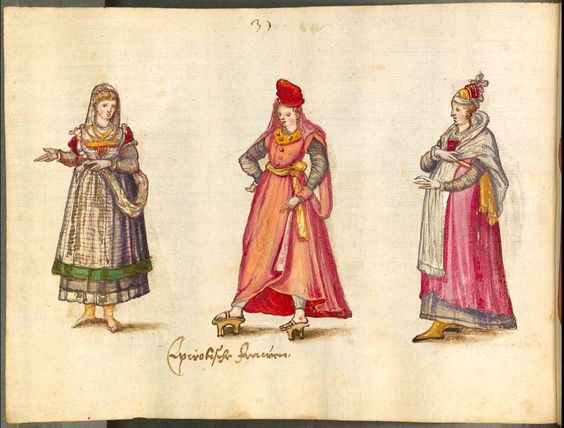

Taken from Noel Malcolms publications and other sources.12
Theodora Tedea was an Albanian woman born in 1580. When she was 21, roughly around 1591, she was captured by the Turks and married off to a Muslim man in the Ottoman Empire. A few years later a Greek Christian took her away and sold her to an Italian man in Naples, where she eventually told her story to the Inquistion in 1606 and won back her freedom.3
Theodora Tedea was described as from the “Scherpan” region in the district of Albania, aged about 25, daughter of Gjin Tedea, and of Veppa of Phiginie. She testified the following:4
“I was born of a Christian father and a Christian mother, and I lived as a Christian, staying in my own district. And when my father died, and I was staying with my mother, the Turks came by sea with galleys, and at the [word illegible] of my mother they seized me, and took me to a district of the Turks [or: ‘Muslims’] called Balliciauso. This happened five years ago.
As I was a virgin, my master gave me to a Turk, his servant, as his wife, and for some years I stayed with that Turk, my husband, and I became pregnant. And while I was married to that Turk, a Greek [or: ‘Orthodox’] man called Marino took me away from that Turk, telling me that he wanted to take me to the place where my mother lived; I was happy with that, as I believed him.
He took me to Lecce, where he sold me as a slave to Giovanni Battista Moles, who brought me here. I’ve been here for two years, And because Giovanni Battista Moles died, I am the slave of signora Amelia Branci, his wife. Last year my mistress made me confess to a monk of Santa Maria della Speranza, who was Spanish; I told him that I had been married to a Muslim, and that I was a Christian, the daughter of Christians; he didn’t make any objection, and gave me communion at the church of the Speranza. That happened last Easter.”5
The Inquisition was not finished with Theodora
“When I was in the power of the Muslims, I did not deny the religion of Jesus Christ. It’s true that my master told me a hundred thousand times to become a Muslim; I said that I was a Christian, and that I didn’t want to convert to Islam. What religion did she practise when she was in the land of the Turks? ‘I lived as a Christian, as I had done in my homeland, and I didn’t do anything different in the land of the Turks; I just prayed to God for my soul, and said the Lord’s Prayer, and the Ave Maria, as people do in my homeland, in the Albanian language.
Did she go to mosques, or baths, to say prayers? ‘I never went to the Turks’ mosques to say prayers, and the Turkish [or: Muslim] women don’t go to mosques to say prayers but do it at home. I said my prayers as a Christian. I never went to the baths—I don’t know what those baths are. I didn’t enjoy living in that land, and wanted to live in my homeland? And did she eat meat on the Catholic fast days? No, nor was she ever forced to; on Fridays and Saturdays ‘I ate fish, and lenten food, and I’m telling you the truth. Finally she added: ‘When I was taken by that Greek man, I was pregnant, by my husband who was a Turk, and here in Naples I gave birth to a daughter, who has been baptized. She then signed the document with the mark of a cross.”
The Inquisitors questioned Theodora further
“Later that day they brought her back for further questioning, and recorded some details about the timeline of her story which had not been clear. It emerged that when she was seized by the ‘Turks’ she was 21; she stayed with them for five years, was married to the Muslim man for the last two of those, and was taken by the Greek three years previously, so she was now aged 29.
Four months later, on 12 July, they called her in again. Clearly they were not convinced by all her previous state- ments, as they began by asking her once more whether she had lived as a Muslim. (It may have seemed unlikely to them that a Muslim would marry a Christian woman and not require her to convert.
This was in fact quite normal Muslim practice, but the great majority of the ‘renegades’ who appeared before the Inquisitors were male, not female, so their grasp of these matters may have been uncertain.) Her answer was the same. ‘I led a Christian life, as an Albanian, and my husband, who was a Turk [or: “Muslim”], did not force me to lead a Muslim life.
I went around dressed as a Turk, because in that place the Turks just like the Albanians dress in the same way, and from people’s dress you wouldn’t know who was Albanian, and who was Turkish [or: “Muslim”]. Had she enjoyed living in infidel territory? ‘When I was living in the land of the Turks, and I had that hus- band, I was happy living there, and I lived there in a good state of mind, because I couldn’t do otherwise, and because I was leading an Albanian life, and living in my own way. I went to the church of the Albanians, where the Greeks Orthodox said Mass.”
The questions of the Inquisition
“She was asked again whether she had denied the Christian faith, she said no. She then signed the statement with her mark of a cross; but having done so, she then made some further comments which were recorded. ‘If I hadn’t fled from there, I would still be there now, as I was leading an Albanian life. And again: ‘If I hadn’t come to this Christian territory, I would have continued to lead an Albanian life, living as a Greek [sc. Orthodox] person who didn’t know the Catholic faith as it’s known here; and that’s how I would have died, because I didn’t know about the true Catholic faith, as I have got to know it here, because in that place people live in an ignorant way.
Yet still the Inquisitors were not satisfied. Two days later Theodora was questioned again. How do the Muslims marry? ‘I haven’t seen how they do their mar- riages. I know well that they take the women and bring them to their home, and say that they are their wives. When she was given by her master to his servant, ‘there was no ceremony at all, he just took me for his wife, and I took him for my husband, and my master gave me three beatings to make me go and live with my husband, because I didn’t want to live with him, and my husband was a Muslim and led a Muslim life.’
She added: ‘I am an Albanian, and when an Albanian man marries an Albanian woman, the women change their dress, they go to the church, they take the ring, the man puts the ring on the woman’s finger, their relatives go to the wedding, they say Mass, and they do the usual ceremonies in the Albanian way. But when I was given to that Turk as his wife, they didn’t do anything-nothing was done.
This was her final interrogation; the record of it also noted a certificate-brought in by her, apparently from a Jesuit, Francesco Corcione, saying that she could be given the sacraments. (This was, in effect, a statement that in his opinion she was an Orthodox Christian: the Roman Catholic Church viewed members of the Orthodox Churches as in communion with it, even though they were judged to be schismatic.)
And yet perhaps some doubts remained; for it was not until 22 March of the following year, 1607, that a decree of absolution was finally issued in the case of Theodora Tedea. The repeated interrogations of this woman had not confirmed the Inquisitors’ suspicions about her conversion to Islam; nevertheless it is a striking fact that she shifted her ground on the question of whether she had been contented to live among Muslims.
Very possibly though she did not quite say this-her resistance to the arranged marriage had faded during the two years that it had lasted, giving way to acceptance or even affection. She had certainly learnt to accept those changes in her life over which she could have no control; and, as we shall see, arranged marriages were not at all unusual, even within one’s own faith community. But to the modern historian, the most interesting aspect of her testimony is the way in which she referred to that community and to her own identity.
‘Albanian’ was used by her, apparently, not just to characterize the language she spoke, but also to mean Christian, and, in effect, Orthodox Christian-even though she also used the word ‘Greek’ or ‘Greeks’ to describe the Orthodox Church and its priests. (As we have already seen, ‘Greek’ was the normal word for ‘Orthodox, just as “Turk’ was used to mean ‘Muslim).
Yet at the same time she was very conscious of the fact that some aspects of her Albanian’ way of life were identical with those of the people she referred to as ‘Turks. Admittedly, the situation she described would be a little clearer if the place where she lived among these Muslims, ‘Balliciauso, could be firmly identified; there is no obvious candidate for it in modern Albania, or in the adjoining regions. But her statement that she went to ‘the church of the Albanians, and her comment that these “Turks’ and Albanians dressed in just the same way, do make it seem likely that it was within the area that was then inhabited by Albanians in the more general sense of the term.”
References
- https://www.google.se/books/edition/How_to_Be_a_Renaissance_Woman/VMHEEAAAQBAJ?hl=en&gbpv=1&dq=Teodora+Tedea&pg=PR39&printsec=frontcover ↩︎
- https://www.google.se/books/edition/Adieu_Osteuropa/BwuWEAAAQBAJ?hl=en&gbpv=1&dq=Teodora+Tedea&pg=PT72&printsec=frontcover ↩︎
- https://books.google.se/books?id=qfxIEAAAQBAJ&pg=PT65&lpg=PT65&dq=Theodora+Tedea&source=bl&ots=EpUhWxk5vm&sig=ACfU3U3yQc1zbupyLvx2MDA2Ij98_akNbA&hl=en&sa=X&ved=2ahUKEwjX9Z_WncmFAxV2KRAIHasZA8s4ChDoAXoECAMQAw#v=onepage&q=Theodora%20Tedea&f=false ↩︎
- https://academic.oup.com/book/37426/chapter-abstract/331515112?redirectedFrom=fulltext&login=false ↩︎
- https://books.google.se/books?id=oevqDwAAQBAJ&pg=PA90&lpg=PA90&dq=Theodora+Tedea&source=bl&ots=oXiaw3_Xil&sig=ACfU3U0t9xi-U-3ynsfXvIt-5WmZtn1mPQ&hl=en&sa=X&ved=2ahUKEwjX9Z_WncmFAxV2KRAIHasZA8s4ChDoAXoECAIQAw#v=onepage&q=Theodora%20Tedea&f=false ↩︎


 Balkan Academia