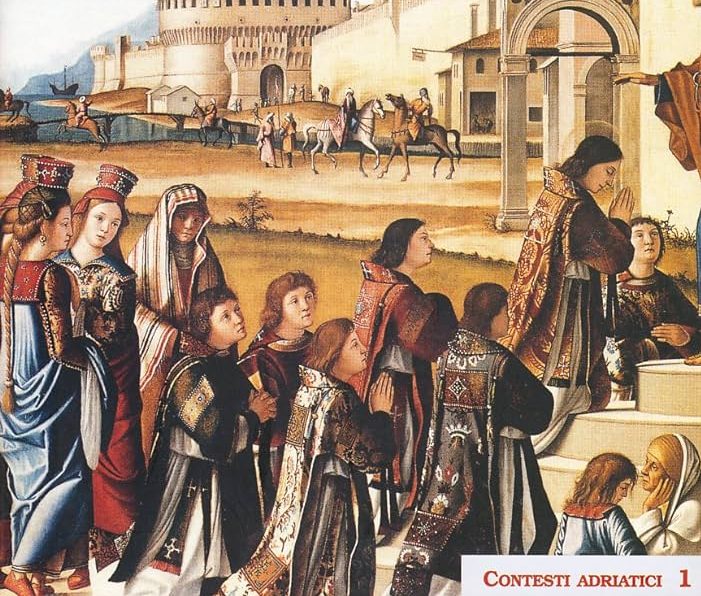

The Albanians of Borgo Erizzo coming in 1726.1
“There are two documents in the archive, which speak of Albanians who came to settle in the closest surroundings of Zadar, and both bear the same date 15 August 1726. Since prior to these documents, there is no mention of Albanians who came to these parts, it will be reasonable to believe that Borgo Erizzo did not originate before the year 1726.”
“The first document says in its introduction:
“Moved by legitimate, worthy concerns and by the zeal of religion and devotion to the public name, the below mentioned families of Ottoman Albania have resolved to escape from the tyranny of the barbarians and take shelter in the very happy State of His Serenity in these provinces, with the total abandonment of what they respectively possessed in those parts.”
Document 2 confirms this:
“Drawn from the concerns of religion and devotion to the public name, there were some families of Albania shaken by the yoke of the Ottoman tyranny, with the abandonment of their substances, and of the ordinary natural shelter, reduced to State of the Serenissima Republic to establish one’s domicile there.”
It was therefore religious persecution and mistreatment on the part of the Turks, which pushed these Albanians into voluntary exile, abandoning everything they held dear. And they must have been very serious torments, if individuals born in the mountains willingly left the land of their fathers, the rocks made immortal by their glory and their blood, to seek an uncertain fate in a foreign country.
The Albanian peasants were rich
“The documents themselves tell us that these first Albanians, who came to settle in our vicinity, were not homeless and breadless proletarians who left their homeland in search of easy fortune. They were wealthy peasants, who, outraged in religion and perhaps even in honor, persecuted by Ottoman greed, came to place themselves under the wings of the Venetian Republic, to ask it not for rest and alms, but for lands to work and support themselves. honorably. It was therefore natural that the Republic should not refuse such a precious purchase; especially since the lands of this province, devastated and destroyed in the last wars with the Turks, remained largely useless due to lack of workers.”
General Nicolò Erizzo II (1723-1726)
“The Superintendent General Nicolò Erizzo II (1723-1726) therefore made arrangements so that these fugitives would quickly find a stable home and therefore not have to suffer. thyrs of their resolution; something he must have achieved, judging at least by the concern he showed in this meeting. The Superintendent had immediately decided to place these Albanians, who in all formed 46 families, in the vicinity of Zadar, so that their products would serve the citizens as a convenience, and the village to be built would serve as an embellishment to the capital itself. But he wouldn’t try… “
46 Albanian families in Zadar
“His intent would have been achieved, due to lack of available land, if the archpriest D.n Giovanni Grisogono, son of the knight Giovanni, to show his attachment to the State, had not given up his possession, located in Silocco di Zara and about 2 kilometers away . And on this, the necessary houses for the 16 families were built at government expense, to which naturally food had to be provided at first. This is supported by document 4, in which it is expressly said that on the land, kindly ceded by the archpriest Giovanni Grisogono, by order and at the expense of the government, 16 houses with adjacent land were built to provide shelter and needy vegetables for the 16 families”.
The lands were not sustainable for the Albanian families
“However, since these lands were not enough to support so many individuals, it was therefore necessary to look for other available ones at a greater distance from the city. The prov. Gen. Erizzo II ordered Colonel Engineer Melchiori to move to the vicinity of Zemonico and to survey with a specific design that quantity of public lands sufficient for the needs of the 46 families.”
“This in fact happened, and Melchiori’s proposals met with the government’s approval; following which Erizzo II, using the stereotype formula for such circumstances, “invested and granted provisionally with title of simple lease to the families of the Albanians who had recently come to public devotion, the quantities of lands in the spaces and sites described by Engineer Melchiori.”
List of names of the Albanians who came in 1726
The names have been corrected according to their Albanian origin, according to this article.2
- Luca d’ Andrea Gesgenovic (Lukë Andri Gesgeni)
- Nicolò di Luca Marghiecievich (Nikollë Luka Margieci)
- Nicolò d’Andrea Gesgenovich (Nikollë Andri Gesgeni)
- Giovanni d’Andrea Gesgenovic (Gjon Andri Gesgeni)
- Pere di Marco (Marks parents)
- Prem Vucca Marghiecevich (Prenë Vuka Margieci)
- Paolo Gliech Marghiecievich (Palë Glec Margieci)
- Nicolò d’Andrea Marghiecievigh (Nikollë Andri Margieci)
- Nicolò di Luca Marghiecievich (Nikollë Lukë Margieci)
- Giech Prend Marghiecevich (Gegë or Giec Prend Margieci)
- Marco Discialo Marghiecievich (Mark Desali Margieci)?
- Prenz Prema Marghiecievich (Prenë Prem Margieci)
- Petar Vucca Gianova (Pjeter Vukë Gjanova)
- Nico Matessich (Nikë Matei)
- Luca Prend (Lukë Prendi)
- Stanica Gieleneovich (Stanë Gjelenovi)
- Visco Cielencovich (Visco Qelencovi?)
- Lech Pero Marghiecievich (Lekë Margieci)
- Luca Lucich (Lukë Luci)
References


 Balkan Academia