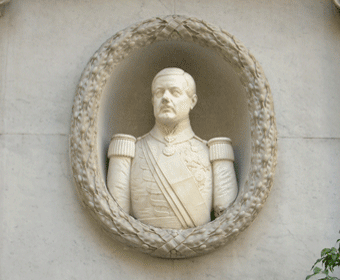

Demetrios Gentiluomo Albanese (1580s), Giorgio Basta (Gjergj Bashta) and Demetrio Lecca Epirota (1779-1862).
Alessandro Duka of the Albanian Duka family Wallachia in the 17th century
“Alexander Duka reigned three times, in 1665, 1669, 1678 and 1673 in Wallachia. Constantine twice, in 1693 and 1701. Ottoman politics. Stephen XII (1660), Alexander VII Duka (1665) Constantine II Duka (1693) were Albanians; Demetrius I Kantakouzenos (1674) (1) and Nicholas I (2) Maurocordatos (1716) Greeks (3); Antonio I Rosetti (1676) of Genoese origin.
Constantine I Cantimiro (1685) Antiochus I Cantimiro (1696) Demetrius II Cantimiro (1711) had come from the Crimea, and were descended from a Turkish nation (the Nogai Tatars). Eustace I Dabija (1662) Elias III (1668) Stephen XIII Petriceiu (1672) were Romanians. Despite their own energy, the Albanian families had not been able to found anything lasting on that shifting ground.”1
Demetrio Gentiluomo Albanese was a Stradiot Albanian in the 1580s.
” … in Rocca near Taranto by Demetrio, an Albanian gentleman. Having devoted himself to the profession of arms, he succeeded and in 1580 he was created commissioner general of cavalry; then he passed to France in 1590 and remained there until 1593; then to Hungary and back to the Netherlands in 1596; then to Transylvania and finally returned to Hungary, where in 1601 and 1603 he won two illustrious victories, one against the famous Sigismondo Battori, and against Moses to supply the city of Fère besieged by Henry IV, an undertaking which earned him very high fame. For his important services in Naples, he was decorated with the title of Count of Huste. poetry. He died around 1607.”2
Albanian Stradiot Giorgio Basta (Gjergj Bashta), son of Demetrios
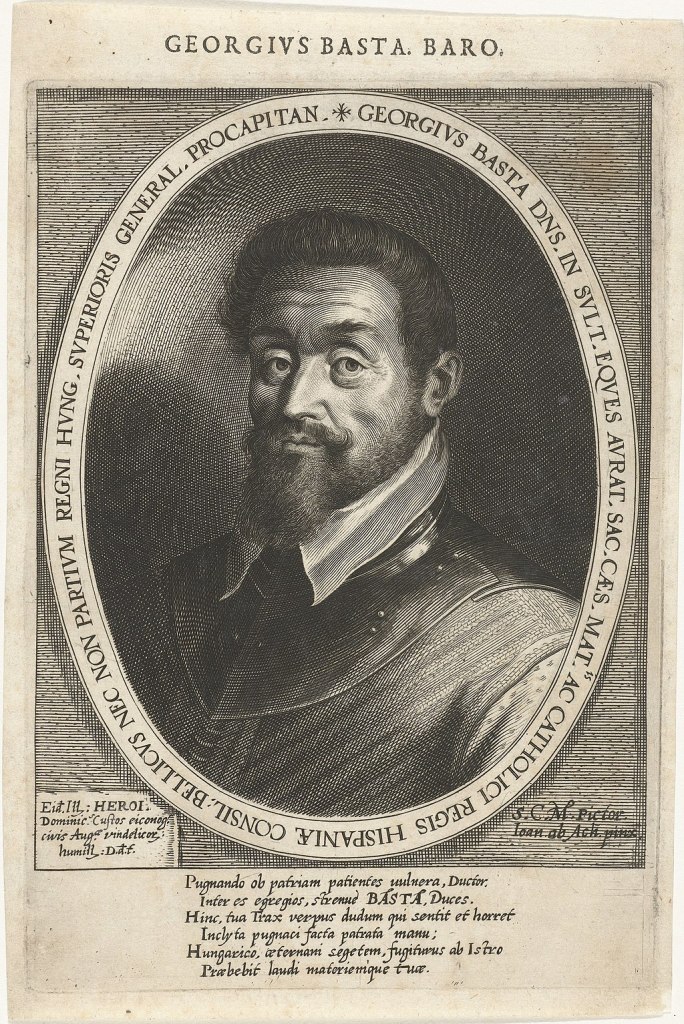
“Giorgio Basta was the son of an Albanian gentleman, Demetrio, who took refuge in Puglia after abandoning his fiefdoms in the face of the Turkish threat. Demetrius entered the Spanish army stationed in the Duchy of Milan with the rank of captain … “3,4
“Giorgio Basta was of Albanian descent and he had served in the Habsburg army in the Low Countries, where he commanded the light cavalry during the governorship of Fernando Alvarez de Toledo and Alessandro Farnese. In 1597 he had joined the imperial forces in Hungary in order to fight the Ottomans. Basta’s war techniques were admired by his contemporaries.
Achille Tarducci, an Italian engineer in the imperial army, included in his treatises on ancient and modern machinery, detailed descriptions of the campaigns by Giorgio Basta against the Turks. Tarducci’s book was published by Ciotti in 1601. For his treatises Giorgio Basta drew heavily upon his past experiences in the war against the Dutch rebels and the Ottomans.
In 1606, Ciotti published Basta’s military treatises on the function of the leading officer, Il maestro di campo generale.” Giorgio Basta also wrote a treatise on the light cavalry, Il governo della cavelleria leggera which was posthumously published by Bernardo Giunta and Giovanni Battista Ciotti in 1612. The title page advertised that the book was useful to soldiers, beneficial to warriors, profitable to captains and inter- esting for everybody. The book was translated into Spanish and published in 1624 in Brussels by Jan van Meerbeeck.”5
Giorgio Bastas report influenced Habsburgs policy
“Based on their experiences and observations in Transylvania, the imperial commissioners Johann von Molart and Nikolaus Burghausen, together with Giorgio Basta, wrote a detailed report for Rudolf II in February 1603. The report would exercise a strong influence on Habsburg policy toward the Principality in the coming years. In it the officials recommended the complete restoration of the Gyulafehérvár see, including the reclamation of the former property of the Transyl- vanian diocese. They saw this as a necessary step in order to win the population back to Catholicism. The condition of the few Catholic clergy who remained in the country was painted in the most dismal colors.”6
Demetrio Lecca Epiriota (1779-1862) (Alb: Dhimitër Leka Epiroti)
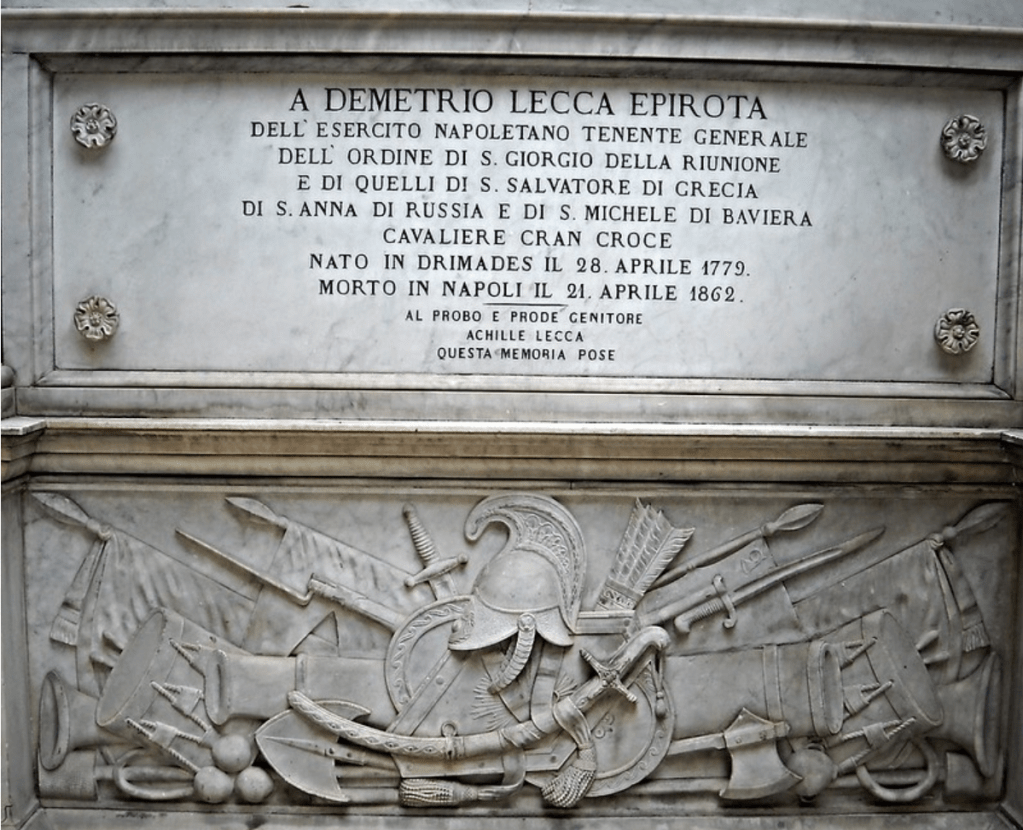
Demetrio Lecca Epiriota was an Albanian lieutenant general of the Neapolitan army and of the Order of St. Savior in Greece.7
“Demetrio Lecca (Drimades, locality near Dhermi in Albania, 24 April 1779 † Naples, 21 April 1862), Albanian from Epirus, was lieutenant general of the Neapolitan Army, inspector general of the Line Infantry in 1860, knight of right of the Order of Saint George of Réunion (23-4-1819), knight of the Order of the Holy Savior of Greece, of the Order of Saint Anna of Russia and of Saint Michael of Bavaria.8

The Albanian poet Girolamo De Rada (1814 † 1903) dedicated his 1836 work “Il Milosào” to him (3); in that year Demetrio, very well liked at the Bourbon court, to which he had sworn loyalty as brigadier marshal, resigned upon Garibaldi’s entry into Naples. He was buried in the monument erected by his son Achille (Naples, 7 February 1832 † Naples, 9 February 1900), second class captain of the Corps of Engineers of the Army of the Two Sicilies; he too, like his father, did not want to join the Savoy army.
The Albanian Dhimitër Leka was 71 years old in 1860
“In 1860 the infantry of the line must have numbered no fewer than 32,000 men; Inspector of the same was the lieutenant. gen. Demetrio Lecca, seventy-one year old Albanian, one of the last representatives of that large Greek-Albanian colony militant in the Macedonian army in the service of the King of Naples since the time of Charles III.”9
Arbereshe-Albanian heritage
“Giovanni Gicca, a Tenente colonello (Lieutenant colonel) of the Macedonian Royal Regiment, was the son of Demetrius, brother of Count Gicca-Strati. This plaque was dedicated by his nephew – the sister‟s son – to Dhimitër Leka24 (1779-1862). Gicca was the last commander of the regiment, to which Girolamo De Rada devoted his first song of the Canti di Milosao (Këngët e Millosaut): “A S.E. il General Brigadiere Commendatore Signor Demetrio Lecca, questi canti che
sien testimonianza dell‟attaccamento agli antichi costumi della dispersa gente d‟Epiro, Girolamo De Rada”. Since modern Albanian literature originates from this work, said ties serve us to better understand its specific cultural environment and explain the new stage of the Arbëresh and Albanian culture in the diaspora.”10
References
- https://www.google.se/books/edition/%C3%82_La_%C3%82_rivista_europea/EsC7OzdwbXAC?hl=en&gbpv=1&dq=Alessandro+Duka+1665&pg=PA533&printsec=frontcover ↩︎
- https://www.google.se/books/edition/Notizie_biografiche_e_bibliografiche_deg/mwXgAAAAMAAJ?hl=en&gbpv=1&dq=demetrio+gentiluomo+albanese&pg=PA14&printsec=frontcover ↩︎
- https://www.google.se/books/edition/Agents_of_Empire/KHKKBgAAQBAJ?hl=en&gbpv=1&dq=Giorgio+Basta&pg=PT573&printsec=frontcover ↩︎
- https://www.google.se/books/edition/Scritti_storici/JaEKAQAAMAAJ?hl=en&gbpv=1&bsq=demetrio+gentiluomo+albanese&dq=demetrio+gentiluomo+albanese&printsec=frontcover ↩︎
- https://www.google.se/books/edition/Specialist_Markets_in_the_Early_Modern_B/3t8zDwAAQBAJ?hl=en&gbpv=1&dq=Giorgio+Basta&pg=PA235&printsec=frontcover ↩︎
- https://www.google.se/books/edition/Early_Modern_Religious_Communities_in_Ea/5J09mqMWiogC?hl=en&gbpv=1&dq=Giorgio+Basta&pg=PA148&printsec=frontcover ↩︎
- https://www.nobili-napoletani.it/Albanesi.htm ↩︎
- https://www.nobili-napoletani.it/Lecca-Ducagini-Guevara-Suardo.htm ↩︎
- https://www.storiologia.it/apricrono/storia/a1860d.htm ↩︎
- file:///C:/Users/Petrit/Downloads/Naples_an_important_center_of_the_Arbere.pdf ↩︎


 Balkan Academia