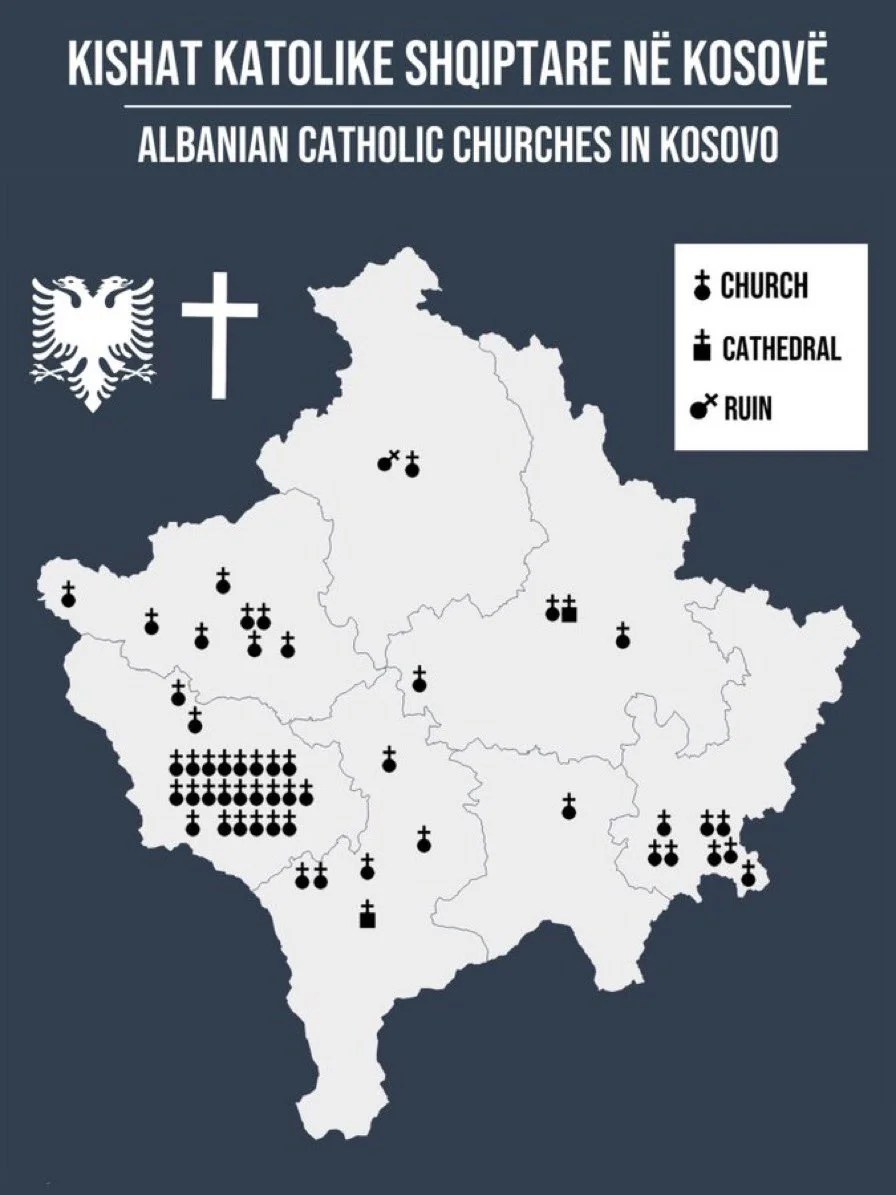

The influences of the western construction style will be best seen in the Church of the Monastery of Deçan or as it is also called the Pandakratori, rebuilt or built during the rule of Stefan Deçan and Dushan (1327-1335 ). The main characteristic of this building is the Romanesque style of construction that A. Stefanović shows. This section deals with how Serbian medieval rulers rebuilt Albanian Romanseque and Byzantine churches to fit the Slavic Orthodox style.
According to the data, the Deçani Monastery was built by the Albanian architect Father Vita Kuçi – Cuci with 18 sculptors and stonemasons. The Monastery of St. Stephen or Bajska, located in Banjë of Mitrovica, was rebuilt by King Millutin. Its walling was carried out during the years 1312-1317. According to the author D. Bogdanović, it is possible that a monastery existed here even earlier. That this object was rebuilt on the foundations of an old temple is supported by the authors V. Marković, A. Stefanović and also by the magazine of the Serbian Patriarchate “Pravoslavlje” which is published in Belgrade.
Albanian sculptors Miho (Mikel) Tivarasi (Miheli of Tivar) and Gjin Aleksi and Mark Nikollë Gega
Also, we have data that show a number of prominent Albanian masters – sculptors of church construction who were distinguished at that time, such as: Miho (Mikel) Tivarasi of the 14th century, Gjin Aleksi and Mark Nikollë Gega, etc.
The dance of the Albanians in the courtyard of the Graçanica Monastery
Support for our positions presented throughout this paper, that the Orthodox churches and monasteries were rebuilt or rather adapted with interventions during the rebuilding to transform from the Catholic to the Orthodox style, as understood by most cases mentioned above, we will also find in some Serbian researchers who stand out with their works on these issues.
G. Sljepčević, shows that: the Nemanjids, the rulers of Rashka, had no knowledge of the construction of churches or monasteries, they only used the Byzantine objects and culture, being at one time their copyists and imitators. This, according to the author, is also shown with the temporary headquarters (residences) of their kings that will move throughout the period of rule.
They did not have a permanent place (center, city or palace). The head of the chair for medieval archeology in Belgrade, Dr. Gj. Jankovic emphasizes that, as far as is known, Kosovo, Montenegro and Herzegovina are the territories that mostly have churches that have been serving continuously for a thousand (1000) years. Of these, we have buildings built as early as the the 6th and 7th centuries or those of the the IX and XI, as are the churches in Lipjan, Graçanicë and Zonja Prene (Ljevishka) in Prizren.
The academic, D. Bogdanović, shows that two Byzantine cities occupied by Stefan Nemanja, Prizren and Lipjani, were religious centers at that time. When Archimandrite Sava organized the “Rashka” autocephalous church, he divided it into ten (10) bishoprics, of which three (3) were located in today’s Kosovo territories. The development of today’s territory of Kosovo, according to the author, as a “spiritual center” of the “Serbian” people during the Middle Ages is supported by the large concentration of churches and monasteries.
He continues, until today it is not possible to know how many churches were or have been preserved from the pre-Nemanjid era, because research, systematic as well as archaeological research has not been carried out, adding, a pretty large number of Nemanjid (Rashka) churches, sure that are erected on the old foundations of Byzantine temples.
King Milutin (1282-1321) did not ubild any new monasteries
The good connoisseur of these issues, V. Marković, tells us that the history of Orthodox churches and monasteries as written and described by Serbian tradition and historiography, leaves no choice but to understand that the last works-buildings, the Nemanjid ones, are raised on the money account. Thus, many monasteries are described to the Nemanjids, which are much older than their time. V. Markovic also shows that King Millutini (1282-1321) did not build any new monasteries, he only rebuilt the old and abandoned ones.
Milutin occupied Albanian Byzantine churches
For this, our old and new historiography present Millutin as the founder-builder of many monasteries. Characteristic of his time is that Millutini rebuilt many monasteries in the territories he occupied from Byzantium, more than in the old “Serbian” territories. Historian, St. Stanojević, emphasizes that even before Stefan Nemanja, there were many monasteries and religious leaders on the borders with Rashka, and it does not all begin with Nemanja, as our historiographers want to present.
The author, V. Petković, comes to the conclusion that the “Serbian” tribes ” (Slavic, E. R.) since their arrival and settlement in these (Balkan) territories until the c. of the XVIIIth century, marked great movements. Churches and monasteries were built and rebuilt, for which “we cannot affirm and prove that these works are exclusively Serbian”.
Serbian psuedo-science
In this direction, as we emphasized above, we are dealing with Serbian pseudo-scientific propaganda which tries to present the territory of Kosovo as the “spiritual center of the Serbian people” during the Middle Ages, which according to them, is maintained with the large number of conceived Serbian churches and monasteries in this territory.
It should also be emphasized the tendencies of a large part of the authors of Serbian historiography, who try to argue with data that the headquarters of the Orthodox Church of Rashka will be moved to Peja during the half of the 13th century, more specifically, maybe in the year 1253, from Zhiça, the seat of the archbishopric moved to Peja.
However, in this regard, referring to the data of Serbian authors, it is emphasized that Peja only in the last decade of the 13th century became the center or seat of the Archbishopric of Rashka. According to them, after the Mongol attacks and the burning of Zhica in 1284, the seat of the archbishopric was moved to Peja. According to others, the seat of the church moved from Zhica to Peja in the last decade of the 13th century when it was attacked by Tatars and Cumans who looted and burned it, who took revenge on Rashka for an attack led by King Millutin against them. (V. Jankovic).
Also, other authors support the fact that only at the end of the 13th century, after the fall of Žiča, Peja became the new seat of the Raska archbishopric (V. Boshković, S. Qirković). In this direction, the trends are that the parts of the territory of today’s Kosovo, specifically the territory of Drenica, are presented as “Drenica, the second holy Serbian mountain”.
In this regard, it is interesting to mention that, the author points out that in the 14th century there were 13 monasteries and 5 churches in the territory of Drenica (T.Vukanović). The same author then, emphasizing that with his research results of the settlements, which are “based on scientific truth” draws conclusions that: in the territory of today’s Drenica, there were a total of 9 monasteries and 42 churches, i.e. fall into confusion in the same book.
Nationalist propaganda
Likewise, it is worth emphasizing the nationalist propaganda of the Serbian Orthodox Church that was always singled out and is singled out for falsification and speculation regarding the matter in question. According to the authors of the book “Memorandum for Kosovo and Metohija” published by the Serbian Orthodox Church, it is emphasized that: “Kosova and Metohija”, the “Holy Land” of the “Serbian people”, represents for us what Jerusalem represents for the “Jewish people” “.
For this, more than 1300 churches and monasteries that are found there testify best and most strongly. Similarly, other authors support these positions by emphasizing that: “The area of the southern province of Serbia is covered with 1300 churches and monasteries with the official name “Kosovo” (with Metohija, which since 1968, at the request of the Kosovar Albanians, has been removed from the official , and then from daily political communication), which in the Serbian language is symbolic, the most important word which after the name of God, the name of Saint Sava (the founder of the Serbian Orthodox Church in the 13th century), simultaneously marks the identity cultural and national of the entire Serbian people” (D. Bogdanovic).
Propaganda in this direction continues: “… in the territory of Kosovo and Metohija…, the Serbian Orthodox people and their church have 1300 churches and monasteries from the 12th to the 20th century, built during eight centuries…” (Novosti, Belgrade, 2004). It is also emphasized that according to the evidence in the territory of Kosovo there should be around 200 preserved or destroyed objects, but in reality there are more if the unidentified archaeological sites (church ruins) were counted and researched.
According to A. Uroshević, the condition of the sight of this area (it is about Kosovo) in the Middle Ages speaks of a large number of church ruins, remains of old churches, and according to him, there were such signs in almost all villages, even Serbian and Albanian, while in some villages there are two or more ruins of churches (A.Uroshevic). Even D. Bogdanović states that, according to archaeological research, it is proven that there were 1300 Serbian churches, monasteries and other monuments in the territory of Kosovo.
Data such as above, built and guided by the historiography and daily politics of the Serbian government, therefore, try to support the concept of the monuments of the Christian cult that exist in Kosovo by increasing the impressive number that can be seen, for what and According to them, Kosovo represents “extraordinary” values. To better clarify the issue related to the construction and reconstruction of religious buildings in the territory of Kosovo in the Nemanjid period, we also offer the data that show that King Millutin (1282-1321) rebuilt nearly 30 monasteries, among which in the territory of Kosovo only three, in Prizren, Bajska and Graçanica.
King Stefan Deçani (1321-1332) built only Deçani. During the period of Dushan, the Saint Archangel Monastery was built (M. Kashanin, “Pravoslavlje” magazine). During the Ottoman period, the sources that appear at that time, which we present by M.Kashanin, show that, from the period of the patriarch Makarije in the half century. the 16th, rose from the ruins and were rewritten-drawn again with hundreds of churches in the territories ruled by the Ottomans (think of Kosovo, Serbia and Sanjak).
D. T. Batakovic referring to Ottoman sources (Ottoman registers)show that during the century In the 15th and 16th centuries, there were ten to fourteen Orthodox temples that were active. The leaders of the orthodox church of Peja (1557-1766) relying on the medieval tradition of the Nemanjid rulers and the state of Rashka, now with a larger territory than theirs, rebuilt the old cults and established new ones.
The revitalization – the operation of churches and monasteries took place, where twenty (20) new churches were built in Kosovo alone, while many of the old ones were improved by being rewritten-drawn (D. T. Batakovic, R. Samargjiq, Gj. Sljepçeviq). The Ottoman registers for the Sanjak of Vushtrri – Pristina (administrative-political territorial unit in the Ottoman Empire), from the years 1490-1491, 1525-1526, 1530-1531, 1544-1545 and 1561 show that 42 monasteries and 11 churches were recorded, while in that of Prizren, 2 monasteries and 15 churches are noted (D. Bataković).
It will be interesting to present the data provided by Bishop Artemije (Radosavljevic) of Prizren, who in his writings published in “Raspeto Kosovo”, when he talks about the danger and damage to churches and monasteries in Kosovo during the year’s war 1999, also presents the register on a number of them. From this register it turns out to be churches and monasteries built during the periods: ninth century. the XIVth; ninth century the XVth and XVIth; fifth century of the XIX and fifty-three (53) that were built in the XXth.
We presented these data from this register in order to show that a number of churches are from the Ottoman period and what is more important, here it is clearly seen that fifty-three (53) churches are recorded that were built in the century. XXth. Here, we see that the churches of the 20th century are simply “political” churches. These political churches will be built by Serbia with the aim of explaining to the world that Kosovo is “their land”.
But the whole world now knows that Kosovo was occupied by Serbia in 1912-1913 and Serbia is paving the way for the construction of such a large number of churches until 1999, when Kosovo will be outside of it.
To prove that the goals, attitudes and data of Serbian historiography are really pretentious, malicious and nationalist, the large and unargued number presented for Orthodox Christian monuments – churches and monasteries that may have existed in Kosovo , which according to them are brought from 1300 and sometimes up to 1500 objects.
For this reason, we think for sure that there are neither historical sources nor studies that are based on facts, that there were so many churches in this area at that time or today, apart from constructions with a political background. For this reason, we freely come to the conclusion that such writings are a hundred percent falsification of historical and scientific reality.
Finally, as a strong and argumentative basis for all our positions presented in this paper, we offer the evidence on the real state of cultural heritage monuments, which show exactly how many Christian churches and monasteries in Kosovo are characterized in the order of cultural and historical monuments. We are presenting the exact data stored in the documentation of the Provincial Entity for the Protection of Cultural Monuments, Pristina, from 1990 (today, the Kosovo Institute for the Protection of Cultural Monuments).
The data from the archive of this institution show us and prove that: in the territory of Kosovo today, 183 objects (of different types and genders), Christian churches, mainly Orthodox, of which 126 have monument treatment, are recorded. while 57 objects are only recorded (data obtained by Dr. Fejaz Drançolli). The objects in question are registered in the central register of monuments in this institution and from these monuments, we can say that a number of them belong to the Byzantine-Kosovar style, post-Byzantine as well as local character (F. Drançolli).
We emphasized these last data on purpose, because they show that the territory of Kosovo during the Middle Ages and later, was not the epicenter of the activity of the Orthodox Church of Rashka – “Serbia” as claimed by Serbian historiography, a matter that is proven by the above-mentioned data .
Conclusion
In conclusion, we emphasize that the material culture of the Arbers during the Middle Ages and then of the Albanians in the territories of Kosovo was prey to foreign rule, in our case the most extreme one – that of Rashka during the Middle Ages. We emphasized that, during the time, many religious monuments, such as Catholic and Orthodox, have coexisted in Kosovo, which served at that time both for the Arber-Albanians and for the other population that lives in this country at that time and today.
From the data we have highlighted, it can be seen that the Orthodox Church of Rashka-“Serbia” appropriated many of these cultural monuments, the local Illyrian-Arberian churches and monasteries where it built and rebuilt on them, as was seen especially during the 14th century, churches of later called their own, transforming them into Orthodox churches.
From here, the material culture of Kosovo over the centuries was destroyed and looted, continuing with the trends (that did not stop even today) to be acquired in different forms as we presented them. We present these positions in order to show that Serbia and its historiography, almost without exception, claims to stand by these principles even today: that Kosovo is the “Cradle of Serbization”, “Serbian Holy Land”, “the seat of the Orthodox Church Serbs” and other anti-scientific and inhuman attitudes, which according to scientific arguments do not hold, and moreover leave harmful consequences in the future relations between peoples. Today, the number of medieval sacral objects, Catholic, Byzantine and Orthodox churches present traces of the material culture of the past that characterize the material culture of the people of Kosovo and beyond.
Rejecting the attitudes and trends presented by Serbian historiography, from the above-mentioned data, today we can say that in Kosovo we have monuments of the Christian cult that have been built over time from antiquity to today, and not only those Christian, Catholic and Orthodox of the Middle Ages, but also continuing with the Islamic cultural monuments that today we have a large number of them, today we treat them as heritage of the local culture and they belong to the people and citizens who live and operate in Kosovo, without making distinctions of cultural heritage in any aspect.
In this direction, we will also add the opinion that it is a social, intellectual, institutional and state obligation, that the monuments of cultural heritage, whatever they may be, to be protected, conserved, restored, etc., to be kept alive, because they belong to material culture and spirituality of humanity, in our case the local population of Kosovo and universal world culture.
Finally, it would have been good to tell the Serbian historians, an issue that I am sure they know about but do not emphasize and write, that the historical data prove that the Illyrian-Arbian Albanians, throughout history, lived and acted in these lands and beyond since ancient times, and were able to survive various conquerors and rulers, such as the Romans, Byzantines, Slavs, Ottomans and Serbs until the present day.
During this time, it is proven that a part of the monuments of their cultural and historical heritage survived (including in this context, Christian churches, Orthodox churches and monasteries as well as objects of Islamic culture – mosques, mosques, etc.) which were built over time and some of which survived until today. These same Illyrians, Albanians, over time, have accepted the religious culture of the Christian faith for more than ten centuries (from the 1st century to the 10th century).
Afterwards, they will also be partially under the Byzantine Orthodox Christian influence for nearly three centuries (10th and 13th centuries), nearly two centuries under the pressure of the Slavic Orthodox Church (13th and 14th centuries ‘t) and that continues with the acceptance of the Islamic religion since (15th and 19th centuries).
During these centuries of journey, the Albanian people embraced three confessions, Catholic, Orthodox and Islamic. The denominations that coexisted with the Albanian people and that they still believe in today, make them respect, maintain and appreciate the religious monuments inherited throughout history as an inseparable part of their culture.
Reference
DR.ENVER REJHA: ACQUISITION OF THE ALBANIAN HERITAGE BY THE SERBIAN ORTHODOX CHURCH. The author is a Scientific Coordinator at the Archaeological Institute of Kosovo. First part: http://www.pashtriku.org/?kat=60&schriki=2298


 Balkan Academia