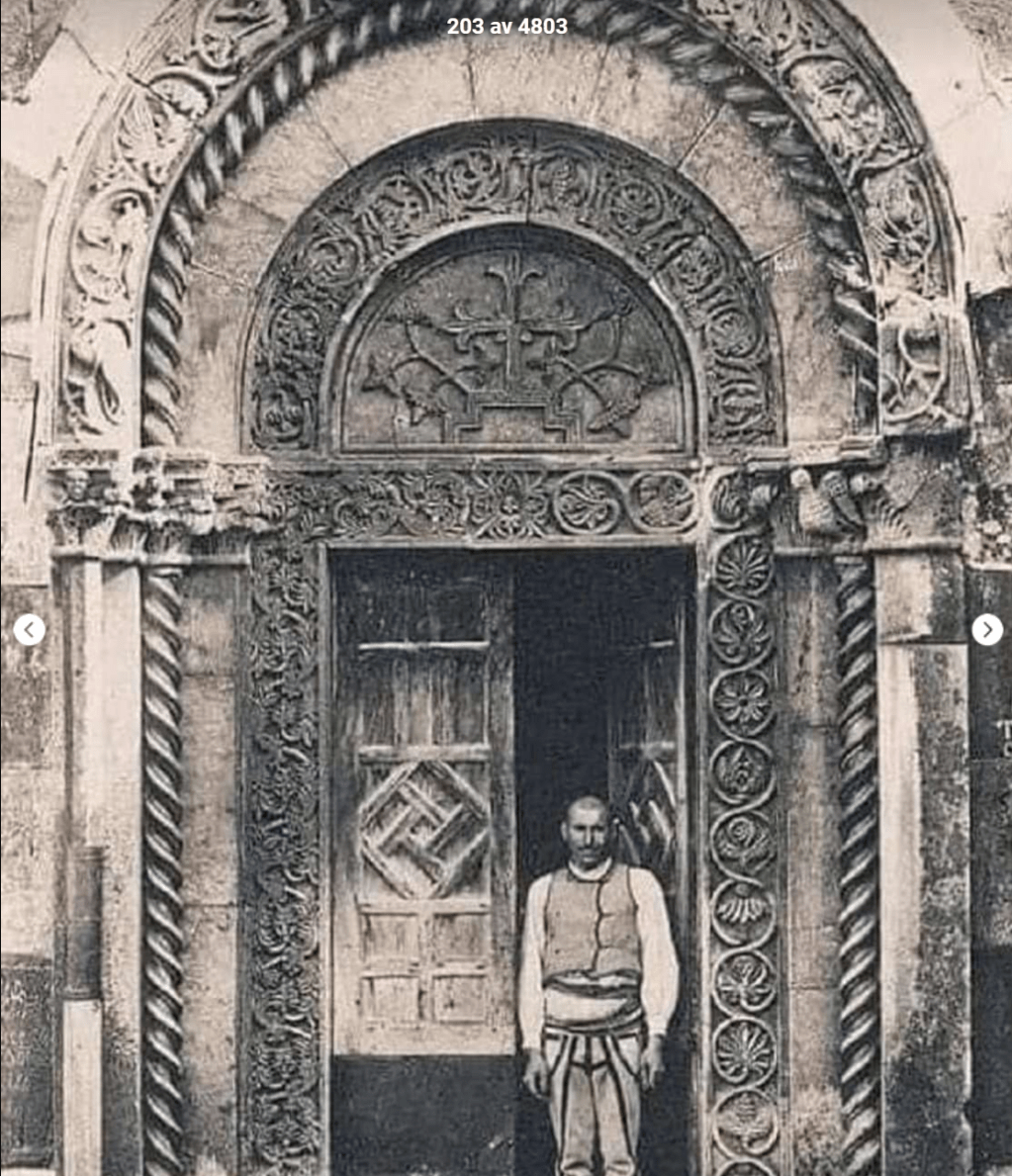

The following article discusses the possibility of Vita (Vitus) of Kotorr having an Albanian heritage from the Kuqi tribe.
Kuçi tribe.
” … Vita Kuçi from Kotor and Miho Tivarasi from Antivari (today Bar), who, together with several master stonemasons from the Adriatic coast, gave the monastery the character of a Western European style through elements of Romanesque and Gothic architecture…”1
Vita of Kotor was a Franciscan Friar, so he could not have been a Slav Orthodox, and therefore, no Serb or Montenegrin.2
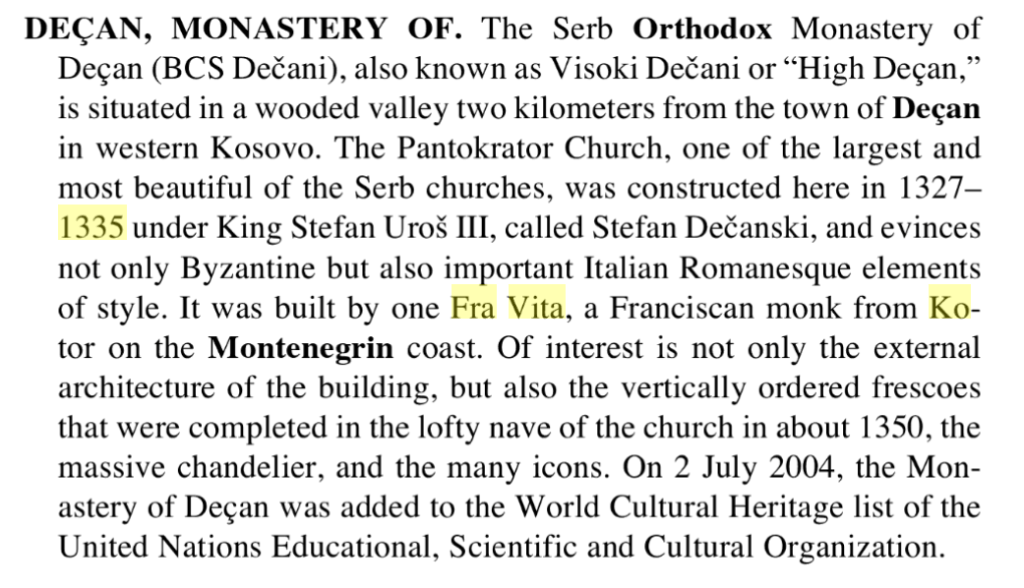
Serbian scholars ignore that the friar was an Albanian by depicting him as “Vito Kotorian”.
“It is interesting to note that other Orthodox monasteries do not have similar ornamental depictions, and it is particularly unusual to find sculpted lions, or other zoomorphic motifs, which are more typical for the Roman-Gothic style as seen in Italy and elsewhere in Europe, but also in the Adriatic coast.
The fact that in its appearance this church differs greatly with other Orthodox churches, and that it shares many similarities with Catholic Churches, diminishes the attempts of Serbian scholars to categorize this church as an Orthodox monastery. Furthermore, some Serbian scholars willingly choose to ignore the appearance of the title friar, moreover completely neglecting the fact that the friar was an Albanian architect, by attempting to depict him as Vito Kotorian.”3
Fra Vita was from “Catholic Zeta”
“The master builder of the great construction is therefore a Franciscan friar, coming from the ‘royal city of Kotor, in Zeta Catholic, famous already in the 12th century … “4
German source from 1998
“… 1335 erbaut wurde . Stifter dieses Klosters war König Stefan Uroš III . Dečanski , die Bauausführung lag je- doch in Händen der Baumeister Vita Kuçi aus Kotor und Miho Tivarasi aus Antivari ( heute Bar ) , die zusammen mit mehreren …”
Translation:
“…was built in 1335. The founder of this monastery was King Stefan Uroš III. Dečanski, but the construction work was in the hands of the builders Vita Kuçi from Kotor and Miho Tivarasi from Antivari (today Bar), who, together with several…”5
He was a Franciscan monk from Dalmatia
“Surprisingly, the architect was not Serbian Orthodox, but one Franciscan of Kotor on the Dalmatian coast, Father Vitus, and this showing the scale and, to a Western eye, familiarity with the design. The the stone is smooth and looks like it was cut yesterday; it shines in creamy white, yellow and purple stripes of marble.”6
Prince Stefan Nemanja summoned builders from “its neighbors” (Catholic Albanians of Dalmatia and Kotor)
” … It is very possible, then, that builders trained in western workshops the Adriatic Coast and Italy) were summoned to the court of the Grand Prince Stefan Nemanja to work on his new projects, perhaps not due to lack of “highly trained builders” in Serbia at this time, but rather as a result of Serbia’s outreach and contacts with its neighbors that contributed to new visual and architectural forms taking shape in a new milieu…”7
References
Enver Rexha, “Serbian Historiography for Kosovo” (XIII-XIX), Pristina, 2009, p. 17.
- https://www.google.se/books/edition/Albanien_zwischen_Kreuz_und_Halbmond/QIppAAAAMAAJ?hl=sv&gbpv=1&bsq=Vita+de+Kotor+Kuci&dq=Vita+de+Kotor+Kuci&printsec=frontcover ↩︎
- https://www.google.se/books/edition/Historical_Dictionary_of_Kosovo/Pg-aeA-nUeAC?hl=sv&gbpv=1&dq=Fra+Vita+Kotor+1335&pg=PA72&printsec=frontcover ↩︎
- https://www.researchgate.net/publication/347381909_The_Monastery_of_Decan_and_the_Attempts_to_Appropriate_It ↩︎
- https://iris.unive.it/retrieve/handle/10278/26998/23171/FRANCESCANI_NEI_BALCANI.pdf ↩︎
- https://www.google.se/books/edition/Albanien_zwischen_Kreuz_und_Halbmond/QIppAAAAMAAJ?hl=sv&gbpv=1&bsq=Vita+Kuci+1335&dq=Vita+Kuci+1335&printsec=frontcover ↩︎
- https://www.google.se/books/edition/Land_of_Eagles/xdOLDwAAQBAJ?hl=sv&gbpv=1&dq=Vitus+Kotor+Dalmatia&pg=PT70&printsec=frontcover ↩︎
- https://sita-uauim-ro.s3.eu-west-2.amazonaws.com/09_Sullivan.pdf ↩︎

 Balkan Academia