
Text taken from KOHA.
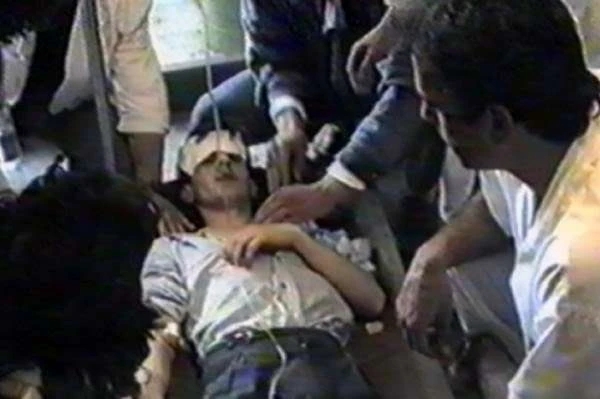
Memories of the early spring of three decades ago, bring the cries of thousands of Albanian students. The Serbs had poisoned innocent young people in many schools in Kosovo. But the Yugoslav state never accepted this, saying that this was staged and prepared acting. Doctors and professors tell KosovaPress about what happened in March 1990, where about 8 people were poisoned with toxic poison. The same ones had presented facts in front of the Serbs, insisting that it was a case of mass poisoning.
The poison used had a strong impact on the body causing muscle stiffness, vomiting, fainting, mood disorders and many other consequences.
Xhafer Murtezaj, who at that time was a professor of Physical Education in Skenderaj high school, remembers the cries of students in each class of the school.
The 75-year-old tells KosovaPress about the horror he experienced at that time.
“As much as a cry was heard in one class, four or five girls, it was heard in the other. A panic was created among the other students. Then there was great concern among the population. Parents would come, they had no hospital vehicles, in Skenderaj at that time there were no more than two or three cars. Those citizens who had cars even to the hospital have taken them or there have been cases where they have taken them to the Medical Center of Kosovo. It was something very serious”, Murtezaj confesses.
The samples taken from the blood of the poisoned were difficult to prove. There were also Serbs in the leadership of the hospitals, who prevented the truth from being revealed. The government at that time worked hard to prevent the truth of this crime from being understood.
“I took the blood of some patients, not all patients. And since the analyzes were not possible to be performed at the Institute of Biochemistry, which was two floors higher, because the director was a Serb. I made an agreement with the head of the biochemical laboratory in Obiliq to store the samples and work on them during the night as he was in charge. These results have shown that more than 70 percent of admitted patients did not have calcium values, which as such are sufficient to cause those hypercalcemic cramps”, says Neshet Rizvanolli, who at that time worked in the Nuclear Unit in Pristina.
In the overcrowded floors of the clinic in the capital, even the corridors were being used for the treatment of children who could hardly sit or lie down.
“All those patients came with symptoms of numbness, with cramps, which were typical of a condition of hypocalcemia, which causes muscle stiffness. The treatment was done according to the symptoms… Most of the students had to be treated with calcium for hours, which shows that they had a hypercalcemia not caused by the state of anxiety but by some agency that reached the organism, through the respiratory tract”, he says.
“Kosovo, a test of medical conscience”, was the title of the symposium held on September 2, 1990. This was not well received by Belgrade, as it shed some light on the truth of the poisonings in Kosovo. Experts from many countries were participants, including former president Ibrahim Rugova.
“I presented these data at the symposium on poisoning, which was held in Zagreb, and I remember the reaction of the professor from Belgrade, who was a neuropsychiatrist, because the thesis of the Serbs at that time was that these were panic attacks, therefore the representative they sent was a neuropsychiatrist and not a poisoning expert”, continued Rizvanolli.
“This was more than a war,” says the then director of Blood Transfusion, Mazllum Belegu.
“There has been no greater pain than seeing those manifestations of poisoning in children. Everything that happens to children, to adults is more stable, the adult copes with it. But to see the children trembling, not being able to stand on their own feet, not even to talk or anything. I remember someone saying ‘is this war?’ I said: ‘no this is not war, this is more than war’. Children become like that, I don’t know what kind of soul and heart they had”, Belegu tells KosovaPress.
In Kosovo, about 8 thousand students and adults were poisoned during 1990. This preceded the events that later escalated into demonstrations for the rights of Albanians and later also in the fight for the liberation of Kosovo from the Serbian occupier.
Reference


 Balkan Academia