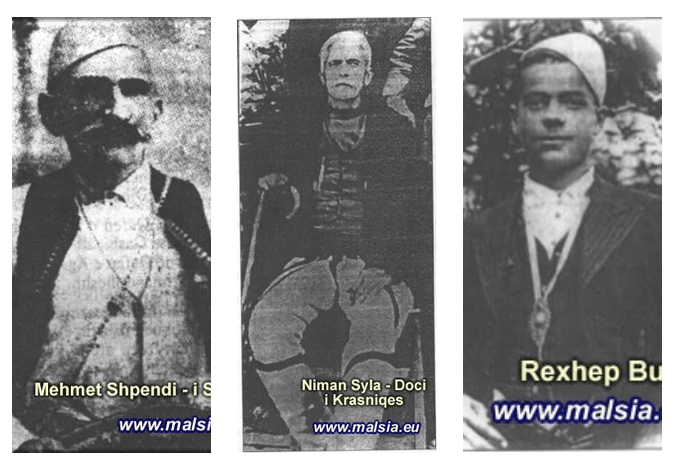

Taken from Dedushaj “100 vjet lufte”.
War crimes by Radomir Vesovic in Arzhanicë and Nokshiq in 1912
In 1880 the Albanians of Pepaj defeated the Montenegrin troops. As part of a vengance, in October 1912, Radomir Veshovici burned not only the 15 houses of this village but also those of Arzhancé and Nokšići, a total of 127 houses. The populism of these villages forced them to disperse within the province.
Without mentioning here the murders of those days: Jakup Arifi, Shaban Hasan, Haki Smajlaj, etc. Punisha Raçiqi repeats the same thing in February 1919, when Pepaj stood heroically as always in history: Shpend Smajlaj together with Emin Mumini e l’lava and ten other comrades “held the position in Pepaj until they were all killed”. . 3 Unprecedented massacres were perpetrated by the Serbo-Montenegrins on the people of this village throughout the rule of the Kingdom of Yugoslavia.
This forced most of his brave men to climb the mountains and join the Kachak Movement led by Metë e Sadri Smajlaj, Ramé e Rexhep Faku, Bacaj, Azem Bacaj and Tomé e Lekë Lekaj. This is also confirmed by the death of many such brave men, with rifles in hand, as happened with Halil I. Shabajn e Arzhanica, Niman e Hasan Bacajn and Gjon Lekajn, killed in the Vali hill, above Martinaj.
During the Second World War, these highlanders not only became an indestructible dam in the protection of the ethnic Albanian border, but also became the feeders of hundreds of Albanian volunteers who came from the various northern provinces to protect the border. The village of Pepaj turned into an arena of clashes between the defenders of the Albanian ethnic territories and the Montenegrin Chetnik-communists.
By the end of 1944, all populists were forced to retreat and abandon the village, which the Montenegrins burned, where they knew about it several times during the first 50 years of the century that we are leaving behind. They moved away, leaving behind dozens killed and massacred, among whom were Ibrahim e Bajaze Bacaj and Bjeshke Lekaj, then imprisoned: Ali e Ramé Smajlaj and Lekë Lekaj, etc. The Slavic-communist terror did what the 100-year wars had done: It displaced almost everyone. Today, a total of 4-5 people live there, and even then only old people. While young people have taken the world in their eyes, like migratory birds. Montenegrins have settled in the abandoned Albanian houses and almost every Albanian trace has been erased in those parts.
Montenegrin-Vasojevic troops, led by Punisa Racic and Acro Cemovic, committed many atrocities against the families of Balidemajve and Martinaj in Qafë te Previse
The oldest Albanian settlement in the territory of Plave-Gucise, Trepca, since the beginning of the century. XVIII is known as Martinaj. This is the era of a Selcian leader named Martin, whose martial tradition is preserved even by his descendants. Bali Dema stood out as a successful leader of the uprisings among the Tanzimat in these parts, and for this Ali Beg Gucia chose him as his deputy during the wars for the defense of Plava with Guci in 1879-1880.
He excelled especially in the battles that took place in Gricor (Gercar), Martinaj and Vizitor, protecting Gucine from the hordes of Todor Milan, in those cold winter days. As everywhere in Malesi, the names of heroes are preserved in Martinaj. This is what happened with Bali Deme, whose name became the patron of an entire brotherhood – Balidemajve. For their defeats during the century XIX Vasovicians had kept detailed records and as soon as they conquered this province, in October 1912 they killed and massacred less than 700 people.
Most of them were massively shot in Qafe te Previsë, among which were two nephews of Bali Deme: Bajram Haxhia and Arif Avdyli. The village of Martinaj at that time had 60 houses, most of which were burned by the Montenegrin occupiers. Avro Cemović’s massacres were repeated in March 1919 by Punisha Raciqi, thus leaving deep traces of the hurt of all those who remain alive and their descendants. One of the offended and tortured since his childhood, was the son of Balidemaj – Deme Reku, born in 1915 in this village.
Serbo-Montenegrin atrocities against the Vuthaj family in 1913
In Plave-Guci in the years 1850-1880, there was also the duke of Vuthaje: Ahmet Zeneli. It has remained in the people’s memory that without receiving the opinion of Ahmet Zeneli, the Pasha of Gucisé did not undertake any action. And he often acted as he advised.
In those years, Mul, Mehmet and Arif Kurti, Sali Jaha, Zymer Selmani, Rexhep Fazlia were also distinguished – who became famous for their bravery and manliness. He was killed after the Battle of Nokšić, in Velike, in a fight with the Montenegrin pirates who guarded our border. Then: Mel Selmani, Niman Syla and Mal Ahmeti – who stood out for his kindness, patriotism and generosity.
For the bravery of these men, the Montenegrins took revenge very badly in 1913. They massacred: Syla Istrefin, Kamer Nezirin, Cele Shaban, etc. . During and after the First World War, Çun Mula and Avdyl Hysa stand out from the Gjonbalaj brotherhood. Both of them have been members of the Kosovo Committee since 1937. During the Second World War, together with Mustaf Haxhine, they were leaders of the second League of Prizren in this province.
They distinguished themselves in the battles against the Montenegrin Chetnik-communists. A wise action of Mustaf Haxhise, after the capitulation of Italy, in September 1943, remained in the memory of the people of Gucise. Montenegrin propaganda managed to frighten the people of Gucise and instructed them to flee (for the first time in the thousand-year history of this ancient country) not in the direction of Albania but in the direction of the “free territory” – what did the Montenegrin communists call the area of Andrevica?
Mustafa understands the disloyalty of the Montenegrins and tells them that Gjorgje Llashić’s Chetniks are there, with knives in hand to cut everyone’s throats, as these beasts of the Carpathians used to do and still do today. He convinced them to turn back and that nothing bad would happen to them from the Germans, they were coming from the direction of Peja.
Qosaf family and Sadik Halili and the Montenegrin atrocities by Avro Cemovic in 1912-1913
Qosaj of Vuthaj family are the descendants of Satnish Nrel Bala. They participated in all the events and battles that took place in defense of freedom and the Albanian borders. The men in the voice of the assembly were Sylë Hajdar Qosi and Sadik Halili. Bajram Kurti, Halil Etemi, Tahir and Bucak Qosi etc. took part in the Nokshiq war. At the beginning of the century Sadik Halili played an important role.
When the Qosaj brotherhood was the target of the “witch hunt”, in the period of Avro Cemović 1912-1913, who massacred: Plak Tahir, Shaban Hasan, Mehmet Shaban, Hajdar Osman, Mane, Jusuf and Alush Qos and the brothers: Adem e Avdyl Zeken. During the reign of the Kingdom of Karagjorgjevic, these families, as well as all Albanians, were oppressed with all the ferocity and hatred that the Slavs have towards us.
In the period 1941-1944, at the time of Albania – as that world was called, the Qosaj were alongside the volunteer forces for the protection of the Albanian border. In 1946, the nationalist, Man Zeke, was shot at the entrance of the cave and his friends were arrested, tortured and imprisoned. Our well-known academic: Rexhep Qosja and his brother – the famous director Isa Qosja – are members of this Vuthaj fraternity. The lawyer Ali Cubi and the sculptor, Smajl B. Qosaj.
Ismail Nikoçi and the Nikoçaj family and the Montenegrin troops atrocities at Strelishtë in 1913
Nikoçaj of Gucise are descended from Trieshi of Mbishkodre. In Guci, they are a well-known and patriotic family. At the time of the League of Prizren, Fehrat Nikoçi was one of the most prominent members of the Staff for the defense of Gucise. Hasan Bajri stood out during the period of independence, as well as against the new invaders – the Montenegrins.
They just conquered the province in question, tied up hundreds of Albanian patriots and took them to “Strelishte” (shooting site) in Qafe te Previsë. On March 9 (22, according to the new calendar) 1913, before the shooting, the Albanians stood as men, true Albanians. They did not accept any of the fraudulent requests of the Montenegrins to accept the conquest of the province and the change of religion. In order to instill panic among the Albanians, they carried out more humane massacres against them, showing their barbarism and civilization, which was not far from the wildness of rabid beasts.
Those days in Previ from Nikocaj, in addition to Hasan, Mala i Haxhi Sejdi, Adem Bashi, Haxhi Shabani, Ali Frei, Bajr Zeqiri, Ibrahim Rrustemi, Syle Istrefi etc. were also shot. But the outstanding intellectual and patriot of this brotherhood and the whole of Gucise – Ismail Nikoçin, was martyred in Nikšić. The national activity of this intellectual is clearly seen from the “urgent telegram” that the Military District Command – Guci sent to the Minister of War, Mr. Brigadier J. Vukotiq né Cetine: No. Secret 10.XII.1913
Sali Bashi Hasangjekaj and the Montenegrin atrocities in 1920
The Hasangjekaj brotherhood from the village of Martinaj, are Vukels of the Kelmend tribe. Gjeke Vuku was of the Catholic faith, while his son Hasani passed somewhere towards the end of the XVII century or the beginning of the century. XVIII in Islam… After the massacres carried out by the Serbo-Montenegros on the Province of Plave-Gucise, in March 1919, Sali Bashi moved to Albania and settled with his whole family in Baçallek, Shkodra, together with hundreds of other refugees from the village of Martinaj.
In addition to the daily work he did to keep his family alive, he also responded to the voice of the Motherland when it asked the Kosovo Committee. In 1920, he took part in the Kopiliku war against the Yugoslav hegemonists who had control over Shkodra. From this time on, he became, so to speak, an unsung soldier Bajram Currit.
He also took part in the Democratic Revolution of June 1924, in Albania. He was part of the group of Kosovars who supplied food and weapons to Hysni Currin, who was in Puke with 4-500 Kosovar fighters from Dukagjin. One day, the long caravan of loaded horses was going up through the mountains of Miredita and when it reached Gomsiqe, it was attacked by a large band of looters.
Ali Meta and Adern Myftari-Gjonbalaj tried in vain to convince the robbers to open the way. Without waiting, they started the rifle. After an unequal battle, which lasted over two hours, all the leaders of the caravan (7 of them), Ali Meta and Adern Myftari were taken prisoner!? There remain martyrs: Sali Bashi-Hasangjekaj together with Vuthjanet: Isuf Etemin, Ali Cubin-Brucaj and four rugovas…
Another son of this brotherhood who distinguished himself for his patriotic deeds was Avdi Smajli. Deep in the heart and mind of Avdi young, the murder of his brother, Shelko Hakut, in the fight for the defense of the Krahina, at Ura e Plava, remained unstained. Selku was injured in one leg and could not move. The encirclement by the Montenegrins narrowed. Friends tried to carry him, but he said no. Leave me here, I want to stay until death. His rifle was heard until late in the day. Until he drained the last drop of blood. God knows how many wounds on his body he received and where do the Montenegrins bury him?”
Reference
“100 vjet lufte” by Rexhep Mani Dedushaj, 1998, New York.


 Balkan Academia