

Albanians of Petnjica in 1930

Albanians of Bjello Pole

Albanians of Kollashin in 1944
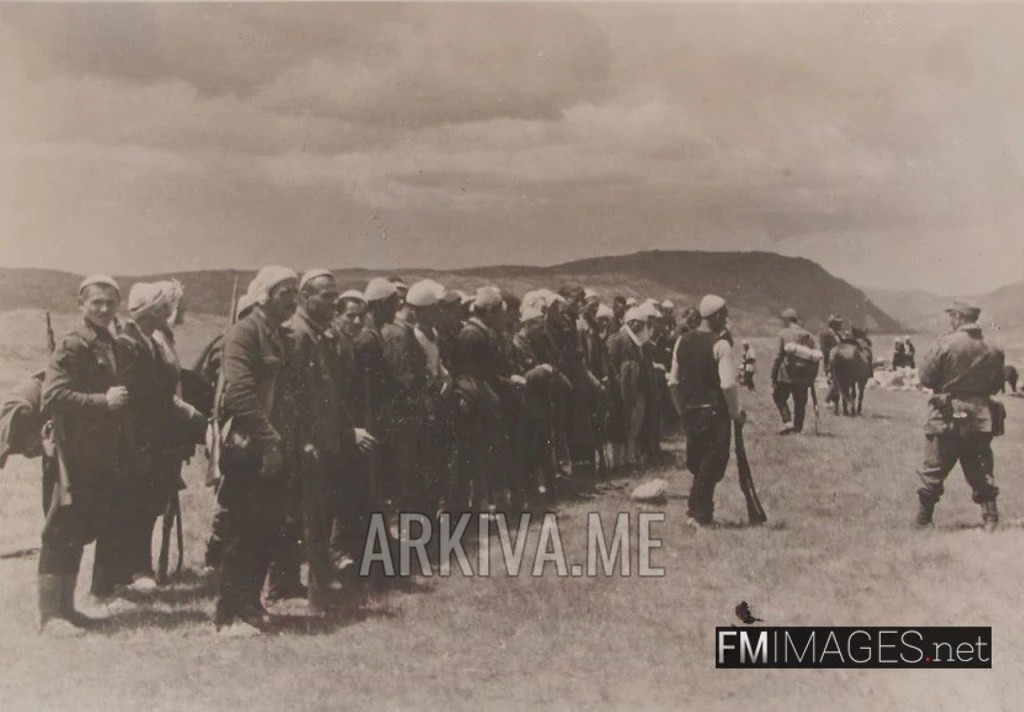
Albanians of Bjello Pole in 1932
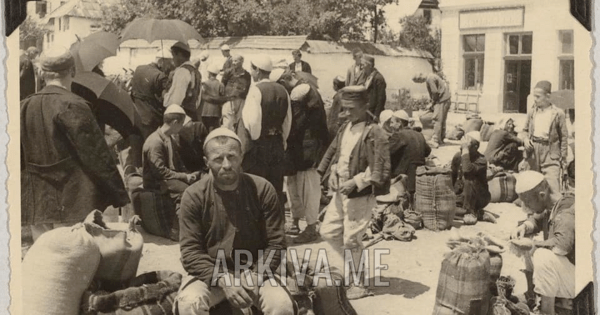
Albanians and Montenegrins of Andrijevica in 1903


The history of the Albanian tribes of Moraça
Milan Sufflay writes:
“Strong units of Romanians (Arumuns or Vlachs), as a southern continuation of the southern Morlaks, are seen in today’s eastern Montenegro (early 20th century). Not only two mountain peaks, Durmitor and Visitori, bore Romanian names in 1330, but also in old Serbian documents, which deal with places even further to the east (of Montenegro), they are full of Slavic names with Romanian suffixes. (Gradul, Radul, Bvladul).”
Piperi and and Mogushë tribes of Moraca
“The numerous brotherhoods of Romanian shepherds lived here, gathered together, like the Piperis and the Mogushes, between the Zeta and Moraca rivers and provided, together with the Slavic Luzhans, material for the creation of Montenegrin tribes… The origin of the Montenegrin Pipers, who according to Erdeljanović’s research, were formed by the Pipers and by the very powerful inhabitants of the old Zhupa of Luzhha and by the wandering Romanian Mugoshes, then the origin of the third tribes becomes clear.”
A brotherhood (1416 “Villa Vllasami” in the district of Shkodra), which was a society of shepherds… The Daco-Roman origin of these Romanians is given by the name of the Mogoshes (we remember here the black devil named Dushan Mugosha, who was and is believed to be a Serb from those from Kosovo, but who were Serbized Vlachs), who still live today in many places of the Romanian kingdom (Mogosani, Mogosesci, Mogosoie)…”
“The city statutes of Kotor from the 14th century clearly distinguish the Croats further north from the Slavs (Sclavi), who mixed with Romanians (Vualachi) and Albanians lived near the cities… then especially the brotherhood “Sremlan Vlachs”, who in 1330 lived near Peja. This brotherhood with its own name has preserved the memory in Srijem (Syrmium). Even in the northern arc of the Drin united in Shkodra’s suburbs and in the district of Puka (Epicaria) there are still roaming Romanian elements…”
(Source: https://pashtriku.org/besnik-imeri-minoritetet-ne-shqiperi/)
Families of Kolashin and Moraca
Written originally by Ramiz Lushaj.
Kolashin, a heroic and ethnic Albanian town, at the head of the Moraça River, is known in history for the 7-year war (1852-1858) against the Principality of Montenegro with the accession to the throne of Prince Danilo I, culminating in two of theirs: the Battle of Ostrog (1853) and the Battle of Grahova (1858), which had great international resonance.
Behind them stood Russia and France, which for a century gave blessing and all-round support for strengthening and territorial growth of this small principality of 3 thousand km2, which had doubled its political-administrative surface with conquests and annexations of lands ethnic Albanians, with violent assimilation of Albanians.
In these wars, the Albanians of Plavë-Gucia, Gjakova Highlands, Northern Malesia have also taken an active part, some of them are known differently in popular tradition as the “War of Moraça”, which were bloody confrontations so strong that the warriors and succeeding generations “measured” bravery in the houses and mountain councils with heroic deaths, with wounds received on the body or with pride in battle. This was like a kind of “biography” of the time, even though it eclipsed the “Battle of Nokšić” (1879-1880).
Mekul tribe of Nokshiqi
In this war, the Mekuls of Nokšići (Nokšajje) also participated, the men of their two towers: of Ibër Meta – his son Smajli with his two or three nephews and of Ramë Suko – Rama with his eldest son, with Hysenin (Hysi), who went and fought together, protecting each other’s arms from the attacks of the Montenegrins of Cetinje.
After four days of hard fighting (April 28 – May 1, 1858) Prince Danilo I with his brother military leader, Mirko, with over 7 thousand military forces, raised the banner of victory against the Porte with 7-13 thousand military forces, most their Albanians from the tribes of Kelmendi, Gashi, Krasniqi, Hoti, etc. from the shores of Lake Shkodra to the mines of Mitrovica, from the three bajraks of Plavë-Gucia and the Vise of Mirdita, etc.
The two great pro-Slavic empires of the time, Russia and France, conditioned the Ottoman Empire to form a commission for determining the borders of Montenegro with the Porte, which began its activity in November 1858, annexing also the territory of Kolashin in the Montenegrin principality. Montenegro, after the wars of conquest, increased its territorial surface to 4,700 km2 by taking the ethnic Albanian lands of Kuči, Piperi, Vasojeviči, Palabardhi, Shipshanik, etc.
The Albanian family of Mulla Shiqeri of Moraça
In this historical Albanian territory, which today administratively bears the name of the municipality of Kolashin and is considered an unofficial center of the region of Moraça, there lived an outstanding family of Albanians: that of Mulla Shiqeri, who had long ago earned the title “Hoxha of Kolashin”. They were such a perfect work that even their hometown – Kolashin gave them their own name for nobility, just as Mulla Smajl Adem Mekul has been called “Hoxha i Nokshiqi”.
These two Albanian national families: the Nokšićs and the Kolashins, fought together for centuries for freedom and independence and their nobility in battles and battles. They shared a generous piece of bread together and faced the risk of war together, as did Hysen Halili of Kolashin and Brahim Bajram Hysi of Nokshiq, the two embers of Albanian freedom against the Montenegrins.
One of the etymological explanations of the name Kolashin elaborates that this territory was a “fortress” in the resistance wars at the head of the geo-strategic Moraca, where the ancient and new tribe of Kelmendi traveled, as Pjetër Bogdani specifies in 1865, where “Cemi of Vukli” and “Nikçi of Kelmendi” of the Alps, where even the Nokšići of history takes root with his genes.
Tower of Mulla Sheqeri of Kolashin
An impregnable Albanian fortress was also the epic tower of Mulla Sheqeri i Kolashini (not only a hoxha, but also a religious teacher), whose father, Hoxhe Halili, had also earned the title “Haxhi”: otherwise he was called “Haxhi Halili i Kolashini” “, even it is said that they also appreciated the religious title “Myderriz”, which means “professor of knowledge”.
This tower of genetic and scholastic knowledge was also a place of honor. They gave 41 strong men for the freedom and independence of the Albanian nation, so that it would not be subjected to unjust decisions of the Congress of Berlin in1878 and the Conference of Ambassadors of London 1913.
This tower holds in its legend a record of bloodshed with the Montenegrins: in three years, 21 men were killed. Brothers of Mulla Sheqeri of Kolashin, separately Hyseni was fighting, and Zeqiri and Qazim were also fighting, that all four unitedly fought with words and bullets in the valley of the mountain of Kolashini and the surroundings up to Plavë-Guci, and when the life of the local kacak was in danger on the sides, the tribes of the Gjakova Highlands and Kosovo crossed the Dardane mountains.
Hysen Halili Kolashin and Brahim Bajram Nokshiqi
Hysen Halil Kolashin and Brahim Bajram Nokšić often fell into ambushes, were pierced by bullets, and brutally killed by Montenegrin and Serbian bandits. These two Albanian noblemen, Kelmendi and Vasojević, became dangerous for the principalities or kingdoms of Montenegro and Serbia.
The two Balkan kingdoms, Montenegrins and Serbs, waged an unstoppable and bloody political, racist, religious, etc. war. to the tower of the Kolashians who did not bend, did not avoid and did not retreat in their right of national, religious, tribal, civic defense. The Moraca monastery was then allocated to the Montenegrin interests.
Written by Ramiz Lushaj.
French paper of 1912: Turgut Pasha and the Albanian refugees of Moraca.
“La Vie heureuse” has published, on April 15, 1912, on page 5, an article about the special relationship of Mrs. Edith Durham with Albania and the Albanians, which, Aurenc Bebja, through the Blog “Dars (Klos), Mat – Albania”, has brought it to the Albanian public:
“Among the thousands of touching and ingenious ways of being charitable that women have discovered, here is one that, moreover, does not go without courage. We know what is the miserable life of the Albanians, on whom, at this very moment, the question of the East weighs heavily. You must also know that for eleven years a woman, Mrs. Durham, has been their Providence.
It was in Podgorica early last August that I met Mrs. Edith Durham. I met him in a small town on the border with Montenegro, where the mountain Albanians had taken refuge, persecuted by the Turks. One cannot imagine the poverty in which these unfortunate people were, whose houses were burned by the troops of Turgut Pasha and who only had for shelter the caves dug on the steep banks of Moraca.
In these infested thickets, men, women, and children, mixed with a few cattle, had waited for five and eight months for the end of their sufferings. I visited the refugees with Mrs. Durham. These poor people came to meet her, kissed her hands, called her their queen, asked her for help and protection against their enemies. Every day, in 50 degree heat, along the stone paths, she wandered into their desperate camp, handing out the little money she got for them from England. She had bought fabrics (clothes) which she divided into pieces of three meters; to each piece she added two needles and thread, for she had rare and touching experience of these things”
Gjergj Fishta and the Moraça battle of 1862
Moraça is mentioned in Gjergj Fishtas “Lahuta e Malesis”
“In a pasture near Vranina, Vulo Radoviqi kills the Albanian shepherd Avdi Hisa and takes the herd as prey. Avdi’s sister, Turkina, mourns her brother according to the mountain tradition. When he hears her cry, Oso Kuka calls his warriors to take revenge. They are followed and catch the thieves of the herd right on the bank of Moraca, where after a fierce battle they recover the herd. The Slavs lose two men, while the Albanians prepare to retreat, satisfied that they took Avdi’s blood twice.”
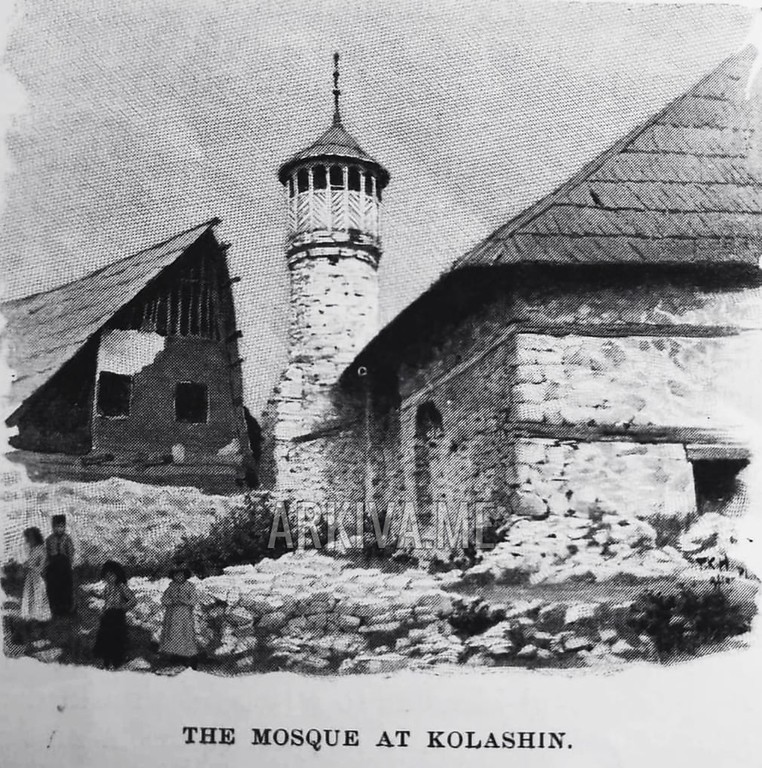
The mosque of Kolashin in 1899
Përshkrimi/Description: Familja Haxhibuliq nga Kollashini (Mali i Zi) të cilët u shpërngulën në Sanxhak pas vitit 1924 / Hadzibuliq family from Kollashin (Montenegro) who moved to Sandzak after 1924
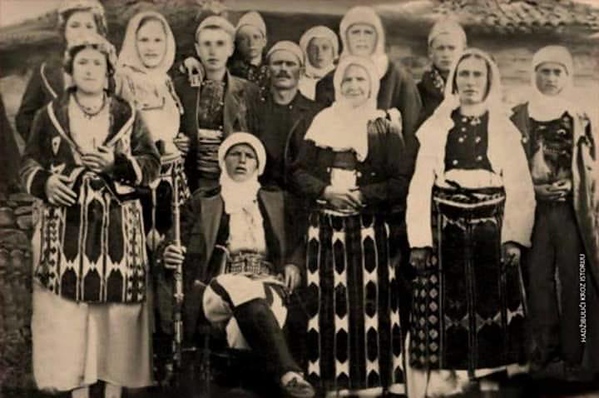
Burimi/Source: Historia Krajës (Facebook)
References
- Kur erdhi në krye të ”Principatës” mixha i Krajl Nikollës, Princi-peshkop Danilo II (1851-1852) apo i thirruni ma pas zyrtarisht princi Danilo I (1852-1860), mixha i Krajl Nikolla I, vllai i Vojvodës Mirko.
- A. Theiner, Vetera Monumente Slavorum, Meridionalium, II. Zagarbriae, 1875, fq.217-221, në: Marko Jaèov, Spisi Tajnog Vatikanskog Arhiva, XVI-XVIII-veka, Beograd,1983, fq.136.
- Shaban Bali Nokshiqi. Kujtime dorëshkrimore – kreu: “Shtëpia e Mulla Sheqerit për besë e kumbari”. Tiranë, 2010.
- https://www.illyria.com/besa-e-shaban-balise-te-nokshiqit-ne-deren-e-mulla-sheqerit-te-kolashinit/


 Balkan Academia