
UNESCOs decision to attribute the Lahuta or Gusle to Serbia has caused much debate in the Balkans. Montenegro has decided to appeal the decision, as the Guslar community of Montenegro considers the instrument to be Montenegrin. However, Albanians also consider it to be their own. The following articles discusses how and why the Lahuta is indeed of Albanian or Illyrian origin. The south Slavic populations there fore adopted the instrument.
Pjeter Bogdani mentions the “Laudeve” (Lahuta) in the Cuneus Prophetarum from 1685:
“..ata që kënduekshin ndë mjedis të vashzavet e rasa të laudeve…”
Translation: “..those who sing in the midst of feasts and Lahutas…”

Source here.
- Rugova has a Lahuta tradition of 12 generations or 360 years
According to lahutar Isë Elez Muriqi, a Lahutar from Rugova, the Rugova highlanders have embraced the tradition of playing the Lahuta for 360 years, or 12 “breza” (generations). This is oral folklore and a testimony of the Lahuta indeed being fundamental to Albanian folklore. The first man to play the lahuta was Hysen Selman Husaj (1791–1876).
Link to interview here.
2. The Lahuta is an ancient Illyrian instrument
“… lahuta ( lute ) , an ancient Illyrian instrument of thirty to fifty strings which is played with a bow . Since many Albanians fled their country in the 12th century to avoid living under Turkish and Slavic rule , some settled in …”

3. The first documentation was in 1897 by Albanologist Gustav Meyer
“The documentation of the Albanian oral epic tradi tion began with a nonAlbanian publication by an Austrian Albanologist, Gustav Meyer. In his book Albanesische Studien (6 vols), published in Vienna in 1897, he included fifteen lines (a fragment) of an Albanian epic song from the cycle concerning the brothers Muji and Halil (Neziri 1998: 25)”
4. There is a connection between Homeros “Iliad” and the Albanian Lahuta
“Various scholars have attempted to find clashes between Homer’s “Lahuta of the Highlands” and “The Iliad”, especially in the atmosphere by the two poems. They have compared characters that have common traits, event scenes, etc. Their conclusion was that the Homeric poem, with the exception of the distant model on which the poet was based, shared the Balkan affiliation with the Fishtian poem.”
5. Fishta was inspired by the Greek “Iliad”, the “Odyssey” and the Latin “Aenedi”.
“Fishta wrote in the old Gege language of Northern Albania which was the language of his natural and native. He was strongly influenced by both traditional oral epics his culture, as well as from the Greek epics such as the Iliad, the Odyssey and the Latin Aeneid.”

Source here.

Source here.
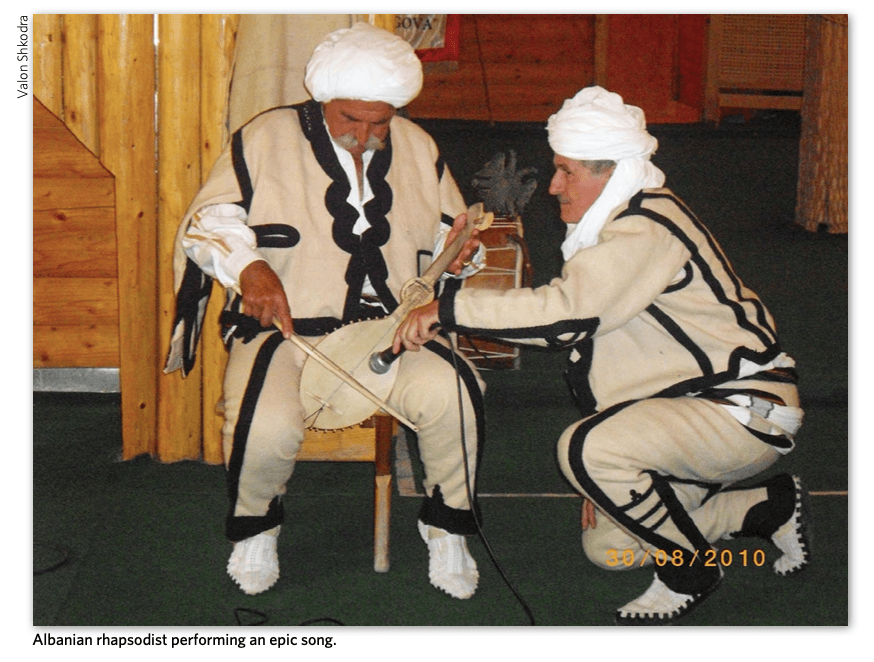
An Albanian playing the Lahuta
6. Frank Nopca believed the Lahuta was imported from Turkey as he recognized it from Constantinople in 1812
“… Lahuta and the Cüteli, Turkish imports, because I find both mentioned as Turkish musical instruments from Constantinople as early as 1812. Since Castellan’s work, from which I take this information…”

Source here.


 Balkan Academia