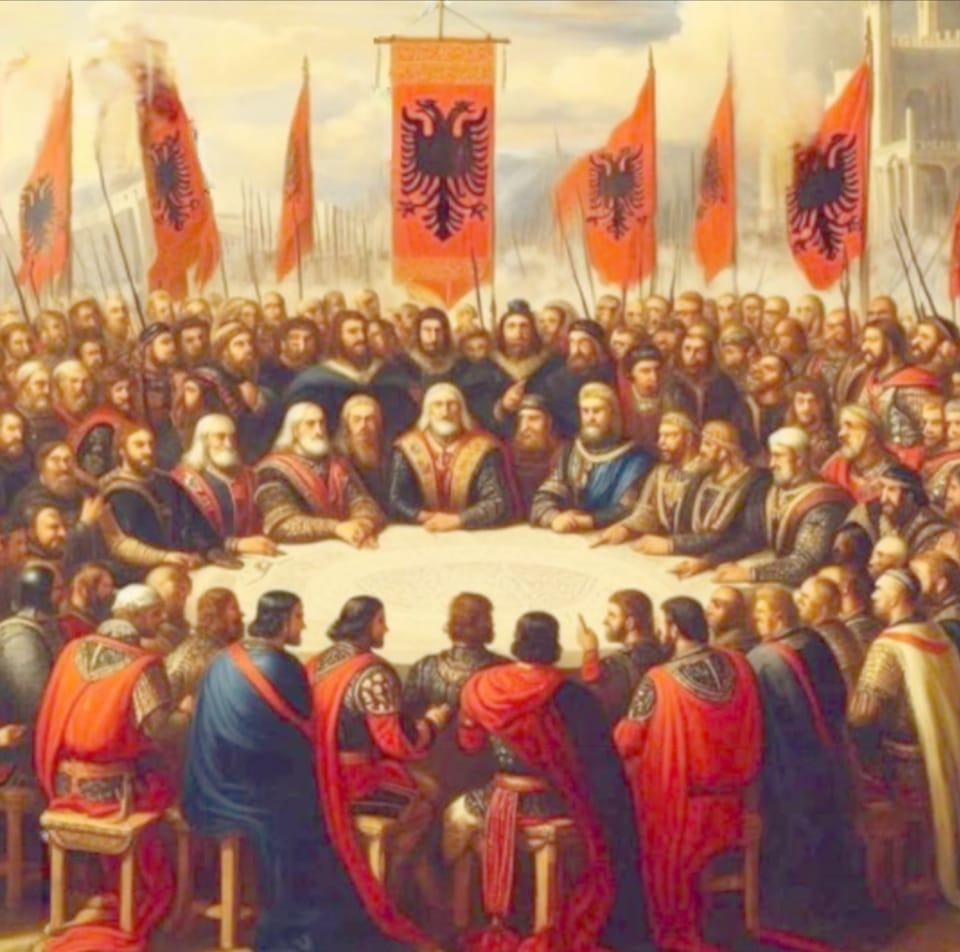

The penetration of the Spahis through the autonomous mountainous areas, the spread of the Ottoman rule, the increase of obligations towards the Albanian peasantry, caused a stronger resistance of the highlanders, animated the movement of the rest of the Albanian peasantry, as well as the efforts of the secular and religious Albanian leaders to transformed the separate armed uprisings and the dissatisfaction of the Albanians into a general movement for liberation, with a higher and wider organization than before.
The combat experience and the failure of the uprisings of the century. XVI showed the highland insurgents that the defense of self-government and the struggle for liberation from the Ottoman yoke could be achieved by uniting their forces with those of other provinces, and with more suitable organizational forms.
Such a form was made in the Albanian assemblies, which were a new political institution with an interprovincial character, a higher and wider union of forces, which was achieved on the basis of the existing provincial assemblies. In the Albanian assembly, in addition to the heads of the self-governing mountainous provinces, representatives of other provinces participated. A series of Catholic and Orthodox prelates joined these assemblies, whose interests, like those of the peasantry, did not agree with the Ottoman rulers.
The transition to this new organizational form, behind which stood the peasantry and its lay and clerical leaders, raised the war to a higher, wider and fiercer scale, introduced it into a new phase. The Albanian highlands, also favored by the mountainous terrain, now became the centers of the leadership headquarters and the main foci from which insurgent movements, unprecedented in their breadth and strength, erupted and spread to the rest of the country.
The experience of the war taught the Albanian leaders to embrace a new form of war in order to face more successfully the great power of the invaders: to unite and direct through the Albanian assemblies all the foci of the Albanian resistance, and to coordinate their struggle for freedom with that of the oppressed peoples of the Balkan Peninsula and with the struggle of the European states for the expulsion of the Ottomans from Europe.
A number of projects were drawn up in the Albanian assemblies. They appealed to European countries for the liberation of all Albanian lands. The commemorations showed the readiness of the Albanians for war, the number of fighters, the strategy and tactics that would be followed for the liberation of the country, including the cooperation of the insurgents with the guards of the castles, who were of Albanian origin.
There, efforts were made to convince the governments of the European states to undertake an action against the Ottoman Empire, which would be coordinated with the military actions of the Albanian and Balkan insurgents. At the same time, the assemblies demanded firearms from them, since with swords, spears and arrows, the Albanian insurgents were in inferior conditions compared to the Ottoman forces.
Assembly of Mati 1590
In the period between 1590-1620, a series of such assemblies were organized. The center where these assemblies took place became the province of Mati. The war of the insurgents of the northern provinces reached its peak in the years 1590-1595, when 10,000 insurgents from the mountainous provinces of the Ohrid and Dukagjin sanjaks expelled the Ottoman authorities from the highlands and extended their attacks to the neighboring provinces. The uprising exerted a great influence inside and outside the borders of the Albanian lands, and in particular it revived the liberation struggle of the Macedonian population.
Assembly of Saint Mary 1594
In the wake of these uprisings, on November 7, 1594, a general assembly of Albanian leaders gathered in the monastery of Saint Mary in Mat to draft the project of the uprising and the liberation of the whole country. The Albanian leaders, Tom Plezhja and Mark Gjini, who also held the title of knight, as well as Bishop Nikollë Mekajshi, were assigned the task of entering into talks with the pope for the implementation of the uprising project.
Secretly to the Republic of Venice, which did not want to break the peace with Istanbul, the project was presented to the papal delegate in February 1595. The requests of the Albanian representatives in Rome to provide weapons did not bear any fruit. The Pope advised the Albanians to wait because the right time had not come. On the other hand, Venice was able to divide the ranks of the participants of the assembly by using its influence on some leaders. In June 1595, when the formation of the European coalition against the Ottoman state was announced in Albania, the Albanian leaders informed the Pope that the Catholic and Orthodox Albanians were ready to start an uprising as soon as the war started.
At the same time, in the provinces of Southern Albania, efforts were made to secure weapons and tools for the uprising from European countries. In 1595, the patriarch of Ohrid, after returning from Moscow, went to Butrint and, with the governor of Corfu, asked the Venetian senate for help in the uprising. But the senate rejected his request.
Weapons were also requested from the Pope of Spain (1596), but the Pope did not send any help, presenting as a pretext the huge expenses he was making in Hungary for the war of this country with the Ottoman Empire. The court of Spain promised and sent a small contingent of soldiers. Nearly 10,000 insurgents armed with jatagans and arrows, coming from the provinces around Vlora, attacked the Ottoman army in the city in the hope that Spanish aid would arrive at the port of Vlora. But this enterprise went in vain, because even those weapons that were launched were seized at sea by the Venetians.
Blinish Assembly 1598
This attitude of the European states and the Vatican damaged the uprisings in Albania, but could not stop the efforts to spread them in most of the provinces. In 1598, the second interprovincial Assembly was organized in Blinisht of Zadrima. He turned to the Austrian emperor for help. Venice captured the representatives of the assembly and sabotaged the alliance. However, the idea of organizing a general uprising spread throughout the Albanian lands. The clergy and prelates played a role in its spread.
Assembly of Dukagjin 1601-02
The heads and prelates of the provinces of Mbishkodra and Dukagjin were joined by many heads of other northern, middle and southern provinces. With the participation of their representatives in 1601, a large assembly was held near the church of Saint Lleshdri (Aleksandrit) in the village of Dukagjin. In its proceedings, which continued in 1602, 2,656 secular and religious delegates from 14 provinces of Albania participated (from the Highlands of Shkodra, Zadrima, Dukagjini, Kosova, Lezha, Kurbini, Mati, Dibra, Petrela, Durrësi, Elbasan, Shpati and from Myzeqeja).
The Assembly was led by Nikollë Mekajshi, Nikollë Bardhi and Gjin Gjergji. He made the decision to start the war for the liberation of the country. This historic decision was signed by 52 main leaders, 4 from each province. But securing allies and weapons remained a problem.
In order to dispel the suspicions of Venice and to attract it to its side, the assembly decided this time to turn first to the Republic of Saint Mark to ask for help and weapons. For this purpose, two representatives, Nikollë Bardhi and Pal Dukagjini, were sent to Venice. But even this time the senate sent the Albanian representatives with the usual order to wait since “the time had not come for war against the Turks”.
The Assembly decided to send its two representatives to Venice again to declare to the Senate that if it did not help the armed movement, the 40 thousand Albanian insurgents would be forced to turn to the other European kingdom, having consider Spain, Venice’s rival. Even these threats did not convince the Republic, which more than ever wanted to maintain peace with the Ottomans, for the reason that at this time peace talks had begun between Istanbul and Vienna.
This time too, the Republic acted on the spot to sow the seeds of discord in the ranks of the leaders of the assembly in order to avoid the danger of the Albanians getting closer to Spain. She was able to bribe with gold and make for herself Nikollë Bardhi and Pal Dukagjini, as well as several other leaders.
Thus the efforts to secure an active external ally as well as weapons did not bear any fruit. The international political situation was not ripe for military actions against the Ottoman Empire, because, based on their interests to maintain peace with Istanbul, the main European states did not give the Albanians the requested help.
Assembly of Kuči 1614
The first assembly was convened in 1614 in Kuc, in the heart of the Albanian Mountains, with the participation of representatives of the insurgents of Albania, Montenegro, Bosnia, Herzegovina, Serbia and Macedonia. It took place in two sessions, one in July and the other in September. Of the six main Balkan leaders of this assembly, two were Albanians, Gjergj Bardhi of Mirdita and Lala Drekali of Kuçi, while a quarter of the 44 Balkan representatives came from the foci of the Albanian resistance.
In the second session of the assembly, the plan of combat operations was drawn up. . Special importance for the preparation and initiation of military operations in the Balkan Peninsula was devoted to the Albanian insurgent mountain foci. In these foci, 12,000 fighters would be sent for help from all the Balkan provinces, who would be equipped with weapons and, together with the Albanian insurgents, would launch attacks against the Ottoman garrisons from there.
The attack for the liberation of Vlora would be carried out from Himara, the operations for the liberation of Kruja would be carried out from the highlands of Dukagjin, the attack for the liberation of Shkodra would begin from the Malësia e Madhe; Similarly, from Montenegro, Castelnovo in the Kotor Gorge would be attacked. At the foundation of this plan was the readiness for war as well as the many years of experience of the uprisings of the peoples of the Balkans, and especially that of the Albanians. The Metropolitan of Durrës and the Orthodox bishops would also participate in the uprising of Ioannina and Arta.
In this session, the issue of securing weapons was raised again as the main issue. Disheartened by the previous failures, the participants took a new decision, which was a severe blow to the Catholic princes, who had so far kept them in words about the organization of “crusades” and had not given effective help in arms. The assembly tasked its diplomatic envoy, the Albanian Gjon Renësi, to declare in the Catholic courts of the Italian states that the assembly would not hesitate to turn for help to the Protestant states, such as England, the Netherlands and other Protestant princes of Germany.
Among the Western European statesmen who began to encourage the Balkan insurgents in the hope that victory would enable them to lay hands on the liberated lands were the Duke of Parma in Italy and the Duke of Nevers in France, behind whom he stood actually Spain. The Duke of Parma agreed to help the planned uprising with arms and launched a ship loaded with supplies to the Albanian coast, but it was seized on the way by the Venetians. Then the assembly decided to coordinate the uprising with the expedition that the Duke of Nevers was preparing to land in the Balkan Peninsula. But even the efforts of this French prince failed due to European political contradictions.
Assembly of Prokuplje in 1616
Since the first steps did not give the desired results, after the Kuci assembly, efforts were made for a new assembly. On November 11, 1616 in Prokuplje, as a contemporary source says, “the main lords of the kingdom of Bosnia, Kosovo, Serbia, Albania, Macedonia and the Archduchy of Herzegovina” participated. Due to the new conditions that had been created with the increasing role of Austria as the main opponent of the Ottoman Empire, this time the assembly brought to the fore the task of liberating Bosnia first, since there was a greater possibility of being helped by Austria.
However, even in this assembly, a landing in Albania was deemed necessary, because the Albanian uprisings constantly kept open a wound in the weakest parts of the Ottoman Empire. On the Albanian coast, from where the roads to the inner parts of the Balkans started and that, as stated in the decision, a part of the people of this country “does not obey the Sultan and lives freely (as they are – author’s note) the lordships of Dukagjin, Kelmendi, Pipri, Palabardhi and Montenegro”.
Therefore, in every military plan, as before and now, Albania occupied one of the most important places. Once the European fleet landed on the Albanian coast, 10,000 men would join the Herzegovinian forces. With 40,000 people from Dukagjini, Kelmendi, Pipri, Palabardhi and Montenegro, they would take the castle of Shkodra and from there they would go to Sofia, where they would join the other forces to lay out the plan for taking Istanbul. The project remained on paper again. The Duke of Nevers prolonged the preparation of the expedition. On the threshold of departure the fleet burned. Spain went to war with the Ottoman state.
Assembly of Belgrade 1620
Another evidence of the Balkan liberation movement was the assembly of Belgrade, which convened on November 18, 1620. There, the plans of the two previous assemblies were examined in more detail and the need to liberate Shkodra from the insurgents of the Great Highlands and the Highlands was emphasized. of Dukagjin, as well as the liberation of Kruja from the inhabitants of the highlands of Central Albania.
Of the 24 leaders of the Belgrade assembly, who signed the war plan, the most important were Lala Drekali of Kuçi, Gjin Gjergji of Dukagjin and Vuk Gjeçi of Kelmendi, after whom came the other leaders who came to the assembly from the Albanian mountains. United in the “Link of Arbë”, Dukagjini, Pipri and Kelmendi would bring out 14,000 fighters. Everyone would gather in Peja, where an army of 50,000 infantry and 30,000 cavalry would be created from the forces of Albania, Macedonia and Serbia. This time too, the assembly chose the Albanian Gjon Renësi as one of its envoys to the European courts. However, the requested help with weapons and the landing on the Albanian shores were not provided this time either.
Assembly (ecclesiastical) of Arbni 1703
Meeting of the bishops of Roman Christianity in Albania, held in 1703, on the initiative of the archbishop of Tivar, Vincens Zmajevic, and under the patronage of Pope Clement XII. Made important historical decisions for the life of the church and the Albanian secular world. Some of the acts of this assembly/council were written in the Albanian language. It was held in January, in Merqi, a small village near Lezha.
Assembly of Berat 1828
Also known as the “Treaty of Berat”, during the preparations that the High Gate was making to withstand the pressure of the Great Powers in favor of the Greek cause, the sultan, like all the Muslims of the empire, also called on the Albanian Muslims to take up arms to defend “the religion and the state”. Mehmet Reshid Pasha ordered the feudal leaders of Southern Albania to appear in Janina together with their warriors. Iljaz Poda did not obey this order at first, although the Anatolian vizier had sent him notices that he had forgiven him for his past attitudes.
To convince Iljaz Poda, the High Gate also intervened, which, at the same time, threatened to punish him if he did not obey. Iljazi did not obey Porta either and, together with other leaders who followed his example, began work to expel Mehmet Reshid Pasha and other officials from Southern Albania.
Meanwhile, the Greek uprising, which had been distorted by the strong blows of the Ottoman-Egyptian armies, with the support of the Great Powers, began to revive. Since at this time the armies of the Porte had left Moreja, while the other Ottoman forces, including those of Omer Pasha Vrion and Ismail Pasha Plasa, were concentrating on the war with the Russians, Istanbul ordered the Vali of Rumelia to organize a new expedition against the Greeks. But even this expedition could only be undertaken with the help of the Albanian feudal lords.
The Albanian feudal lords, not only because they were sympathetic to the Greek cause, but also because they were convinced that it would triumph, and because they considered participation in the expedition dangerous for their interests and for the country, refused to engage in the war against Greece.
They saw this action as one of the ways to expel Mehmet Pasha and other Ottoman functionaries from Southern Albania. Iljaz Poda, Ismail bey Vlora and Shahin bey Delvina, decided that a broad assembly of representatives of the Albanian leaders should be called for this matter. Meanwhile, before the assembly convened, they entered into talks with the Greek government to determine the position that both sides would take in the conflict that had erupted. During the talks, both sides pledged not to attack each other’s territories.
After this agreement, in the first week of November 1828, the assembly of Albanian leaders met in Berat. The assembly carried out its work in secret meetings, which lasted from the 6th to the 8th of that month and were held under the chairmanship of Ismail bey Vlora, Iljaz Poda and Shahin bey Delvina. In the assembly, the issue of governance was mainly discussed and it was emphasized that the Ottoman officials had concentrated all the privileges in their hands, expelling the natives.
Therefore, it was decided to break the authority of the vizier from Kytahija of Anatolia, to remove him from the governance of Albania and if he were to be replaced by others, they would also be expelled, creating obstacles, until the power of the country was concentrated in the hands of the Albanians. . It was thought that this goal would be achieved before Istanbul settled its disputes with the Great Powers, because when Mehmet Reshid Pasha’s hands were freed, he told the assembly, he would take severe revenge on them and subjugate the country using the Albanians. against the Albanians.
On November 9, sent by Mehmet Reshid Pasha, Sulejman bey Konica and Tahir aga Abazi arrived in Berat, who demanded the response of the Albanians to the vizier’s call. The leaders of the assembly turned them back, promising that they would give the answer to the vizier orally in Zica, where they would appear with their forces. They thought of informing Mehmet Reshid Pasha that they agreed to undertake the defense of the borders of Southern Albania with their own forces, but on the condition that, in addition to providing food and ammunition, the sanjak of Vlora would be given to Ismail bey Vlora for governance and the sanjak of Delvina Shahin bey Delvinë and the derbands of the sanjak of Tërhalla, Iljaz bey Podë.
As for the troops that would be needed to be used outside the borders of Southern Albania, against the French or Greek troops, they required the provision of the soldiers’ salaries. The demands of the leaders of the assembly were actually aimed at the expulsion of Mehmet Reshid Pasha and the Ottoman officials from Southern Albania.
Mehmet Reshid Pasha, who was informed about the decisions of the assembly by his agent hidden among the assembly participants, did not appear in Zica, but sent three of his representatives. The leaders of the assembly of Berat understood this evasion of the vizier, so they left and did not participate in the expedition, which could not be undertaken.
Following their example, the Cham feudal lords, who had somehow agreed to go under the orders of Mehmet Reshid Pasha, not only gave up, but expelled his forces and representatives from Paramithia. This action marked the beginning of the Albanian feudal movement for the self-government of the country as in the time of Ali Pasha Tepelena.
Demoralized by the failure he suffered and worried about being forced out, Mehmet Reshid Pasha once again asked to be removed from the positions he held. But the High Porte did not accept this request and, since the Albanian feudal lords were satisfied with these acts only and did not take action to clean their sanjak from the Ottoman officials, Istanbul drew up another plan, to kill the main Albanian leaders – Ismail bey Vlora and Iljaz Podën, and thus disbanding the agreement of Berat, oppressing it or forcing it to obey the orders of the central government.
In order to achieve this goal, the word spread that Mehmet Reshid Pasha would be removed from his position because he proved incapable of making the Albanian Covenant a support of the empire in the crisis period of that time. At the same time, Ismail bey Vlora was sent the firman of his appointment as the governor of the Sanjak of Vlora with the rank of pasha with two tujas and Iljaz bey Poda, the firman of his appointment as the temporary commander of Ioannina until Ismail bey Tepelena arrived there.
Ismail bey Vlora fell into the trap and went to Ioannina, where on January 5, 1829, when he was climbing the stairs of the palace, he was killed by Mehmet Reshid Pasha’s men. While Iljaz Poda escaped, because he did not go to Ioannina. But the killing of Ismail bey Vlora did not confirm the hopes of the High Gate to subjugate the Albanians.
On the contrary, the movement assumed the character of a real revolt, which was accompanied by the expulsion of the Ottoman officials and the establishment of the power of the Albanian leadership in the provinces around Ioannina, in Zagori, Konica, Mecovo. The goal was for Mehmet Reshid Pasha to leave. The latter, after announcing to the Porta that in order to subjugate the Albanians, large military forces had to be used, prepared to leave Albania. Meanwhile, the Sultan charged him with the duty of Grand Vizier and commander-in-chief of the army in the war against Russia. This decision was announced in Ioannina on February 6, 1829.
Reference
https://ftillimi.org/historia/sundimi/dukurite/kuvendet-shqiptare/


 Balkan Academia