
Albanians of Bijelo Polje, 1935
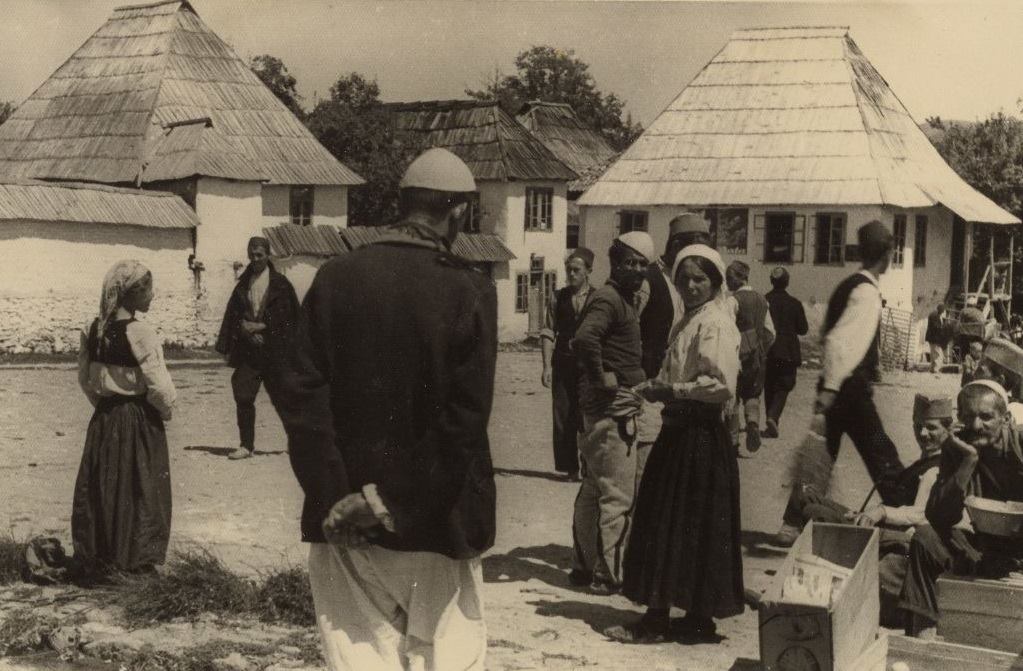
Source FM Images Albania.
Albanians of Fundina and Kotse and the Tripeshi tribe
“Montenegro also includes some Albanian villages such as Fundina and Kotse and an Albanian tribe called the Triepschi or Zatriebatz.”1
Albanian League oppossing the cession of Shpuz
“The committee formed in this city consisted of Muslims and Catholics, Prenk Bib Doda, Captain of Mirdite, being one of the main leaders. Before its formation, Catholics and Muslims had already cooperated and signed a protest to the delegates of the great powers in Berlin against the cession of Tivar, Ulcinj, Podgorica (Titograd), and Spuža by the Treaty of San Stefano.”2
Spuz or Spic (latin. Spizza)
“The coastline itself is the landscape of Spic (Alb. Spuz, also Spizza), who is a native of Turkish Albania, one of the various targets of aggrandizement Montenegrin.”
The Kuka valley of Moraca river
“On almost all sides, mighty mountain masses form a natural border. Only the Kuka valley with the Moracka river in the northwest is an exception. In the southeast, the Zevna river forms the border, and in some cases the borders have not been established. The Montenegrin valleys flow into Albanian scenes of frequent battles and atrocities.”3
Albanian mahalas (neighborhoods) of Shpuz and Ognost (Niksic)
In the 16th century, the population of Spuz was composed of Serbs, Turks and Albanians. Albanians were noted to have their own mahalas (neighborhoods) within Spuž and Onogošt (Nikšić).4
Albanian forces in Shpuz and Niksic in 1877
“The entire Turkish force before Spuz attacked the Montenegrins in Martiniza on 6 June. The battle lasted from early morning until the afternoon The Turkish officers had to force their wavering troops back from the battle until the Montenegrins went on the attack and chased the Turks to the Spuz fortress. Yesterday the prince ordered the bombardment of the very strong Fort Uzrinice, which lies on the way to Niksic. After heavy bombardment, with some projectiles reaching as far as Niksic, the fort fell into the hands of the Montenegrins”5
Niksic belonged to Turkey
In 1851, Gjonlek Begu of Niksic traveled from Constantinople (Istanbul) to fight for Albanian nationalist interests, and he aimed to establish himself in Niksic, which belonged to the Ottoman Empire at the time.6 When he encountered Montenegrin soldiers, he challenged them to a duel but was shot down, as was his body guard.
References
- https://books.google.se/books?id=l_gnjKUo-rgC&pg=RA3-PA27&lpg=RA3-PA27&dq=Albanische+Niksich&source=bl&ots=nXzAe3zRPP&sig=ACfU3U20FCY6NJaZl9nd0IALiSc9XhwkxQ&hl=sv&sa=X&ved=2ahUKEwjUmLb6n7qHAxUIExAIHb7ZD88Q6AF6BAgNEAM#v=onepage&q=Albanische%20Niksich&f=false ↩︎
- https://www.google.se/books/edition/The_Albanian_National_Awakening/8QPWCgAAQBAJ?hl=sv&gbpv=1&dq=Albanians+Shpuz&pg=PA38&printsec=frontcover ↩︎
- https://www.google.se/books/edition/Neues_Konversations_Lexikon/PSFCAAAAcAAJ?hl=sv&gbpv=1&dq=Albanische+Spu%C5%BE&pg=PA704&printsec=frontcover ↩︎
- Vasić 2005, p. 124. ↩︎
- https://www.google.se/books/edition/F%C3%BCrther_neueste_Nachrichten_f%C3%BCr_Stadt/f5Y34UmuvCgC?hl=sv&gbpv=1&dq=Klaciga+Montenegro&pg=RA23-PA8-IA1&printsec=frontcover ↩︎
- https://www.google.se/books/edition/The_Growth_of_Literature/Ds2oBKF_FrUC?hl=sv&gbpv=1&dq=Djulek-Beg&pg=PA333&printsec=frontcover ↩︎

 Balkan Academia