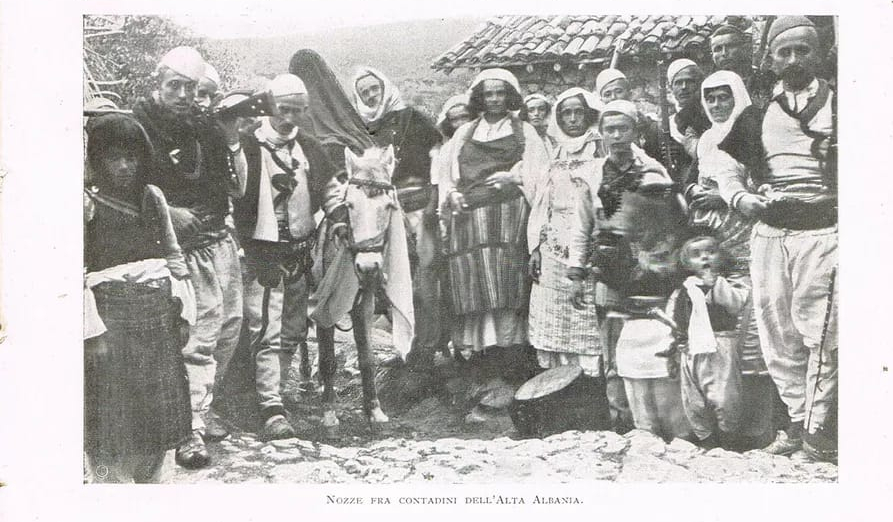

Authored by Petrit Latifi
On the bases of the historical religious and social conditions under which the Albanian ethnos lived in those centuries in the regions where they live today, we can affirm that this part of the Albanian names
of the Albanian ethnos is in fact the minimum of a unified anthroponymic system of that ethnos which during those centuries had nearly been Slavized from the onomastie point of view.
We shall give here only one example which provesthat not only during the Middle Ages was there an Albanian population in Kosova, Macedonia and Montenegro,but also that it had its own naional language. Our example has to do with the replacement of the patronym with an attribute which has as its basis the ethnic nameof the inhabitants — an attribute which must be taken as a feature of the ethnic belonging. Hence, for example, in the chrysobull of Stefan Dusan with which he confirmed the noble Ivanko Probistitovic of Shtipi in the possession of a garden, there is also mention of such people as Mano Vllahu, Gin Arbanasi, Dragosllav Vllahu, Dragosllav Serb*. We point out that this is one among many such cases especially in the territory under the rule of the Brankovices, which testifies that the names tooreveal the ethnic belonging of the individuals who bear them.1
In the case of the Albanian ethnos we must take into account the family and blood relations among the inhabitants of a village or family (although in the Serbian church documents blood relations appear rarely), linguistic belonging of the personal names may often lead to denial of the existence of the Albanian ethnos inone or several villages of Kosova, Montenegro, Macedonia and southeastern Serbia, however, the cases with the names of the Albanian villages (called “Katun Arbanasa”) such as Greve, where the inhabitants nearly all have Slavonic names, the case of the Katun Arbanasa which is situated in the surroundings of the present village of Xerxe, where the names are in part Slavonic, then the names of the villages described were Wallachian (Bllace, Pinusinc, Kostecan today Kostrec, Susican, Studencan, Ngucat, Bernjaka and others), there are a few Albanian names which support the idea that the Albanian ethnos was much larger in number than what may be presumed from the names and the other data in the field of onomastics.
Seen chronologically, the earliest proof of the presence of the Albanian ethnos during the 13th century in present-day Kosova (judging on the basis of a place name which has an Albanian ethnic name as its second part) is that mentioned in a letter of Knjaz Miroslav before the years 1253-1254.2
From this document of the first half of the 13th century it emerges that Miroslav had, apart from the villages on the bank of Humi, two villages in the present territory of Kosova. He also had a village near Dukagjin (in the document: Hvosno) and another in Drenica (in the document: Derzkovina); near Dukagjin he had the village of Rakos whereas in Drenica he had the village of Krusevc in the surroundings of present-day Serbica. When Miroslav defined (before 1253-1254) the boundary of the present village of Krusevc of Serbica, he said that it extended “. . . from the mountain to the Devicstream, from there over the mountain to the stream of the Albanians in the mountains and from there to theriver, in Klina”
Another proof which, on the basis of the linguistic belonging of the names, speaks of the presence ofthe Albanian ethnos, is perhaps that of the years 1293-1302 in which, among the inhabitants of a place called Ship in the present village of Pogragje of the Klina region, there are: Dobrosllav the son of ‘ Gjin, Gergo Kavacone of the sons of Zverk and Bratil the son-in-law of Gon of whom we may say that they are Albanians names Gon (Gjon) Gjergj and an antroponym Zverk or a nick-name formed from the word zverk (neck). More detailed data have to do with the anthroponymic.3
In our opinion it should be taken up as a separate study whether Gon is the Slavonic variant of the Albanian name Gjon or some older phase of the Albanian or a diminutive of the anthroponym Progon. We have seen many cases which prove that Gon is the diminutive of Progon whereas in other cases it emerges as Slavonic variant or an ancient phase of the Albanian name Gjon, material of the Albanian ethnos offered by the Decan chrysobull of 1330 which gives, although not always, the names of the inhabitants of the places under the rule of the Decan feud.
An analysis of this chrysobull has been recently made by Muhamet Ternava. From some of the data of this chrysobull it emerges that in the villages which were property of the Decan feud, there were inhabitants with Slavonic names, Albanian names and Wallachian names. Among the inhabitants with Albanian names in those regions are Prenko, an inhabitant of the village of Bohoriq, Bukur and Toloje in the present village of Isnic of that region ,where as in the present village of Gramacel there was one Gon.
The more Albanian names we find, the greater the possibility of seeing the depth of the penetration of the Serbian names among the Albanian ethnos in the village called -«katun arbanasa» in the chrysobull, which was situated on the right side of the Drin River, near the present village of Xerxe. The number of inhabitants with Albanian names in that village is greater than those with Slavonic names. Here we see the following inhabitants:
“*les tuz i s detiju branislav curko s bratijom i sdetiju svingolv i s detiju gon busat i gon i petro, i gingratan georgic i budan. Petr sum a i s bratiom mataguzsbratom lazor i prijezda. krec s detju, gonoma.”
This chrysobull also mentions names of the present village of Xerxe… inhabitants of Xerxa were: Rajko Ginovic and his brother, Rajan and his children, Radesa Tudorovic and her children, Ivansa and her children, Male and Mile and their children, Gale and Radoslav, Perkvo and their children, Brata Gjonovic, Budisllav Bunkov, Bojko Mausovic and Dragan, Bogoje Tisanovic, Dragan and the children, Cipc and the children, Stojko Velijanovic and Hranko Glusac.
The presence of the Albanian ethnos in Kosova in the 30’s of the 14th century is also proved by the names found in the village of Serosa (which some locate in the region of Decan keeping in mind the fact that it belongedto the Decan feud — which is wrong because from the point of view of its name it should be placed in the region of Rahovec where the Serosh village can be found ) inhabitant Priboje Drugovic of the region of Plava which is mentioned in 1348 in the chrysobull of St. Dusan, the monastery at St. Arhangel of Prizren.4
«Sacuvana su nam i zanimljiva imena stareSina tadasnjih£erzevskih porodica, podanika protopope Prohora, i prvih cuvaradecanskih. To su bili: Rajko Ginovic s bracom, Rajan s decom.Ozroje s decom, Kostreva s bracom i decom, Rade&a Tudoro-vic s decom, Ivansa s decom, Malac i Milac s decom, Faljej iRadoslav, Kuzma i Semijun, Djurdjie, Bojislav i brat mu Radin,Radoslav i Dobroslav, Prkov s decom, Brata Djonovie, Budi-slav Bukovac, Bojko Mausovic i Dragan, Bogoje TiSanovic,Dragan s decom Gipac s decom, Stojko Velijanovic i Hranko Glusac.5
According to notes we have found later, there is every reason to think that during the 14th century in several church documents the name Serosh included a separate region near Gjakova and not a village or a smaller territorial unit.6
There is no doubt that among the inhabitants are Albanian names and patronyms. Such are the surnames Ginovic and Gonovic, which prove, on the basis of the logic, that the Albanians had been there without doubt even before 1330, because Rajko who was a head of family was the son of Gjin or of the Gjmis family,and in the same manner Brata Gjonovic.
Of this category is the inhabitant Boboje Tisanovic in the family name of whom there is every reason to look for the Albanian name Tish which is found in the present Albanian name Tish and the family name Tishuk. Among the inhabitants of Xerxe at the time of the chrysobull there were somewho had Albanian names such as Mal, Mil, Bob which are written with Slavonic suffixes in the chrysobull.
As many scholars have stressed the other inhabitantsof this village who do not have Albanian names are not necessarily of a non-Albanian ethnos, but those who have Albanian names, mostly family names, are those among whom the Albanian names have been preserved unconsciously. The possibility of the Albanianization ot the Slavonic ethnos is ruled out, because of the economic, religious and historical conditions in which the Albanian ethnos lived during the 13th and 14th centuries.
Another proof of the same nature is found about the village of Sushican of Dukagjin, which is called a Wallachian village where among the inhabitants with Slavonic and Wallachian names, in 1330 in the Decan chrysobull, a Smil and a Gin the son Mojan emerge, which without doubt is the characteristic Albanian name Gjin, and thisis not a unique case. Inhabitants called Wallachian but with Albanian names apart from the Wallachian and Serbian names, are to be found in Wallachian villages of Dukagjin. Among them apart from Wallachian names such as Sharban, Shishman, Kercul and the Slavonic names, there are Albanian names such as Lesh, Gjin, Tol etc.7
From a superficial study of the names of the inhabitants of the Decan feud it emerges that the Albanian population of that region used the names: Dede (in Dedosh an inhabitant of Cabic, p. 90) Dode (Dodul — an inhabitant of Gramacd, p. 84), Bale (Balko and Baloje, inhabitant of Cerrabregu of Decan, p. 70), Meke (Mekjav’c,Mekijna, Mejavcik, see pp. 58, 92, 20), Kel (Keljan inhabitant of Doberdol of Klina p. 57), Bob (Bobeta, p. 57),Beb (Bebel, Beben pp. 92, 93), Nike (Niksha, p. 51) Guri-bardhe {Guribardhe, p. 21), Miran (p. 6), Mil (Miljak, p. 6,72), Mirak (p. 48), Milot as Milotic, p. 6, Bel (as Beljano-vic, etc.), also see place names further on Ladus (p: 38).Gurakuq (Kurikuq, p. 38). Mai (Malja, p. 100), Dosh(p. 100 etc).
The Albanian names of the population of the Decan feud are Gin (Ranko Ginovic — – inhabitant of Prapa-qan) 16 , Kuqi (in the form of Kueevc — inhabitant ofCabiq) 17 , Tish {in the form of Tishan — inhabitant ofCabic) 1 * Prek Cela (in the form of Prekocel — inhabitant of Strelc) 19 , Mil (in the form Mile— inhabitant of Lubenic)*,Curr (in the form Curi — inhabitant of Lebusha) 20 , Sume(in the form of Sumnja — inhabitant of Rostovica) 21 ,Bushat, Kuc, Mai, Prenk (inhabitants of Serosh) 22 , Suland Meks (inhabitants of Cabic) 23 , and others.8
Among names which from the linguistic point of view are Albanian is the name Lul, which in the Serbian documents emerges in the Serb form Lulic. The Banjeska chrysobull gives the earliest proof of the presence of this name among the inhabitants of Mediaeval Kosova. In this source of the years 1313-1318 a Hranoe Lulic is mentioned as a Wallachian inhabitant of the village of Pijainc. We also find the same name later in those regions. It is also mentioned among the inhabitants of an Albanian ethnos in 1455′, whereas Gl. Elezovic finds it in the cadastre book of Delvie of the 18th century and identifies it with the family name Lulic of Vushtrica which, according to the author of the dictionary, is one of the most ancient families of that place.
Tol, which is mentioned in 1330 and 1348 is amongthe names of the Albanian ethnos of the Middle Ages. The Decan chrysobull of 1330 mention’s a Toljislav thebrother of Bogoi, Toljislav, the son of Priboji, Toljislavhead of family and another Toljislav with his brother Grada and Priboje 27 . In 1348, on the other hand, in the village of Stavisa of Prizren. which under the Dusan chrysobull was given to the Shen-Mehill monastery of Prizren, there is a priest Troshan with his two brothers Tolojen and Priboji . We included the name Toloje among the names of the Albanian ethnos of the Middle Ages on the basis of the fact that in 1385 there were many inhabitants of the Decan region with that name, and also because their blood ties show that they belonged to the Albanian ethnos.9
A thing that can also be explained by the fact that in these regions to this day people still have the family name Tol-Tolaj. Another proof of the presence of the Albanian ethnos on the basis of the names can be seen in the name Bardh which is also found in 1348 in a letter of Stefan Dusan which acknowledged all the donations of the predecessors and added his own to the Hilendar monastery.
In this document in the Prizren region a bashtina (garden) of Bardhi is mentioned. In the charter of 1355 of czar Dusan with which he proved the property of the monastery of St. Nicholasof Dobrusta among other people who will be in the service of that monastery, is a certain Gin Bezi, a name which without doubt is of the sphere of Albanian names. But there is more to it. This should also be considered one of classical examples of the Slavization of the names of the Albanian ethnos. In these names we see, apart from the phonetical Serbian adaption of Gjin to Gin, the transliteration of Bardhi to Bell. In this case the Slavization process of the Albanian names is also proved by the Roman variant Gon Albi of the same name, which is an onomastic caique.10
The Albanian ethnos is present not only in the town of Prizren, but also in its surroundings (recall Arbanasi; katun Ginovci, Katun Mag-jerci, Katun Bellogllav-ci, Katun Flokovci, Katun Cernca, Katun Caparci, Katun Gonovci, Katun Shpinadinci, Katun Novaci). Apart from this case Serbian church documents provide facts that prove the presence of that ethnos in the surrounding of Prizren, in the present villages of Suhareka. Hence, the committee that had been selected (24 of them) to define the boundaries of the villages of Mamusha and Nistra 133 , which in fact consisted in markingout the boundaries of the property of the Hilendar monastery and the St. Archanger monastery of Prizren,was made up of the following persons: Peiko Gincemcfrom Reshtan, Rush Ginovic from Studencan, Petko Bu-shat from Lezhan, Boshic Mzija from Bernjak andothers.
For this region we found antroponymic proof of the presence of the Albanian ethnos in sources of this kindalso for the present villages Bllaca, Kabash, Ngucat, Jan-gishta, Kostercari and Sineja, Gullboc and Pinushin (nolonger existing), where as the existence of the toponyms of the Albanian anthroponymic type, during these centuriesis proved by the present villages of Kabash, Breza of Opoja and in the non-existing village of Nistra.This becomes clear if we recall that among the inhabitants of the present village of Bllaca, called “Wallachian village”, in 1348 among other names there are many with a Slavonic origin: Doda and his brother and sons, Baljan, Beri and his sons, Bob and his sons.
The village of Nistra, as can be seen from the text of some letters and chrysobulls which had to do with these regions, was in the region of the present village of Mamusha. Astrebov (see Stem Srbija i Arbanija, Beograd 1901, p. 62) spoke of this village and he, too, located it in the Mamusha region.This is more convincing after finding in the terrain of Mamusha the microtoponym Nistra and traces of a village which has disappeared.11
In the othervillage (Ngucat) also called “Wallachian village”, the names Rob (twice), Balda, Baldovin and others appear. In the village of Jancista there are individuals with the names Rogje and Laloje. Among the inhabitants of the Waliachian village of Kostercan appear the names Berand sons, Bogda Tanusevic and Pcversko Semanovic.
Here are also mentioned the inhabitants Tul, Bujacin, Puloga and Osmak” which must be considered “as” Albanian names of the Albanian ethnos that have been preserved to this day as family names and personal names. Hence, among this ethnos today we find the patronyms Tuli, Buja, Pulaha, Pula and Smaka (in all its variants Smakic-Smakovic) etc. For many reasons we are led to thinkthat the inhabitant Belshut of the village of Vermiea of the Prizren district has an Albanian name which has been preserved to this day only in family names and nicknames.12
The toponym Milesheva Bara is mentioned in the same chrysobull (See Hrisovuija cava Stefana Dusana,.., p. 291) near the place where this village bordered on the village of Banje of Suhareka. In that toponym we see the Albanian name Mil with the suffix esh, which is an Albanian place name derived from a personal name. Here we see that the suffix esh, about which much has been written (see Prof. A. Xhuvani and ProfE. Qabej, The Suffixes of the Albanian Language, Tirana 1965,pp. 37-38), may be of an Albanian origin, where as from the point of view of its age it is considered (Jokl, for example) of the Roman period of the Albanian language.13
From the field of place names, especially those derived from personal names, we shall mention the placenames Rudina e Leshit which neighboured on Busina,which was situated near the St. Peter monastery of Korisht , then the place name Shpija e Bushatit, in the territory of the village of Breza of Opoja, and Kroi Kukalit on the territory of the no longer existing village of Nistra, bordering on the present village of Mamusha of the Prizren region.
It is self-evident that these placenames bear the Albanian personal names Llesh, Bushat and Kokal which have often been found, especially the latter, during the 16th and 17th centuries in those regions. The examples which prove the existence of the Albanian ethnos during the 14th century are more abundant.
Thus, for example, in the chrysobull of Stefan Dusan,with which he founded the monastery of the saints Michaeland Gabriel of Prizren, he mentioned, among the properties and people who made donations to the monastery, those with such names the linguistic belonging and perhaps ethnic belonging of whom was undoubtedly Albanian. Most interesting here is the fact that there were inhabitants with names from the sphere of the Albanian anthroponymy in the town of Prizren itself.
The chrysobull mentions for example a Lesti Vorbetari, a Gjon, a Novak Feci, a Gjin Rakoca, a Pribisllav Qyieti and a Lesfcko, the son of Leshi. In Diversa e Libris debitorum of Raguza, we find that Lzepur de Presrena, Lumasius and Vognus Jovanovic were three debtors to Raguza in 1369. There is no doubt that the first name must beconsidered of the sphere of the Albanian names; here we find the Albanian noun lepur (hare) in the nickname Lepur in the second the patronym Lumi — Lumasi, whereasin the third, as Jireeek points out, the Albanian name Gjon.14
The quotation of p. 284 of the Hrisovulja proves without
doubt that the place called the Shtepija e Bushatit (Bushat’s
House) was in the region of the present village of Vukovc of
the Llapushnik zone, present-day Gradina, which is recorded in
the chrysobull as Gradishta. This opinion is also supported by Jastrebov, see Staret Stbija i Arbanija, p. 72.
Another testimony of the presence of the Albanian ethnos in Kosova during the 14th century, even in its low land areas is a letter of Countess Milica written in 1395. She and her sons had been requested by a superior of Hrusija of Hilendar to define the disputable boundary of the villages Sllovije, Dobra and Suhadoll, upon which old men were appointed: Radollav Oparac and Ivanko,the brother of Lesh from Gracanica, Peter Golklas andBogosllav Nenojevic from Livagja, Bogdan Kikic andBogdan Mihovic from Surcin (Svercin), David Hropinaand Bozhic Dobrenovic from Lypian.
There is nearly nodoubt that among these old men there were some of the Albanian ethnos among whom Ivanko — the brother of Lesh , is indisputable. As we can see from the names there are among them such inhabitants as Oporac, Petar Goklas, Bogdan Kikic — whose names are outside the linguistic sphere of Slavonic, such as the first two, for example; there are among them such names that have been preserved to our days among the Albanians such as the patronym Kika, Kikaj, Nikoll, the third inhabitant.
Another more ancient proof of the presence of the Albanian anthroponym in the Kosova plain is the charter of the Gracanica monastery of 1321. Among the names mentioned in it, which were also used by the Albanians, was that of a woman who, together with the others, is called a Wallachian. Her name does not appear in the charter, but she is put down as the «wife of Gonkin». There is good reason to look for the name Gon with a diminutive suffix added to it, the name Gon in the form Gonik. We are right to consider the name Gonko of the same category; it was the name of the brother of the ruler Uglesha who died in 1371 in the Marica battle, and the name Gormir, one of the inhabitants.15
It is clear that the name Uglesha is a compound word of the type name + name, which was formed after the long use of two names Uke and Lesh in close proximity. This opinion is also supported by the fact that this name has no meaning in Slavic. It cannot be analysed by means of the Serbian lexic (see S. Pulaha, The Albanian Element according to the Onomastics of the Regions of the Shkodra Sandjak in the Years 1485-1582 “Historical Studies”, 1/1972.)
Uglesha is is perhaps one of the examples which shows the way of phonctical adaptation of the Slavonic anthroponymic present village of Cubic in the Llapusha region, whom Stefan Uros (Decanski) gave for a Serb sokolar Greek Gerekar, in 1330. This Albanian name was wides pread during the 14th century. Apart from the Slavonized forms Gonmir, Gonik, Gonkin, Gonce, Gowaj, we find ita mong females, too. Thus the wife of vojvoda Radic Sankovic was called Gonsava.
A toponym of this type is found in the chrysobull of Decan of the year 1330, in which a small territorywith the name Lesh is mentioned. The place called “Truallishta e Leshit” was in the region of the Modra Sllatina which was a winter settlement in the Dim valley of the Gjakova region in the present region of Has of Gjakova, which in the written documents of that periodis written Patkovo.
The fact that this name is found in a place name which, at that time, was a small territory, also givesrise to the opinion that that name was in use before 1330. For illustration we add that the personal name Leshis found in 1348 in a place name, Leshev Doll whichmarked the boundaries of the village of Klisha (today Kishoj) of northern Albania. Apart from an anthroponym, the name Lesh is also used in microtoponyms in the Middle Ages in the Prizren region and in other regions inhabited by Albanians in this century. In the Decan chrysobull of 1348 a toponym Rudina e Leshit is mentioned somewhere near Rudina e Leshit is perhaps the place that Danicic, C. Rjecni (II. p. 32) defined on the basis of the testimony published in Glas SKA. XV, as the border of the present village.16
On the otherhand the same chrysobull mentions the territory of Gion Bardhi. In another charter of Dusan, in that of 1397-85? the microtoponym Llazi i Tanushit is mentioned! Without doubt this is a toponym of the anthroponymic type used with the Albanian anthroponym Tanush. The toponym territory of Koman, a place in the Prizren region which together with the village of Izbisht of that region were donated by king Stefan Uros to the monastery of Hilendar in 1327, should be included here.
There is no doubt that this toponym of the anthroponymic type preserves in itself the Albanian anthroponym Komanin the function of a patronym Komann. The the basis of the onomastic material in the region of Mitrovica, Shala and Bajgora and the surroundings of Wisntma makes up a separate chapter. Onomastic material on this region in the 14th century from the chrysbull of Saint Stefan, which is best known by its popular name Baniska chrysobull of Krajl Milutin in 1313-1318.
As far as the onomastic material is concerned here only personal names of those who have been described doubt there are Albanian names because, as we have seen, Wallachian was not used to denote aspecific ethnic meaning, but is in the first place asynonym for the word shepherd, although in some cases, of Mushtisht. We add here that we have discovered some microtonyms which preserve the name Lesh as from the analysis of their linguistic belonging they may be Wallachians as well.17
In the following we shall list some of the names which do not seem to belong to the Wallachian language, but Albanian language. Thus, among the inhabitants of the Pijainc village are mentioned: Hranisllav , Makjerovik,Voihna Boik, Voihna Dobrodevik, Desisllav, Vila Dimirik, Baldovin, Mac’kat and Koman, where we do not find Albanian names in common use, but traces of them, which emerge among the Albanians as patronyms andethnonyms. Hence these names can be found preservedamong the Albanians (without any geographical continuity with the places where they are mentioned) such as Magjeri, Boiq, Deva, Desku, Maceta, Maketa and Koman.
In the other “Wallachian” village, Sishatovc, we find such names as Ninoje, Muzak, Balin, Bunisllav, Baloje, Ba-lin, Bunillo, Dedoje where there is every reason to seek for the Albanian names Nino, Bale (despite the forms they have assumed under the influence of the Slavonic diminutive suffixes: Balm, Baloje, Baljosllav), Bun (with all the Slavonic forms it has assumed: Bunillo, Bunisllav, Bunisha) Muzake and Dede. An inhabitant called Dedoje is found in the «katun» bellgarski (today the Albanian Bugariq, Serbian Serbobran).18
On the basis of the work we have done in the terrainwe support the opinion that all were wrong who identified katun Bareljevski of the Banjska chrysobull of the years 1313-1318 with the present village of Borileva of the surroundings of Prishtina. On the basis of the presence of the oronym Barel inShala, as well as many toponyms of the type Katun and Katunishte the geographical order of the place names and the pro-perty of this monastery, as well as in some other districts, weidentified this mediaeval village as Bajgora with its pasture highlands (and four other villages of Shala), perhaps of the Shala region, mentioned in this chrysobull,there are also inhabitants with the names: Bunisllav,Kumanic, Bunisha, Desimir, Bale and Tol’cin, whichmay, with good reason, be read as Bale, Bun, Tol and Koman, in the Slavonic form.
Whereas among the “Wallachians” of the Bobojevc village the followingnames are mentioned: Toloje, Dedoje and Shevel , inwhich we see the Albanian names Tol and Dede and the name preserved by the Albanians in the form of Shavell. In the Voisilc village we find the antroponym Berce where we see the Albanian name Ber preserved today only as a patronym Beran.
This chrysobull provides toponymic data in favourof the presence of the Albanians in the present region of Llapusha of the Kosova plateau and of the district of Vushtrica, in particular. When marking out the boundary of the presentvillage of Kieve of Llapusha, among other places which bordered this village there is a stream called Regjevskistudenc. Today the Rigjeve quarter of the village of Gallareve exists there, hence there is no doubt that we have to do with the Mediaeval name Regj-Reg — one of the widespread Albanian names.
A toponym of the anthroponymic type has also been found in this chrysobull for the district of Istog. Here it is mentioned that the boundary of the Osojan village, apart from other places, was made up of a Preka cesta Kucevska where we can see the Albanian name Kite preserved in the Kugi phrateria, in the region of Montenegro today, where as in Kosova we find it in the function of the name of the Kuqi family. If this etymology and comparison is considered adequate, I remind thatup to now we have failed to take it into consideration.19
Among incontestable toponyms of the anthroponymic type belonging to the Albanian ethnos and language is the toponym Muzakjevkusht found in the chrysobull, it was the boundary of the present village of Strofc of the Vushtria region which in this document is called Strellc.
On the basis of the fact that this Albanian, personal name is found in all the place inhabited by Albanians during the Middle Ages to our days, we may rightly consider it to be pan-Albanian. We find this name among the Albanians in Greece, where it emerges in the form of Mousakas as a surname of the Albanians of SIciathos (see Titos Johales, Considerazionis “onomastica e toponomastica albanese in Grecia”, ^Balkan Studies^, Biannual Publication of the Institute for Balkan Studies, vol, 17, no. 2, Thesaloniki 1976, p- 314.).
The testimony in which the Kuci phraterie of the region of Montenegro is mentioned, belongs to the 14th century. There is no doubt that the name of this phraterie and, later, the village of the same name, has the Albanian name Kug as its basis. T.Johalas (ibid. p. 314) and Idriz Ajeti (see Contribution on the Study of Onomastics in the Middle Ages in the Territory ofMontenegro, Bosnia and Hercegovina and Kosova, «A1 penologi-cal Investigations*, series of philological sciences, IV/1974, Pri-shtina 1975, p. 11). This gives it as a noun derived from the Albanian adjective kuq (red), but the etymology of the toponym Kug should not be made on the basis of the place name, because this place name has not come from the appelative, but from the personal name.
If this is right then the opinion that the place name Kug is derived from red land, is not right. The correct etymological analysis of the toponym Kug can be made on the basis of the personal name Kug, the semantic value of which may be closer to the Albanian adjective kuq (red) inanalogy with the bar Ah (white), as in the anthroponym and patronym Bardha-aj.20
The presence of the Albanians in these regions,approximately in the present village of Vinarc of thedistrict of Mitrovica, is proved by the personal name Duke, which is found in a letter of countess Milica in 1395 with which she and her sons donated the monastery of Saint Pantelejmon some property and she mentioned that the noble man Duke’ gave the village of Vinarc of present-day Mitrovica as a donation to this monastery.
Although from the etymological point of view we shall treat the Albanian toponymy of Mediaeval Kosova and the other regions inhabited by Albanians separately, here we must point out that among places which formed the boundary of the Mediaeval village of Trepce was that of Ambul. We recall that, although for toponymsof this type opinions have been expressed pro and against the Albanian etymology , the Albanian adjective ambel.
Although the question of the identification of toponyms on the terrain and the question of the anthroponymic and patronymic continuity will be treated separately, we shall only mention that not far from the place where the Muzakjev Kusht toponym is mentioned in the Middle Ages, a family Muzakaj(today called Muzaq) still exists; this family lives between the village Toraxha and Jezer of the region of Vushtria, This is one of the cases which proves the territorial patronymic continuity of the Albanians in these regions.21
Treating the etymology of the word ambel, Prof. E. Qahej in About Some Questions of the History of the Albanian Language, in the “Bulletin of the State University of Tirana, series of social sciences, 3/1963, p. 72 and in Studies on the Etymology of the Albanian Language, in the -“Bulletin of the State University of Tirana, 4/1960, p. 25 held that the two should be seen in this toponym. This moment hasits importance for the history of the consonant group sof the Albanian language.
Here we shall add that in this chrysobull there is also some other toponym of the anthroponymic type which has an Albanian name or is found among the Albanians, This is the case of the toponym Sumegnica which, according to this chrysobull, was formerly a separate village or the microtoponym in a village. It was one of the points which delimitated the Osojan village of the region of Istog, but first it shouldbe sought for in the region of the Tucep village.
This place name, which in 1485-86 is called a territory, had in itself one of the characteristic Albanian names Sume.The presence of the Albanians during the 13th-14th centuries proved in short and with few examples from onomastics, can be completed with proofs that emerge from orders and requests of the Serbian rulers in their charters and chrysobulls. Such elements can be found in present-day Montenegro since 1280.
At that time Queen Helena gave some lands to the monastery of Shen-Koll of Vranina and forbade all big or small gentry and all the local rulers, be they Serbian, Latin, Albanian or Wallachian, to use them; whereas 80 years before, according to Miklosic (or 40 according to Novakovic). Vlladisllav, in a letter by which he donated some lands and gave privileges to the monastery of Shen-Koll of Vranina in 1424, mentions the Albanians, whom he forbids to use those lands as winter pastures.22
The presence of the Albanians in the region of Tivar and perhaps in Tivar itself during the 14th century is proved in the chrysobull of tzar Stefan Dusan with which he founded the monastery of the Saints Michael and Gabriel in Prizren, and by the strength of this chrysobullgave some property and conceded feudal rights upon it. In that chrysobull it is said:
“And all of my imperiali ncome Tivar Akrostik of 100 perper 1 give to the Tiva rpeople and they are to give the church ten loads of oilin 14 stare (measures), which should be carried thence by the Albanians.”
On the other hand, in his chrysobull of Decan, Stefan Dusan orders that all the Albanians and Wallachians should take salt to st. Serge’s church where as in another charter, that to the monastery of st. Michael of Prizren of 1358, he ordered the Albanians to go to church to work like the Serbs and pay the tithes. Proof of this kind is found also in the chrysobull of Decan (1330), according to which the Albanians were prohibited from exploiting the mountains that the ruler had given the monastery of Decan, and this prohibition covered all the highlands of Altin (of the district of AltunIli) .This region is also mentioned in a letter of Stefan Uros III, alias Stefan Decanski, who donated to the monastery of Decan, apart from those villages, also the : Wallachian and Albanian villages.23
Following this Dusan sent his forces to evacuate Krushic and Llapceva of the present region of Llapush (Prekorupe) of their inhabitants and define the mountain boundaries of the church in Ponorc. These places, according to the charter, were property of the church, therefore Dusan prohibited all big and small gentry, the Wallachians and the Albanians, to graze their sheep in those meadows.
Another such fact, which has to do with payment of the tithes on agricultural products by the Albanian population, is found in documents of the year 1355. In this charter, with which he gave property and privileges to the monastery of Hilendar, apart from other things, Dusan prohibited the Albanians too to graze their sheep in the meadow of the church of Ponorc, Kruscice and Llapceva (see above) and ordered that this population pay the customs duties on the wine it sold on the Knicimarket {present-day. Klinavc)
The fact that this population paid one tenth of the wine shows that vineyards were grown in those regions, and this in turn speaks of the fact that such a pursuit is not in the nature of a nomadic shepherd population, a thing that speaks in favour of the presence of Albanians in those regions even before the 14th century, to which this source refers.
Another testimony of the presence of the Albanians in the Prizren region can also be found in 1355 in the charter of Tsar Stefan Dusan by which he confirms Hilendar in possession of part of the monastery of St.Peter of Korisht. In this charter the Albanians are prohibited from grazing their sheep in the property of that “monastery”.
There is mention of a case in which Albanians were fined for the breach of such order by 300 rams. This fact perhaps has to do with the localities mentioned above as Albanian villages (Caparci, Magjerci,Gonovci, Ginovci, Flokovci, Shpinadija, Bellogllavci, No-vaci, Cernca). Other data from the Serbian church sources, which indirectly prove the presence of the Albanians in Kosova and other regions inhabited by Albanians, are those which have to do with an ethnos which in these sources is called «Latin».
The opinion that we have to do with Albanians even when they are called «Latins« is enforced by a charter of countess Mara V. Brankoviq and her sons, Grigor, Gjergj and Lazar, of 1306, in which she donates a hospital of Hilendar the income from the Hoca market. Here it is defined that whoever comes to this market, being Serbian, Latin or Turk, should pay the market tax. There is, in fact, no doubt that the word «Latin» here is used to denote the ethnos “arabanas”.
From this as we shall see below, it emerges that in Serbian church sources the word “Latin” also had the meaning “Catholic”. That the word “Latin” also means «Catholic» in these charters can be proved by another charter of Stefan Dusan in 1349, which he gives the Ragusians trade privileges, a stand which is repeated in a charter of 1357 tzar Stefan Uros llI.
We find this present also in the charter of 1280 of Queen Helena, with which she donated property to the monastery of St. Nicholas of Vranina and instructed that it should be inviolable by any noblemen, whether Serbian, Latin, Albanian or Valachian. There is reason to suppose that the attribute «Arbanas» or perhaps “Greek” is given to the Albanian Orthodox population.2425
The 2nd paragraph of the letter in which the people donated to the monastery are Gen Voglic, and his brother, Domink Salkut and his brother, Bardona and his children the Marsenovics and the Kerrac. This shows that the names Domnik, Salkut, Bardon may have sounded to the Slavs as Latin and on this basis they called them Latins.
Another proof that the Albanian catholics were called “Latin” is found in the chrysobull of King Stefan Uros II who in 1300 ordered that the Greeks, Bulgarians, Serbians, Latins, Albanians or Valachians must regularly pay the taxes both in Tetova and Gracanica. In a charter of King Stefan Decanski where by hegranted privileges to the Prizren bishopric in Levisha, it said that all Latins or Greeks, must go to the fair.
This is perhaps the “best proof which shows that the notion of ethnic identity was not clear , and that, as in this case, the Albanian catholics were called “Latin” and the Albanian orthodox “Greek”. This is the more so as in Kosova, at the time the letter was written, there were no Latins or Greeks (proprie dicti) which had to be specifically mentioned.
This is shown, for example, by a charter of Dusan according to which the income fromt he Latins must be given to the Church , which notonly proves that the Latins were Albanian catholics but that the anthroponym Dminko, Damiko was an Albanian name in the 13th-14th century is best proved by the names of the inhabitants of the locality “Katun Arbanasa” situated inthe region of the present village of Xerxa. Here figure Albanians with names or surnames like Dminko, Daminko, Dominko, who are mentioned in 1330 (see Deeanske Hrisovulje, p. 55).26
The name “Latin” in the 14th century was applied to non-Orthodox Christians, those of Catholic religion. Going by the place where they are mentioned it is clear that they were Albanians, as in the case of the inhabitants of the village of Shikaj (Shiklja in the chrysobull) who were without doubt Albanians. The geographical extension of the «Latin» population (the Shkodra Lake, Vranina, Tetova, Shkup, Prizren and later Mitrovica, Vushtrria, Podieva, Novoberda, Gjilan, etc.) shows best that the attribute “Latin” was given to that part of the Albanians who resisted Orthodox assimilation.
These regions are known to have been populated by a non-Slav Illyrian (Dardan) population, which was Romanized before the immigration of the Slav tribes. During those centuries the Albanians figure with Slav names, and there are only few traces of a formerly existing Albanian antroponymic system. In these sources Albanian names figure with Slavonic suffixes -ic (Lulic,Volic); -Slav Toljisfcru; -oje: Toloje, etc. However. Albanian names also appear such as: Duke, Gjon, Gjin {thelatter as Gen, Gin and Gon) Lesh, Tuz, Bardh, Sume,Vogel, Mataguzh, Progon, Kuc, Psrenk, Bushat, Mai, MilTanush, Kiman, Dede, Bode, Kokal.
The names which figure in the document of the Serbian Church prove incontestably that during the 13th -14th centuries in the region of Montenegro (Orahovo,Vranina, near Cetina), in Macedonia (the district of Shkup, Shtip, the highlands of Tetova and Tetova itself)and in Kosova (Bjeshket e Nemuna, Decan, Prizren, Suhareke, and its surroundings), in the present regions of Llapusha (Percevel, Llapceve, Pogragje and Krushqice) in the Kosova Plateau (Gracanice) and in the region of Mitrovica (Vinarc) there were people with Albanian names.
Apart from the onomastic (antroponymic) material with the frequently repeated names of Gjon, Gjin, Lul,hlesh, Bardh, Progon, Mai, Bujak, Vogel, Tol, Pec, Nino,Bushat, Shok, Bukur, Prenk, Tuz, Duke, the presence ofthe Albanians during the 13th-14th centuries in the regions still inhabited by Albanians is also proved bythe donation acts in which the Albanians are also mentioned.
In these documents the Albanians emerge not only as shepherds. Among them are also noblemen such as the noblemen Duka of Shala of Bajgora, for example,who in 1395 donated the present village of Vinarc oft hat region to the monastery of Hilendar, Lady Mara with her son Gjergj Mazrreku (see further on), whereas the Albanians of the present region of Llapusha (Prekorupa) also had to pay tithes on vineyards and wine, which could not be done by a nomadic population, but only one with an agricultural tradition in our case, viti-culture.
The Albanians of the region of Prizren also had to pay tithes on honey and wax which could by no means be expected from a nomadic population. One thing that emerges clearly in these documents is that the word “Wallachian” did not always have to mean the Wallachian, but was very often a synonym for the shepherd. This is proved in the case of the village Sushicati of the region of Decan, which is called Valachian and in which Albanian names are found.
That the word “Valachian” of the documents of the Serb church does not mean Valachian population is seen from the names of people mentioned at the beginning of the 15th century or even in the 13th century “Vlach de catuno Druschovich (1404); Bocdanus Tollanovich de catuno Sottovich (1313)… Vlachus de cathono Burmas Vlachus de cathono Radoslavi Xurovich (1404)” etc where it is clear that the adjective is put before purely Albanian place names, like Shota, Burrmadh and Zhur.27, 28
The presence of the Albanians outside Kosova can be traced as early as the 14th century not only in the region of Vranina of present Montenegro (sea above) buta lso in the region of Tetova. It is seen in the charter of King Uros II of the year 1300, in which he restored the monastery of St. John in Shkup and ordered that whoever came to the market in this town, whether Greek,Bulgarian. Serbian, Latin, Albanian or Wallachian must pay the dues both in Tetova and Gracanice, or in acharter of Stefan Dusan in 1337 in which he restored the church of Tetova and donated it some villages, as well as the Nanov Dol highlands, barring everyone, the Albaians included, from grazing their sheep in thesehighlands.
Another proof of this is found in the first half of the 14th century in a charter of King Milutin of Serbia, who among other people he donated to the church of St. Archangel of Shtip and the Hilendar Monastery mentions a certain Gergo Kovac, in the same source, a certain Gerdovica is mentioned in the same context.
The presence of the Albanians of Tetov and north western Macedonia is also proved by numberof Turkish census of property and population which also that of 1455. Hence here we find in the village of Leunovo of north western Macedonia in 1455 a Gon Siromah,a Nikolla , Arnauta nd a Martin Arbanas .From these few onomastic data, although not all the onomas material of the Turkish has yet been transcribed, it emerges that the Albanians were present in those regions, which is also proved inpart by the toponomy of that region.
The presence of the Albanians m the region of Tetova, and perhaps in Tetova itself, can also from the few names recorded registerter of St Mary of Tetova which is supposed to have been held around the year 1346. Here it is said that a contested property is either of Progon or of the churches this property had formerly belonged to the church.
We draw attention to the latter name. Here the question must be about a widow, the wife of a certain Getgi. Here we want to stress that the woman call herself according to her husband’s name (for example, Ahmetica, Stiniz etc.) is characteristic to this day of the Albanians of Macedonia – mainly Tetova, Kercova, and perhaps of allthe southern regions of Yugoslavia, inhabited by Albanians.29, 30, 31
Apart from the region of Tetova, the presence of the Albanian during the 14th century in present-day Macedonia is proved also near the region of Shtip in 1350. This emerges from a charter of Stefan Dusan whereby he donates a nobleman Ivanko a church and serfs among which is mentioned a Gin Arbanasi asbashtina property.
We find the earliest evidence of the presence of the Albanians in the region of the present-day Montenegro in 1222-1223, in a charter of King Stefan who donated property and people to the monastery of Zhica. Among the people called «Wallachians there are Doda and Tus(Tuz). Fr. Safarik gives more precise information:
“Doda…Bukor…Tusi and his mother Gnpon, ProdanSharban, Dedal, etc. A. Solovjev^ gives a broader list.Among others, there are people called Batin GerdoshBun, BerU, Tthoc, Kuman, Gmgush, Cue, But TurfrkBuc Proda, Bukor (many of them), Bala, Mile, PonegRug, Begot, Golk, Doda, Dedol, the widow Dragusha andTuzi and his mother, Sharban, Gun, Hodisha™. Amongthose names there are many which are used by theAlbanians to this day (for example Bun, Koman Mica,Bale, Dole, Buta, and others), or family names (Benla,Tihog, Bega, Rugova), or toponyms of Kolova such asCygylag’e, Turjake, Sharban, Ngucat”.32
Another document which proves the presence of Albanians is a character of King Milutin whereby he donates to the monastery of Vranina the village of Orohovo in the present-day Montenegro, and together with it, a certain Vasil and his children from Arbanasv.33
Treating some toponyms of the territory of Kosova with the etymological aspect, Skok stresses that this toponym seemed to him etymologically Wallachian but he does not go further. We recall that etymologically this toponym is of the anthroponymic type and is formed from the anthroponym Gun, found among some inhabitants called «Wallachians» in those centunes. This antroponym may be connected in the Balkanism, if it does not run counter to the semantic aspect of the name, for it is difficult for a person to have the name of a garment. Ngucat is a form with a metathesis of the form Cuncat.34
The chrysobull of Decan of 1330 gives us more complete information on the presence of the Albanians in the region of Montenegro where, among the inhabitants ofthe village of Komoran of that region, a Progon is mentioned, whereas when the inhabitants of that villageare again mentioned in connection with other problems,one of its inhabitants there is a Gon.
Most of the Albanian names are found among theinhabitants of the village of Kushevo in which thesenames appear: Pali and Bushati with their children,Gjurg Danci, Gin Qerosoviq, Gon Mihali, Dminko andAndre ja, Gjerni Bardhi with his children, Pjeter Grubniaand Pal Gjon Gjegersh Golemi with their children andbrother Tanushi and Nikolla Pal Mtrasa with his brotherand children, Mark and Mark and Burmadhi and his brother with Shurin Dminko Bardhi and children, Nikolle Kaltaniqi with his brother Pal Bythedosa, Lazori Dminko Danci and children Nikolle Derri, Lazer Leti and the Greek woman with her children Nikolle Leti, Pal Necaci, Andre Neraci, Dminko Progoni.
Among these inhabitants who have preserved the Albanian names or the arbanas attribute, which reveals their ethnic belonging, is a Petar Thomocic m . As the writer used the Greek leter theta to write the surname of Pjeter, we suppose that he must have heard that sound in these regions and confirm our supposition with the fact that this sound does not exist in the Slavonic phonological system, there fore he borrowed the Greek letter theta to write it more accurately (although if accuracy there is, it remains the first and last of these letters in these documents) according to its pronunciation.35
Among others, are mentioned: Lesh the grandfather ofNikolla, Mile the brother of Bra tun, Progon the son of Bogdan and Gjon the son of Pavli. The presence of the Albanians there finds support in the onomastic material of the 13th-14th centuries, which is much more abundant in the 15th century. Toponyms among in which there are traces of Albanian names, consequently those of the Albanian ethnos, during the past centuries can be found in the region of Montenegro of today.
Thus, in a charter of Ivan Cernojevic, theruler of Zela in 1485, among other places there is a territory around present Cetina, which he donated to the monastery of St. Nicholos of Vranina, describing it as a territory in which: “the road leads from Cetina to Vertelcon the right side from the Gjin Hill to our boundaries.”
The blood and family relations which exist among those individuals who have Albanian names and those who have Serbian names, that is, Christian names in the Slavonic form, show that they, too, belonged to the Albanian ethnos and show what Slavonic names were used in the 13th-14th centuries by the Albanians.There is no doubt that the beginning of the processof the Slavization of the names of the Albanians should be sought for at the beginning of the 13th century when the state power of the Nemanjia was established, and continued even more rapidly as a result of the lack of opposition on the part of the local feudal gentry, and, in the first place, because of the influence and authority of the Church, the state power, the administration andthe economic situation under which the Albanians lived during those centuries.
A classical example which shows the depth of thepenetration of the Slavonic names among the Albanians is the anthroponomy of the village of Greva (in the PSRA), the inhabitants of which had a majority of Slavonic names although the sources prove that they were Albanians.36
The onomastic material presented in short in this paper raises the question: Are these names a proof of the presence of the Albanians as a minority or proof of theirpresence as the local population, but without its own feudal class, without its national Church and, consequently, a subdued population?
This ethnos emerges nearly entirely Slavonized from the point of view of onomastics, and the Albanian names are the last relics of an Albanian anthroponymic system, as a result of the absence of the local feudalclass in the ethnos from which it emerged as an organized group.
The lack of the Albanian political factor resulted in the fact that “the territories with Albanian population, for example, the territories of Kosova, the Dukagjin Plateu (Metohia) and western Macedonia were not included in the Middle Ages in the territories with Albanian names, because the Albanian political formation was not established there, but they remained continuously under the rule of the foreign invaders (Byzantine,Serbian, Bulgarian ).
Compared to the region which was included under the name Albanon during the 11th-14thcentury, which was in the quadrangle Tivar-Prizren-Oher-Vlora, where the presence of the Albanian rulers (The inhabitants of that village had such names as: Bogisha i brat mu Magoja a sin mu Andreja, Martin a sin mu Andreja i Shushko, Pavl Gjurash a sin mu Zaharija; Bognha Ivana sin mu Nikolla a brat mu Gjor; Tanush, Gjorgj a sin muMihail, Dminko a sin Andrija, Koperc a sin mu Gradan Dolin iGjurash, Dminko Gon Ivan, Gjorg a ded im Marko; Boika iGon i Dobervac a sin mu Nikolla, i Gjorg i Nikolla i Gin a dedim Zaharija.37
On the basis of the examples presented above itemerges that the Albanian ethnos had Albanian, Slavonic and some other names with an unknown origin during the 15th century. Hence the Albanian ethnos used the following Albanian personal names:
Gjin,Gjon,Bushat, Sume, Lesh, Reg, Progon, Kuc, Mazrrek, Mak,Mai Mil, Tish, Bob, Puto, Lul, Tol. Bardh, Rush, Tanush,hale, Pul, Dede, Dode, Kal, Kokal Dush, Dushman, Pec,hum, Lazer, Mak, Kel, Dosh, Nino, Muzak, Meks, Bale,Brabat, Koje, Meke, Beb, Miran, Mirak, Gurahardh, Gu~rakuq, Milot and some other which in the Serbian churchdocuments emerge in the form ; Gin, Gon, Gonac, Gonshin,Gonmir, Gonko, Gonoma, fern. Gonsava Kucic, Kuceva,Masarik, Mazarik, Maketa, Meceta Maloje, Mile Sumnja,and Sumeg, Tisanovic, Bobza Bobal Puislav, Toloje, Tol-sin, Tolisllav, Barda Bardonja, Laloje Lalzin, Pulkoca,Dedoje Dedac, Kalajan Kalin, Kukal Dosoje, Dusol,Lumas, Luzor Lumasius and Lumska, Ninoje NinoseviqNinos, Muzak, Balshin, Beloje Berbat, Kojadin etc.Makjan’c, Mekinja, Mekjavcik, Bebej Beben, Guripardic,Kurikuc, Kelijan etc.
Some of these names are found to this day in microtoponyms such as: Lesh (Lesheva Rudina, Leshevo selish-te), Sume (Sumegnica), Kuc (Kucevska cesta), Tanush(Tanushev Llaz), Kokal (Kukalin Studenc), Bushat (Busha-tova Kukja), Bel (Beljeva Gar), Mak (Macinci), Muzak(Muzakjev Kusht), Rec (Reg-jevski studenc) etc.
Apart from these the Albanians had a good memberof names which belonged to the Slavonic anthroponymy. During that century the Albanian population of Kosova had the following names of the Slavonic and Wallachian language Gollub, Prijezda, Tesmir, Bogosllav, Rajko Brata, Bogoje, Rad, Dragos, Smil, Hranoje, Petko, Peiko, Bozi6,Novak, Pribisllav, Run-koj, Budan, Branisllav, and personal names of that ethnos which emerge in the Slavonic form such as: Pavl (for Pal), Gjurg (for Gjergj).
Other Albanian names
TETOVO year 1337 PROGON pronjare- ST. john year 1300 SKOPJE -BAR (Tivar) 1330 -Northeastern Kosovo 1355 (llapcevo) ” prohibition to the albanian shepherds” -Vranjina monastir 1280 central Montenegro, ” Gen VOGLI -ic , LESH, GJON ets – 1222 , ZICA Monaster, the early evidence of “vlachs & Arbanasi ” in Montenegro ” DEDA, DODA, TUSI, PRENKA etc” – 1326 village ZANJEV DO, BOSTUR near Kotor Bay , Northwestern Montenegro ” GJIN ( DJINO) and Pal grupsic, Demeter SON OF BARD(H)ONJE”.
Today village VESHALLA ( FYROM)
The ONOMASTICS of THE 1452 Fshati Veshlovik-Veshalla ,ishte regjistruar në defterin e vitit 1451-1452, me këta kryefamiljarë të krishterë që të gjithë me përkatësi etnike albane: Gjuro i biri Pelegrinit ;Nikolla, i biri tij ; Meksha i biri Gjergjit ;Gjin, i biri Gjureles ;Liko, i vëllai i tij ; Dush-ko, i biri i (Likes); Stanimir , i biri Pelegrinit ; Dimitri i vëllai i tij (i Pelegrinit) .Pelegrin , i varfër (siromah) ; Stepan , i biri i tij ; Vladislav , i biri i Dimitrit ; Pop Radislav , Gjini i vëllai i tij ,(i pop Radoslavit ); Dominiko , i biri i Dimitrit ;Span-ko , i biri i Petrushes; Lazor , i biri i tij ; Niko i vëllai i tij ; Gjorgj(Gjergj), i biri i Gojunit ; Lazor , i biri i tij ; Dimitri, i vëllai i tij; Pavlo , i biri i Bresjarit ;Petro, i biri i tij ; Nikolla, i vëllai i tij ; Dimitri, i biri i Tanushit ;Miho, i vëllai i tij ; Miho, i biri Luzos ; Gjini, plak (star); Bogdani i vëllai i tij; Dimitri i vëllai i tij ; Gjorgji (Gjergji), djali i tij tjetër ; Ivan, i biri Gjinit ; Bogdan, i vëllai i tij ; Dimitri, i biri Lazorit ; Nikolla, i vëllai i tij ; Niko , i biri i tij ; Gjorgji (Gjergji) , i vëllai i tij ; Loresha , i biri i Dimitrit ; Nikolla, i biri i tij ; Noka, i biri i Kaloqit ; Dimitri, i biri i tij ; Relini i biri i tij tjetër ; Petra i biri i Gjorkos ; Zguri i vëllai i tij ; Dimitri , i vëllai i tij ;Bozhidari , i vëllai i tij (i Zgurit ) ; Shoq-a , i biri i Bratoslavit ; Dimitri i vëllai i tij (Shoq-it ) ;Gjon, i vëllai i tij ;Radislavi dhe Kojqini, vëllezer të Gjonit (nipat e Shoqit të gjyshit të tyre ).
Today Leshok
ONOMASTICS in 1452 Vendbanimi Leshka-Leshok me këta kryefamiljarë: Spana-Staja,i biri i Gjon Bardit ( Bardhit) ; Dança, i biri i Prenkos ; Gjorgj (Gergj ) i biri i Oliverit ; Stepani i biri i tij ; Radislav Dojçin,Josif i i vëllai i tij, Dmitri ; Daba, i biri i Visigorit ; Vasili, i biri i Malqes (Malja; Niko, i biri i Malqes (Mala ); Marko Arbanasi (Arbneshi); Radislav, i biri i Bertonit ; Ubri, i biri i Martinit ; Jovan , i biri i Martinit ; Peshkopi i varfër ; Dimitri shnajder (rrobaqepës) ; Kolo Arbanasi (Arbnesh) ; Stalesha i biri i Zoja-s; a Nikolla i biri i Zoja-s ; Tusheva, i biri i Zoja-s ;Mihail, i biri i Zoja-s ; Millosh, i vëllai i tij ( i Zoja-s); Nikolla, i biri i Malorit ; Nikolla , i biri i Gjineshit (Gjini); Bogdan, i biri i Gjinashit ; Filip, i biri Kalogjerit (kalojor ); Bogoslav , i biri i Lleshit; Damjan i vëllai i tij ( i Lleshit) ; Pavlo , i biri i Gjinit ; Gjin i biri i Pavlos ;Gjinash, Arbanasi (Arbneshi ); Radic, i biri i tij ( i Gjin Arbanasit ) ; Radivoj, i biri i Doda-s ; Pop Gjinqa (Gjini ); Nikolla, i vëllai i tij ; Bozhidar, i biri i Gjinit ;Rajko , i biri i Mileshes; Gjon, i biri i Pjako-s ; Roman, i biri i Mankos ; Nenada, i biri i Dosaq-it (Dosa) ; Marko, i vëllai i tij ( i Dosa-s) ; Jako , i biri i Dejanit ; Mihaç Gjuko, pop Nojica (Noca); Gjon , i vëllai i tij ; Radiq, i biri i Noices ( Noces) ;Dren-ko Milça ;Rela i biri i Kalogjerit ; Gjini , siroma i (varfer ) ;Dimitri , i biri i tij i Gjinit ; Dabzhib, i biri i Lila; Gjon, i biri i tij ; Nikolla , i biri i tij (Lilas); Rela i biri i Dimitrit ; Petra Arbanasi (Arbneshi); Niko , i biri i Markos; Lazor,
Poroj, Miletino, 1452
Fshati Poroj-Prroj i Tetoves me këta kryefamiljarë :Nikolla Arbanas ( t.Arnaut ); Behadir, i biri i Shoq-o-s; Dabzhiv , i biri i Miron-it ; Grop-çe, i vëllai i Vesel-ko-s ; Dimit-ri , i biri i Stepan-it ; Nikolla, i biri i Sorgo-s ; Stepani, i biri i Grop-çe-s ; Gjuro i biri Dano-s; Dimitri i biri i Kros-o-s; Kol-o i biri i Arbanas-it, Lush-iq , i biri i Gjur-in-it; Gropan, i biri i Dimitr-it; Nik-o, i biri i Andre-ja-s; Bogdan i biri i Pula-q-it ; Nikolla, i vëllai i tij Shoqi ; Gjuro , i biri i Pula-q-it; Lazor , i biri i Radi-qi-it ; Daba , dhëndri i Don-çe-s; Dac-a , i biri i tij ; Gjin-adi , i biri i Shul-e-s.i vëllai i itj (Markut) ; Roza , e vejë.Fshati Miletino me këta kryefamiljarë: Nikolla Arbanas , Mihail , i biri i tij ;Mihail, i biri i Mar-k-a- Gjon-i, Niko (Pet-ko), i birii biri i Bard-os-it, Gjorgji i vëllai i tij,Dimitri , i biri i Visan-it, Pelegrini i biri i Visan-it ; Bord-o, i ardhur , Andre-ja Arbanas (t.Arnaut ),Gurgur Arbanas (t.Arnaut) , Bogdan , i biri i Doranit ;Gjon, i biri i Burdos ; Dimitri , i biri i Todor-it ; Dimitri i biri i Nik-o-s ; Gjon , i biri i tij ; Ilçe , i biri i Marin-it; e veja Gjono-va ; e veja Mara ; Janko , i biri i Gjonit ; Lazor i biri i Rale-s ; Lamb-o , i biri i Rale-s ; Lamb-o , i biri i Boja-s ; Gjon-i, i vëllai i tij ; Lazor, i biri i Huan-it ; Dimitri, i biri i Tan-ço-s ; Dimitri, i biri i Man-ko-s ; Meno, i biri i Tanushit ( përgaditësit e kanë lexuar Panush ); Lazor , i biri i Tan-çe-s ; Lamb-o , i biri i Nik-çe; Jovan , i biri i Gjin-o-s ; Nik-o , i biri i Tanush-it .other VILLAGES of POLOG VALLEY … Fshati Ponorishte me këta kryefamiljarë: Manuel Arbanas ; Danko,i biri i Doç-a-s; Gjon Spasa ; Stan-ko , i biri i Lak-o-s ; Djushman , i biri i Nikolla-s ; Mana i biri i Doç-it ; Nikolla i biri i Dojç-in-it ;Dimitri , i biri i Marak-o-s ; Rodaslav ,i biri Muzak-it ; (përgaditësit e kanë lexuar Mozak ), Dushman , biri i Nika-s , Nikolla , i biri i tij ; Dojç-in , i biri i Petr-os ; Gjon Arbanas ; Milosh, i biri i Doç-o-s ; Gjur-o, i biri i Sotir-it ; Nikolla, i biri i Dushman-it ; Nikolla , i biri i Dino-s.Fshati Siniçani me këta kryefamiljarë :Nikolla , i biri i Gjon-it ;Gjon, i biri i Klaj-o-s; Gjoni, star (plak); Don-ko , i bir i tij ; Nik-o , i biri i Andre-ja-s ; Ivan , i biri i Andre-ja-s ; Todor , i vëllai i toj ; Pal-lesh , Todor, i biri i i Zero-Ziro-s ; Radoslav , i biri i Gjonit ; Nikolla, i biri i Gjesh-o-s , Mihail , i biri i Dujak-os.Fshati Çelopek me këta kryefamiljarë : Marko , i biri i Arbanas-it ; Stanisha , i biri i Arbanas-it ; Dralla , i biri i Marin-it ; Rala , i biri i Pren-çe-s ; Nik-o, i biri i Dushman-it; Prusha , biri i Petrush-it ; Hamza , i biri Gjin-it ; Martin Arbanas ; Dimitri , dhëndërr i Martinit ; Kojçin , dhëndërr i Jorgj-it ; Nikolla , i biri i Dushman-it ;Ugrin , i biri i Kallogjer-it ;Rada , i biri i Gjuka-le-s ; Niko, i biri i Dushman-it ; Ugrin , i biri i Bojk-o-s; e veja Donika ; e veja Pronka ; e veja Nika ; e veja Anrea-s .Fshati Negotin me këta kryefamiljarë: Petro , Arbanas ; Gjorgji i biri i tij ; Gjon-i, siromah ( i varfer ) ; Vasil , i vëllai i tij ; Gjorgji , i biri i Drallit ; Gjurk-o , i biri i Konda-s ; Pejo Arbanas ; Dimitri i biri i Gjerhj-it ; Gjergji , i biri i Rod-in-it ; Bogdan , i biri i Dralla-s ; Borça, i biri i Kruz-it ; (kryezi) ; Gjergj , i biri i Petro-s ; Mill (Miell ), i biri i Petro-s ; Radoslav , i biri i Domi-q-it ; Miho , i biri i Radoslav-it ;Dabzhiv, i biri i Domi-q-it .Fshati Dibrishte me këta kryefamiljarë :Mitran , i biri i Kodra-t-it ; Rajko , i biri i tij ; Millosh , i biri i tij ; Dabzhiv , i biri i Hamza-s ; Gjorgj, i biri i Goga-s ; Stepan , i vëllai i tij ; Dabzhiv, i biri i tij ; Dosa , i biri i Ilije-s ; Lala , i vëllai i tij ; Dona, i biri i Bud-it ; Dimitri , i biri i Dibrashi-it ; Neno , i biri i Geg-o-s ; Dimitri , i biri i Geg-o-s ; Jovan , i biri i Geg-o-s ; Nik-o, i biri i Mil-tush-it ; Jovan , i vëllai i tij ; Bojk-o , i biri i Gjon-it ; Lazor i biri i Dobr-it ; Lazo-r , i biri i Nikolla-s ; Rajko , i biri i Nikolla-s ; Argjir , i biri i Rele-s ; Tanush , i biri i Oliverit ; Nik-o , i biri i Lal-ush-it.Fshati Hvalisha me këta kryefamiljarë: Nikolla Arbanas (t.Arnaut ); Mel-Mil-ko i biri i Nikollas ; Harbati .? ;Arbanas (t. Arnaut );Nik-o, i biri i tij ; Dik-o, i biri i Gjon-it; Stanisha , i biri i Marin-it ; e veja Prenka (përgaditësit e kanë lexuar Trenka ) ; Dushman , i biri i Vel-ko-s ; Gjorgj-o , i biri i Marin-it .Fshati Reçica me këta kryefamiljarë : Gjurgj-o , i biri i Gjon-it ; Gjurash i biri i Arbana-sit ; (t. Arnaut ) ; Leko, i biri i Gjon-it ; Stepan, i biri i Don-ko-s ; Dejan , i biri i Dojç-in-it .Fshati Turçani i Epërm me këta kryefamiljarë : Gjon Arbanas (t. Arbanas ) ; Daba , i biri i Gjonit ; Nilolla , i biri i Mir-o-s ; Jeni, i biri i Mir-o-s ; Miro-s , i biri i Boj-as ; Dimitri, i biri i Stala-s ; Stepan, i biri i Gjonit ; Petko , i biri i Gjonit ; Simon , i biri i Nikolla-s ; Gjon , i biri i Kallogjer-it ; Bozha , i biri i Kalloxher-it ; e veja Kalina ; e veja Mara .Fshati Dobridol me këta kryefamiljarë: Gjin, i biri i Beka-jo-s ; Miho, i vëllai i tij; Tan-o , i vëllai i tij ; Gjini, i biri tjetër i tij ; Gjon , i biri i Leko-s ; Nik-o , i biri i Lek-o-s ; Gjon, i biri i Stojan-it ; Bogdan , i biri i Stojan-it ; Dan-ço , i biri i Krum-it (Krymi ) ; Petko, i biri i Gjinit ; Mill , i biri i Petkos ; Tan-o , i biri i Miho-s ; Petko , i biri i Gjon-it ; Dimitri , i biri i Kale-s ; Daba, i biri i Kola-s ; Dança , i biri i Gjergj-it ; Nikolla , i biri i Pop-it ; Jak-s , i biri i tij ; Gjini , i biri i Popoit .Fshati Banica e Epërme me këta kryefamiljarë : Nikolla Arbanas (t. Arnaut ) ; Progon , i biri i Tanushi-it (përg. E kanë lexuar Janush ) ; Jovan , i biri i Prenk-o-s ; Todori , i biri i Ton-o-s ; Pron-ko , i biri i Rale-s ; Marin , i biri i Stojk-o-s ; Niko Dibrani ; Kol-in , i biri i Bojk-a-s.Fshati Zhernovjani me këta kryefamiljarë : Petko (Petër ) , i biri Gjonit; Dimitri Arbanas (t.Arnaut ) ; Nikolisha Arbanas (t. Arnaut ); Velko Arbanas (t.Arnaut ) ; Milush Drll-iq ; Mustafa Agrijan ; e veja Dona ; Lazar Arbanas ; Ivan , i biri i Gjon-it ; Nikolla , i biri i Ton-a-es.Fshati Stença me këta kryefamiljarë : Petro Arbanas (t. Arnaut ) ;Gjini i biri i Dimitr-it ; Rala , i biri i Gjon-it .Fshati Jodvarci me këta kryefamiljarë : Gjoni Arbanas (t.Arnaut ) ;Doda star ; Nik-o , i biri i tij ; Nikolla , i biri i Ok-iq-it ; Nikolla Andrea ; e veja Dona ; Gjuro, i biri i Lush-an-it ; Nikolla i biri i Man-o-s .Fshati Morovishta- Modrishta me këta kryefamiljarë : Pigr-os .Nikolla , i biri i Gjonit ; Mil-e , i biri i Gjonit ; Pavlo , i biri i Gjon-it ; Bogdan , i biri i Gjonit ;Gropa-n, i biri i Pren-os-it ; Nina-ç-Bina-ç ? Arbanas ; Pejo, i biri i Lazor-it ; Tanush, i biri Gjorgje-s ; Ton-ko, i biri i Gjorgj-it ; Don-ço, i biri i Petr-es ; Daba Pllesh-iq-i.Fshati Shtumeshnica me këta kryefamiljarë : Marin Arbanas ; Petro , i biri i Niko-s ; Milush, i biri i Dod-ila; Milush , i biri i Krym-it ; Jovan, i biri i Goja-s ; Rajko, i biri i Kojçin-it ; Jovan , i biri i Kojqin-it ; Pejo, i biri i Goja-s ; Ton-ka , i biri i Kojqin-it.Fshati Gara-Garja me këta kryefamiljarë : Shtefo Arbanas ; Kola , i vëllai i tij ; Tashko, i biri i Shtefo-s ; Dimetri, i biri i Kole-s ; Nikolla, star ; Gjon , i biri i tij ; Jovan , i vëllai i tij ; Gjon , i vëllai i Berish-li-q-it ; Daba , i biri i tij ; Gjoni , i biri i Nikolla-s; Jovan , i biri i Nikolla-s ; Vasil, i biri i Nikolla-s ; Stepan , i biri i Nikolla-s ; Todor , i biri i Nikolla-s ; Niko , i biri i Koles ; Cvetko , i biri i Kolë-s ; Kojlo Domazat ; Dimitri , i biri i tij .Fshati Mala Turqani ( i vogel ) me këta kryefamiljarë: Lazar Arbanas ; Nikolla , i biri i Gjin-it ; Rajko , i vëllai i tij ; Pop Nikolla ; Rela , i biri i Gjin-it ; Vllad-ko i biri i Gjinit ; Nikolla , i biri i Gjinit ; Rajka , i biri i Nikolla-s ; Dimitri , i biri i Nikolla-s ; Ugrin Protogjer.Fshati Zhelino me këta kryefamiljarë : Progon , siromah ( i varfer ) ; Nela , i biri i tij; Hamza , i biri i Hrança-s ; Dimitri i biri i Hrança-s ; Nikolla , i biri i Progon-it ; Dabzhiv , i biri i Progon-it ; Maladin , i biri i Progoni-it.Fshati Zdunja me këta kryefamiljarë : Gjorgji Arbanas ; Mill, i biri i Doks-a-s ; Daba , i vëllai i tij; Mano Arbanas (t.Arnaut ) ; Gjin Protogjer .Fshati Mali Jadvarci (i vogël ) me këta kryefamiljarë : Gjini , i biri i Gjinit ; Ivan , i biri i Gjinit ; Dujko , i biri i Gjinit ; Bozhidar , i biri i Tesha-s , Todor , i biri i Brajko-s ; Rajko, i biri i Gjin-it ; Pejo, i biri i tij ; Ivan , i biri i Gjinit ( përgad. E kanë lexuar Gen-Gene ).Fshati Zoganofci me këta kryefamiljarë : Nikolla , i biri i Pin-ço-s-Binç-o-s ; Don-ço i biri i Dabzhiv-it ; Nikolla , i biri i Donç-os ; Pavl-i , i biri i Nikolla-s .Fshati Flashça me këta kryefamiljarë : Mile, i biri i Drall-in-it ; Gjon , i biri i tij ; Radislav, i biri i Drall-in-it ; Melko (Mil-ko) , i biri i Gjonit.
Albanian names in Macedonia
Gjon Duçe ose Doçe, Gjon Kirkit ose Kirgit dhe Miho Meksha.Во 1519 година, некои од селаните: Mahmut Abdulla, Pal Petko, Lin Janica, Laç Tode, Petri Stojan, Leko Miho, Gjon Miho, Lado Pejçin etj. (Turski dokumenti, T. VIII/I, f. 625)Беличанец, пописот од 1467, т. Имињата на жителите населото;Boshko Gjon, Stojko Leka, Bogdan Pejo, Petko Gjon, Gjin Gjon, Vele Gjin, Gjin Pero, Stojko gjin, Bran Nikolla, Petro Gjin, Pero Leka, Leka Pero, Nikolla Stojko, Leka jane etj.Богд, е христијанин село и извишувасевероисточно од Дебар Nahinë Река. Во 1467, Bogdeva е “лице” на Караѓоз бег Некои жители биле; Nikolla Meto (Mijo), Bogdan Marko, Gjin Pejo, Nikolla Pejo, Pejo Bogri, Pop Pejo, Petri Jove etjVOLLKOVI- Во 1467, селото е Дервен Кристијан ЕИ; се протега североисточно од Дебар, припаѓа наRekës.t Nahisë.
Progon
Progon Tome, Kole Tome, Andrea Tome, Hozhava Tome Pejo Gjon, Dimitri Gjursan, Stojan Pejo, Kojo Pejo, Dimtri Stojan GIRQANI или Grekaj – е христијанин селото. Се наоѓа североисточно од Дебар. Имињата нанеколку шефови;Lazar Gjin, Petri Bogdan( i dont think that this was a slav to), Jovan Gjin, Keko Gjin, Keko Todor, Gjin Petko, Dede Bodin, Zaharia Gjin VËRBEN-лежи североисточниот дел во Дебар и Река Nahinë. Во1467, селото идентификувани девет христијански семејства, имињата на главите на домаќинствата; Gjergj Luçe, Vasko Luçe, Margin Popi, Pale Skure, Kole Kozmaj, Mile Gjirak, Tanush Gjirak etjВо книгите ОтоманскатаСанџак 1583 Охрид.
Имињата на некои жители Mustafa Pejo, Nikolla Bogdan, Pal Llazari, Mezak Llazari, Gjin Bogdani, Pal Kole (Çole), Laç Pejo, Pal Marko, Marko Gjin, Mir Pal, Pal Todor, Jovan Gjon, Pejo Nika, Pejo Lato, Koja Pal, Kojo Gjergj, Pal Gjergj, Gjon Gjurro, Marko Gjin, Gjergj Pejo, Jovan Gjon, Gjergj Joko ( Boko), Gjon Petko, Petar Tanushi, Pero Marko, Gjin Shimjat etj. ( Turski dokumenti za Ohridskiot Sanxhak, T. VIII/I, f. 632-633)NISHTROVË- е христијанин село и се протега североисточно од Дебар Nahinë Река. Во 1467 жители на селото биле според овој регистрација:Kol Bardhi ( like the name of one of my friends), Gjon Pashajët, Gjore Ivret, Stepan KovaçВо пописот од 1519 година,Miho Dade, Gjoni i biri i Mihos, Petri Boshko, Kolo Pavlo, Gjin Krojçe, Pavle Deno, Gjin Stamati, Petro Stamati, Gjin dane (Dabe), pop Nikolla, Pop Jovani, Gjin Jovko, Gjin Nikkola, Koço Drenko, Todor petri, Nikolla Bogdani, Velçko Gjin, Hran Gjin, Mile geno, Leko Gjorgji, Gjin Petri, Jefçe Nikolla ТоаZHUZHLE-христијански селото Река Nahinë. Во 1467, селото е “лице” на Караѓоз бег, се состои од вилаетРека селаните се;Gjon Kirkoviq( this must be serbian yes ???), Gjon Vlash, Kirk Bardh, Leka Dabdas e Pop Meksha Ali Stojan, Ivan Barde (Bazde), Jançe Gjon, Nikolla Gjon, Kojo Jan, Konstantin Janak, Petro Nikolla, Hasan Meritor, Marko Çoço, Kojo Boshko, Jovan Boshko, Gjon Kojo, Gjin Kojo, Stepan kojo, Jovan Pejoetc etc etc
References
- See Oblast BremkoviCa, opsirni katastarski popis iz 1435godine, Sarajevo 1972.3 See Selami Pulaha, Registration Book of the ShkodraSandjak of 1485, Tirana 1974.248 ↩︎
- A. Solovjev, Odabrani spomemci srpskog vrava, Beograd, ↩︎
- St. Stojanovid, Start srpski hrisovulji, Ijetopisi, rodosllovi. . .
in Spomenik III, Belgrade, 1890, p. 9. ↩︎ - {see Hrisovulja cam StefanaDmana koiom osniva manastir St. Arhangel Mihaila i Gavrila uPrizrenu 1348, in Glasnik druStva Srbske Slovenosti, sveska XV,Beograd 1862, p. 303). ↩︎
- (pp. 129-130 of the chrysobull — see Rad. M. Grujic,Licna vlastelinstva srskih crkvenih pretpostavnika u XIV i XVveku, in Glasnik Skopskog naucnog drustva, III, 1934, p. 63).13 ↩︎
- 7 Muhamet Ternava, The Albanians in the Decern Feud in
the 30’s of the 14th Century according to the Decan Chrysobull,
Bulletin of the Philosophy Faculty of Prishtina, IX, Prishtina 1974.
8 See Milog and Milojevic, Decamke Krisovulje in G-lasnik
Srpskog ucenog drustva, Drugo odeljenje, Knj. XTI, Beograd
1880, p. 8.
9 M. Milojevic, ibidem, p. 72.
10 Ibidem, pp. 16, 84.
11 We recall that there is reason to think that the name
Shok is translated as Drugovic xvhich is seen in the case of the ↩︎ - 14 See M. Milojevic, Detamke Hrisovulje. . . , p. 46.
15 Ibidem, p. 122. ↩︎ - 16 Ibidem, p. 36.
17 Ibidem, p. 89.
18 Ibidem, p. 92.
19 Ibidem, p. 75.
20 Ibidem, p. 78.
21 Ibidem, p. 79.
22 Ibidem, p, , 45, 46.
23 Ibidem, pp. 91-92. ↩︎ - 24 See Lj. Kovacevic, Svetostefanska hrisovuija, Spomenik
IV, 1890, Beograd PP- 7, 8.
.25 See Oblast Brankovica, opsirni katastarski popis iz 1455
godine, Sarajevo 1972.
26 See Glisa Elezovic, Recnik Kosovsko-Metohiiskog dijalekta,
I, SKA, Beograd 1934, p. 372.
x 27 See M. Milosevic, Decanske hrisovulje. . . , p. 6-w,
28 See S. Novakovie, Selo, Srpska Knjizevna Zadruga, Beograd
1965 (reprinted), pp. .160-161. ↩︎ - See Stejan Novakovie, Zakonski Spomenici srpski drzava
rednjega veka, Beograd 1912, p. 423.
30 S. Novakovie, Zakonski Spomenici. . . , p. 423.
31 Dr. Ludivicus de Thalloczy, Dr. Constantinus Jirecek; Dr.
Emilianus de Sufflay, Acta et diplomata res Albaniae Mediae
letatis illustrantia II, p. 146
32 S. Novakovie Zakonski Spomenici. . . , p. S88. ↩︎ - 34 Aleksander Solovjev, Odabrani spomenici srpskog prava,
p. 216.
35 We might have to do with the present village of
Kosterc of the Suhareka region.
36 See Hrisavulja cara St. T}usana, . . , 1348, . , . p, 289.
37 Ibidem, p. 291. ↩︎ - 38 Ibidem, p. 292.
30 Ibidem, p. 294. ↩︎ - 42 Ibidem, p. 295.
43 Ibidem, pp. 295-2 9fl. ↩︎ - (Hrisovulja. . . , p. 284). ↩︎
- 56 S- Novakovic, Zakonski Spomenid. … p. 684.
57 Voynus Jovanich (arb. Gion-Jovan) (see Istorija Serba II.
p. 178, note 3). We add for illustration that an inhabitant of
the Bunjan village of the Decan monastery — today in the
PSRA, was called Lumsha (see M. Milosevic, DeZanske Hrisovuljei
p. 109).) …. a _ _
58 See Bad M. Grujic, Gusari na Svetoj Gori i Htlandarskl
mrg Hrusija od XI1-XIV veka, Glasnik Skopskog naucnog druStva
XIV, 1934, p. 30 ; S. Novakovic, Zakonski Spomenici. . . , p. 490. ↩︎ - (see Danicic, Rjecnik. .., I,
p. 215).
64 For the latter see Danicic, Rjecnik. .. I, p. 215.
65 Ibidem, p. 215.
66 See M. Milojevic, Decanske hrisovulje. . . t p. 123.
67 Ibidem, p. 283. ↩︎ - 60S. Novakovic, Zakonski spomenici. . . f p . 688.
70 S. Novakovic, Selo, p. 114.
71 Ibidem, p. 123.
72 S. Novakovic, Zakonski spomenici.., p. 39e.
73 See Li – Kovadevic, Svetostefanska Hrisovulja, Spomenik
Srpske Kraljevske Akademije IV, Beograd 1800, pp. 3-». ↩︎ - 74 Ibidem, p, 7,
75 Ibidem, p. 7. ↩︎ - 76 Ibidem, p. 8.
77 Ibidem, p. 8.
78 Ibidem, p. 9.
79 Lj. Kovacevic, Svetostefanska hrisovuiya. .., p. 3. ↩︎ - See Lj. Kovacevic, St Hrisovulja. . . ↩︎
- 82 S. Novakovic, Zakonski spomenici. .., p. 519 .
83 Lj. Kovacevie, Svetostefanska Hrisobulja. . . , p. 3. ↩︎ - 85 Ibidem, p, 3.
86 See Selami Pulaha, Registration Book of the Shkodra
Sandjak of 1485, p. 325.
87 S. Novakovic, Zakonski Spomenici. . . , p, 579 .
88 Ibidem, p. 578. ↩︎ - 89 See Selected sources on the history oj Albania, II (ffth-
15th century), State University of Tirana, Institute of History
and Linguistics, Tirana 1962, p. 101.
90 S. Novakovie, Zak. spom, p. 578.
91 Ibidem, p. 697.
92 M. Milojevi’c, Decanske Hrisovulje. . . , p. 127, Zakonski
spomenici. . . , p. 647. ↩︎ - 96 Ibidem, p. 28.
97 S. Novakovic, ibidem, p. 688.
98 Ibidem, p. 28.
99 Ibidem, p. 170.
100 Ibidem, p. 180.
101 See note 92. ↩︎ - 92a S. Novakovie, Zakonski spomenici, p. 430.
93 S. Novakovie, ibidem, p. 430.
94 See A. V. Solovjev, Dva priloga proucavanju Dusanove
drzave, Glasnik Skopskog naucnog tirustva, II, 1-2, 1927, p. 28.
95 Ibidem, p. 28- ↩︎ - See note 128.
104 S. Novakovic, Zak. spotfi.
105 Ibidem, p. 640,
106 Ibidem, p. 698. ↩︎ - Hrisovulja. . . , p, 2B7. ↩︎
- See note 128.
104 S. Novakovic, Zak. spotfi.
105 Ibidem, p. 640,
106 Ibidem, p. 698. ↩︎ - 110 See note 104.
111 S. Novakovic, Zakonski spomenici, . . , p. 660.
112 See Dj. Danicic, RjeZnik… I. 205, «Medu ljudima u
Stipu koje je krajl Milutin dao Crkvi arhandelovskoj u Stipu
prilozivgi je Hilandaru bio je. . .» : ↩︎ - See Mihailo Dini’c, Dubrovacka srednjovekovna karavan-
ska trgovina, Jugoslovenski Istorijski Casopis, 1-4, Ljubljana-
Zagreb-Beograd 1937, pp. 134-135, note 15. ↩︎ - See Galaba PallkruSeva, Aleksander Stojanovski, Etmc-
kite vrmet vo severozapatna Makedonija, va XV «*> Jugoslo-
venski Istorijski Casopis, 1-2, 1970, p. 35.
115 Ibidem, p. 39.
116 Ibidem, p. 37. .
117 A. V. Soloviev, Jedna srpska zupa za vreme carstva, Gias- ↩︎ - nik Skopskog naucnog drstva, III, 1928, pp. 31-32.
118 A. V. Solovjev, Odabrani Spornemci Srpskog Prava, p.
130, ibidem, p. 132.
119 S. Novakovid, Zak. Spom. p. 306.
120 See Fr. Miklosich. Monumenta serbica. . . , p, 62.
121 See Pamatky dnevniho pisemnictivi Jihoslovanov, DI1 pre-
dechozi, sebral a vydal Pavel Josif Safarik, Vydani druhe, Dapl-
siky z poziistalnosti Safarikovy rafrnnozene, upravil Josef Jire-
cek, V. Praze, 1893, p. 7. ↩︎ - A. V. Solovjev, Odabrani Spomenici: . . ‘, pp. 19-20.
123 See Pamatky drevniho pisemnictivi Jihoslovauv, Dil pred-
^hozi, sebral a vydal Pavel Josifi Safarik, Vydani druhe, Daplosiky
z pozustalnosti Safarinovy razmno&ne, upravil Josef Jirecek, V.
Praze, 1873, p. 7. ↩︎ - S. Novakovtc, Zakonski Spomemcz. . . , p, 580. ↩︎
- 131 See M. Milojevic, Decanske Hrisovulje. . . , p, 104.
132 Ibidem, p. 114.
133 Ibidem, p. 120.
134 A. Solovjev, Odabrani spomenici. . . , p. 67, ↩︎ - 135 Ibidem, p. 104.
136 See Oblast Brankoviia, opsirni katastarski popis iz 1455
godine Sarajevo 1972, p. 17. ↩︎ - Kogo Bozhori, Studies on the Extension of the Name
Arbanon in the Byzantine Period, ^Historical Studies* 4/1972, pp.
135-140. ↩︎


 Balkan Academia