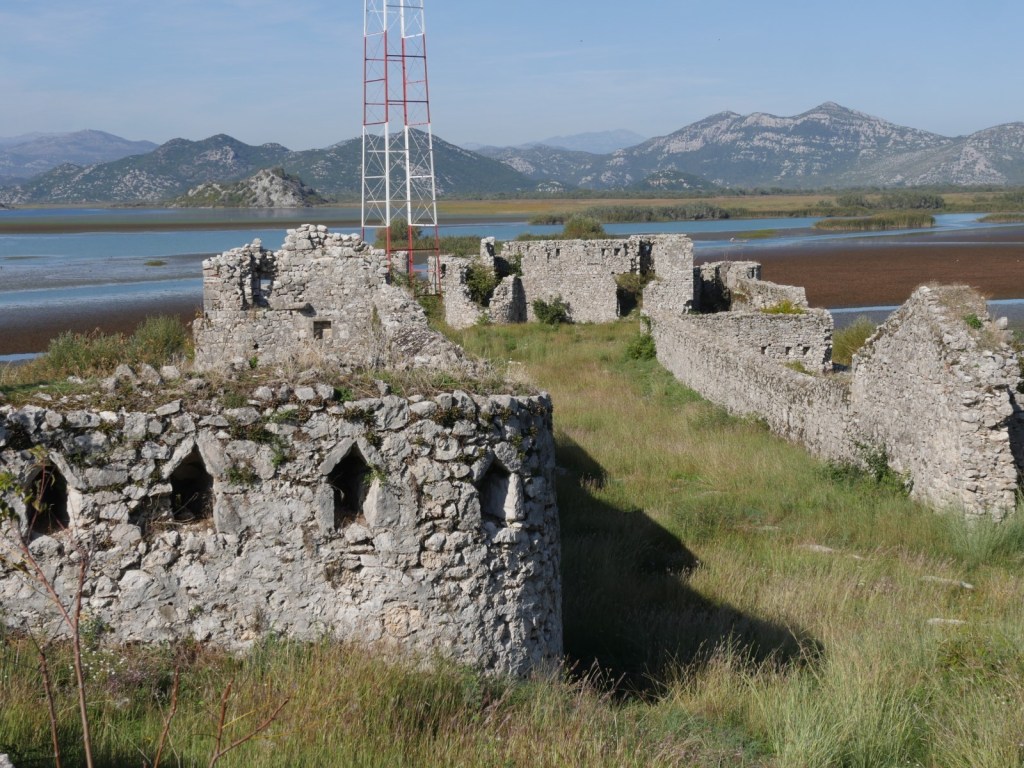

The island of Vranina has existed at least since 2500 years ago. This is proven by the archaeological remains discovered long ago, but also by the oral traditions handed down to this day, which prove to us that there were two temples on the island of Vranina. The first temple is that of Teuta (the Illyrian queen) and the second temple was called “Slate of the White Star”.
Background
The temples were located on two ridges of Vranina, and every spring the local residents and the people of the area around the lake (Shkodra) went up there and slaughtered cattle making sacrifices (ferlika), thus celebrating the arrival of spring. These rites belonged to the pagan rites that were inherited until recently after the birth of the Christian doctrine, which the Vraninas, like all other Illyrians, embraced without hesitation.
Vranina was called “Sini i Liqeni”
The name Vranin did not exist until “late” (13th-14th century), the island had the name “Sini i Liqeni”, where it is said that there was a fairly developed town, which is thought to have been part of the early Hoti. There are rumors that the parents of the Roman Emperor of Illyrian origin, Diocletian, lived temporarily in this town. The name Vranin is thought to have replaced the name “Eye of the Lake” when the Slavic hordes attacked and destroyed this 2,000-year-old town.
In addition to the damage to the buildings and civilization in this town, so many residents were killed (protecting this area of Albanian land) that it began to be called the “Eye of Blood”. The murders and horrors continued even after the Ottoman occupation, but above all it became a center where the Ottomans gathered and killed all opponents of the empire.
This place already began to be known by the name of the place where people were killed, even for short it was called Vra-njerez “Tr: Kill people” until it took the forms of the united name Vranierz, which gradually Ottoman writers, who generally paid as such Slavic wage earners (shkje) and transformed into the well-known name Vranina, thus giving it the shape of a Slavic word, which later the Montenegrin neighbors used as an argument to fill the mind of old Europe that this strategic island belongs to them, which the Turks supposedly had “Albanized” for centuries.
Stephen I forbids the Albanians of using the lands of Vranina in 1234
“The first mention seems to me to be in a charter of Stephen I at the monastery of Saint Nicholas of Vranina on Lake Scutari in 1234. It is established that the Albanians will not be able to winter in this place.”1
Albanians of 1424 were forbidden to graze their sheep on the lands of Vranina
“… Vranina in 1424 , mentions the Albanians , whom he forbids to use those lands as winter pastures.”2
Montenegrins invaded Vranina in 1838
“… and Morakovitj, the Tsernogortses (Crnagores) invaded in 1838 an island several leagues long where the village of Vranina is; in 1840, they entrenched themselves in a rocky islet even closer to …”3
References
- https://www.google.se/books/edition/Revue_d_anthropologie/svmbWqgxXMsC?hl=sv&gbpv=1&dq=Albanais+Vranina&pg=PA628&printsec=frontcover ↩︎
- https://www.google.se/books/edition/The_Albanians_and_Their_Territories/u3IKAQAAIAAJ?hl=sv&gbpv=1&bsq=Vranina+Albanians&dq=Vranina+Albanians&printsec=frontcover ↩︎
- https://www.google.se/books/edition/Les_Slaves_de_Turquie_Serbes_Mont%C3%A9n%C3%A9gr/6xZb5NYrsh8C?hl=sv&gbpv=1&dq=Albanais+Vranina&pg=PA185&printsec=frontcover ↩︎

 Balkan Academia