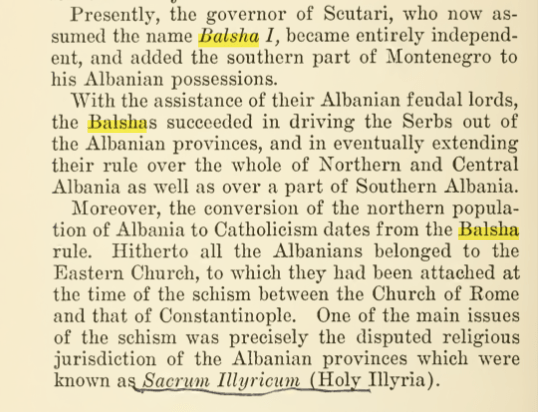

Taken from “Albania, Past and Present” authored by Constantine A. Chekrezi.
“With the assistance of their Albanian feudal lords, the Balshas succeeded in driving the Serbs out of the Albanian provinces, and in eventually extending their rule over the whole of Northern and Central Albania as well as over a part of Southern Albania. Moreover, the conversion of the northern population of Albania to Catholicism dates from the Balsha rule. Hitherto all the Albanians belonged to the Eastern Church, to which they had been attached at the time of the schism between the Church of Rome and that of Constantinople. One of the main issues of the schism was precisely the disputed religious jurisdiction of the Albanian provinces which weere known Sacrum Illyricum (Holy Illyria).”
The Balshaj familys Albanian origin
In 1398, an illegitimate son of Gjergj Balsha, named Zasso Albanesi, is mentioned. In the “Biography of Stefan Lazarevic” by the 15th century Slavic chronicler, Konstantin Philosopher, the Balshas are known “as Albanian lords”: (Бальша Арбанашьскыи господинь – Balša arbanašski gospodin). Documents of the Republic of Ragusa refer to Albanian customs (costumi albanesi) of the Balshajs. Even in the old Serbian writings there is the form Balsha- Балша (L.Stojanovic, Stari srpski rodoslovi i letopisi, Belgrade, 1927, p.118, 225) The Russian consul in Shkodër and Prizren during the Ottoman Empire, Ivan Stepanović Jastrebov, connects the last name of to the family with the toponym Baleč (sz. Balec) near Shkodra, in Rrjoll.
The German linguist Gustav Weigand suspected a mixed Albanian-Vlach ancestry when he saw that the surname Balsha appeared in an early list of Albanian surnames in Romania. Eqrem bey Vlora, inclined to believe in Du Cange’s assertions in the work Illyricum vetum et novum that for Balshaj he writes “Quidam ex Albaniae proceribus cognomento Balsa” and of Orbin “ex indigenis nobilibus Albaniae”, because according to him only an Albanian origin corresponds to the work and behavior of the Balshays.
Vlora also claims Romanian followers of the Balshais. According to the sources used by Athanas Gegaj, Skënderbeu claimed that he was the heir of the Balshais, at least this was for the benefit of centralizing his power. Joseph Swire claims that the Balshaj formed an Albanian state and tried to protect it from the Turkish “invading hordes”. The Balshaj were also Albanians according to the Serbian author I. Bozic (“Neverea Vuka Brankovica”, in “O Knjezu Lazaru”, Krusevac, 1977).
Two contemporary researchers, Gazmend Shpuza and Pranvera Bogdani, also speak of Albanian origin, and in general, Albanian historiography supports the hypothesis of Albanian origin. It is further mentioned the fact that in Balshaj the governance was done by the three brothers: Strazimir, Gjergji and Balsha II, who signed the documents together and used the same seal.
Xhufi points out that the institution of co-governance was also found among other Albanian nobles and was characteristic of large Albanian patriarchal families. Tivari, Ulqini, Shkodra and Vlora served as temporary residences, while in the summer months they moved to their residence in the highlands of Tivari.
According to Shpuza, the Albanian origin is also confirmed by the religious tolerance that the Balshaj showed after converting to Catholicism, which differed from the extreme intolerance of the Serbian kings who were devoted to the eradication of heresies.
The American medieval scholar Kiril Petkov calls them Albanians, as do Plamen Tzvetkov, Kristo Frashëri, Kasëm Biçoku, Rolando Fabrini, the Bulgarian Academy of Sciences and the Encyclopedia Britannica.
Reference


 Balkan Academia